Tag Archives: Photos

Photo gallery: Alvares Ski Resort in Iran’s Ardabil Province

Iran Sareyn Sarein MapAlvares is a ski resort in Iran’s northern province of Ardabil. It is the second standard ski resort in Iran and is situated in the village of Alvares which is located 24 kilometers away from the city of Sareyn.

Sources: TASNIM | Photos, Wikipedia | Sareyn

The Tehran Graphic Design Week 2015 started!

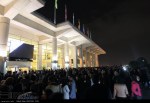
The Tehran Graphic Design Week 2015 started on April 26 at the Iranian Artists Forum (IAF) as tens of graphic art enthusiasts demonstrated support for the event by gathering outside the venue under the slogan “Graphic Art Needs Promotion”.

“Graphic designs are with us wherever we go. From the moment we wake up, graphic designs are before us telling us what to wear and what is attractive,” said graphics expert Akbar Alemi, a member on the selection committee and the ceremony host.

The head of Iran Graphic Designers Society (IGDS) Ali Rashidi said the extensive world of graphics can offer more than posters and logos and called for Iran to advance in all areas of this pragmatic form of art, Mehr News Agency reported. He took note of “motion graphics and economics of art” as two key areas of IGDS focus this year, and said “this society aims to promote non-still (non-print) graphics.”

French graphic designer Ruedi Baur, who was a guest invitee, said “motion graphics cannot be defined as they are out of our control”. Australian designer Ken Cato opposing the view, stated that motion graphics “even defines throwing up your business card up in the air,” and to prove a point, he did just that.

An introduction to motion graphics and its applications on DVDs was unveiled by Mahdi Mahdian, secretary of the event.

In addition to the two international guest invitees, a number of renowned figures attended the function, including graphic designers Ghobad Shiva, Majid Balouch, Amrollah Farhadi, Mostafa Asadollahi, typography designer Masoud Sepehr, and calligrapher Bahram Kalhornia.

The Tehran Graphic Design Week usually kicks off every year around the World Graphic Design Day which is on April 27. The Tehran Beautification Organization, Contemporary Art (Honar Moaser) Publications and Sepia Co. cooperated with IGDS running the event.

According to Mehdi Mahdian the works exhibited were selected by a committee composed of Akbar Alami, Bahram Azimi, Reza Alavi, Mehrdad Sheikhan and Amir Mohammad Dehetani.

Tehran Graphic Design Week 2015 features various programs such as commemoration of a veteran artist and exhibition of works by two international graphic designers. The Tehran Museum of Contemporary Art displays works by graphic designers Rudie Baur from France and Ken Cato from Australia in separate exhibitions.

Tehran Graphic Design Week 2015 runs for one week in the Iranian Artists’ Forum located on Musavi St., off Taleqani Ave, Tehran.

Program (in Persian): Iranian Graphic Design Society | Graphic Design Week 20015 – Program

Sources: Culture and Heritage National Agency, Tavoos Online, Tehran Times, ISNA | Photos

Iran’s North Khorasan Province: Aspakhu Fire Temple

North Khorasan, Iran – Aspakhu MapThe Aspakhu (Espakhou) Fire Temple is one of the oldest structures in Iran’s North Khorasan Province. According to studies and excavations it belongs to the Sassanid era (AD 224 to AD 651).

It is located by the village of Aspakhu (also romanized as Espakhou, Aspakhv), 65 kilometers west of Ashkhaneh, in Maneh and Samalqan County, North Khorasan Province, Iran.

The temple is built on top of a high hill next to a forest of pines and cedar trees. Beyond its entrance into a rectangular yard, a corridor leads to a domed room in the eastern part of the structure. The Fire Temple has a domed roof and consists of stones and mortar, further strengthening the assumption of its Sassanid origins. It is believed that the Fire Temple gets its name from the word Hasb which gradually evolved into Asb (meaning horse). The area and village in particular appeared to have been a training ground for horses.

Photos by Ehsan Kamaly for Mehr News Agency.

Locals refer to the Fire Temple as a church although there has been next to no evidence of any past Christian residents. Furthermore the domed roof, its scattered slits (presumably to allow smoke to escape), and its round altar give the Fire Temple theory more credibility.

A fire temple in Zoroastrianism is the place of worship for Zoroastrians. In the Zoroastrian religion, fire, together with clean water, are agents of ritual purity. Clean, white “ash for the purification ceremonies [is] regarded as the basis of ritual life,” which, “are essentially the rites proper to the tending of a domestic fire, for the temple [fire] is that of the hearth fire raised to a new solemnity” (Boyce, 1975:455).

In 2010-2011 studies were being made to research the feasibility of renovations to the Fire Temple. The Espakhoo Fire Temple has been registered as a national heritage site, with the number 1579, by Iran’s Cultural Heritage Department.

A beautiful photo of Aspakhu Fire Temple at night by Abbas Rastegar: National Geographic | Your Shot | Aspakhv fire

Sources: Mehr News Agency | Aspakhv Fire, Payvand News of Iran, Historical Iranian Sites and People | Espakhoo Fire Temple, Wikipedia | Aspakhu


Iran’s Tehran Province: Persian Garden Park in Tehran – Part 2

Here the second batch of pictures of the Persian Garden Park in Tehran. Enjoy!

The Persian Garden Park is a 3.4ha (8.4 acres) areal in Tehran that was designed based on the pattern of a Persian Garden.The reconstruction project planned passages for the disabled and dedicated 2.5ha (6 acres) to green spaces, preserving the old trees and planting new species. The park has six fountains, a restaurant and tea house, a public library, a children’s playground and other facilities.

More information and photos:
The other Iran | Iran’s Tehran Province: Persian Garden Park in Tehran – Part 1

Sources: TEHRAN Picture Agency | Growing tulips in the Persian Garden, TEHRAN Picture Agency | Persian Garden on a rainy day, Tasnim News | Photos

Iranian Armenians rally in Tehran to commemorate the 100th Anniversary of the Armenian Genocide

Thousands of Iranian Armenians rallied in Tehran on Friday, protesting in front of the Turkish Embassy to commemorate the 100th anniversary of the Armenian genocide.

Many in the crowd, who marched from the Armenian Church in Tehran to the Turkish Embassy, held signs in Farsi and English asking the international community to recognize the genocide, while others chanted slogans calling for justice and the downfall of the Turkish government. “What Armenians demand now is that the Turkish government recognize [the massacre] as genocide and accept its legal consequences,” Karen Khanlari told Iran’s Press TV during the protests.

There were different events organized to commemorate the 100th Anniversary of the Armenian Genocide on April 23 and April 24. In Tehran were the religious ceremonies held at the St. Sarkis Cathedral.

Following sovereign countries have officially recognized the Armenian Genocide: Argentina (2003) , Austria (2015), Belgium (1998), Bolivia (2014), Canada (1996), Chile (2007), Cyprus (1975) was the first country to raise the issue to the UN General Assembly, Czech Republic (2015), France (1998), Germany (2015), Greece (1999), Holy See (2000), Italy (2000), Lithuania (2005), Lebanon (1997), Netherlands (2004), Poland (2005), Russia (1995), Slovakia (2004), Sweden (2010), Switzerland (2003), Uruguay (1965) was the first country to recognize the events as genocide, Venezuela (2005). On Apr 24, 2015 the Bulgarian parliament approved a resolution using the phrase “mass extermination of the Armenian People in the Ottoman Empire”. The United States of America, Israel, the United Kingdom, Australia or Spain do not use the term genocide to refer to these facts.

Robert Beglaryan and Karen Khanlaryan, MPs of Armenian origin, have also had speeches in Iran Majlis concerning the Armenian Genocide Centennial. “We call on the government and the President Rouhani in particular to call the real facts by their name. That will make it possible to support the security in the region,” Robert Beglaryan said in his speech.

Iran has been conducting a moderate and cautious policy regarding the Armenian Genocide over the last years. Remarkably, though, the MPs of the 6th Majlis of Iran condemned the Armenian Genocide. Seyyed Mohammad Khatami, then President of Iran, visited Tsitsernakaberd during his official visit to Yerevan on September 9, 2004. Vice president of Iran, Hamid Baghaei, pronounced the word ‘genocide’ during the conference ‘Iran: The Bridge of Victory’ in August 2010. “The government of Ottoman Turkey committed genocide in 1915; and a certain number of Armenians fell victim to it,” he said although the statement was refuted not to aggravate the relations with Turkey.

However, both the political and religious elite of Iran, as well as ordinary citizens admit the fact of the Armenian Genocide, as according to the Iranian sources, the Ottoman Turks have not only perpetrated genocide against the Armenians, Assyrians and Greeks, but also have slaughtered many Iranians in Urmia Region in 1918.

In Iran there are Armenian Genocide Memorials in Abadan, Ahraz, Arak, Isfahan, Tehran and Urumieh, all of them on Armenian Churches ground. In Abadan the Genocide Memorial was renovated since it was next to the church damaged during the Iran Iraq war.

Other Commemoration events worldwide:
1. Los Angeles Times | Armenian Genocide Anniversary Apr 24, 2015
2. The Huffington Post | Poignant photos from around the world show Armenian Genocide has not been forgotten

Sources: www.hyeli.com, Wikipedia | Armenian Genocide recognitionarmenian-genocide.org | Recognition countries, Mehr News Agency (MNA) 1, MNA 2, IRNA 1, IRNA 2, ISNA 1, Tasnim News Agency, panorama>>am | Asory Genocide, panorama>>am | Rouhani letter, armenian-genocide.org | Genocide Memorials in Iran, uacla.com | Armenian Genocide Memorials, team-aow.discuforum.info | Monuments Commemoratifs du Genocide Armenien

Iran’s East Azerbaijan Province: Saint Stepanos Monastery near Jolfa

The St. Stepanos Monastery (Armenian: Maghardavank) is an Armenian monastery about 15 km northwest of Jolfa, East Azarbaijan Province, northwestern Iran. It is situated in a deep canyon along the Arax river on the Iranian side of the border between Nakhchivan Autonomous Republic and Iran. Since 2008 it is on UNESCO’s World Heritage List together with the St. Thaddeus Monastery and the Chapel of Dzordzor.

The general structure mostly resembles Armenian and Georgian architecture and the inside of the building is adorned with beautiful paintings by Honatanian, a renowned Armenian artist. Hayk Ajimian, an Armenian scholar and historian, recorded that the church was originally built in the ninth century AD, but repeated earthquakes in Azarbaijan completely eroded the previous structure. The church was rebuilt during the rule of Shah Abbas the Second.

History
The first monastery was built in the seventh century (AD 649) and completed in the tenth century. However, St Bartholomew first founded a church on the site around AD 62 but it was partly destroyed during the wars between the Seljuks and the Byzantine Empire in the eleventh and twelfth centuries.

Following the conquest of the region by the Mongols of Hulagu, grandson of Genghis Khan, in the middle of the thirteenth century, Christians benefited from the favorable Ilkhanid dynasty, and a peace agreement is signed between the Armenian Church and the Ilkhans. The monastery was restored in the second half of the thirteenth century.

The monastery was completely rebuilt in 1330 under the leadership of Zachariah. St. Stepanos Monastery found the height of its cultural and intellectual influence in the fourteenth and fifteenth centuries. The monastery produced paintings and illuminated manuscripts, in areas as diverse as religion, history and philosophy.

In the early fifteenth century, the new Safavid dynasty protected the Armenians but the region is at the center of the rivalry between the Safavids and the Ottomans, who invaded Western Armenia in 1513. St. Stepanos in the sixteenth century observed a gradual decline until Shah Abbas I decided to evacuate the region from its inhabitants in 1604. The monastery then was abandoned. From 1650, the Safavids, however, decided to occupy the region again, and the damaged and abandoned St. Stepanos monastery was restored in the middle of the century.

At the beginning of the eighteenth century, the area became a challenge for the conquest of the Russian Empire. Yerevan was conquered by the Russians in 1827. The border between Persia and Russia was established on the Araxes by the Treaty of Turkmenchay. Consequently part of the population was displaced by force to Russian Armenia. The Qajar rulers continued to protect the Armenians. They encouraged the rebuilding of St. Stepanos Monastery between 1819 and 1825.

The monastery has undergone several restorations recently twentieth and twenty-first centuries, especially since 1974.

On UNESCO World Heritage List
The Armenian monasteries in Northwestern Iran have borne continuous testimony, since the origins of Christianity and certainly since the 7th century, to Armenian culture in its relations and contact with the Persian and later the Iranian civilizations. They bear testimony to a very large and refined panorama of architectural and decorative content associated with Armenian culture, in interaction with other regional cultures: Byzantine, Orthodox, Assyrian, Persian and Muslim. The monasteries have survived some 2,000 years of destruction, both of human origin and as a result of natural disasters. They have been rebuilt several times in a spirit in keeping with Armenian cultural traditions.

Further information: Iran Chamber Society | Church of Saint Stephanos

Sources: Wikipedia | Saint Stepanos MonasteryIran Chamber Society | Historical Churches in Iran, Tishineh | St. Stepanos Monastery, Wikimedia Commons | Saint Stepanos Monastery, UNESCO World Heritage List | Armenian Monastic Ensembles of Iran, IRNA | Photos 1, IRNA | Photos 2

Photo Series: Spring in Iran – Arasbaran, East Azerbaijan Province

Arasbaran, formerly known as Qaradagh or Qaraja dagh, is a large mountainous area stretching from the Qusha Dagh massif, south of Ahar, to the Aras River in East Azerbaijan Province of Iran. The region is confined to Aras River in the north, Meshgin Shahr County and Moghan in the east, Sarab County in the south, and Tabriz and Marand counties in the west.

Since 1976, UNESCO has registered 72,460 hectares of this region as biosphere reserve. Arasbaran is home to 215 species of birds, 29 species of reptiles, 48 species of mammals and 17 species of fish. The local flora include hornbeam, sumac and berberis. The large walnut and cornelian cherry (zoghal) trees, wildly grown alongside water-streams, provide an important income source for inhabitants but there are also more exotic plant species, such as redcurrant, truffle and herbs with application in traditional medicine.

There were several Turkic tribes in this area and characteristic aspects of their culture, developed around Nomadic pastoralism, have persisted to our times. Nomadic population at present has been estimated to be about 36000.

The spoken languages are Azerbaijani or Oghuz, a branch of the Turkic language family but most inhabitants are familiar with Persian language.

Arasbaran carpets are in between Persian carpets and Azerbaijani rugs. Still, there is also an indigenous style known as Balan Rug. The peak of carpet weaving art in Arasbaran is manifested in Verni (Azerbaijani rug), a carpet-like kilim with a delicate and fine warp and woof, which is woven without a previous sketch.

Verni weavers employ the image of birds and animals in simple geometrical shapes, imitating the earthenware patterns that were popular in prehistoric times. A key décor feature is the S-element that means “dragon” among the nomads. At present, Verni is woven by the girls of Arasbaran Tribes, often in the same room where the nomadic tribes reside and is a significant income source for about 20000 families.

Many elements of the indigenous culture, particularly local music, have survived to the present day. More recently a slow but persistent cultural revival has been in progress. The Ashughi music is central to this shared identity.

A recent study has indicated that Mikandi valley, Aynali forests and Babak Castle have the highest potential for ecotourism. Another potential touristic attraction could be the summer camps of semi-settled tribes of Arasbaran, known as Ilat, who spend 5 months of year in uplands for grazing their livestock. There are also cornelian cherry (zoghal) festivals in Kaleybar and a yearly pomegranate festival in Mardanaqom village with Ashugh music performances.

See also: List of biosphere reserves in Iran

Sources: Wikipedia | Arasbaran, Mehr News Agency | Photos, IRNA | Photos, ISNA | Photos

Iran’s Tehran Province: Persian Garden Park in Tehran – Part 1

The tradition and style in the design of Persian Gardens (Persian: باغ ایرانی transliterated as Bagh-e Irani) has influenced the design of gardens from Andalusia to India and beyond.

The Persian Garden Park in Tehran, located on north Sheikh Bahai Street – District 3, is a 3.4ha (8.4 acres) areal that was designed based on the pattern of a Persian Garden. The two main entrances are located on the eastern and the western side of the park but it has also two other gates on the northern and southern side.

The reconstruction project planned passages for the disabled and dedicated 2.5ha (6 acres) to green spaces, preserving the old trees and planting new species such as bay leaf, berberis, firethorn (pyracantha), eglantine (sweet briar), milkweeds (asclepias), shrubs and other seasonal and perennial plants.

The park has six fountains, a restaurant and tea house, a public library, a children’s playground, a sports ground, bathroom and dressing room facilities as well as a prayer room.

Sources: IRNA | Photos, Tehran Municipality, Tishineh | Bagh-e Irani Park, Wikipedia | Persian Gardens

Photo Series: Spring in Iran – Bojnourd, North Khorasan Province

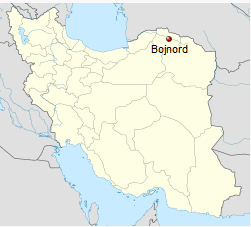
Iran, Bojnord MapBojnord (Bojnourd) is the capital of the northeastern Iranian province of North Khorasan on the border with Turkmenistan. Located 1070m above sea level, north of the Alborz mountain range and south of the Koppeh Dagh (Kopetdag) mountains, it is about 750km away from Tehran.

The city is quite famous for its multicultural background. Many people speak at least 2 different languages including Persian, Tati, Khorasani Turkic, Kurmanci Kurdish, and Turkmen. Intermarriage between said ethnic groups is common.

The city contains many historical and natural attractions, such as mineral water springs, small lakes, recreational areas, caves and protected regions, and various hiking areas. Most of the historical relics are from the Qajar era, as earthquakes continue to ravage older relics.

Some of the popular attractions of Bojnurd are:
Besh Qardash (five brothers) mineral spring
Baba Aman Spring and Jungle Park
Mufakham mirror house, built during the Qajar era
– Mufakham Historical Hospital, built during the Qajar era
– Mausoleum of Sultan Seyed Abbas (brother of Imam Reza)
– Bazkhaneh valley
– Ayyub mineral spring
– Ruwin village

Sources: Wikipedia | Bojnord, Mehr News Agency | Photos,

Iran’s Razavi Khorasan Province: Mashhad’s Spring Flower Festival (Photos)

Each year, the city of Mashhad celebrates spring with a Flower Festival. More than eight million bulbous flowers (e.g. tulips) are being planted in parks and streets and can be enjoyed until mid-May.

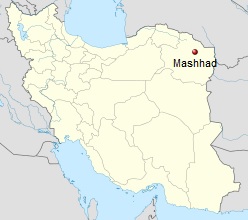
Razavi Khorasan, Iran - Mashhad - MapMashhad (Persian: مشهد‎) with 3.150.000 inhabitants is the second most populous city in Iran and capital of Razavi Khorasan Province. It is located in the northeast of the country, close to the borders of Turkmenistan and Afghanistan. It was a major oasis along the ancient Silk Road connecting with Merv in the East.

Every year, millions of pilgrims visit the Imam Reza shrine. Mashhad is also known as the city of Ferdowsi, the Iranian poet of Shahnameh, which is considered to be the national epic of Iran.

The city is located in the valley of the Kashaf River near Turkmenistan, between the two mountain ranges of Binalood and Hezar-masjed. The city benefits from the proximity of the mountains, having cool winters, pleasant springs, mild summers, and beautiful autumns. It is only about 250km (160 mi) away from Ashgabat, Turkmenistan.

Long a center of secular and religious learning, Mashhad has been a center for the arts and for the sciences. The Ferdowsi University of Mashhad, the Madrassa of Ayatollah Al-Khoei, originally built in the seventeenth century, and the Razavi University of Islamic Sciences, founded in 1984, are located here.

Mashhad is also home to one of the oldest libraries of the Middle-East with a history of over six centuries. The Astan-e Quds Razavi Museum, which is part of the Astan-e Quds Razavi Complex, is home to over 70,000 rare manuscripts from various historical eras. There are some six million historical documents in the foundation’s central library.

Apart from Imam Reza shrine, there are a number of large parks, the tombs of historical celebrities in nearby Tus and Nishapur, the tomb of Nadir Shah, Kooh Sangi park and the Koohestan Park-e-Shadi Complex.

Some points of interest lie outside the city: the tomb of Khajeh Morad, the tomb of Khajeh Rabi’ where there are some inscriptions by the renowned Safavid calligrapher Reza Abbasi and the tomb of Khajeh Abasalt. In Tus, 24km away from Mashhad, is the tomb of Ferdowsi. The summer resorts at Torghabeh, Torogh, Akhlamad, Zoshk and Shandiz are also nearby.

The Shah Public Bath, built during the Safavid era in 1648, is an outstanding example of the architecture of that period. It was recently restored, and is to be turned into a museum.

Other articles about Razavi Khorasan Province: The other Iran | Razavi Khorasan Province

Sources: IRNA | Photos, Wikipedia | Mashhad, Tasnim News Agency | Photos

Iran’s North Khorasan Province: Bojnourd – Besh Qardash (Five Brothers) mineral spring

Besh Qardash (or Besh Ghardash) (Persian: بش قارداش) is a monument and mineral spring in Bojnord, northeastern Iran. The place is an entertainment and historical tourism attraction and labeled as a national heritage by Iran Cultural Heritage, Handcrafts and Tourism Organization.

The Besh Qardash is 7km away from the city of Bojnord. The place is close to the villages of Qeri Janlu, Mehnan and Asadli.

The term “Besh Qardash” means “Five Brothers” in the regional Khorasani Turkic language. It refers to the mythic history of the place. According to the myth, there had been five brothers fighting against then-brutal-government and when they harbored to a hillside, they disappeared and five water springs started welling.


During the Qajar era, Naser al-Din Shah passed the place in his state visit and ordered Yar Mohammad Khan Shadlou (also known as Sardar Mufakham) to construct a monument right next to the springs. A crown shaped swimming pool was built afterwards.

Other articles about North Khorasan Province: The other Iran | North Khorasan

Sources: Wikipedia | Besh Qardash, Tishineh | Besh Qardash Park

Iran’s North Khorasan Province: Bojnourd – Mofakham Mirror House and Building

The Mofakham Mirror House (Persian: Ayeneh Khaneh Mofakham) in Bojnourd, the capital of North Khorasan Province on the border with Turkmenistan, served as official residence. In 1975 the Mirror House was included in the list of National Monuments of Iran.

The building, completed mid-1870s, is an oblong-shaped two-story construction consisting of nine chambers. Famous for its mirrorwork used for interior decoration as well as its rich tile design, belonged to Sardar Mofakham, a senior official of the late Qajar period.

“The House of Mirrors Mofakham” is one of the architectural jewels of the Nasser-e-Din Shah Qajar era. In the past it was located in the middle of a large orchard at a close distance to other buildings as the Hozkhaneh, “The Garden of fountains”, and the Kolah Farangi Building. Together they constituted the “Dar-ol-Hokumeh” (House of power).

The Kolah Farangi Building collapsed following the earthquake that shook the city of Bojnourd but Mafkham Mirror House and Building remained to this day.

The Mafkham Building was constructed as Sardar’s Mofakham residence. It maintains thirty-four chambers and two large halls. The façade is covered with tile works, depicting humans, animals, and geometrical shapes. The building is fully covered with tiles in different shapes and forms in blue, yellow, pink, purple, white, red, and black colors, while each pillar has been decorated with particular patterns and designs.

The building now houses the Museum of Ethnography Bojnord (Mofakham Museum). The video below is a visit of Press.TV to the Mofakham Museum:

https://www.youtube.com/watch?v=5Zr0i5cYBjI

Sources: Tishineh, Iran Daily, Wikimedia Commons | Bojnord, Wikipedia | Spiegelhaus Mofakham, La Revue de Téhéran | N°12/2006, irib.ir

Photo Series: Spring in Iran – Paveh, Kermanshah Province

Kermanshah, Iran – Paveh MapPaveh is the capital of Paveh County in Kermanshah Province, Iran. At the 2011 census its population was 23.704 inhabitants.

Paveh is located in the west of Iran, 112km from Kermanshah. It lies in a sub-region along the Iran-Iraq border commonly referred to as Hewraman situated within the larger geographical region of Kurdistan. The city is considered by inhabitants of the region as the capital of the Hewraman. The inhabitants of Paveh are mostly Kurds that speak Auramani.

As a mountainous town, Paveh has cold winters and cool springs. The surrounding mountains are normally filled with fresh spring water from March to June. The town is also encircled with large fruit gardens which create beautiful sceneries during summers.

An old myth regarding the name of the city is that the Emperor Yazdgerd III sent his son named Pav to this area to renew his religious Zoroastrian faith. Both Persians and the local Kurdish inhabitants practiced Zoroastrianism during the Persian Empire’s Sasanian era from which this myth is derived.

Sources: Wikipedia | Paweh, Mehr News Agency | Photos

Iranian actress Roshanak Gerami

Roshanak Gerami (born on September 23, 1983 in Tehran) is an actress, known for The Rule of Accident (2013), Melbourne (2014) and No Where No Body (2013).

Posts on other interesting Iranian women: https://theotheriran.com/tag/women/

Sources: IMDB | Roshanak-Gerami, whatsupiran | Roshanak-Gerami

Photo gallery: Sizdah Be-dar – The Iranian national picnic day

Sizdah Be-Dar (frequently stylized as “13 Bedar”) means in Persian literally 13th in outdoors. It is a festival in the Iranian culture and part of the Nowruz new year celebration rituals, held on the 13th of Farvardin (the 1st month of the Iranian calendar), during which people spend time picnicking outdoors.

Sizdah Bedar is the day Tir (The Blessed day) of the month Farvardin from ancient Persian (Iranian) calendar, which was the first day of agricultural activity in ancient Persia. Be-dar in Persian means going out. Nowadays, Iranians go out to have fun with their families all the day long.

Sizdeh Bedar is celebrated in Iraq, Armenia, Azerbaijan, Central Asia, and elsewhere. An increasing number of participants are taking part in the holiday. In cities like Los Angeles with large populations of Iranians, a growing number of parks are set up by the city to accommodate the large number of people.

Sources:
Wikipedia | Sizdah Be-dar, Mehr News Agency | Photos 1, Mehr News Agency | Photos 2, IRNA | Photos 1, IRNA | Photos 2, IRNA | Photos 3, IRNA | Photos 4

Iran’s Golestan Province: Kordkuy and Gonbad-e Kavus Counties (Photos)

Kordkuy’s County protected area, Khalid Nabi Cemetery and Gonbad-e Qabus Tower are among the attractions that helped Golestan’s tourism growth.

Jahan Nama is a village with 99 inhabitants (2006) in Chaharkuh Rural District, Golestan Province, Iran. This area is situated in the southern heights of Gorgan and the southeast of Kord Kooy (the Mountain of Kurd). In 1973 30,650 ha in this region were declared protected area.

Wild goat, wild sheep, vension, panther, wolf, beer, owl, eagle, shoulca, weasel, and porcupine belong to the wildlife of this region and some of its plants are: Rosh, Azad, Barberry, Sorkhdar, Kolahe Mir Hassan, Bolandmaza Namdar, Borage Cowslipe, Ras, and Darmaneh. Several studies in the area found 1350 specimens, which included a total number of 607 vascular plant species.

The most important rivers and springs are: Sefid Rood, Tarkan, Mahzi, Chaar Baq, Ziyarat, Marsang, Sbumargah, Shahpasand, Haji Abad, Gachian, Mord Cheshmeh, Vara, Khosh Dasti, Kalichal, Qormehtou, Pazeebon.

Gonbad-e Qabus Tower is a monument in Gonbad-e Qabus, Iran, and a UNESCO World Heritage Site since 2012. The Tower in the central part of the city reaches 72 metres (236 ft) (including the height of the platform).

The baked-brick-built tower is an enormous decagon building with a conic roof, which forms the golden ratio Phi, that equals 1.618. The interiors contain the earliest examples of Muqarnas decorative styles. The decagon with its 3 meter-thick wall, divided into 10 sides, has a diameter of 17 m . The Tower was built on such a scientific and architectural design that at the front of the Tower, at an external circle, one can hear one’s echo.

The tower was built in 1006 AD on the orders of the Ziyarid Amir Shams ol-Ma’āli Qabus ibn Wushmgir. It is located 3 km north of the ancient city of Jorjan, from where the Ziyarid dynasty ruled. The tower is over 1000 years old.

Khalid Nabi Cemetery (in Persian: cemetery of the prophet Khaled) is a cemetery in northeastern Iran’s Golestan province, roughly 65km northeast of Gonbad-e Kavous, in the Gokcheh Dagh hills of Turkmen Sahra. It is mainly situated on a mountain ridge about 1 km distance from the mausoleum called “Khaled Nabi” who according to oral tradition of the Yomut Turkomans was a pre-Islamic prophet (payghambar).

The cemetery was visited in 1979 and 1980 by the archeologist David Stronach . He found over 600 standing stones which are spread out in several locations. About half of them are on the ridge which he calls ” High Plateau ” South and south-east of that are small groups of stones on several other ridges and hillocks. At some distance there is another group of perhaps 150 stones which are distributed over a wide area on the south side of the mountain. Stronach noted two types of gravestones on the site. In both he saw “highly stylized representations of people.”

In popular media the stones are often described as examples of phallic architecture and a major tourist attraction. Touristic visitors often have perceived the cylindrical shafts with the thicker top as depictions of male phalli. This gave rise to popular guesses about preislamic fertility cults as background to such perceived depictions. Consequently the rounded, second type of stones were attributed to female forms and graves. Such descriptions have added to the popularity of the site for visitors from distant parts of Iran. The cemetery is now a national heritage site protected by the Iranian government.

Sources: Mehr News Agency | Photos, Wikipedia | Khalid Nabi Cemetery, Wikipedia | Gonbad-e Qabus Tower, Wikipedia | Jahan Nama

Iran’s Hamedan Province: Ali Sadr Cave – The world’s largest water cave

Hamedan Province, Iran - MapThe Ghar-e Ali Sadr is the world’s largest water cave which attracts millions of visitors every year. It is located in Ali Sadr Kabudarahang County about 100 kilometers north of Hamedan, western Iran.

Excavations and archeological studies of the cave have led to the discovery of ancient artworks, jugs and pitchers dating back to 12,000 years ago. Animals, hunting scenes and bows and arrows are depicted on the walls and passages of the exit section. These images suggest primitive man used the cave as their abode. The cave was known during the reign of Darius I (521-485 BC) which can be verified by an old inscription at the entrance of the tunnel. However, the knowledge of the existence of the 70 million-year-old cave was lost, and it was only rediscovered in 1963 by Iranian mountaineers.

The cave is entered at the side of a hill called Sari Ghiyeh which also includes two other caves called Sarab and Soubashi, each 7 and 11 kilometers from Ali Sadr Cave.

Apparently, the water in Ali Sadr cave stems from a spring in Sarab. In the summer of 2001, a German/British expedition surveyed the cave, finding to be 11 kilometers long. The main chamber of the cave is 100 meters by 50 meters and 40 meters high.

The cave walls can extend up to 40 meters high, and it contains several large, deep lakes. The cave has a river flowing through it and most travel through the cave system is done by boat. More than 11 kilometers of the cave’s water canals have been discovered so far. Some routes are 10 to 11 kilometers long and all lead to “The Island”, a centrally located large atrium.

More articles on Iran’s nature: The other Iran | Nature

Sources: Wikipedia | Ali-Sadr Cave, IRNA | Photos, Alisadr Toursim Co | Portfolio, Wikimedia Commons | Ali Sadr Cave

New Year’s dreams – What do Iranians wish for this year that just started?

The start of a new year is associated with dreams and new things we would like to achieve.

Iranians wrote down what they wish of this New Year and were photographed holding their written wishes and an element of the haft sin. Enjoy the photo gallery!

Click on a photo and see the translation of all the wishes:

Learn more about the Iranian New Year (Nowruz), its traditions and food:
The other Iran | Nowruz

Sources: Mehr News Agency

Iran’s South Khorasan Province: Birjand Citadel (Photos)

Birjand Citadel (also Birjand Castle or Citadel of Paeenshahr) is a citadel in Birjand, South Khorasan province, Iran. The citadel has an area of 3000 m² and dates back to Safavid era. It originally had 7 towers of which, six stand today.

Sources: ISNA | Photos, Wikimapia | Birjand-Citadel

Chaharshanbe Suri – An Ancient Iranian Fire Festival to celebrate the last wednesday eve of the year

Chaharshanbe Suri is a fire jumping festival celebrated by Iranic people (Persians, Azerbaijani people, Armenians, Kurdish people, Assyrians, Bahá’í, Jews, Christian and Zoroastrians). The event takes place on the eve of the last Wednesday before Nowruz.

“Red Wednesday”, the words Chahar Shanbeh mean Wednesday and Suri means red, is an ancient Iranian festival dating back to at least 1700 BCE of the early Zoroastrian era. Also called the Festival of Fire, it is a prelude to Nowruz, which marks the arrival of spring. Bonfires are lit to “keep the sun alive” until early morning.

The celebration usually starts in the evening, with people making bonfires in the streets and jumping over them singing “zardi-ye man az toh, sorkhi-ye toh az man”. The literal translation is, my yellow is yours, your red is mine. This is a purification rite; you want the fire to take your pallor, sickness, and problems and in turn give you redness, warmth, and energy. There is Zoroastrian religious significance attached to Chaharshanbeh Suri and it serves as a cultural festival for Iranian and Iranic peoples.

Another tradition of this day is to make special Chaharshanbe Suri Ajil, or mixed nuts and berries. People wear disguises and go door to door knocking on doors as similar to trick-or-treat. Receiving of the Ajeel is customary, as is receiving of a bucket of water.

Sources: Wikipedia | Chaharshanbe Suri, ISNA 1, ISNA 2, ISNA 3, IRNA 1, IRNA 2

30th Fajr International Music Festival in Iran – Photo gallery (part 2)

Some of the performers shown in the photo gallery below were covered earlier in this blog. To get some back ground and more photos or videos, please click:
https://theotheriran.com/tag/music/

Click on a photo to open in original size, and navigate through the gallery.

Sources:
IRNA| Photos 1, 2, 3, 4, 5, 6, 7, 8, 9, 10,
ISNA | Photos 1, 2, 3
Tasnim News | Photos 1, 2

German artist Otto Piene’s “Rainbow” exhibited in Tehran Museum of Contemporary Art in Iran

A collection from the “Rainbow” series by German artist Otto Piene is currently being showcased at Tehran Museum of Contemporary Art.

Tehran Museum of Contemporary Art is hosting a collection of artworks by the German painter, printmaker and environmental artist, as well as the founder of the influential European postwar movement Group Zero Otto Piene.

This is the fourth time this museum hosts German artists’ artworks. But this is Piene’s first ever exhibit in the Middle East which opened at Tehran Museum of Contemporary Art on Tuesday evening, revealing a variety of artworks ranging from paintings to light sculptures, smoke and fire paintings, and beautiful environmental “sky art.”

Sky art is a term he coined in 1969, which allowed him to use landscape and cities themselves as the focal point of his work.

Most of Piene’s works have been inspired by nature and based on the four elements of ‘light, fire, air and earth’ which points to the philosophical viewpoint of this avant-garde artist.

The first galleries of the museum is dedicated to his rainbow works and silkscreen prints. Then his other works are put on display which are the combination of grids with sources of fire (candles, gas-burners) producing smoke-traces and fire paintings, in which the paint was burnt.

One of his works in particular is said to have been specially made for Tehran exhibition. It is the light sculpture inspired by tile works of Imam Mosque which has been created from glass.

With much regret, Piene passed away in July 2014, and did not get the chance to attend the exhibition in Tehran.

He always sought a better world in his dreams and believed his most brilliant work was to light up the dark sky.

The exhibit of this German artist will be running until April 17 at the museum located on North Kargar St., next to Laleh Park.

Sources: Deutsche Welle | Farsi, Deutsche Welle, Mehr News Agency

German animation “Virtuoso Virtual” wins in Tehran International Animation Festival 2015

The 9th Tehran International Animation Festival was held from March 8 to 12. Over 130 works from across the globe were screened at the event.

German animation “Virtuoso Virtual” directed by Thomas Stellmach and Maja Oschmann has won the top prize in the International section of the 9th Tehran International Animation Festival, the organizers announced on Thursday.

“Virtuoso Virtual” shows some modest drawings that seem to come from nowhere. Following a secret choreography, they take on characteristics and moods of the music and narrate a story that appears to be laid out in the music.

The second prize went “All the Winters I Haven’t Seen”, Iranian animator Omid Khoshnazar’s acclaimed anti-war animation.

It tells the story of a pregnant woman in New York City who discovers that her fetus suffers severe physical defects. Totally unaware of the problem, the mother finds that she has been exposed to chemical weapons, a matter entirely absent from her medical records.

“Coda” directed by Irish animator Alan Holly received the third prize. “Coda” is about the afterlife. It shows some exotic experiences and the possibility of forgiveness.

Iranian animator and writer Mehdi Alibeygi was presented with the special jury award for his surreal short film “Changeover”.

“My Mom Is an Airplane” directed by Yulia Aronova from Russia was crowned best film in the About Children Section.

Award Title Winner Country
1 Golden Statue for the best animation Virtuoso Virtual Thomas Stellmach and Maja Oschmann Germany
2 Silver Statue for the second animation All winters that I haven’t seen Omid Khoshnazar Iran
3 Bronze Statue for the third animation Coda Alan Holly Ireland
4 Golden Statue for the best animation on the theme of children and young adults My Mum Is an Airplane Yulia Aronova Russia
5 Golden Statue for the best student animation Carn Jeff Le Bars France
6 Golden Statue for the best TV production Kung Fu Bunny (Kitchen War) Zhiyong Li China
7 Golden Statue for the best commercial animation Venice / Massi Simone Icaro Massi Italy
8 Special Statue of the jury Change over Mahdi Alibeigi Iran
9 Special Statue of the director of the festival —- Alexander Petrov Russia
10 Honorary diploma Green Fields Benjamin Vedrenne France
11 Honorary diploma Indah Citra Pierre-Antoine Naline, Sarah Feruglio, Maxime Orhnial, Anthony Oliveira France

Sources: Payvand News, Tehran International Animation Festival, TIAF | Photos

Photo series: Winter in Iran – Tehran

To bid the winter farewell here are the last snow photos of this season. Enjoy Iran’s capital city, Tehran, covered in snow!

Sources: ISNA | Photos 1, IRNA | Photos, ISNA | Photos 2

Iran’s South Khorasan Province: Furg Citadel (Photos)

The Citadel of Furg, or Arg e Furg, is a citadel from the 12th century, located in Iran’s South Khorasan province 90 km east of the city of Birjand. The citadel was founded by Meerza Muhammad Rafiee Darmiany I (Lama). Materials used in the building include stone, brick, clay, gypsum, lime and mortar (Sarouj).

Source: Payvand News of Iran

Photo series: Winter in Iran – Snow in Bisutun, Kermanshah Province

Please also check out the amazing story and photos of the Bisutun Inscription – the Iranian Rosetta Stone, that was vandalized by Allied soldiers during the Anglo-Russian invasion of Iran.

Sources: Tasnim News | Photos, The other Iran

Taraneh Alidoosti: Awarded Iranian actress, blogger and writer

Taraneh Alidoosti is a Crystal-Simorgh winning Iranian actress. In a poll conducted among 130 film critics by Sanate Cinema magazine, she was voted the best Iranian actress of the decade. In 2012, a similar poll by the Film Monthly also chose her as the best actress of the decade.

Her father, Hamid Alidoosti, is a former member of the Iranian national football team and currently a football coach in Iran.

Career as actress
She began her acting career at age 17 with the leading role in Man, Taraneh, panzdah sal daram (I Am Tarane, Fifteen Years Old), (Rasul Sadr Ameli, 2002). Critics praised her performance as a defiant 15 year old girl who after a failed relationship is determined to rear a child on her own, while struggling with poverty and social stigma. She won the Bronze Leopard for Best Actress from Locarno International Film Festival in 2002, as well as the Crystal Simorgh for Best Actress from the 20th Fajr Film Festival, becoming the youngest ever to do so. Shortly after she set another record, getting nominated three consecutive times for the best actress prize at the Fajr Film Festival for her first three films. Since then she has maintained a steady but selective work flow in both theatre and cinema. She is mostly known for her choosy criteria in accepting challenging, dramatic roles, as exemplified by her long collaboration with Oscar winner Asghar Farhadi, making her one of the most acclaimed actresses of her generation.

Blogging/Writing
In addition to her acting career she is also known for her writing as featured in her personal weblog . Additionally, her short stories and commentary pieces have been widely published in magazines and daily newspapers such as Shargh. In 2010, a piece written in support of director Asghar Farhadi, defending his comments in support of dissident Iranian artists, caused her weblog to be closed by government officials. Her new weblog however is active now. A collection of stories by Canadian author Alice Munro collected and translated by Taraneh Alidoosti, was published in 2011. It received the prize for best fiction translation at annual Book of Season Awards. She is fluent in English and German.

Awards
Bronze Leopard for Best Actress from Locarno International Film Festival in 2002
Crystal Simorgh for Best Actress from the 20th Fajr Film Festival (youngest actress to win the prize with 17 years)
Best fiction translation at annual Book of Season Awards

Filmography
2002: Man Taraneh, Panzdah Sal Daram (I Am Taraneh, Fifteen Years Old)
2004: Shahre Ziba (Beautiful City)
2006: Fireworks Wednesday
2008: Canaan
2008: Shirin
2008: Tardid (Doubt)
2009: Darbareh Elly (About Elly)
2010: Whatever God Wants
2011: Life With Closed Eyes
2011: At the End of 8th Street
2012: Modest Reception
2013: The Shallow Yellow Sky
2014: The Life Wedlock Mr Mahmoudi & Banoo

Sources: wikipedia | Taraneh Alidoosti, Bing Image Search

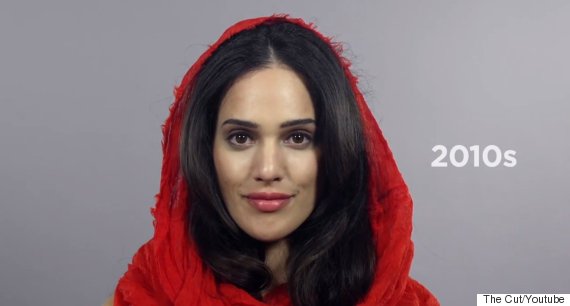
Video: The look of Iranian women from 1910 to 2010

Iranian Woman 2010

Iranian Woman 2010

In 1910, women sported monobrows and had pared-down make-up, with a close-fitting hijab.
A decade later, the hijab becomes looser and softer around the crown of the head, reflecting social changes – the Iranian social movement for women began.
In the 1930s, the Shah of Iran Mohammad Reza Shah Pahlavi implemented big changes – starting with the name of the country from Persia to Iran, and banned the hijab.
We can see hair getting more elaborate, make-up becoming heavier and looks that reflect Western trends.
Then the revolution occurs in 1979 and is evident in the sober, black hijab and face devoid of make-up.
But, while these were dark times for many Iranians, hope flourished again with the Green Movement, which sought to bring about political change after the 2009 presidential election.
While the hijab – now mandatory – remains until the 2010 look, it becomes more colourful and once again, a bit looser.

Source: The Huffington Post UK | How Iranian beauty has changed over 100 years

Negar Javaherian – Awarded Iranian actress

Negar Javaherian holds a Bachelor Degree in Stage Design from the School of Art and Architecture at Azad University in Tehran, Iran. She started her acting career in theatre at the age of sixteen. In 2001, at the age of seventeen, she acted in her first film I Am Taraneh, I Am Fifteen Years Old (2002). Since then, she has played in a number of films and theatrical performances.

Her recent films include Howze Naghashi (2013), for which she was nominated for the Best Actress Award by the Asia Pacific Screen Academy (Australia), Here Without Me (2011), for which she won the Best Actress in the Supporting Role at the 15th Cinema Home Ceremony (Iran), Gold and Copper (2011), for which she received the Best Actress in the Leading Role Award at the 28th Fajr Film Festival (Iran) and Before the Burial (2008), for which she was awarded the Best Actress prize at the 11th Osian’s Cinefan Festival (India).

Negar Javaherian performed in a theatrical play The Fourth Wall (2012-2013) which was awarded the Best Performance of the Year (Iran). Two theatrical plays, Ivanov (2011) and Where Were You on January 8th? (2010), went on European festival tours. For the latter, she was nominated for the Best Actress Award at the International Fajr Theatre Festival (Iran).

Awards
Best Actress in a Leading Role for Tala va Mes, from 28th Fajr Film Festival, 2010 (1388)
Best Actress in a Leading Role for Tala va Mes, from cinema home ceremony, 2010 (1388)

Sources: imdb.com, Wikipedia | Negar Javaherian

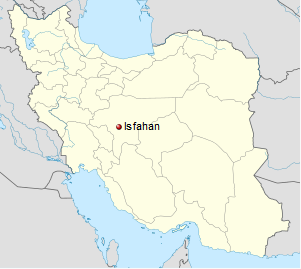
Photo gallery: Zayanderud River in Iran’s Isfahan Province

Iran Isfahan Esfahan MapThe Zayanderud River, as largest river in the central plateau of Iran, starts in the Zagros Mountains and flows 400 kilometres eastward before ending in the Gavkhouni swamp, a seasonal salt lake, southeast of Isfahan city.

Sources: Tasnim News Agency, Wikipedia | Isfahan

Chinese New Year Festival in Tehran, Iran

More than 1,000 people took part in “Happy Chinese New Year in Iran” celebration in Tehran ahead of the date by enjoying Chinese food and martial arts performance.

The event, organized by the Chinese Embassy, was a chance for the participants to learn about Chinese traditions, such as Chinese medicine with a doctor from the University of Tehran showing the practice of acupuncture. The doctor said the Chinese medical clinic set up by the university receives dozens of patients every day as Chinese medicine has been gaining popularity in Iran in recent years.

Red Dragon, directed by Ahmad Rastgou, and co-produced by Iran and China was displayed at the event and a children’s workshop brought together Iranian and Chinese children through Chinese national games and entertainments. A charity shop presented Chinese traditional handicrafts including calligraphy and Chinese miniature along with fireworks entertained the guests.

Performers from a local martial arts club wowed the crowd with their stunning acts and lion dances. A treat to traditional Chinese snacks such as dumplings and noodles also attracted a long queue.

“This is my first time to join Chinese Spring Festival celebration. I think it’s very interesting. Spring Festival is the most important festival in China. I saw lion dances just now. It’s fantastic,” said a student studying Chinese language at university.

The Chinese ambassador, Mr. Pang Sen and the chairman of the Iran-China Friendship Society officially opened the New Year by painting the eyes of the dragon as a symbol of resurrection of the dragon. Mr. Sen accompanied guests in visiting pavilions designed to introduce Chinese culture and traditions.

China’s Ambassador to Tehran expressed gratitude for the guests and dignitaries in the ceremony and congratulated them on Chinese New Year; “Chinese New Year, like that of Iranians, is the spring and renewal of the life on earth, and is one of the greatest traditional festivities, which is widely celebrated across China with magnificent events,” he told the participants.

Wikipedia on the origins of Sino-Iranian relations:
The Parthians were apparently very intent on maintaining good relations with China and also sent their own embassies, starting around 110 BC: “When the Han envoy first visited the kingdom of Anxi (Parthia), the king of Anxi dispatched a party of 20,000 horsemen to meet them on the eastern border of the kingdom… When the Han envoys set out again to return to China, the king of Anxi dispatched envoys of his own to accompany them… The emperor was delighted at this.” (Shiji, 123, trans. Burton Watson).

In this link you can find a video of this year’s Chinese New Year Festival (with Chinese speaking Iranians): CCTV News Content

Here is a video report of last year’s Chinese New Year celebrations in Tehran (in English):

Sources: IRNA | Photos, wikipedia, Mehr News Agency, CCTV News Content


US American saxophonist and Grammy Award winner Bob Belden: “I will never forget Iran”

American saxophonist Bob Belden, who gave performances with his band Animation in Tehran, says he will never forget Iran.

Trumpeter Pete Clagett, keyboardist Roberto Verastegui, drummer Matt Young, and bassist Jair-Rohm Parker Wells are other members of ‘Animation’ who accompanied Belden in the Tehran performances.

In his short speech before the concert, he expressed his happiness to have been visiting Iran, adding that he and his companions found love and happiness in the presence of the Iranian audience. The musician also referred to their trips to the historical cities of Isfahan and Shiraz and added that they were delighted to see the cities and meet their good people.

In addition, Belden said that during their trips, they met several young Iranian musicians who were very talented. He asserted that he liked Iran and its people very much and especially enjoyed Persian kebab.

He called music the common language among all nations and said that he has found many friends through music in different countries. His speech was followed by performances of several pieces, some of which were from his Grammy nominee compositions.

Speaking of his interest in visiting Iran again, he said that he would download their performance in Tehran on internet sites to let other people watch and see where the concert was performed.

The 30th edition of Fajr International Music Festival ran from February 13 to 20 in different venues across the Iranian capital Tehran.

About Bob Belden:
James Robert Belden (born October 31, 1956) is an American saxophonist, arranger, composer, bandleader and producer. He is noted for his Grammy Award winning jazz orchestral recording titled The Black Dahlia. He is also a past head of A & R for Blue Note Records.

Sources: Payvand News of Iran, Wikipedia | Bob Belden

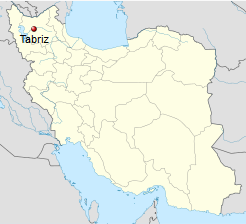
Photo series: Winter in Iran – Snowfall in Tabriz

Iran, Tabriz MapTabriz is one of the historical capitals of Iran, and the present capital of East Azerbaijan Province. Tabriz is located at an elevation of 1,350 meters above sea level in the Quru River valley between the long ridge of the volcanic cone of Sahand and Eynali mountain. The valley opens up into a plain that gently slopes down to the eastern shores of Lake Urmia, 60 kilometres (37 miles) to the west. With cold winters and temperate summers, the city is considered a summer resort.

The city has a long and turbulent history with its oldest civilization sites dated back to 1,500 B.C. It contains many historical monuments representing the transition of Iranian architecture in its long historical timelines.

The predominant language spoken in Tabriz is Azerbaijani language. The language has a strong Iranian substrata since it has for many centuries been in close contact with Persian. Like every other part of Iran the lingua franca is Persian. For the first time, an academic program on Azeri opened in Tabriz University in 1999.

Tabriz was a house for numerous Iranian writers, poets, and illumination movements. In old times the city notables, supported poets and writers by organizing periodical meetings. Within its long history it was a residence for many well known Iranian writers and poets. The list can start from the old time Rumi, Qatran, Khaqani to recent years Samad Behrangi, Gholam-Hossein Sa’edi, Parvin E’tesami.

Sources: Mehr News Agency | Photos, ISNA | Photos, Wikipedia | Tabriz

Iran’s 33rd Fajr Film Festival – winners and closing ceremony

The 33rd edition of Iran’s Fajr International Film Festival has come to an end with “Crazy” by the renowned Abolhasan Davoodi winning the Best Director and the Best Film awards. Produced by Bita Mansuri, Crazy received 11 nominations, including best film, best director for Abolhassan Davudi, best actress for Tannaz Tabatabaii, best cinematographer, best screenplay and best music.

Winners for the national main competition section:

Best Supporting Role Actor – Houman Seyyedi for ‘I Am Diego Maradona’
Best Main Role Actor – Saeed Aghakhani for ‘The Long Farewell’
Best Screenplay – ‘A Time for Love’ by Roya Mohaghegh
Best Director – Abolhasan Davoodi for ‘Crazy’
Best Film – ‘Crazy’ produced by Bita Mansuri
Best Main Role ActressBaran Kousari for ‘Binam Alley’

Sources: Payvand, ISNA | Photos, ISNA | Photos 2, Tasnim News Agency | Photos

Azita Hajian: Iranian actress and director

She was born on 10 January 1958 in Narmak, Tehran. She graduated in theatre acting and directing from the Faculty of Dramatic Arts in Tehran, Azita Hajian started stage acting in 1975 and film acting in 1989 with “Thief of Dolls” (Mohammad Reza Honarmand). Due to her theatrical background in the field of children and teenagers, her first films were in the same field. She is one of the majors teacher of acting in Iran. She has also played in some TV series.

Her two daughters, Mehraveh and Melika, are both actresses.

Sources: Wikipedia | Azita HajianBing Image Search

Shafajoo a successful Iranian startup for digital healthcare services

shafajoo-iranian-digital-healthcare-startup-satratech-group

Shafajoo (meaning In Search of Healing in Persian) is an Iranian digital healthcare service that helps you find a nearby doctor and instantly book an appointment. They have many other services including podcasts and discussion forums. The target users are not just about the patients: it also includes physicians. Doctors, for instance, will have a user profile including their biographies and resumes. I think the most interesting part of this product is that you are able to ask doctors questions, questions that they will answer, thus preventing unnecessary visits to their offices. While there are few agile teams in Iran, this team uses the power of agile methodology in software development. They are also writing many articles related to healthcare.

Shafajoo has been launched at MAPS(An Iranian Accelerator) and It is a product of SatraTech Company. It has now almost 100,000 visits per month and 4000 active users. They are working on regional markets especially the Middle East, and plan to have English and Arabic versions of Shafajoo.

Source: techly.co – Shafajoo wants to be your healing angel

Photo gallery: Azeri singer Alim Qasimov performs in Iran with Tehran’s Wind Orchestra

Renowned Azerbaijani musician and singer, Alim Qasimov, gave a concert in the Iranian capital in a joint performance with Tehran Wind Orchestra.

Alim Hamza oglu Qasimov (born August 14, 1957) is an Azerbaijani musician and one of the foremost mugham singers in Azerbaijan. He was awarded the International Music Council-UNESCO Music Prize in 1999, one of the highest international accolades for music. His music is characterized by his vocal improvisation and represents a move away from the traditional style of mugham. Qasimov has recorded nine albums, three of which are mugham albums with his daughter, Farghana Qasimova.

Sources: Tasnim News | Photos, Wikipedia | Alim Qasimov

Photo series: Winter in Iran – Snowfall in Kerman

Kerman is the capital city of Kerman Province, Iran. At the 2011 census, its population was 821,374, making it the 10th most populous city of Iran.

Iran, Kerman mapIt is one of the largest cities of Iran in terms of area. Kerman is famous for its long history and strong cultural heritage. The city is home to many historic mosques and Zoroastrian fire temples. Kerman is also on the list of the recent world’s 1000 cleanest cities. Kerman is also a former capital of Iran, a position that it held during several periods. It is located on a large, flat plain, 1,036 km (643 mi) south of Tehran, the capital of Iran.

Sources: ISNA | PhotosWikipedia | Kerman

Photo gallery: Fajr Film Festival in Iran

The Fajr International Film Festival or Fajr Film Festival is Iran’s annual film festival, held every February in Tehran, Iran. It takes place every year on the anniversary of the Iranian revolution. There were 90 feature films submitted for the 29th edition of the festival in 2011.

Sources: Wikipedia| Fajr International Film FestivalTasnim News | Photos FIFF 1Tasnim News | Photos FIFF 2Tasnim News | Photos FIFF 3ISNA | FIFF 1ISNA | FIFF 2ISNA | FIFF 3ISNA | FIFF 4ISNA | FIFF 5

Photo gallery: Bisutun Inscription – Iranian Rosetta Stone from 522BC in a 116 hectar UNESCO World Heritage Site

Bisutun Inscription (Behistun Inscription) is a multi-lingual inscription located on Mount Bisutun in the Kermanshah Province of Iran, near the city of Kermanshah in western Iran.

Authored by Darius the Great sometime between his coronation as king of the Persian Empire in the summer of 522 BC and his death in autumn of 486 BC, the inscription includes three versions of the same text, written in three different cuneiform script languages: Old Persian, Elamite, and Babylonian (a later form of Akkadian). In effect, then, the inscription is to cuneiform what the Rosetta Stone is to Egyptian hieroglyphs: the document most crucial in the decipherment of a previously lost script.

The inscription is approximately 15 metres high by 25 metres wide and 100 metres up a limestone cliff from an ancient road connecting the capitals of Babylonia and Media (Babylon and Ecbatana, respectively). The Old Persian text contains 414 lines in five columns; the Elamite text includes 593 lines in eight columns, and the Babylonian text is in 112 lines.

The monument suffered some damage from Allied soldiers using it for target practice in World War II, during the Anglo-Soviet invasion of Iran.


In 1999, Iranian archeologists began the documentation and assessment of damages to the site incurred during the 20th century. Malieh Mehdiabadi, who was project manager for the effort, described a photogrammetric process by which two-dimensional photos were taken of the inscriptions using two cameras and later transmuted into 3-D images.

In recent years, Iranian archaeologists have been undertaking conservation works. The site became a UNESCO World Heritage Site in 2006. In 2012, the Bisotun Cultural Heritage Center organized an international effort to re-examine the inscription.

The site covers an area of 116 hectares. Archeological evidence indicates that this region became a human shelter 40,000 years ago. There are 18 historical monuments other than the inscription of Darius the Great in the Behistun complex that have been registered in the Iranian national list of historical sites.

Sources: Tasnim News | PhotosWikipedia | Behistun Inscription

Iran finishes 4th in Indoor Hockey World Cup after losing to Germany (this year’s host and winner of the last 3 World Cups)

https://i0.wp.com/payvand.com/news/15/feb/Iran-Germany-Indoor-Hockey-World-Cup.jpg

Photo from Iran-Germany game

The Netherlands took the gold medal in the men’s final of the Indoor Hockey World Cup thanks to a 3-2 triumph against Austria.

The Iranian team finished fourth but surpassed all expectations.

Iran, ranked 10th in the FIH Indoor World Rankings, caused one of the biggest shocks in Indoor World Cup history by hammering Russia and booking a ticket to the semi-finals.

Sources: Payvand News of Iran, Wikipedia | Indoor Hockey World Cup, Fédération Internationale de Hockey

Two galleries in Tehran are holding a retrospective of awarded Iranian painter Sirak Melkonian

Iranian painter Sirak-Melkonian-1-HR

Iranian painter Sirak Melkonian

Two galleries in Tehran are holding a retrospective of painter Sirak Melkonian in a joint project. A collection of paintings created over the past 70 years by the 85-year-old artist are on display at the Aria and Ab Anbar galleries, the Persian service of ISNA reported on Tuesday.

The two exhibitions opened on January 30 and will run until February 19.

Aria Gallery: 10 Zarrin Alley, off Vali-e Asr Ave.
Ab Anbar Gallery: 2 Roshan Manesh Alley, Khaqani St., off Enqelab Ave.

Biography
Sirak Melkonian was born in Iran in 1931. He gained national recognition in 1957, winning a prize in the Contemporary Iranian Artist Exhibition of the Iran American Society. That achievement was followed by the Imperial Court Prize Tehran Biennale in 1958 and first prize in 1959 for the Tehran Paris Biennale. First prize in 1974 International Art Exhibition In Tehran brought him International acclaim and he was subsequently invited to exhibit his work at the International Exhibit in Basil, Switzerland.
Throughout 1976 and 1977 he exhibited internationally, most notably at the exhibition of Grand Palais and the Salon De Montrouge in Paris, as well as the Washington International Artfair in the United States. Sirak currently lives and teaches in Toronto, Canada.

Awards
1957- Winning a prize in the Contemporary Iranian Artist Exhibition of the Iran American Society.
1958- The Imperial Court Prize Tehran Biennale
1959- First prize for the Tehran Paris Biennale.
1974- First prize for International Art Exhibition In Tehran

Some works by Sirak Melkonian

More works by Sirak Melkonian: Mahart Gallery | Sirak Melkonian

Sources: Facebook | Sirak Melkonian, Payvand News of Iran

Photo series: Winter in Iran – Snow sliding in Mahnan near Bojnord

North Khorasan, Iran – Mahnan (Mehnan) MapMehnan (also Mahnan and in Persian: مهنان‎) is a village in Aladagh Rural District, in the Central District of Bojnord County, North Khorasan Province, Iran. Its populations (2006) was 1.341 inhabitants.

Bojnord is the capital city of North Khorasan province, Iran. It is about 701km (436mi) from Tehran.

The city is quite famous for its multicultural background. Many people speak at least 2 different languages including Persian, Tati, Khorasani Turkic, Kurmanci Kurdish, and Turkmen. Intermarriage between said ethnic groups is common.

Sources: Mehr News Agency | Photos, Wikipedia | Bojnord, Wikipedia | Mehnan

Interview with Iranian photojournalist Newsha Tavakolian: “Whenever I reach the end, I start from scratch”

Newsha Tavakolian - Iranian photographer 03

Newsha Tavakolian (photo by Arash Ashouriniya)

Newsha Tavakolian, an established photojournalist and art photographer, started her experimental career at 16. After a while she pursued it professionally in Iranian and foreign media. Two decades on, her social recognition and awareness has catapulted her into the ranks of the outstanding photographers.

Zanan-e Emrooz magazine released an interview with Newsha in its 7th issue (December 2014) about her career and life. The following is an excerpt  of it, published in Iran Front Page:

Why did you pick photography? Was anybody in your family who did photography?
At first I knew nothing about photojournalism. I did it for money. My parents were in Germany for my dad’s surgery, and my siblings and I were in Iran. Apart from financial problems, I found the education system annoying. Later I learned that I was suffering from Dyslexia at school but nobody knew about it. Back then I didn’t want to rebel; it was just a normal reaction to the tough conditions of the time…. after dropping out of school, I took photography at my mom’s suggestion and used everything as a subject for photography. […]

Once you said you always wanted to narrate the story of your subjects. Are your recent collections your narration of the characters? […]
My first work was Mothers of the Martyrs Collection: photos of mothers whose sons had been martyred. The undeniable resemblance between mothers and sons was interesting. […] Two reverse trends: a son who has remained in his youth with a cheerful face and a mom who looks emaciated because of the loss of her son. I just selected the backgrounds for the pictures and there was no other intervention on my part. […]

I just show part of their lives and leave the remainder to the imagination of the audience. I like to see viewers get involved in the story of my photos, not just their beauties. None of my photos has a strange surreal atmosphere. They feature the familiar scenes we pass by each day, but we now pause to watch the photos and they make us think.

For instance, the visitors of the Look Collection (2011) told me they felt as if they were watching themselves in those photos. This shows that I have successfully represented a typical character type in the photos. Drawing on my experiences in photojournalism and social documentaries, I’ve reached this point. My photos feature the middle class; that’s why more people identify with the characters in my work. […]

“When I shot these images, it was a dark time in Iran’s history,” says Newsha Tavakolian. “It was a time of extreme pressure on the public, especially on the youth, who were all struggling under the imposed restrictions.” Curious about the isolated lives of the middle-class youth in Tehran, Tavakolian staged images based on the real stories of her friends and neighbours to depict a society that the photographer believes is often reduced to exaggerated stereotypes in western media, and to give a more accurate portrayal of “normal people” in Iran.

As a photojournalist, you not only covered the news on Iran but also news stories in the region, including the Iran-Iraq war. How was it like?
Back then I was 21. In Iraq I was accompanied by two American women. When we left Iraq after the war, they had other projects to work on and show themselves, but I came across closure of newspapers [in Iran] and a stagnant situation in which you would be consumed by inaction.

After one and a half years I realized that I’d spent too much time on something which I couldn’t change. I admitted that I was living in this country with all limitations and I needed to redouble my efforts to work here. […]

I refocused my efforts on upgrading my works. You cannot believe how terrible I was in photography and how much I worked on it. I’m the harshest critic of myself. I relentlessly review my works in order not to let others find any faults with them; I don’t let anybody undermine my self-confidence either. I constantly evaluate and challenge my works, and I think this is a forwarding method.

At the time of war, I was among the first photographers who were in Iraq. I sent my photos through my agency to Time and Newsweek magazines. They didn’t know I was a girl. Well, this heartened me because my works were put above my gender. […]

Where do you think the world is heading with too many photos available? Today mobiles and tablets don’t miss even one single moment. ….
I don’t walk down this path. I don’t produce a big volume of photos. I’m stingy in photography. I feel responsible for taking any photo. I’m stingy even in sending the feed to my eyes and mind. I wouldn’t look at just any video or photo because I wanted to train my eyes.

You are not supposed to watch anything just to spend time or relieve tiredness; otherwise your sight will get sick, just like you don’t eat anything just to fill your stomach. Perhaps these photos are helpful for future historians not to encounter any ambiguity […]

As a professional photographer, is your life affected by news? Is news still tragic for you?
Pieces of bad news send chills down my spine. I’m still involved in photojournalism. It is a labor of love. Let me give you an example. After a tough period of hard work – a four-month trip to 13 countries for filming and photography for an educational project – and facing problems with the Carmignac Foundation, I was in the Netherlands where I decided to go to the beach and have a rest. It coincided with the crash of a Malaysian airliner in Ukraine. The families of the Dutch nationals who were onboard the [doomed] plane went to the airport to ask about their loved ones.

I rushed to the airport when I heard the news. I was unaware that I had no camera, so I collected one at the airport and started to take photos. Nobody was waiting for my photos.

About one month ago I went to Iraq for a personal project. I didn’t snap the most important photo I could take and wrote it instead*.

You’ve travelled to many countries. Have you ever thought about migration given that your husband is not Iranian?
I’m still in Iran because it is the only place where I can use all my senses: anger, happiness, concerns, etc. My Iran photos are the strongest. It’s hard for me to let go of what I’ve developed an interest in. Luckily my husband is interested in Iran too.

I like Iran despite its shortcomings to which I don’t turn a blind eye. This society’s problems bother me and I cannot remain indifferent to them. If I live here and like it, I should do whatever I can for it. […]

Tell us about what you’ve changed in yourself through your own constructive criticism.
Whenever I hold a camera, I imagine it’s my first time. […] Each day I try to gain new things. It all started when I returned from Iraq. I could either suffer from postwar depression or forget whatever I had experienced in order to return to normal life. I chose the intentional forgetfulness in order not to be entrapped by sentimentalism, and not to regret the past. Never do I think about the past. I face the future. Each time I reach the end, I start from scratch.

———————–
* A Thousand Words for a Picture That I Never Took, Newsha Tavakolian, Sharq newspaper

Biography of Newsha Tavakolian: The other Iran | Newsha Tavakolian

Sources: Iran Front PageRoads & KingdomsThe Guardian

Photo series: Winter in Iran – Snowball fighting in Kerman City

Kerman is the capital city of Kerman Province, Iran. At the 2011 census, its population was 821,374, making it the 10th most populous city of Iran.

Iran, Kerman mapIt is one of the largest cities of Iran in terms of area. Kerman is famous for its long history and strong cultural heritage. The city is home to many historic mosques and Zoroastrian fire temples. Kerman is also on the list of the recent world’s 1000 cleanest cities. Kerman is also a former capital of Iran, a position that it held during several periods. It is located on a large, flat plain, 1,036 km (643 mi) south of Tehran, the capital of Iran.

Climate
The city’s many districts are surrounded by mountains which bring variety to Kerman’s year round weather pattern, thus the northern part of the city is located in an arid desert area, while the highland of the southern part of the city enjoys a more moderate climate. The mean elevation of the city is about 1755 m above sea level.

Kerman city has a moderate climate and the average annual rainfall is 135 mm. Because it is located close to the Kavir-e lut (Lut desert), Kerman has hot summers and in the spring it often has violent sand storms. Otherwise, its climate is relatively cool.

Culture
Kerman has an abundance of architectural relics of antiquity. It is among several cites in Iran with a strong cultural heritage, which is expressed in the local accent, poetry, local music, handicrafts and customs that Kerman has introduced to the world of culture.

The Iran museum of Zoroastrians, which showcases the ancient history of Zoroastrians, is in Kerman’s Fire Temple. The idea of launching the museum along with the library of Kerman’s Zoroastrian Society came to light in 1983, when the head of the society, Parviz Vakhashouri, and the former head of library, Mehran Gheibi, collected cultural heritage artifacts of Kerman’s Zoroastrian community. These two officials added many other objects to this collection.The museum was officially inaugurated during Jashn-e Tirgan in 2005 by Iran’s Cultural Heritage, Handicrafts and Tourism Organization (ICHHTO).

Jashn-e Tirgan or Tiregan is an ancient Iranian rain festival observed on July 1. The festivity refers to archangel Tir (literally meaning arrow) or Tishtar (lightning) who appear in the sky to generate thunder and lightning for providing the much needed rain.

Sadeh ceremony is celebrated every year in Kerman. Also The archeological ancient area of Jiroft and Tappe Yahya Baft are located south of Kerman. Rayen Castle is also located on Rayen town,south east of Kerman.

Sources: Mehr News Agency, Wikipedia | Kerman

Iran’s Kurdistan Province: From Sanandaj to Marivan

Sanandaj is the capital of Kurdish culture and Kurdistan Province at Iran. At the 2011 census, its population was 373,987. Until the 17th century it was only a small village, when the governor of the region, Suleyman Khan Ardalan, renovated a fortress there, known as “Sena Dezh”, which gave the town its Persian name.

The economy of Sanandaj is based upon the production of carpets, processed hides and skins, milled rice, refined sugar, woodworking, cotton weaving, metalware and cutlery.

Enjoy the photo gallery with images taken from Sanandaj to Marivan:

Post related to this region with information about Marivan:
Photo Series: Winter in Iran – Marivan, Kurdistan Province

Sources: CNNWikipedia | Sanandaj

Iranian-American music conductor and composer Shahrdad Rohani directed orchestra in Tehran

Acclaimed music conductor Shahrdad Rohani performed an orchestra for a big audience Friday night at Tehran’s Grand Hall of the Interior Ministry.

Shahrdad Rohani, born May 27, 1954 in Tehran, Iran is an Iranian-American composer, violinist/pianist, and conductor. His style is contemporary and he is well known for composing and conducting classical, instrumental, adult contemporary/new age, film soundtrack as well as pop music.

Early life
His father, Reza Rohani, was an accomplished musician and Shahrdad followed in his father’s footsteps. He started down the path of becoming a musician at the age of five when he learned to play the violin under the instruction of his father.

He was a student to a well-known Persian violinist, Ebrahim Rouhifar. At age 10 he attended the Persian National Music Conservatory of Tehran. He studied with a Swiss teacher named Basil as well as an Armenian teacher named Hagh Nazarian, who taught him to play the piano; they worked together for seven years.

After studying at the Tehran Conservatory, Shahrdad Rohani left his family, many of whom still remain in Iran, and traveled in 1975 to Austria where he attended the Academy and Conservatories of Music in Vienna. Then, in the early 1980’s, he accepted a scholarship to study music at UCLA and moved to the United States.

Musical career
From 1987 until 1991 Mr. Rohani served as the music director and conductor of the COTA symphony orchestra in Los Angeles. He has appeared as a guest conductor with a number of prestigious orchestras including London’s Royal Philharmonic Orchestra, Minnesota Orchestra, Colorado Symphony Orchestra, San Diego Symphony, Indianapolis Symphony Orchestra, New Jersey Symphony, Zagreb Philharmonic Orchestra, the American Youth Philharmonic Orchestras and many others.

Shahrdad arranged the music and conducted the orchestra to supplement Yanni’s keyboard compositions during the Yanni Live at the Acropolis concert in 1993, an open-air concert with the London Royal Philharmonic Concert Orchestra in the Parthenon, Athens, Greece. Shahrdad also played the violin in all but two of the tracks during this concert. Yanni Live at the Acropolis was acclaimed by both critics and audience and became the most widely viewed program ever shown on Public Television in United States and is the second best-selling music video of all time.

Rohani was commissioned in 1998 by the government of Thailand and the committee of the 13th Asian Games to compose and conduct the music for opening ceremonies. The composition became the most popular song of the Asian Games.

In 1999 Rohani received the Thailand’s Pikanes award, the country’s most prestigious music award for an outstanding orchestral performance. The award is considered the highest artistic achievement.

Sources: Mehr News Agency, wikipedia, IIP Digital | U.S. Department of State

Newsha Tavakolian: Iranian photojournalist and documentary photographer

Newsha Tavakolian - Iranian photojournalistNewsha Tavakolian (born 1981 in Tehran) is an Iranian photojournalist and documentary photographer. She has worked for Time Magazine, The New York Times, Le Figaro, and National Geographic. She is particularly known for focusing on women’s issues in her work, and has been a member of the Rawiya women’s photography collective, she co-established in 2011. She lives and works in Tehran.

Career
Born and brought up in Tehran, Tavakolian is a self-taught photographer. She began working professionally in the Iranian press at age of 16, at women’s daily newspaper ‘Zan’, after a 6-month photography course. At the age of 18, she was the youngest photographer to cover the 1999 student uprising, using her Minolta with 50mm lens, her photographs were published in several publications.

She got her international break in 2001 at age 21, when she met J.P. Pappis, founder Polaris Images, New York at photography festival in Perpignan, France. Thereafter, she began covering Iran for Polaris Images, in the same year, and started working as a freelancer for The Times in 2004.

In 2002 she started working internationally, covering the war in Iraq for several months. She has since covered regional conflicts, natural disasters and made social documentary stories in Iraq, Lebanon, Syria, Saudi Arabia, Pakistan and Yemen. Her work is published in international magazines and newspapers such as Time Magazine, Newsweek, Stern, Le Figaro, Colors, The New York Times, Der Spiegel, Le Monde, NRC Handelsblad and The New York Times Magazine.

Countering the predominantly male western dominance on photojurnalism in her region, she brought together a group of six Middle Eastern women photographers, uniting them in the RAWIYAH collective.

A common theme in her work is photo stories of women, friends and neighbours in Iran, evolving role of women in overcoming gender-based restrictions, and contrasts the stereotypes in western media. Her photo projects include Mother of Martyrs (2006), Women in the Axis of Evil (2006), The Day I Became a Woman (2010) and Look (2013), which opened at Thomas Erben Gallery, New York City.

She was part of the 2006 Joop Swart Masterclass organized by World Press Photo. In 2007 she was a finalist for the Inge Morath Award. Her work has been exhibited and collected at institutions such as the British Museum, the Victoria and Albert Museum, Los Angeles County Museum of Art, the Museum of Fine Arts, Boston and Somerset House, London (April 2014), where she was one of eight Iranian photographers featured in the critically acclaimed “Burnt Generation” exhibition.

In 2012, her first book “The Fifth Pillar” was published by Gilgamesh publishers in London, covering her personal take on the annual Muslim pilgrimage, the Hajj. More recently, Newsha was commissioned by the Qatar Foundation to travel around the world for 3 months taking photographs for a book about education to be published in March 2014. Also in 2014 Newsha was a member of the 2014 World Press Photo competition jury. Her work will be exhibited in Paris in November 2014, where also her new book will be launched. After Paris the work will go on a tour to London, Frankfurt and Milan.

Awards
2014 Fifth laureate of the Carmignac Gestion Photojournalism Award.
2009 Magic of Persia Contemporary Art Prize Finalist, United Kingdom
2007 Inge Morath Award, Finalist, Magnum Photo Agency, New York, United States
2006 Joop Swart Masterclass, World Press Photo, Amsterdam, The Netherlands
2006 Still Photography Award from the All Roads Film Project, National Geographic, Washington, D.C, USA
2003 Runner-up in Picture of the Year International Competition, Magazine Feature Category, National Press Photographers Association and Missouri School of Journalism, USA

Books
She Who Tells a Story – Women Photographers from Iran and the Arab World, Kristen Gresh with a foreword by Michket Krifa. MFA Publications, 164 pages, 110 color illustrations
2012 Fifth Pillar, Hajj Pilgrimage, by Newsha Tavakolian, Gilgamesh Publishing House
2010 A History of Women’s Photographers, by Naomi Rosenblum, Abbeville Press.
2008 Iranian Photography Now, by Rose Issa, Hatje Cantz Verlag
2009 Transit Tehran: Young Iran and Its Inspirations, by Malu Halasa and Maziar Bahari, Garnet Publishing

Sources: Newsha Tavakolian Photography, Wikipedia | Newsha Tavakolian

Photo Series: Winter in Iran – Masuleh, Gilan Province

Beautiful pictures of Masuleh covered in snow:

For more detailed information about Masuleh and its unique architecture:
The other Iran | Iran’s Gilan Province: Masuleh Village

Source: Mehr News Agency | Photos

Series Iranian Art: Handicrafts – The art of turquoise inlaying

Iran is one of the world’s most prolific countries in producing decorative gemstones, and its sky-blue turquoise has always been a magnet for beauty seekers throughout history.

The word turquoise, which dates to the 16th century, is derived from an Old French word for “Turkish”, because the mineral was first brought to Europe through Turkey from the mines in Iran. The Iranians named it “pirouzeh” (meaning victory) and the Aztecs knew it as Teoxihuitl.

It is an opaque stone, which differs in shade from blue, green and blue-green depending on its origin. It is rare and valuable in finer grades and has been prized as a gem and ornamental stone for thousands of years owing to its unique hue. It takes a fine polish and does not lose color with time.

Persian turquoise is extensively found in Iran’s northeastern city of Neyshabur (Nishapur) and dates back to 4,000 BCE. Neyshabur turquoise mines, located 53 kilometers northwest of the city and near the old caravan routes, are believed to be among the world’s oldest known turquoise mines, which supplied the stone to Europe, Western Asia and America.

In Persia, turquoise was the de facto national stone for millennia, extensively used to decorate objects (from turbans to bridles), mosques, palaces and other important buildings. The massive, robin’s egg blue Persian turquoise is used in making jewelry and creating mosaics, inlays or overlays that have adorned numerous monuments over the centuries.
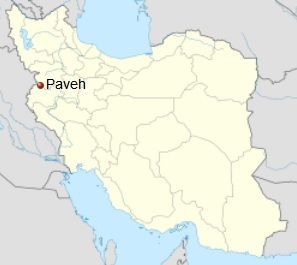
The Persian style and use of turquoise was later brought to India, its influence seen in high purity gold jewellery (together with ruby and diamond) and in such buildings as the Taj Mahal. Archeological excavations have yielded Persian turquoise in ancient graves in Turkistan and throughout the Caucasus dating back to the first to third century BCE.

Iranian artists use turquoise in various forms of art including calligraphy and handicrafts. Inlaid turquoise is one of the most beautiful Iranian artworks. It is made by implanting small pieces of turquoise stone in mosaic fashion on the surface of the dishes, ornaments and decorative objects with copper, brass, silver or bronze bases.

Sources:
wikipedia
Press TV
Photos by Alieh Sa’adatpour for Mehr News Agency