Tag Archives: International

Photo gallery: Fans in Iran celebrate the 2018 FIFA World Cup

During the world cup many Iranians watched the matches in cafés, restaurants, shops or public screenings. After each match people flooded the streets to celebrate and show their support for the team; Iran achieved their best performance at a world cup. They finished third in their group with four points and overall in 18th place out of 32 squads.*

An own goal by Aziz Bouhaddouz (90+5′) allowed Iran to win their first match 1:0 against Morocco. Spain won the second match 1:0 (Diego Costa 54′) but the Europeans struggled to create chances against a very disciplined Iran that defended brilliantly, showed plenty of tactical cohesion and looked dangerous going forward. Saeid Ezatolahi had a goal disallowed for offside.

The third match against Portugal ended in a draw 1:1 (Quaresma 45′; penalty Karim Ansarifard 90+3′). Morteza Pouraliganji rose up to the challenge and kept Cristiano Ronaldo in check. In the second half, Ali Beiranvand managed to save Ronaldo’s penalty kick. Seconds before the final whistle, Iran went all out for the winner and a desperate Saman Ghoddos effort was deflected onto the path of Mehdi Taremi who found himself one-on-one with Portuguese goalkeeper Rui Patricio. Taremi hit the wrong side of the netting, consigning his side to finishing third in their group. Iran needed all three points to advance to the knock-out stage.

In The Guardian, Paul Doyle rated Ali Beiravand’s overall performance with an 8 and chose the Iranian goalkeeper in his best eleven of the group stage.

*Note: In 1978, Iran finished in 14th place out of 16 participants on their first World Cup appearance.

Sources: Borna News Agency, Fars News Agency (FNA) 1, FNA 2, IRNA 1, IRNA 2, IRNA 3, IRNA 4, IRNA 5, IRNA 6, IRNA 7, ISNA 1, ISNA 2, ISNA 3, ISNA 4, ISNA 5, ISNA 6, Mehr News Agency (MNA) 1, MNA 2, MNA 3, MNA 4, MNA 5, MNA 6, MNA 7, MNA 8, MNA 9, Tasnim News Agency (TNA) 1, TNA 2, Tehran Picture Agency (TPA) 1, TPA 2, TPA 3, Young Journalists Club (YJC) 1, YJC 2, YJC 3, YJC 4, YJC 5, YJC 6, YJC 7, AFC, The Guardian (TG) 1, TG 2, Wikipedia 1, Wikipedia 2, Wikipedia 3

FIFA World Cup 2018: Iran’s team and fans in Russia (Photos)

Reza Ghoochannejhad – The violinist who understands seven languages
Reza scored the only Iranian goal in the World Cup 2014. Besides football, the forward is known for his skills with the violin and for languages; he speaks English, Dutch, Persian and French. Additionally he has a good understanding of German, Italian and Portuguese.

He played in the youth national team of the Netherlands and, at the age of 21, he wanted to leave football to study law. He was convinced by Marc Overmars, the winger that played in Barcelona, to stick to football. He wants to finish his studies when he retires from football. “The people who know me know that there is something more than football for me”. His sister-in-law is Sareh Bayat, a famous Iranian actress who participated in the 2012 Oscar-winning film “Nader and Simín, a separation”. After Iran’s win against Morocco with an own goal by Bouhaddouz, he took a moment to console his opponent on Instagram:

“I don’t know you personally but in life, sometimes you win, sometimes you lose. Don’t let this own goal bring you down. We are all professional sportsmen and this is a part of football. I am so happy and proud of my team and my country, but wanted to wish you also all the best in your career. Reza”.

Sardar Azmoun – The Iranian “Messi”
Sardar, 23 years old, is compared to the crack of Barça due to his ability. A comparison that, however, the striker of Rubin Kazan rejects immediately. “I do not know why they say I’m the new Messi, my game has nothing to do, maybe it’s because we use the same boots,” he says. Azmoun was born in Gonbad-e Kavus to a family of Turkmen origin from Iran’s Sunni minority. He started his career in Sepahan FC (Isfahan, Iran).

As top scorer in the league and for the national team he is the favorite of the masses beloved by the fans and his team members. He is addicted to social networks. When he was younger, he was summoned by the Iranian sub-15 volleyball team due to his height (1.86 meters) and the conditions inherited from his father, a former player. He is also passionate about horses.

Alireza Jahanbakhsh – The child that fell in love with football at the world cup
Alireza Jahanbakhsh is Iran’s biggest threat in attack. The winger of AZ Alkmaar is 2017-18 Eredivise’s top scorer. He scored 21 goals and also distributed 12 assists! “It’s not bad to play as a winger” he says. Neither for a child who, until 12, preferred gymnastics, handball and indoor football over football. Jahanbakhsh, who got hooked on football watching the 1998 World Cup, grew up admiring Iranian winger Mahdavikia, but now he adores Cristiano Ronaldo: “He’s my role model, I always try to learn from him.” His determination and work are exemplary. He is simply the best in the world.”

Milad Mohammadi – The twin nicknamed Road Runner
Milad Mohammadi is a fullback/left winger that plays for Akhmat Grozny in Chechnya. He has a twin brother, Mehrdad, who plays for Sepahan FC. Fans nicknamed Milad “Mig-Mig”, as in the cartoon The Coyote and the Road Runner, due to his speed.

Saeid Ezatolahi – The Persian Pogba with a short stop in Atlético
21-year-old central midfielder Saeid Ezatolahi is the youngest member of the squad in Russia. He wrote Iranian football history as the youngest player to score with the national team.
Son of a trainer, he was nicknamed the Persian Pogba and at the end of the summer of 2014, with 17, he signed for Atlético de Madrid for four years. He played in the quarterfinals of the UEFA Youth League.
“He was a very polite and respectful player. Always wondering about all the tactical aspects to learn as much as possible. He even asked to stay longer to do specific workouts sometimes”, recalls Armando de la Morena, the coach he had in Spain. During the April 2015 transfer window Ezatolahi trained with Cholo Simeone at Cerro del Espino. In July 2015 he transferred to Russia’s Rostov.

Masoud – Or how to overcome four serious injuries
Masoud Shojaei is best known in Spain because he played for Osasuna and Las Palmas. In Pamplona he learned, what it meant to play under pressure in football’s top competitions, with all eyes right on top of him. He had four surgeries after a broken metatarsal during the 2011-2012 season. It took him 16 months to recover, six of them on crutches. After having problems with the regime, he is now back as captain of the Iran squad.

Ghoddos – The Iranian, who came out of the cold of… Sweden
Saman Ghoddos (24 years old) was born in Malmö, Sweden and he received his Iranian nationality last year. He neither knew until then the majority of those who are now his teammates. The match against Spain was his tenth game defending Iran. The midfielder/forward is the son of Iranian immigrants, who never forgot their roots – celebrating Nowruz and Chahar Shanbeh Suri in Sweden. He played two friendlies with the Swedish national team, scoring once.
Ghoddos plays in Östersunds FC. Arsenal’s coach Arsene Wenger praised him after a Europa League match: “Technically and tactically, I was impressed by him”. Ghoddos club did not want to sell him this winter to Celta de Vigo.

Dejagah – Boateng’s friend and owner of a restaurant
Ashkan Dejagah, midfielder of Nottingham Forest since January, sees Kevin Prince Boateng as his brother. The German-born Ghanaian midfielder wished him luck on Instagram in the first game. In January he opened a sushi restaurant in Berlin. He represented Germany at youth levels, where he met Neuer, Höwedes, Khedira, Özil … before playing in Wolfsburg and Fulham. He has Berlin and Tehran tattooed on each of his arms along with the legend “Never forget where you come from”.

Morteza Pouraliganji – Teammate of Xavi Hernández in Al Saad
Morteza Pouraliganji is, with only 26 years, the head of Iran’s defense. He plays in Al Saad of Qatar, Xavi’s team, where he arrived two years ago despite the offers he had from Europe and China. The Spanish midfielder was the great idol of his youth.

Alireza Beiranvand – From sleeping rough to the World Cup with Iran
Alireza Beiranvand was a shepherd in the mountainous region of Lorestan, in the northwest of the country. “My father didn’t like football at all and asked me to work,” Alireza told the Guardian. “He even tore my clothes and gloves and I played with bare hands several times.” He used all his money for a trip to Tehran, where he slept in the in the streets at the beginning. He had several jobs to supplement his income, including working at a car wash where, at 1,93m (6ft 4in) tall, he specialised in cleaning SUVs. He also worked in a dressmaking factory and a pizza shop before making his breakthrough in football. The 25-year-old plays now for Tehran-based club Persepolis.

Playing as a kid “Dal Paran”, a game that involves throwing stones long distances, enabled him to throw the ball much further than many other goalkeepers. His 70-meter assist in the Iranian football league caught the eyes of foreign media and made him famous abroad in 2014. In 2015 Alireza finally became Iran’s first-choice goalkeeper and, with 12 clean sheets in qualifying, he helped Team Melli, as Iran’s team is called at home, cruise to Russia 2018. “I suffered many difficulties to make my dreams come true but I have no intention of forgetting them because they made me the person I am now,” he said.

Carlos Queiroz – Iran’s Portuguese coach
Carlos Queiroz, former trainer at Real Madrid and assistant trainer at Manchester United under Sir Alex Ferguson, […] had worked wonders to get Iran to Brazil. Iran was Asia’s seventh-ranked team when he took over in 2011 and 54th in the world. Within three years Iran was the first ranked team in Asia. For Russia 2018, Iran didn’t lose a single one of their ten games in qualifying and conceded only twice. Sanctions have bit hard:

“We struggle to travel, to have training camps, to bring opponents, to buy equipment. Even buying shirts is a challenge, but these challenges helped me fall in love with Iran. These difficulties become a source of inspiration to the people, it makes them more united, to fight for their country. These boys deserve a smile from the rest of the world.”

Sanctions also meant Nike pulled out of their deal to supply the Iran team with boots one week ahead of the World Cup, forcing players to play with unfamiliar equipment.

“My message for international football is very simple: let us play. Our players deserve that opportunity. Don’t let sanctions create this stigma. Don’t let this go against the spirit of the game. We have football players who love the game”.

“[…] I’ve never, in all my career, seen players deliver so much after receiving so little as I have with these Iran Boys“.

“Tell me one national team which goes to the World Cup without enough friendly games [Greece recently cancelled a friendly, Kosovo then also declined to step in], or by using a 60-metre training pitch?”

Queiroz didn’t expect to be in charge of Iran for seven years. “Football has given me the privilege to go to many places in the world, to see the United States, Japan, Africa or Europe,” he says. “And people ask me about Iran because they’re curious. I tell them that I see exactly the same as in any other country I’ve been to – people who laugh and cry, who dance, who sing. You see mums carrying their kids to school in the morning. You see people complaining about the traffic. Football teaches you how much human beings have in common that have nothing to do with any politics or regimes.”

Football is huge in Iran – the national team regularly drew sell-out crowds of 78,000 in qualifying. “Iran is a football country,” says Queiroz. “Football is in the DNA of the people. Iran is not a fake football country, one which needs to create or imagine fantasy solutions to promote the game. But our players need support and the politics should be left out of the game.” And his young players in Russia? “They have a right to enjoy Russia, to have fun,” he says. “They’ve earned it.”

List of players called up for the 2018 FIFA World Cup (jersey number in parentheses):
Goalkeepers: Ali Beiravand (1), Rashid Mazaheri (12), Amir Abedzadeh (22)
Defenders: Ehsan Hajsafi (3), Rouzbeh Cheshmi (4), Milad Mohammadi (5), Morteza Pouraliganji (8), Mohammad Reza Khanzadeh (13), Pejman Montazeri (15), Majid Hosseini (19), Ramin Rezaeian (23)
Midfielders: Mehdi Torabi (2), Saeid Ezatolahi (6), Masoud Shojaei (7), Omid Ebrahimi (9), Vahid Amiri (11)
Forwards: Karim Ansarifard (10), Saman Ghoddos (14), Reza Ghoochannejhad (16), Mehdi Taremi (17), Alireza Jahanbakhsh (18), Sardar Azmoun (20), Ashkan Dejagah (21)
Head coach: Carlos Queiroz

Sources: MARCA (Original article with contributions by Iranian sports journalist Alireza Moharami. This source was loose translated from Spanish to English), The Guardian, BBC, GQ Magazine, ESPN, FIFA, GOAL, ISNA 1, ISNA 2, ISNA 3, ISNA 4, MEHR, Zimbio, instagram @alirezajb_official, instagram @miladmohammadi.official, instagram @saman.ghoddos, instagram @sardar_azmoun, instagram @rgucci16, instagram @teammellifootball, twitter @FIFAWorldCupIRN

Iran wins bronze at Indoor Hockey World Cup

The Asian Champions won the Bronze Medal match 5:0 against Australia, and became the first non-European team to win a podium position at the Indoor Hockey World Cup, held in Berlin, Germany. Sasan Hatami Nejad won the Best Goalkeeper Award and Reza Norouzzadeh ended as the third highest scorer of the tournament.

Navid Taherirad netted Iran’s opener nearly a quarter into the game; and Reza Norouzzadeh doubled Iran’s lead in the 19th minute. After Hamid Nooranian jabbed the team’s third goal, Norouzzadeh was on target twice again, completing a hat trick in the span of just 21 minutes.

Austria beat Germany 3-2 in the penalty shoot-out and shattered the hosts’ championship hopes, after both teams were tied 3-3 at full time. The Netherlands were the reigning champions, but did not qualify to defend their title.

Ranked currently 7th in the world, Iran lost one match (the semi final against Germany, world number 1), out of a total of 8 matches played at the event. They drew against Austria (world number 2 and Indoor Hockey World Cup 2018 Champions), won against Russia (world number 4), and against Czech Republic (world number 6).

Iranian squad
Behdad Biranvand, Yaghoub Bahrami, Abbas Aruei, Amir Aruei, Hamid Nouraniyan, Alireza Chezani Sharahi, Behnam Fardi, Mohsen Bohlouli, Mohammad Asnaashari, Reza Norouzzadeh, Sasan Hataminejad and Navid Taherirad. Head coach: Esfandiar Safaei

Sources: Payvand News of Iran, International Hockey Federation, Asian Hockey Federation, Wikipedia

Undefeated Iran is Youth Volleyball World Champion 2017

Iran succeeded in their gold medal hunt as they defeated Russia 3-1, winning its second title in the FIVB Volleyball Boys’ U19 World Championship. Japan defeated South Korea for the bronze medal. Amir Hossein Esfandiar from Iran was elected the MVP and Amir Hossein Toukhteh was selected in the tournament’s dream team.

Porya Yali, Morteza Sharifi and Amirhossein Esfandiar dominated in offence as they combined for 54 of Iran’s 59 attacks. Yali led Iran in scoring with 29 points, Sharifi charted 19 points and was Iran’s most efficient hitter, while Esfandiar played consistently across all skill sets. Maksim Sapozhkov, who came off the bench in the second set, top scored for Russia with 16 points.

RESULTS (Iran)
Iran 3 : 2 Italy (25-16, 23-25, 23-25, 25-19, 15-12) – Pool D
Iran 3 : 0 Mexico (25-19, 25-12, 25-18) – Pool D
Iran 3 : 0 China (25-23, 25-18, 25-21) – Pool D
Iran 3 : 0 Czech Republic (25-22, 25-12, 25-19) – Pool D
Iran 3 : 0 Turkey (25-18, 25-21, 25-13) – Round of 16
Iran 3 : 0 Brazil (25-21, 25-20, 25-15) – Quarterfinals
Iran 3 : 0 South Korea (25-23, 25-20, 25-18) – Semifinals
Russia 1 : 3 Iran (20-25, 23-25, 25-21, 20-25) – Final

DREAM TEAM
Most Valuable Player: Amirhosseini Esfandiar (Iran)
Best Outside Spikers: Amirhosseini Esfandiar (Iran), Pavel Tetyukhin (Russia)
Best Middle Blockers: Artem Melnikov (Russia), Amir Hossein Toukhteh (Iran)
Best Setter: Shunsuke Nakamura (Japan)
Best Opposite Spiker: Im Donghyeok (South Korea)
Best Libero: Kenta Ichikawa (Japan)

The 2017 FIVB Volleyball Boys’ U19 World Championship was the fifteenth edition of the world championship for men’s national teams under the age of 19. The tournament was hosted by Bahrain in Riffa from 18 to 27 August 2017. 20 teams from the 5 confederations competed in the tournament.

Sources: FIVB | U19 Boys 2017 (News), Wikipedia | 2017 FIVB Boys’ U19 World Championship, Young Journalists Club, Borna News, IRNA

Iran wins 12 medals at the 2017 X World Games in Poland

The 2017 X World Games is a major international multi-sport event, meant for sports, disciplines or events within a sport, that are not contested in the Olympic Games, held in Wrocław, Poland.

Iran sent a delegation of 19 athletes that competed in 7 disciplines: Archery, Billiard sports, Ju-Jitsu, Karate, Kickboxing, Muaythai and Sport climbing, winning 12 medals (two gold, eight silver and two bronze). All Iranian athletes that did not win a medal reached the quarterfinals.

3214 athletes from 102 countries participated in a total of 201 events in 27 official sport disciplines as well as in 21 events in 4 invitational sports, that included American football, Indoor rowing, Kickboxing, and Motorcycle speedway.This is the first time that Floorball, Lacrosse and Muaythai have been included in the World Games as official sports.

Iran at the 2017 X World Games
16px-Gold_medal_icon.svg Karate – Men’s Kumite 84kg: Zabiollah Poorshab
16px-Gold_medal_icon.svg Sport Climbing – Men’s Speed: Reza Alipourshenazandifar
16px-Silver_medal_icon.svg Archery – Men’s Compound: Esmaeil Ebadi
16px-Silver_medal_icon.svg Ju-Jitsu –
Men’s 94kg Fighting: Mohsen Hamid Aghchay
16px-Silver_medal_icon.svg Karate –
Women’s Kumite +68kg: Hamideh Abbasali
16px-Silver_medal_icon.svg Karate –
Men’s Kumite 60kg: Amir Mehdizadeh
16px-Silver_medal_icon.svg Karate –
Men’s Kumite 75kg: Aliasghar Asiabari
16px-Silver_medal_icon.svg Karate –
Men’s Kumite +84kg: Sajad Ganjzadeh
16px-Silver_medal_icon.svg Muaythai –
Men’s 63.5kg: Ali Zarinfar
16px-Silver_medal_icon.svg Muaythai –
Men’s 71kg: Masoud Minaei
Bronze_medal_icon.svg Billiard Sports – Mixed Snooker: Soheil Vahedi
Bronze_medal_icon.svg Kickboxing Men’s K1 86kg: Omid Nosrati (* invitational sport)

Sources: Wikipedia | 2017 World Games, 2017 X World Games | Iranian medals, Wikipedia | Iran at the 2017 World Games, Facebook @TWG2017

Iranian film won “Un Certain Regard” top prize at Cannes

A Man of Integrity (Lerd), a film that focuses on a goldfish farmer battling corporate oppression in Northern Iran, has won the top prize in the “Un Certain Regard” competition at the Cannes Film Festival on Saturday.

Directed by Mohammad Rasoulof, the film stars Reza Akhlaghirad, Soudabeh Beizaee and Misagh Zare Zeinab. A Man of Integrity marks Rasoulof’s third attempt at the Un Certain Regard section, having previously had two of his other movies nominated including 2011’s Au revoir and 2013’s Manuscripts Don’t Burn, winning Best Director for the former.

Rasoulof’s win comes three months after another Iranian filmmaker, Asghar Farhadi, won the Oscar for Best Foreign Language Film for his film The Salesman.

“Un Certain Regard” is a section of the Cannes Film Festival’s official selection. It runs parallel to the competition for the Palme d’Or. Introduced in 1978 by Gilles Jacob, this section presents works that have an original aim and aesthetic. The name literally means “a certain glance” but is understood by French speakers to mean “from another point of view.” In 2017 this section presented in competition 18 films hailing from 22 different countries.

Under the presidency of Uma Thurman (actress – United States), the Jury was comprised of Mohamed Diab (director – Egypt), Reda Kateb (actor – France), Joachim Lafosse (director – Belgium) and Karel Och (artistic director of the Karlovy Vary Film Festival – Czech Republic).

Iranian short film “AniMal” (Heyvan), co-directed by Bahram and Bahman Ark, won the second prize of the 20th Cinéfondation Selection.  The Jury was headed by Cristian Mungiu (director – Romania) and included Clotilde Hesme (actress – France), Athina Rachel Tsangari (director, writer, producer – Greece), Barry Jenkins (director, script writer – United States) and Eric Khoo (director, writer, producer – Singapore).

La Cinéfondation, by the Cannes Film Festival, was created to inspire and support the next generation of international filmmakers. This year’s selection consisted of 16 student films, chosen out of 2.600 entries coming from 626 film schools around the world.

UN CERTAIN REGARD PRIZES
“Un Certain Regard” Prize: Lerd (A Man of Integrity) by Mohammad Rasoulof
Prize for Best Actress:  Jasmine Trinca for Fortunata by Sergio Castellitto
Prize for the Best Poetic Narrative: Barbara by Mathieu Amalric
Prize for the Best Direction: Taylor sheridan for Wind River
Jury Prize: Las Hijas de Abril (April’s Daughters) by Michel Franco

20th CINÉFONDATION PRIZES
First Prize: Paul est là (Paul is here) directed by Valentina Maurel / INSAS, Belgium
Second Prize: Heyvan (AniMal) directed by Bahram & Bahman Ark / Iranian National School of Cinema, Iran
Third Prize: Deux égarés sont morts (Two youths died) directed by Tommaso Usberti / La Fémis, France

Sources: Wikipedia, Festival de Cannes (Un Certain Regard), Festival de Cannes (Cinéfondation), silverscreen.in, instagram.com #lerd, purepeople.com

Iran won eight medals at Asian u-20 Chess Championship

Young Iranian chess players won two gold, three silver and three bronze medals at the 2017 Asian Juniors u-20 Chess Championships 2017 held in Shiraz.

India dominated the Asian Junior Girls event, winning gold, silver and bronze. Iran did the same at the Asian Junior Open event: IM Masoud Mosadeghpour won the title, IM Alireza Firouzja won silver and Arash Tahbaz bronze.

Mosadeghpour also finished second in Open Rapid with 5.5 points behind IM Tuan Minh Tran from Vietnam, who won gold with 6.0 points. Iran’s IM Mersad Khodashenas finished third.

In Girls Rapid, WCM Sharma Isha from India stood on top of the podium with 6.0 points followed by Iran’s Anousha Mahdian with 5.0 points. Guddanti Harshita of India ranked third.

At the Asian Junior Girls Blitz event Iran’s WFM Mobina Alinasab won gold followed by Guddanti Harshita from India and Mutriba Hotami from Tajikistan. Tuan Minh Tran from Vietnam won his second gold medal in Open Blitz. India’s IM Bharathakoti Harsha finished second and Amirmasoud Moradi from Iran third.

Finals standings
– Asian Junior – Girls: 1st WIM Ivana Maria Furtado (India), 2nd C.H. Meghna (India), 3rd WFM Rutumbara Bidhar (India)
– Asian Junior – Open: 1st IM Masoud Mosadeghpour (Iran), 2nd IM Alireza Firouzja (Iran), 3rd Arash Tahbaz (Iran)
– Asian Junior – Girls (Rapid): 1st WCM Sharma Isha (India), 2nd Anousha Mahdian (Iran), 3rd Guddanti Harshita (India)
– Asian Junior – Open (Rapid): 1st IM Tuan Minh Tran (Vietnam), 2nd IM Masoud Mosadeghpour (Iran), 3rd IM Mersad Khodashenas (Iran)
– Asian Junior – Girls (Blitz): 1st WFM Mobina Alinasab (Iran), 2nd Guddanti Harshita (India), 3rd Mutriba Hotami (Tajikistan)
– Asian Junior – Open (Blitz): 1st IM Tuan Minh Tran (Vietnam), 2nd IM Bharathakoti Harsha (India), 3rd Amirmasoud Moradi (Iran)

Notes
IM: International Master; WCM: Woman Candidate Master; WFM: Woman FIDE Master; WIM: Woman International Master

Source: chess-results.com

Iran wins bronze making Asian history at FIFA Beach Soccer World Cup 2017 (Photos)

Iran ended their Bahamas 2017 campaign on a high with a 5-3 win against Italy in the play-off for third place to become Asia’s highest ever finishers at the Beach Soccer World Cup.

Peyman Hosseini, Iran’s goalkeeper, won the adidas Golden Glove award and Mohammad Ahmadzadeh won the adidas Golden Ball as best player of the tournament and also the adidas Bronze Scorer award with nine goals and one assist.

Italian player Gabriele Gori scored two goals to move beyond Dejan Stankovic into second place for biggest hauls at a single competition. Goalkeeper Peyman Hosseini has had a stand-out tournament. Having scored the first goal of Bahamas 2017 with a long-range volley, he has been a crucial part of Iran’s success on the goalkeeping front too. During their play-off for third place against Italy, he made a stunning, off-balance diving foot save early in the match that got the crowd out of their seats.

Awards
adidas Golden Ball: Mohammad Ahmadzadeh (Iran)
adidas Silver Ball: Mauricinho (Brazil)
adidas Bronze Ball: Datinha (Brazil)
adidas Golden Scorer: Gabriele Gori (Italy)
adidas Silver Scorer: Rodrigo (Brazil)
adidas Bronze Scorer: Mohammad Ahmadzadeh
adidas Golden Glove: Peyman Hosseini (Iran)
Fair Play Award: Brazil

Video: Bronze medal match highlights – Iran vs. Italy

Sources: FIFA 1, FIFA 2, FIFA 3

Art collective Slavs and Tatars’ first exhibition in Iran (Photos)

“Nose to Nose” will run from May 5 to July 14 featuring publications, lecture-performances and exhibitions at Pejman Foundation’s newly opened Argo Factory in downtown Tehran.

The installation looks to the Sufi notion of hamdami, the breathing together of sensuality and spirituality. Their “Not Moscow Not Mecca” installation, first exhibited at the Vienna Secession in 2012, will be restaged. A new Persian translation will be commissioned for their multi-channel audio installation “Lektor”, joining Aboriginal Yuggera, Arabic, Polish, German, Danish, Flemish and Spanish and a translation of David Joselit’s “On Aggregators” will be made available in Persian.

About Slavs and Tatars
Wishing to remain largely anonymous as a collective of unnamed artists, Slavs and Tatars was founded in 2006 by a Polish-Iranian duo. Over the years they have been joined by other artists from all over the world. The group’s work is centered on three activities: exhibitions, books and lecture performances, focusing on an often forgotten sphere of influence between Slavs, Caucasians and Central Asians. They refer to themselves as “archaeologists of the everyday”.
Their works are in collections including The Museum of Modern Art, New York; The Museum of Modern Art, Warsaw; Re Rebaudengo Foundation, Turin; Tate Modern, London and The Sharjah Art Foundation, UAE, among others.

Related articles on Slavs and Tatars (2016): The Brooklyn Rail, Houston Chronicle, Blouin Art Info

Sources: Pejman Foundation, instagram #slavsandtatars, instagram #pejmanfoundation, instagram @argofactory, instagram Pejman Foundation: Argo FactorySlavs and Tatars, culture.pl, Wikipedia, The Third Line

Iranian Reza Alipour sets new world record at the 2017 Climbing World Cup in China

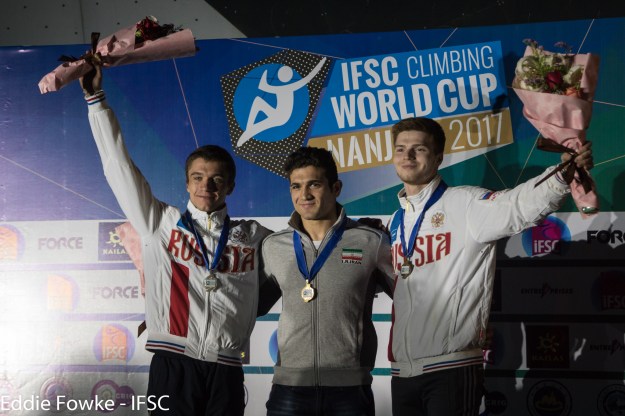
Reza Alipour and Iuliia Kaplina set new speed world records and won gold at IFSC World Cup in Nanjing, China. Shauna Coxsey and Keita Watabe topped the podium in bouldering.

The previous men’s speed world record was set at 5.60 seconds by Danyil Boldyrev at the 2014 IFSC World Championships. Reza Alipourshenazandifar posted a new men’s speed world record of 5.48 seconds in the semi-final race against Bassa Mawem of France, who finished 4th. The Iranian star registered no times above 6 seconds, and completed the historic weekend with a victory in the final against Aleksandr Shikov of Russia. Vladislav Deulin finished in 3rd place.

The IFSC Climbing World Cup is a series of climbing competitions held annually and organized by the International Federation of Sport Climbing (IFSC). The athletes compete in three disciplines: lead, bouldering and speed.

Since 2007 the IFSC has created a standard wall for the world record. The holds and order are always identical, and the difficulty rating is around F6b, which is a level most recreational climbers could complete.

Video: Speed Climbing highlights @IFSC Climbing World Cup Nanjing 2017

Sources: Wikipedia | IFSC Climbing World Cup, Wikipedia | Speed climbing, IFSC | 2017 Nanjing WC Competition Report

Iranian movie ‘Inversion’ wins Best Film Award at MedFilm Festival in Italy

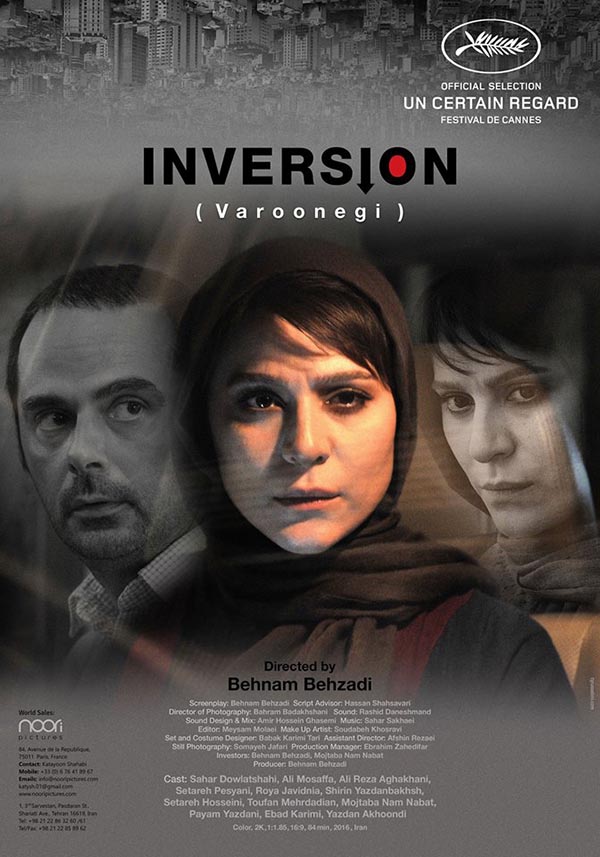
inversion-film-by-behnam-behzadi-varoonegi-poster‘Inversion’, directed and written by Behnam Behzadi, won the Best Film Award at the 21st edition of MedFilm Festival, held in Rome.

Nine films were competing for the “Amore & Psyche” Prize in the official section, ten documentaries for the “Open Eyes” Prize and twenty short films for the “Methexis” Prize. A total of eleven Iranian films, five feature and six short films, were screend in the section “New Iranian Cinema: Beyond Words”.

Inversion is Behnam Behzadi’s fourth directed feature film. It has previously participated in ‘Un Certain Regard’ section at Cannes and received a positive review. The title is a reference to thermal inversion, a meteorological condition causing air pollution. The drama centers around a woman, Niloufar (acted by Sahar Dolatshahi), who decides to take charge and find ways to better express herself in the smog-teeming metropolis of Tehran.

MedFilm Festival is the oldest international film festival in Rome and the first festival in Italy dedicated to the promotion of Mediterranean and European cinema. MedFilm Festival was established in 1995 on the occasion of the 100th anniversary of Cinema and the Barcelona Declaration. Based on the conviction that Diversity is a Value, it encourages relations, cooperation and the development of the film industry between neighbouring countries.

behzradi-behnam-iranian-film-directorABOUT BEHNAM BEHZADI
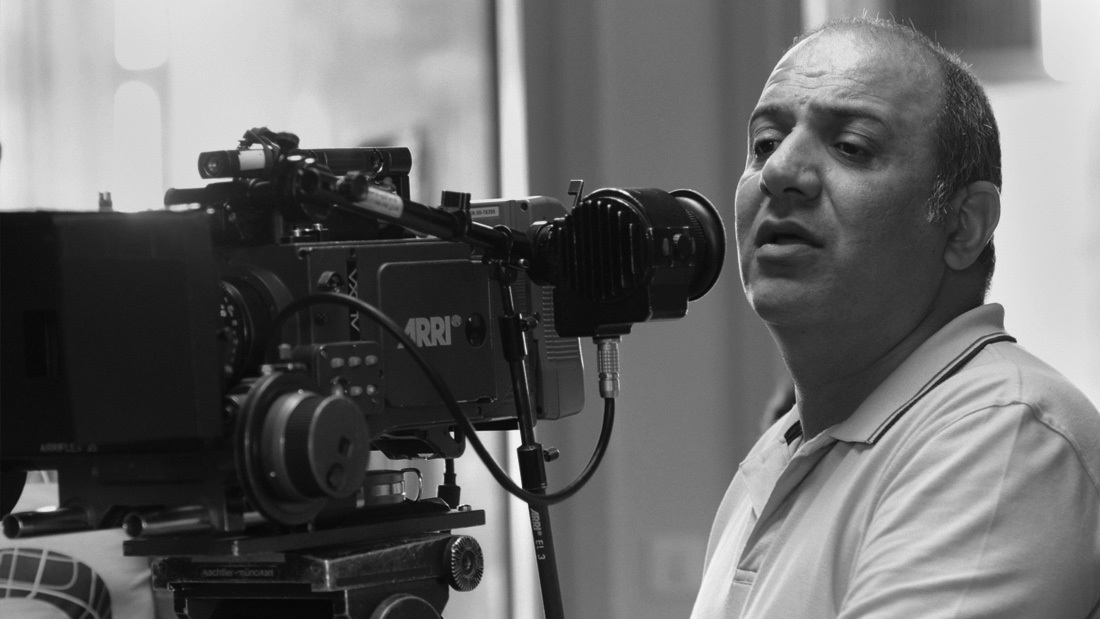
Behzadi was born in 1972 in Boroujen, Iran. He obtained a master’s degree in filmmaking in Tehran and directed over 20 feature films, short works, tv movies and documentaries. He has also written scripts, worked in editing and collaborated with various scriptwriters including Bahman Ghobadi with whom he was co-script writer for the film ‘Nive mang/Half Moon’.

His first short film ‘Retaliation gained an international success, winning the second prize of FIPA 2000 in France. In 2008 his first feature film ‘Before the Burial’ was awarded in several international festivals. In 2013 ‘Bending the rules’ won the special jury prize at the Tokyo Film Festival, the audience award at Nantes and the Special Prize at Mannheim. Behzadi teaches cinema at Tehran University of Art.

Sources: Mehr News Agency, MedFilm Festival | About, MedFilm Festival | Brochure (“Beyond Words”: p. 9-10 ), MedFilm Festival | Inversion, Persian Film Festival in Australia | B. Behzadi

4th Christian-Muslim Summit in Iran: A dialogue against fanaticism and violence

Delegations of Anglican / Episcopal and the Roman Catholic Church, Shia and Sunni Islam,  gathered in Tehran from November 6th to November 9th for the fourth Christian-Muslim Summit of Religious Leaders to reflect and share ideas around the theme of “Respect for human dignity: the foundation for peace and security”.

The summits began in 2007 when former Iranian President Muhammad Khatami spoke at Washington National Cathedral in the US. He called for a gathering of religious and cultural leaders from eastern and western perspectives. The first summit took place at Washington National Cathedral in 2010 and subsequent summits were held in Beirut in 2012 and in Rome in 2014.

At the closing ceremony, the participants issued a ‘Call of Action’ (full text here), in which they underlined the importance that Sacred Texts attach to love, kindness and compassion for fellow human beings, warning against misinterpreting these texts to wrongly justify violence, persecution, intimidation and hate. They called for a “re-reading, renewed comprehension and accurate teaching of our religious beliefs, values and principles, respectful of every human person, of human dignity, and of human rights and responsibilities”, adding that “the willingness to be self-critical can constitute a significant way to counteract fanaticism.”

The statement also condemned desecration of religious sanctities and committed themselves to “promote a culture of non-violence” and to “protect freedom of human thought, belief, and religious practice, by respecting human dignity of all persons.” It also included protection of religious minorities, stating that “the concepts of believer/non-believer, should not affect citizens’ rights and social relationships” and underlined the need for inclusion of women in inter-religious dialogue, promoting the culture of peace, and defending freedom of thought and religion.

The Call to Action was signed on behalf of the four delegations by Ayatollah Professor Sayyed Mostafa Mohaghegh Damad, director of Islamic studies at the Iran Academy of Sciences (Head of Shia delegation); Shaikh Dr Mahdi al-Sumaidaei, the Grand Mufti of Sunni Muslims in Iraq (Head of Sunni delegation); Cardinal John Onaiyekan, Archbishop of the Catholic Archdiocese of Abuja in Nigeria (Head of Catholic Delegation); and Bishop John Chane, senior advisor on inter-religious dialogue to Washington National Cathedral in the US (Head of Anglican/Episcopal Delegation).

Sources: Anglican Communion News Service (ACNS) I, ACNS 2, AsiaNews.it, IQNA, Mehr News Agency, Tehran Times, ISNA

Overview: Iran at the 2016 Rio Paralympics (Photos)

The XV Summer Paralympics were held in Rio de Janeiro, Brazil in 2016. Iran sent a delegation of 111 athletes (23 women and 88 men)  that competed in 12 disciplines (Archery, Athletics, Canoe Sprint, Cycling Road, Football 5-a-side, Football 7-a-side, Judo, Powerlifting, Shooting, Sitting Volleyball, Swimming and Wheelchair Basketball).

Eshrat Kordestani, player of Iran women’s sitting volleyball team, was the delegation’s flag-bearer at the opening ceremony. Iran ranked 15th in Rio 2016, winning a total of 24 medals: 10 gold, 7 silver and 7 bronze. Sareh Javanmardi was the most succesful Iranian athlete in Rio 2016, winning two gold medals.

On September 17th, one day before the XV Summer Paralympics ended, the tragic death of Iranian cyclist Bahman Golbarnezhad shocked everyone. He had sustained severe injuries to his neck in a serious crash that had happened during men’s C4/C5 road race. After receiving emergency treatment at the scene, he suffered a cardiac arrest while being transported to hospital. He later passed away in intensive care.

Flags were lowered to half-mast across the Paralympic Village and a minute of silence was held in memory of Bahman Golbanezhad at the men’s sitting volleyball final, one of the last events of the Games. The Iranian flag was flown at half mast at the final, while the Iranian team dedicated their gold medal to the memory of Golbanezhad. A minute of silence was also held during the closing ceremony of the Rio Paralympic Games as a tribute to Golbanezhad.

Golbarnezhad was born and raised in Abadan, Iran. During the Iran-Iraq war, he relocated to Shiraz. In 1988, he lost his lower left leg when he walked on a land mine. Three years after his injury, he started his professional sporting career first as a wrestler, then he turned to powerlifting, winning twelve gold medals and one silver medal, according to the Iranian Veterans and Disabled Sports Federation. He stopped weightlifting due to a shoulder injury and started cycling in 2002, winning bronze in C4 at the 2010 Asian Para Games. He qualified for 2012 London Paralympics the same year that his wife died due to cancer. Golbarnezhad and his wife had one son.

MEDAL COUNT & NEW RECORDS SET BY IRANIAN ATHLETES
PR: Paralympic Record / WR: World Record / FPR: Final Paralympic Record
16px-Gold_medal_icon.svg Gold – Archery – Men’s Individual Recurve Open: Gholamreza Rahimi
16px-Gold_medal_icon.svg Gold – Archery – Women’s Individual Recurve Open: Zahra Nemati
16px-Gold_medal_icon.svg Gold – Athletics – Men’s Javelin Throw – F57: Mohammad Khalvandi – 46.12m WR
16px-Gold_medal_icon.svg Gold – Powerlifting – Men’s 80kg: Majid Farzin – 240kg PR & WR
16px-Gold_medal_icon.svg Gold – Powerlifting – Men’s +107kg: Siamand Rahman – 310kg PR & WR
16px-Gold_medal_icon.svg Gold – Shooting – Mixed 50m pistol SH1: Sareh Javanmardi – 189.5 FPR
16px-Gold_medal_icon.svg Gold – Shooting – Women’s 10m pistol SH1: Sareh Javanmardi – 193.4 FPR
16px-Gold_medal_icon.svg Gold – Sitting Volleyball – Men’s: Meisam Ali Pour, Davoud Alipourian (c), Mahdi Babadi, Sadegh Bigdeli, Hossein Golestani, Arash Khormali, Majid Lashkarisanami, Mehrzad Mehravan, Morteza Mehrzadselakjani, Abolfazl Oliyaei, Ramezan Salehihajikolaei and Isa Zirahi. Coach: Hadi Rezaei.
16px-Silver_medal_icon.svg Silver
– Archery –
Team recurve open: Zahra Nemati, Ebrahim Ranjbar
16px-Silver_medal_icon.svg Silver – Athletics – Men’s Discus Throw F54/55/56: Alireza Ghaleh Naseri
16px-Silver_medal_icon.svg Silver – Athletics – Men’s Javelin Throw – F13: Sajad Nikparast
16px-Silver_medal_icon.svg Silver
– Athletics –
Men’s Javelin Throw – F57: Abdollah Heydari
16px-Silver_medal_icon.svg Silver – Athletics – Men’s Shot Put – F12: Saman Pakbaz
16px-Silver_medal_icon.svg Silver – Athletics – Men’s Shot Put – F42: Sajjad Mohammadian
16px-Silver_medal_icon.svg Silver
– Athletics –
Men’s Shot Put – F54/55: Hamed Amiri – 11.40m WR (in F54)
16px-Silver_medal_icon.svg Silver – Football –
5-a-side: Defenders (B1) Mohammad Heidari, Mohammadreza Mehninasab, Amir Pourrazavi and Ahmadreza Shahhosseini. Forwards (B1) Rasool Baseri, Sadegh Rahimighasr, Hossein Rajabpour (c) and Behzad Zadaliasghari. Goalkeepers (sighted) Meysam Shojaeiyan and Akbar Shoushtari. Coaches: Javad Felfeli and Mohammadreza Shaddel Basir.
16px-Silver_medal_icon.svg Silver
– Football –
7-a-side: Defenders: Lotfollah Jangjou, Mohammad Kharat, Rastegarimobin Hashem (c) and Hassan Safari. Midfielders: Moslem Akbari, Jasem Bakhshi, Sadegh Hassani Baghi, Mehdi Jamali, Farzad Mehri and Hossein Tiz Bor. Forwards: Rasoul Atashafrouz and Behnam Sohrabi. Goalkeepers: Khazaeipirsarabi Moslem and Babak Safarikourabbasloo. Coach: Amin Allahmani.
Bronze_medal_icon.svg Bronze Archery – Men’s Ind. Recurve Open: Ebrahim Ranjbar – 637 PR (72 arrw. rkg. rd)
Bronze_medal_icon.svg Bronze – Athletics – Men’s 1500m T20: Peyman Nasiri Bazanjani
Bronze_medal_icon.svg Bronze Athletics – Men’s Javelin Throw – F34: Mohsen Kaedi
Bronze_medal_icon.svg Bronze Athletics – Men’s Javelin Throw – F38: Javad Hardani
Bronze_medal_icon.svg Bronze – Athletics – Men’s Shot Put – F53: Asadollah Azimi
Bronze_medal_icon.svg
Bronze – Athletics – Men’s Shot Put – F56/57: Javid Ehsani Shakib
Bronze_medal_icon.svg Bronze – Powerlifting – Men’s -107 kg: Ali Sadeghzadeh

The Iran men’s national sitting volleyball team is the most succesful team worldwide. Since their first appearance at the Summer Paralympics in 1988, they have always reached the finals, winning gold except in 2004 and 2012, when they won silver. Since 1984 they have placed among the best three at the World Championships, winning gold in 1984, 1986, 1990, 1994, 1998 and 2010, silver in 2006 and bronze in 2002 and 2014.

The most succesful Iranians in the history of the Paralympics are athletes Ghader Modabber Raz and Mokhtar Nourafshan, followed by sitting volleyball player Ali Kashfia.

Ghader Modabber Raz competed in F51/F52 Men’s Discus Throw, Javelin Throw and Shot Put in Atlanta 1996 and Sydney 2000. He won a total of five gold and one bronze medals. Mokhtar Nourafshan competed in 1988, 1996, 2000 and 2004 in F53/F54/F55 Men’s Discus Throw, Javelin Throw and Shot Put, winning four gold, two silver and one bronze medals. Ali Kashfia represented Iran in men’s sitting volleyball at the Paralympics from 1988 to 2000, winning four gold medals.

Archer Zahra Nemati and shooter Sareh Javanmardi are Iran’s most succesful women. Nemati won twice gold, once silver and once bronze at the Paralympic Games in London 2012 and Rio 2016, while Javanmardi won two gold and one bronze medals .

Hadi Rezaei won three gold medals as a player at the men’s sitting volleyball event (1988, 1992, 1996) but added three gold (2000, 2008, 2016) and two silver medals (2004, 2012) as a coach.

Related articles:
The other Iran | 2015 IPC Athletics World Championships
The other Iran | Iran in Rio 2016

Sources: Rio 2016 | Iran, Wikipedia | Iran at the 2016 Summer Paralympics, Wikipedia | Bahman Golbarnezhad, BBC | Bahman Golbarnezhad (in Persian), paralympic.org | Biographies, paralympic.org | Statement, The Guardian, news.xinhuanet.com, Young Journalists Club | Closing ceremony, Tasnim News Agency | Opening ceremony, Daily Mail | Opening ceremony, avax.news | Opening ceremony, The Baltimore Sun | Darkroom, paralympic.org | Historical results, Wikipedia | Iran men’s national sitting volleyball team,

The World Youth Orchestra to perform in Iran (Photos)

The World Youth Orchestra arrived in Tehran on Monday and has already had its first joint rehearsal with the Tehran Symphony Orchestra on Wednesday under the leadership of its Italian conductor Damiano Giuranna. Both orchestras will perform together from August 10th to 12th at Vahdat Hall (Roudaki Hall) and will be conducted by Giuranna, Loris Tjeknavorian and Nasir Heidarian.

The World Youth Orchestra, based in Italy, consists of young musicians from 10 different countries, including Armenia, Portugal, Germany and Canada. The guests are also scheduled to hold several master classes and workshops during their stay in Iran.

Seventy-five young musicians from the five continents founded the World Youth Orchestra in Rome in 2001 just four days after the 9/11 attacks on the World Trade Center in New York. The World Youth Orchestra has been nominated Goodwill Ambassador by UNICEF Italia; it has been awarded a Silver Medal and a Silver Plaque for cultural and social merits by the President of the Italian Republic.

Photos: The World Youth Orchestra and the Tehran Symphony Orchestra rehearsing in Iran under Italian conductor Damiano Giuranna

Iran wins gold at World Youth Chess Olympiad (Photos)

The World Youth under-16 Chess Olympiad 2016 was held in Slovakia from July 21st to July 30th and attracted 261 players from 40 countries.

Iran faced Slovakia 2, Austria, Canada, Hungary, Armenia, Russia, Belarus, Serbia and Romania. Parham Maghsoodloo, Alireza Firouzja, FM Aryan Gholami, Arash Tahbaz, WFM Anahita Zahedifar and team captain Khosro Harandi finished first winning gold for Iran for the second consecutive year. Silver went to Russia and bronze to Armenia.

The Iranian team achieved very good performances in recent years at this event: 2016 (1st), 2015 (1st), 2014 (3rd), 2013 (8th), 2012 (2nd) and 2011 (3rd). As of August 2016, Iran has five top 100 junior players (FIDE).

Iranian team results after each round
Round 1 – Iran 4 : 0 Slovakia 2
Round 2 – Austria 2 : 2 Iran
Round 3 – Iran 4 : 0 Canada
Round 4 – Hungary 1 : 3 Iran
Round 5 – Iran 3 : 1 Armenia
Round 6 – Russia 1 : 3 Iran
Round 7 – Belarus 1 : 3 Iran
Round 8 – Iran 3 ½ : ½ Serbia
Round 9 – Iran 2 ½ : 1 ½ Romania

Sources: World Youth Chess Olympiad (WYCO) 2016 (Gallery), WYCO 2016 (Results by country), WYCO 2016 (Best players by board), FIDE (Top 100 junior players – Aug. 2016)

Tehran was turned again into an art gallery (Photos)

Tehran hosted for its second consecutive year “A Gallery as big as a City”, an art event that turns the Iranian capital into a city-wide gallery where large-scale reproductions of hundreds of well-known artworks – both Western and Iranian – hang randomly along the city’s main arteries.

800 copies of artworks by artists across the world have been put on display on 2000 billboards in Tehran. Some of the billboards are dedicated to pictures of objects of cultural heritage, such as reproductions of traditional Persian miniatures, carpets and calligraphy but other also to paintings of Iranian artists like Jafar Rouhbakhsh.

Two-third of the works are from Iran and the rest have been selected from the world’s major artists, some of which may be famous enough to be recognized by nearly half of the population, such as Van Gogh’s The Starry Night or Johannes Vermeer’s Girl with a Pearl Earring.

Other international artists included are Americans Jackson Pollock and Andy Warhol, Austrians Egon Schiele and Joseph Anton Koch, Belgian René Magritte, British Lucian Freud, French Claude Monet, Camille Pissarro, Paul Cézanne and Henri Matisse, Germans Käthe Kollwitz and Caspar David Friedrich and Paul Klee, Italians Leonardo da Vinci (The last supper), Giorgio de Chirico, Japanese Gyokusen (artist name: Gyokkei) and Katsushika Hokusai and Spanish Pablo Picasso.

Related article: The other Iran | Photos compilation: A gallery as big as Tehran

Sources: kojaro.com, IRNA, shahrekhabar.com, Tehran Picture Agency, Payvand Iran News 1, Payvand Iran News 2, Hamshari Photo Agency, Iran Economist, Etemad Online, zibasazi.ir 1, zibasazi.ir 2, zibasazi.ir 3zibasazi.ir 4zibasazi.ir 5zibasazi.ir 6, Tehran Times, sothebys.com


French orchestra touring in Iran

The Orchestre de l’Alliance, under the baton of Pejman Memarzadeh, performed at Vahdat Hall in Tehran earlier this week. Other performances are scheduled in the Iranian cities of Isfahan, Kerman and Shiraz.

In 1995 Pejman Memarzadeh, conductor and cellist of Iranian origin, founded the Association Les Musiciens de la Prée, with the aim of proposing a humanistic and innovative approach to classical music. In 2000 it became the Orchestre de l’Alliance.

All music related posts on the blog: https://theotheriran.com/tag/music/

Sources: Tavoos Online, Wikipedia | Orchestre de l’Alliance, Fars News, Honar Online

Winners at RoboCup IranOpen 2016 (Photos)

The 11th edition of RoboCup IranOpen took place at Tehran International Fairground. Around 2000 university and high school students from different countries competed in three categories including humanoids, flying robots and rescuers, divided into different leagues and difficulty levels. A total of 320 teams, 306 from Iran and 14 teams from abroad (Afghanistan, Canada, China, Germany, the Netherlands, Peru, South Korea, United Kingdom and the USA), competed at this event.

The IranOpen has been organized by the Iranian RoboCup National Committee and Qazvin Azad University. The Committee was officially formed in July 2006 with the objective of promoting robotics and artificial intelligence research.

Winners RoboCup Soccer – 2D Simulation League
1st – Nexus 2D (Ferdowsi University Mashhad, Iran)
2nd – Miracle 2016 (Hefei Normal University, China)
3rd – MT2016 (Hefei University, China)
Technical challenge: Shiraz (Shiraz, Iran)

Winners RoboCup Soccer – 3D Simulation League
1st – UTAustinVilla (University of Texas at Austin, USA)
2nd – Apollo3D (Nanjing University of Posts and Telecommunications, China)
3rd – Kylinsky3D (Hohai University Wentian College, China)

Winners RoboCup Soccer – Small Size Robot League
1st – Immortals (Robotics Engineering Center, University of Tehran)
2nd – MRL (Azad University of Qazvin, Iran)
3rd – ZJUNLict (Zhejiang University, China)
Small Size robot soccer (or F180) focuses on the problem of intelligent multi-agent cooperation and control in a highly dynamic environment with a hybrid centralized/distributed system.

Winners RoboCup Soccer – Humanoid League (Adult, teen and kid size)
Adult: 1st – Baset Adult-Size (Baset Pazhuh Tehran Co, Iran)
Teen: 1st – AUTMan Teen (Amirkabir University, Iran / University of Manitoba, Canada)
Kid Size
1st – Bold Hearts (University of Hertfordshire, United Kingdom)
2nd – Parand Kid-Size (Azad University of Parand, Iran)
3rd – FUmanoids (Freie Universität Berlin, Germany)

Winners RoboCup Soccer – Standard Platform League
1st – Nao Team HTWK (HTWK Leipzig, Germany)
2nd – DAlnamite (TU Berlin / DAI-Labor, Germany)
Innovation challenge: MRL-SPL (Azad University of Qazvin, Iran)
The RoboCup Standard Platform League is a RoboCup robot soccer league, in which all teams compete with identical robots.

Winners RoboCup Rescue – Rescue Agent Simulation League
1st MRL (Azad University of Qazvin, Iran)
2nd S.O.S (Amirkabir University of Technology Tehran, Iran)
3rd Poseidon (Farzanegan High School Tehran, Iran)
Technical challenge: RAS-ROSHD (Roshd High School Tehran, Iran)

Winners RoboCup Rescue – Rescue Robot League
1st – MRL (Azad University of Qazvin, Iran)
2nd – YRA (Azad University of Yazd, Iran)
3rd – VRU (Vali-e-Asr University of Rafsanjan, Iran)
Skill, discovery and mobility challenge: MRL
Flying rescue challenge: YRA

Winners RoboCup@Work
1st – ACE IAUK (Azad University of Kerman, Iran)
2nd – MEC (Shariati Technical College Tehran, Iran)

Winners RoboCup Junior – Soccer Open
1st – Helli Afra (Allameh Helli High School 10, Tehran, Iran)
2nd – AMOS (Salam Zeynoddin High School, Iran)
3rd – Allameh Tabatabaei (Allameh Tabatabaei High School)

Winners IranOpenDeminer – Tele-Operated Deminer Robots
1st – YRA (Azad University of Yazd, Iran)
2nd – Pasargad (Amirkabir University of Technology, Iran)
3rd (joint) – SRC (Azad University of Tabriz, Iran) and Malayer University (Malayer University, Hamedan, Iran)

Winners IranOpenDeminer – Small Size Intelligent Deminer Robots
1st – khayyam Robotic (Azad University of Neyshabur, Iran)
2nd – ROBOSINA (Bu-Ali Sina University, Hamedan, Iran)
3rd – RTL (Azad University of Arak, Iran)

Winners IranOpenUAV
1st (joint) – MRL (Azad University of Qazvin, Iran) and KN2C (K.N.Toosi University Tehran, Iran)
3rd – Cyrus UAV (Azad University of Kermanshah, Iran)

Winners IranOpenROV
1st – MRL (Azad University of Qazvin, Iran)
2nd – anZan Of Persian Gulf (Applied Science University of Ahvaz, Iran)

Related articles: The other Iran | Robocup

Video: Mehr News Agency | RoboCup IranOpen 2016

Sources: 2016 IranOpen; Mehr News Agency (MNA) 1; MNA 2; BORNA News; Fars News; IRNA 1; IRNA 2; ISNA 1; ISNA 2 (in Persian); Jam-e Jam Online 1; Jam-e Jam Online 2; dai-labor.de; Baltimore Sun; Epoch Times (in Persian); Facebook | DAI-Labor

Iranian students win 3rd place at FISU World University Chess Championship (Photos)

The 14th FISU World University Chess Championship (WUCC) was held from April 9th to April 15th, 2016 in Abu Dhabi, UAE.

Eight students represented Iran at the tournament. The women’s chess team consisted of WGM Atousa Pourkashiyan, WGM Mitra Hejazipour, WIM Ghazal Hakimifard and Khalaji Hanieh. GM Pouya Idani, IM Amirreza Pourramezanali, FM Nima Javanbakht and Ali Faghirnavaz formed the men’s team.

In the women’s division all three best placed players attained 6,5 points. WGM Ni Shiqun of China won gold, WIM Ghazal Hakimifard won silver, Iran’s best result at FISU WUCC 2016, and WIM Anna Warakomska of Poland bronze.

GM Hovhannes Gabuzyan of Armenia won the men’s gold medal with 8 points. GM Vladimir Fedoseev of Russia secured silver (7 points) and GM Pavel Ponkratov of Russia got bronze with 6,5 points. Iran’s best player in the men’s division, IM Amirreza Pourramezanali, finished in sixth place attaining 6 points like Serbian IM Marko Nenezic (4th) and GM Samvel Ter-Sahakyan of Armenia (5th).

WIM Alina Bivol placed fourth to complete the three best results for the team award for Russia. Her result combined with those of Fedoseev and Ponkratov garnered the first place team trophy for Russia (19,5 points). The Armenian team of GM Gabuzyan, GM Ter-Sahakyan and WIM Maria Gevorgyan won the runner-up trophy (19 points). The Iranian team of WIM Ghazal Hakimifard, WGM Mitra Hejazipour and IM Amirreza Pourramezanali won third place (18,5 points).

Sources: chess-results.com, FISU | Chess, iusf.ir (in Persian), Borna News

Iran’s Fajr International Festival of Visual Arts: Exhibition

The 8th Fajr International Festival of Visual Arts displayed at Saba Art and Cultural Institute works by over 200 Iranian and foreign artists coming from different countries including Tunisia, Pakistan, Turkey, Italy, Cuba and Kyrgyzstan.

The Niavaran Cultural Center hosted a side-section exhibit of calligraphy and miniature works under the title “Fajr and National Art” and a selection of documentaries focusing on different visual arts including painting, sculpture, miniature, pottery and ceramics was screened at the Saba Institute as well as at the cinematheque of the Tehran Museum of Contemporary Art.

A day dedicated to Mexican art, organized in collaboration with the Mexican Embassy, included thirty five lithographies by José Guadalupe Posada (1852–1913), considered the precursor of Mexican folk art, photos by Tina Modotti (1896-1942) that reflect the struggle of the less privileged of the post-Mexican Revolution period and sculptures by Gabriela Rodríguez, fifteen pieces commemorating the International Year of Light, celebration promoted by Mexico at the United Nations.

Short video by PressTV dedicated to this year’s Fajr International Festival of Visual Arts:

Sources: Mehr News Agency (MNA) 1, MNA 2, IRNA 1, IRNA 2, Honar Online 1, Honar Online 2, Financial Tribune, Tehran Times 1, Tehran Times 2, El Universal (in Spanish)

Iranian documentary wins Amnesty International Film Prize

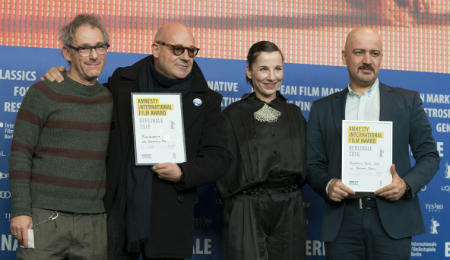
Mehrdad Oskouei’s ‘Starless Dreams’ (Royahaye Dame Sobh) along with ‘Fuocoammare’ (Fire at Sea) by Gianfranco Rosi have won the Amnesty International Film Prize at the 66th Berlin International Film Festival. Rosi’s documentary film about the refugee crisis in the Mediterranean off the Italian island of Lampedusa, won also the Golden Bear prize for Best Film.

Oskouei, one of Iran’s best documentary filmmakers, explores in ‘Starless Dreams’ the anguish and joys of girls in a juvenile correctional facility on the outskirts of Tehran. His small, all-male crew spent 20 days talking to the young women who gave them surprising access to their lives and feelings. The film won in Iran the Best Documentary Director Award at the 34th Fajr Film Festival earlier this year.

The German branch of Amnesty International has awarded the Amnesty International Film Prize for the first time at the Berlinale 2005. The aim of the prize is to draw the attention of audiences and representatives of the film industry to the theme of human rights and encourage filmmakers to tackle this topic. German actress Meret Becker, Swiss film maker Dani Levy and Markus Beeko, Director of Campaigns and Communications for Amnesty International Germany were the members of this independent jury at the Berlinale 2016.

Iranian filmmaker Mehrdad Oskouei (1st R) and Italian director Gianfranco Rosi (2nd L) with Jury members Dani Levy (1st L) and Meret Becker (2nd R) in Berlin - Feb 20, 2016. Photo credits: Henning Schacht / Amnesty International

Iranian filmmaker Mehrdad Oskouei (1st R) and Italian director Gianfranco Rosi (2nd L) with Jury members Dani Levy (1st L) and Meret Becker (2nd R) in Berlin – Feb 20, 2016. Photo credits: Henning Schacht / Amnesty International

About Mehrdad Oskouei
Oskouei, an independent producer, filmmaker, photographer and researcher, was born in Tehran, Iran in 1969. He has a B.A. in film direction from the University of Arts, starting in the theatre in 1981 and the film world in 1988. In 2010, Oskouei received the Prince Claus Award from the Netherlands.

Sources: Tavoos Online, Berlinale, Hollywod Reporter, Reuters, Wikipedia | Starless Dreams, Fajr Film Festival (in Persian)

Winners of the 32nd Tehran Short Film Festival (Photos)

The winners were announced during the closing ceremony of Tehran’s 32nd Short Film Festival held at Andisheh Hall.

The jury members of the International Competition Section were Andrzej Bednarek from Poland, Matthias Flügge from Germany, Seigo Tono from Japan, Gipsy Chang from Hong Kong and Alireza Shoja Noori from Iran.

“A Warm Spell” by Toshimichi Saito from Japan received the Grand Prix of the festival. Best Fiction Film was awarded to “It Will Be Alright” by Patrick Vollrath from Austria. “Songbirds’ Shop” by Anatoliy Lavrenishyn from Ukraine won the Best Animation Award. Best Documentary was awarded to “Touch of Freedom” by Sardar Arshad Khan from Poland.

Jessica Dürwald from Germany received the Best Experimental Award for “Eat My Dream”, “Survival” by Masoud Hatami from Iran won the Special Jury Prize, “Electronic Town” by Tony Mullen from Japan was chosen as the Best Film from Asian Countries. Saeed Nejati from Iran received the Best Film from Islamic Countries Award for “Prohibition” and “Angelus Novus” by Aboozar Amini from Netherlands won the Best Anti-Violence Film Award.

Sources: Tavoos Online, Tehran International Short Film Festival, Fars News, ISNA 1, ISNA 2, Tasnim News, Mehr News

Commemoration of Iranian artist Morteza Momayez with French Graphic Designer Michel Bouvet

In honor of late Iranian graphic designer Morteza Momayez the Iranian Artist’s Forum in Tehran organized a series of events which included a commemoration ceremony, an exhibition of his work and an exhibit and workshop presented by the event’s special guest, French graphic designer Michel Bouvet.

The commemoration ceremony took place in the Ostad Shahnaz Hall at the Iranian House of Artists and it was followed by the opening of an exhibition of Momayez’s work. Michel Bouvet also displayed his work at the Iranian House of Artists and presented a workshop on poster design.

About Morteza Momayez
Morteza Momayez was an Iranian graphic designer, born on August 26, 1935 in Tehran, Iran. He got his bachelor in painting from the School of Fine Arts at University of Tehran in 1965 and his diploma from Ecole National Superier des Art Deco in Paris, France in 1968. He was Editor-in-chief of “Neshan”. Throughout his career, Momayez initiated many cultural institutes, exhibitions and graphic design publications. The renowned pioneer of graphic design in Iran, Momayez received the Art & Culture Award of Excellency from the president of Iran in 2004.

About Michel Bouvet
Michel Bouvet (born 1955 in Tunis) is a French designer and poster artist. He is professor of visual culture at ESAG Penninghen (Paris). Bouvet studied and graduated at École nationale supérieure des Beaux-Arts (ENSB-A). His design influences include Fernand Léger, Raymond Savignac, André François and Roman Cieslewicz. His posters are very often the result of a mixture of techniques (photography, collage, sculpture, painting), which gives them a highly poetic graphic dimension. Bouvet has won many national and international design awards in Poland, Finland, Japan, China and Czech Republic. Since 2002, he designs the corporate identity for the Rencontres d’Arles. He has been the curator of several international graphic design exhibitions.

Sources: Tavoos Online, Wikipedia | Morteza Momayez, Honar Online 1, Honar Online 2, Wikipedia | Michel Bouvet

Mixed exhibition of Iranian and Western art at the Tehran Museum of Contemporary Art (Photos)

The exhibition, entitled ‘Towards the Ineffable: Farideh Lashai’, presents a collection of 130 works including paintings, glassworks, drawings and video arts. It will be on display through February 26, 2016 at Tehran Museum of Contemporary Art.

Italian Germano Celant, Artistic Director of the Prada Foundation in Milan, co-curated the exhibition with the Iranian curator, architect, and filmmaker Faryar Javaherian. It marks the first time a non-Iranian curator of such stature has curated an exhibit at the museum since the revolution.

Javaherian and Celant have created an anthology of works by the Iranian modernist Farideh Lashai (1944-2013), who became one of Iran’s leading artists of the era. The Western works are being presented as context for Lashai’s retrospective. The intercultural exchange was achieved by hanging works by Western artists on gray walls, often across the room from Lashai’s works, which are hung on white walls.

Forty two works by Jackson Pollock, Alberto Giacometti, Mark Rothko, Andy Warhol, Roy Lichtenstein, Francis Bacon, Cy Twombly, Claude Monet, Willem de Kooning, René Magritte, and many others will surround Lashai’s art. Iranian artists are also represented, as works by Manoucher Yektai, Sohrab Sepehri, and Nasser Assar are included.

“I want to force the audience to see the context,” Celant said. “There’s a self-portrait by Farideh, and there’s a self-portrait by Giacometti. We’re trying to say, O.K., the identity of the Iranian art is related to another identity in the world. That’s a dialogue that needs to be established, and that’s my function as a non-Iranian curator.”

In addition, Catherine de Zegher, director of the Museum of Fine Arts Gent in Belgium, and Venetia Porter, the Assistant Keeper in the Department of the Middle East at the British Museum participated at a one-day seminar held at the museum. Art critics and historians Media Farzin, Marjan Tajeddini and the curators also discussed and reviewed the exhibition at the seminar.

In October, the museum signed a tentative agreement with the German government to send 60 artworks from Tehran – 30 Western and 30 Iranian – to Berlin for a three-month show next fall, which would mark the museum’s first exhibition overseas.

About Farideh Lashai
https://upload.wikimedia.org/wikipedia/en/a/a7/Farideh_Lashai.jpgBorn 1944 in Rasht, Farideh Lashai was among the most successful Iranian artists, writers and translators, best known for her abstract paintings. She studied art at the Academy of Decorative Arts in Vienna, Austria, and held over 100 solo and group exhibitions in Iran and many other countries, such as Italy, Germany, the US, Switzerland, Britain and France. After a long battle with cancer she passed away in the Iranian capital, Tehran, in 2013. She was 68 years old.

Lashai particularly won fame for her lyrical abstract paintings and multimedia installations that combined video projections and canvas works. Her works were mostly inspired by her personal experiences and modern Iranian art forms.

Sources: Tehran Times, Vanity Fair, IRNA, Tavoos Online, Honar Online 1, Honar Online 2, Honar Online 3, ISNA, The Telegraph

Iranian winners at ‘Graines d’artistes du monde entier 2015: Face or Mask’, a children and young adults competition in France

Eighteen Iranian children have received awards or honorable mentions for their art work submitted to the international visual art competition held by the Centre pour L’UNESCO Louis Francois based in Troyes, France.

Every year the organization launches an international visual arts competition for children and young adults. This year, the Centre pour L’UNESCO Louis Francois received 5000 submissions from 53 countries.

Bahar Raznahan (1st place), Hediyeh Hasri (7th place), Sara Esmaeilinia (8th place) in the 10-13 age group and Pantea Nemati (12th place) in the 14-17 age group received awards.

Shakiba Bourki, Pouyan Pireh, Nazafarin Akia, Mardin Fathi, Sajjad Mohseni, Rastin Tajik, Parham and Pouya Javidan, Samin Abbasi, Zahra Hemmati, Amir Abbas Parast, Aynaz Shadmanesh, Soheil Kargar, Kiarash Samimi, Fatemeh Abiri and Mohammad-Mehdi Khoshhal received honorable mentions. The drawings were collected and submitted by the Iranian Center for the Intellectual Development of Children and Young Adults.

Sources: Facebook | Centre pour l’UNESCO Louis François, Tavoos Online

Asia Pacific Screen Awards (APSA) honors Iranian actress Fatemeh Motamed-Arya

The 2015 edition of Asia Pacific Screen Awards (APSA) has awarded Iranian actress Fatemeh Motamed-Arya during a ceremony held in Brisbane, Australia. She received the event’s Special Mention for the Best Performance by an Actress for her portrayal of a nurse in ‘Avalanche,’ directed by Iranian filmmaker Morteza Farshbaf.

Kirin Kiki won the award for Best Performance by an Actress for her role in “An” from Japan while the award for Best Performance by an Actor went to Jung Jaeyoung for his role in “Right Now, Wrong Then” from South Korea.

Apichatpong Weerasethakul from Thailand received the best film award for “Cemetery of Splendor” and Alexey German Jr. from Russia won the best director award for “Under Electric Clouds”. The award for best cinematographer went to Mark Lee Ping-bing from Taiwan for his collaboration in director Hou Hsiaohsien’s “The Assassin”.

The 2015 APSA International Jury was presided by South Korean filmmaker Kim Dong-Ho. He was joined by Mostofa Sarwar Farooki (Bangladesh), Zhang Xianmin (China), U-Wei Bin HajiSaari (Malaysia), Alexei Popogrebsky (Russia) and Negar Javaherian (Iran). Javaherian won the UNESCO Award at the APSA in 2013 for her performance in Maziar Miri’s “Painting Pool”.

Established in 2007, APSA is an international cultural initiative to honor and promote the films, actors, directors, and cultures of the Asia-Pacific region, under the auspices of UNESCO and FIAPF – International Federation of Film Producers Associations.

About Fatemeh Motamed-Arya
Born in 1961, Fatemeh Motamed-Aria is one of the most significant Iranian actresses, who has won numerous national and international awards, including the Best Actress Prize of the 2011 Montreal Film Festival in Canada and the Prix de Henri-Langlois award of the 2012 Vincennes International Festival in France. ‘Once Forever’ (1993), ‘Blue-Veiled’ (1995), ‘Gilaneh’ (2004) and ‘Here Without Me’ (2011) are among the films she has performed in so far.

Sources: Tehran Times, Payvandasiapacificscreenacademy.com, Instagram | apscreenawards, taghato.net

International sculpture symposium in Tehran, Iran (Photos)

The 7th International Sculpture Symposium of Tehran 2015, from September 23rd to October 16th, included a stone workshop, an iron workshop and an exhibition section and was subdivided into a main and a student competition category.

The jury of the symposium, with two Iranian and a foreign member, had selected works by 14 foreign artists from Russia, Belarus, Albania, Portugal, Italy, Serbia, Taiwan, South Korea, Germany, Peru, Bulgaria, Greece and Romania to participate in the event.

Sculptors from South Korea, Taiwan and Peru took home the first prizes. Su-Dong Cho from South Korea and Wu Ming-Sheng from Taiwan shared the first prize in the stone category. The second prize in the stone category was also shared by Mehdi Seifi from Iran and Stefano Grattarola from Italy. In the steel category Peruvian sculptor Pool Guillen won the top prize and Amir Vafai from Iran won the second prize.

Sculptors, experts and artists gathered at Tehran’s Milad Tower to examine the art of sculpting in four panels. During the first part of the conference the artists, including Saeed Rafiee-Fard, Javad Hassanjani and Kianoosh Motaqedi, presented papers. The second part analyzed the works presented at the symposium.

To see pictures of the artists click here: IRNA | Artists at the 7th Sculpture Symposium

To see pictures of the award ceremony click here:
1. Mehr News Agency (photos)
2. Honar Online (photos)

Sources: Iran DailyBorna News, IRNA, Tasnim News 1, Tasnim News 2, Mehr News Agency (MNA) 1, MNA 2, MNA 3Honar Online, Tehran Press Agency (TPA) 1TPA 2, Tavoos Online,

Iran via Documentaries: Docunight is hosting Iran documentaries for audiences in the US and Canada

On the last Wednesday of every month, Docunight screens a documentary about, around, or made in Iran or by Iranians in various cities throughout the US and Canada. ‘The Glass House’ by Hamid Rahmanian (2008, 92min) will be  on October 28th.

Docunight is a monthly program, focused on screening Iran-related documentaries that began in San Francisco and has grown to screen films in other cities including New York, Los Angeles, Washington, San Diego, Minneapolis, Washington, Vancouver and Toronto.

Organized by efforts of Ahmad Kiarostami in collaboration with NIAC in the US and ECUPC in Vancouver, the program aims to create an opportunity for cultural exchange and to provide proper grounds for foreign audiences to better understand the Iranian society.

For information on upcoming screenings please visit:
www.docunight.com or Facebook | Docunight

These are the documentaries that have been shown so far:
– Trucker and the Fox (2014, 78min, Dir: Arash Lahooti)
– Abbas Kiarostami: A Report (2013, 82min, Dir: Bahman Maghsoudlou)
– Iranien (Iranian) (2014, 105min, Dir: Mehran Tamadon)
– Going Up the Stairs (2011, 52min, Dir: Rokhsareh Ghaemmaghami)
Behjat Sadr (2006, 46min, Produced by Marjaneh Moghimi, Dir: Mitra Farahani)
Monir (2014, 54min, Produced by: Leyla Fakhr, Dir: Bahman Kiarostami)
– Caged (2013, 52min, Dir: Tala Hadavi)
Street Sultans (2011, 38min, Dir: Paliz Khoshdel, Zeinab Tabrizy)
– Before The Revolution (2013, 60min, Dir: Dan Shadur & Barak Heymann)
– Molf-e Gand (2009, 53min, Dir: Mahmoud Rahmani)
– I Saw Shoush (2002, 8min, Dir: Bahman Kiarostami)
Infidels (2004, 40min, Dir: Bahman Kiarostami)
Pilgrimage (2005, 52min, Marjaneh Moghimi for Butimar Production, Dir: Bahman Kiarostami)
The Bathhouse That Wanted To Keep On Being A Bathhouse (2010, 52min, Dir: Mehdi Shabani)
Park Mark (2010, 42min, Dir: Baktash Abtin)
“Mory” Wants A Wife (2009, 42min, Dir: Baktash Abtin)
Be Like Others (2008, 74min, Dir: Tanaz Eshaghian)
The Law In These Parts (2011, 90min, Dir: Ra’anan Alexandrowicz)
My Name Is Negahdar Jamali And I Make Westerns (2012, 65min, Directed by Kamran Heidari)
Lady of the Roses (2008, 52min, by Mojtaba Mirtahmasb)
Back Vocal (2004, 40min, by Mojtaba Mirtahmasb)
Kahrizak, Four Views (2012, 86min, Dir: Rakhshan Bani Etemad, Mohsen Amiryoussefi, Bahman Kiarostami, Pirooz Kalantari)
Bassidji (2009, 114mins, Directed by Mehran Tamadon)
Red Lines and Deadlines: Life behind the scenes of the Iranian newspaper Shargh (2004, 5-53min, Filmed, produced and directed by Taghi Amirani)
Statues of Tehran (2008, 60min, Dir: Bahman Kiarostami)

Sources: docunight.com, Tavoos Online

Winners of the International Theater Festival for Children and Youth 2015 in Hamedan, Iran (Photos)

The winners of the 22nd International Theater Festival for Children and Youth were introduced during the closing ceremony held on Tuesday, October 6th, in Hamedan.

Veteran Iranian director, Marzieh Boroumand, was honored for her lifetime achievements. Boroumand is most famous for her hits “Grandmother’s Home” and “School of Mice”, two popular puppet series from the 1980s.

About fifty theater troupes from nine different countries attended early October to the 22nd International Theater Festival for Children and Youth.

Related article: International Theater Festival for Children and Youth in Hamedan, Iran (Photos)

Sources: Tavoos Online, Mehr News Agency, ISNA, IRNA

International Theater Festival for Children and Youth in Hamedan, Iran (Photos)

Hamedan hosted early October the 22nd edition of the International Theater Festival for Children and Youth. About fifty theater troupes from nine countries, among others Italy, Germany, Finland, Russia and England, attended the festival and competed in different sections (children, youth and international). Besides their performances the troupes also arranged several workshops.

Sources: Tavoos Online, IRNA, ISNA, Mehr News 1, Mehr News 2, Mehr News 3, Honar Online

‘Gate of Words’ by German artist Philipp Geist is lighting up the Azadi Tower in Tehran, Iran (Photos)

A performance consisting of projections of light titled ‘Gate of Words’ by German artist Philipp Geist is taking place at Tehran’s landmark Azadi Tower until October 5th.

The installation artistically visualizes the topics of freedom, peace, space and time in different languages. During the performance Azadi Tower is to become a three-dimensional light sculpture that can be crossed by visitors.

‘I tried to illustrate words one by one to make the reader pay more attention to them. Sometimes, words are legible and sometimes not. Using this method, I make great attempts to make each and every reader have his/her own interpretation of the subject,’ said the German artist.

Facts about Azadi Tower
– It is one of the most familiar landmarks of Tehran.
– The builduing includes a cultural centre with a library, a museum and several art galleries.
– The entrance of the tower is directly underneath the main vault and leads into the Azadi Museum on the basement floor.
– The main display is occupied by a copy of the Cyrus Cylinder (the original is in the British Museum).
– The monument acts as a grandiose gateway to the Iranian capital, and is surrounded by a large plaza (approx. 50,000 m²).
– Built in 1971 in commemoration of the 2,500th anniversary of the Persian Empire, this “Gateway into Iran” was named the Shahyad Tower, meaning “Kings’ Memorial”, but was dubbed Azadi (Freedom) after 1979. It is 50 meters (164 ft) tall and completely clad in cut marble.

Sources: Mehr News Agency, ISNA, IRNA, Borna News, Instagram @videogeist, Tavoos Online, Wikipedia | Azadi Tower

Morteza Jafari: First Iranian gold medal at the FIS Grass Skiing World Cup competition held in Dizin, Iran (Photos)

Iranian skier Seyyed Morteza Jafari made history at the Grass Skiing World Cup in Dizin, collecting the Iran’s first gold medal in the sport. After winning a silver medal in Super G, he finished in the first place in the giant slalom competitions with a time of 51:09 seconds, followed by Italian Eduardo Frau with 51:78 and Austrian Michael Stocker with 51:98. Slovakian Barbara Mikova won gold medals in Ladies’ Giant Slalom and Ladies’ Super G.

The tournament, that brought together skiers from Austria, the Czech Republic, Italy, Slovakia, Switzerland and Iran, was organized in Dizin. It is the third time, that this ski resort located in the Alborz mountain range and near the capital Tehran, hosts a Grass Skiing World Cup event.

The World Cup season 2015 got underway on July with giant slalom and slalom competitions in Predklasteri (Czech Republic) before moving to Ravascletto (Italy) for slalom events on 17th and 18th July. The tour stopped in Dizin (Iran) on 6th and 7th August, and Marbachegg (Switzerland) on 15th and 16th August, both for giant slalom and super-G events. The World Cup Finals will be held from 21st-23rd September in Kaprun (Austria).

The two major highlights of the season will be the Junior World Championships in Stitna (Czech Republic) from 28th July-2nd August and the World Championships in Tambre (Italy) from 1st-6th September.

Full Dizin Grass Skiing WC results: International Ski Federation (FIS) | Event results

Sources: FIS | News, Tehran Times | News, Team Iran | Skiing News, Press TV | News, Tasnim News | Photos (01-06), ISNA | Photos (07-19), IRNA | Photos (20-46), Fars News Agency | Photos (47-58), BORNA News | Photos (59-76)

Iranian ‘Mehr Theatre Group’ is in Europe performing its new play ‘Hearing’

The Mehr Theatre Group, an Iranian troupe led by director/writer Amir-Reza Kuhestani, will be performing the play Hearing in Switzerland, the Netherlands, Germany and France. The show centers on events happening in a girls’ dormitory.

Hearing premiered at Tehran’s City Theater in July before going on stage in Zurich, Switzerland at the Zürcher Theater Spektakel. They are attending the Noorderzon Festival in Groningen, the Netherlands with performances on August 25th and August 26th.

The troupe will next return to Geneva, Switzerland to perform Hearing on August 29th and August 31st at the La Bâtie, a festival of theater performances and film screenings. In September they will be heading to Frankfurt, Germany and Marseille, France. Full schedule: Mehr Theatre Group | Tour dates

About Hearing (Synopsis)
The girls’ dormitory was always like an unattainable castle. […] After the entrance door, a female world begun in which the entree of any man was prohibited. […] Now, presume that in a situation like this, one day, a girl reported that she had heard a man in one of the rooms. This would be the starting point of the performance.
More about the show: Mehr Theatre Group | Hearing

About Mehr Theatre Group
Mehr Theatre Group was created in 1996. The aim was to create a new type of theater — far from the traditional Iranian theater — based on new stage direction and a new acting style influenced by film. At first, Amir Reza Koohestani joined the Mehr Theatre Group to participate in their acting workshop, but after 6 months of the workshop they decided to produce theater productions based on their training. Since Amir was the only one with writing background he dedicated his time to write for the theater. […] The Mehr Theatre Group is today one of the most well known Iranian theater companies in Iran and has gained international acclaim with successful performances across the world. More about the troupe: Mehr Theatre Group

Below, a trailer of Timeloss, their last work before Hearing, also presented at the Under The Radar Film Festival in New York, USA. Other trailers: Mehr Theatre Group | Videos

About Amir Reza Koohestani
Amir Reza Koohestani is one of Iran’s most successful and prolific playwright-directors. With his third play, Dance on Glasses (2001), in tour for four years, Amir Reza Koohestani gained international notoriety and found the support of several European theatrical artistic directors and festivals. In February 2012, the movie Modest Reception, which script was co-written by Koohestani and Mani Haghighi – actor and film director – wins the Netpac Award at the Berlin International Film Festival 2012. He is the first director to win two consecutive awards for the “Best theatre production of the year” in Iran (Ivanov, 2011 and The Fourth Wall, 2012). More about him: Mehr Theatre Group | Amir Reza Koohestani

Related articles: The other Iran | Theater

Sources: Tehran Times | Art Desk, Mehr Theatre Group

China Philarmonic Orchestra performed together with the Tehran Symphony Orchestra in Iran (Photos)

Iranian-Austrian conductor Alexander Rahbari conducted the Teheran Symphony Orchestra as it played Scheherazade by Rimski-Korsakov and Yu Long conducted the China Philharmonic playing the New World Symphony by Dvorak.

In preparation for the joint concert, Rahbari was in Beijing rehearsing with the China Philharmonic. “It’s a very nice orchestra,” he says. “I hadn’t been to Beijing before, but I am familiar with Chinese musicians and the way Chinese think. Over the past 40 years I’ve conducted a lot of orchestras with Chinese musicians.

“It took us just an hour and 40 minutes to finish rehearsals on the first day. This is a well disciplined orchestra. Good orchestras have similar qualities. When they get down to work, they’re not Chinese or Iranian or German; they’re all musicians.

Rahbari’s positive feelings about the orchestra seem to have been reciprocal. Zhao Yunpeng, the first cello, says: “He’s charismatic and he’s got very sharp ear. He seems to be able to pinpoint problems very quickly. […] We knew little about him before but the rehearsals have been terrific.”

The China Philharmonic Orchestra’s two-night appearance in Teheran is the fourth stop on a 14-day tour taking in five countries (Kyrgyzstan, Tajikistan, Kazakhstan, Iran and  Greece) on the Silk Road.

About Alexander Rahbari and the Tehran Symphony Orchestra
Rahbari first conducted the Teheran Symphony Orchestra about 40 years ago, before the Islamic revolution, when the orchestra was in its heyday and hosted the likes of the violinist Yehudi Menuhin and the choreographer Maurice Bejart.

Rahbari left Iran in 1976 and did not return for another 30 years. In 2005 he was invited to rebuild the Teheran Symphony Orchestra but turned down the offer on political grounds. But eight years later, when Hassan Rouhani was elected Iran’s president, he promised to revive the 80-year-old orchestra and invited Rahbari back.

Sources: China Daily | Musical diplomacy’s perfect harmony, Honar Online | Photos 1, Mehr News Agency | Photos 1, Mehr News Agency | Photos 2, Honar Online | Photos 2, ISNA | Photos

Taha Zaker: Iranian artist wins Graphis gold award

“Contemporary Musicians”, the poster series by Iranian graphic designer Taha Zaker received the gold award of the Graphis Poster Annual 2016. The collection including seven posters by Zaker has been produced in Tehran Studio, and the winners were announced by the jury late July.

Graphis is a Zurich-based international journal of visual communication, the first edition of which was published in 1944. Graphis is committed to presenting and promoting the work of exceptional talent in graphic design, advertising, photography and art/illustration.

About Taha Zaker
Born in 1987, Zaker is a graduate of graphic design. He is the art director and graphic designer at Tehran Studio. He has also produced several documentaries and experimental films. He has also designed the poster of the 33rd Fajr International Film Festival and several other movies such aa “I Am Not Angry”, “Rainy Day”, and “Parviz”.

Sources: Tehran Times, Mehr News, Graphis.com

Iran puts on remarkable show at RoboCup 2015 in China

The 19th RoboCup Tournament took place from July 19th to July 23rd, 2015 in Hefei City, East China with more than 2000 participants from 47 countries. The Iranian teams achieved three first places, three second places and two third places along with top spots at technical challenges and other awards.

Many Iranian High Schools participated at the event. At the 2D Simulation RoboCup Soccer Competition, Phonix from Atomic Energy High School was awarded Best New Team, finishing 10th. At the same competition HERMES from Allameh Helli Highschool was 5th and Genius2015 from Ghazal High School, Shiraz was 11th.

Detailed results for top Iranian teams

1) RoboCup Rescue Competition
Rescue Simulation: 1st S.O.S (Amirkabir University of Technology, Iran), 2nd MRL (Mechatronic Research Lab, Islamic Azad University of Qazvin, Iran), 3rd SEU_Jolly (China)

Rescue Robot: 1st MRL (Iran), 2nd iRAP_Junior (Thailand), 3rd YRA (Islamic Azad University of Yazd, Iran) // Innovative User Interface Award: Hector Darmstadt (Germany) and MRL (Iran).

2) RoboCup Soccer Competition
Humanoid League – Adult Size: 1st THORwIn (USA), 2nd Baset Adult-Size (Baset Pazhuh Tehran Cooperation, Iran), 3rd HuroEvolution AD (Taiwan) // Technical challenges: 1st Baset Adult-Size (Iran), 2nd HuroEvolution AD (Taiwan) and CIT Brains Adult (Japan), 3rd THORwIn (USA)

Humanoid League – Teen Size: 1st Team Parand (Parand Islamic Azad University, Tehran, Iran), 2nd HuroEvolution TN (Taiwan), 3rd AUT-UofM (Amirkabir University of Technology – University of Manitoba, Iran – Canada) // Technical challenges: 1st HuroEvolution TN (Taiwan), 2nd place shared between WF Wolves & Taura Bots Teen (Germany & Brazil) and AUT-UofM (Iran & Canada)

Small Size: 1st CMDragons, Carnegie Mellon University (USA), 2nd MRL, Qazvin Islamic Azad University (Iran), 3rd ZJUNlict, Zhejiang University (China) // Technical challenges: 1st ER-Force (Germany), 2nd ZJUNlict (China), 3rd MRL (Iran)

Middle Size: 1st Water (China), 2nd TechUnited Eindhoven (Netherlands), 3rd ARES (China) // Technical challenges: 1st MRL (Iran), 2nd NuBot (China), 3rd Tech United Eindhoven (Netherlands)

2D Simulation: 1st WrightEagle, University of Science and Technology of China (China), 2nd HELIOS2015, Fukuoka University, Osaka Prefecture University, (Japan), 3rd Gliders2015, University of Sydney and CSIRO (Australia) // Best New Team: Phonix (Atomic Energy High School, Iran).

About RoboCup
RoboCup is an annual international robotics competition aiming to promote robotics and artificial intelligence research, by offering a publicly appealing, but formidable challenge. The name RoboCup is a contraction of the competition’s full name, “Robot Soccer World Cup”, but there are many other stages of the competition such as “RoboCupRescue”, “RoboCup@Home” and “RoboCupJunior”. The official goal of the project is “By the middle of the 21st century, a team of fully autonomous humanoid robot soccer players shall win a soccer game, complying with the official rules of FIFA, against the winner of the most recent World Cup.”

Other related articles: The other Iran | RoboCup

Sources: RoboCup 2015 | Results, Mehr News Agency | News 1, Wikipedia | RoboCup, Mehr News Agency | Photos, RoboCup Humanoid League, Mehr News Agency | News 2

Italian festival ‘Il Cinema Ritrovato’ screening movies from Iranian New Wave cinema

Il Cinema Ritrovato, an Italian festival dedicated to screening newly restored classics running in Bologna until July 4, is showing four Iranian films from the Iranian New Wave cinema. The program is curated by Ehsan Khoshbakht in collaboration with the National Film Archive of Iran.

The black comedy “Night of the Hunchback” (1965) directed by Farrokh Ghaffari, set over the course of one night against a backdrop of uptown Tehran partying to Ray Charles, focuses on the efforts of a group of stage actors, the father of a bride, and a hairdresser and his assistant (played by Ghaffari himself) to rid themselves of an unwelcome corpse.

The satirical documentary “The Night It Rained or The Epic of the Gorgan Village Boy” (1967) directed by Kamran Shirdel, offers a crash course in 1960s Iran. A newspaper story of a heroic village boy who prevented a train disaster appears and spreads quickly. The incident, reported on and challenged by local officials and journalists, is soon doubted and leads ultimately to confusion, with nobody knowing exactly who has saved whom.

“The Cow” (1969) by Dariush Mehrjuii, which is considered as the milestone of Iranian new wave cinema, tells the story of a poor villager whose only source of joy and livelihood is his cow, which provides milk for the village. One night the cow is mysteriously killed and that’s when the madness, or rather transformation, begins.

“A Simple Event” (1973) by Sohrab Shahid Saless depicts a few days in the life of a young boy living by the Caspian Sea. At school he falls behind his classmates and is almost expelled. He helps his father to fish illegally, and at home watches as his mother’s health deteriorates.

About Iranian New Wave
Iranian New Wave cinema came about as a reaction to the popular cinema of the time which did not reflect the lives of regular Iranians. It began in 1969 and then ended with the beginning of the Iranian revolution in 1979. The films produced were original, artistic and political. The House Is Black by Forough Farrokhzad (1963) is considered to be a precursor to the New Wave cinema. Other films such as Farrokh Ghaffari’s “The Night Of The Hunchback” (1964), Abrahim Golestan’s, “Mud-Brick And Mirror” (1965), and Ferydoon Rahnema’s “Siavush in Persepolis” are all considered to be precursors as well. The first film considered to be part of this movement is Darius Mehrjui’s “The Cow” (1969). Other films considered to be part of this movement are Naser Taqvai’s “Peace in the Presence of Others” (1969/1972), which was banned and then heavily censored upon its release, and Sohrab Shahid Saless’ “A Simple Event” (1973) and “Still Life” (1974).

Sources: Tehran Times | News, Il Cinema Ritrovato, Wikipedia | Iranian New Wave

John Speraw, U.S. men’s national volleyball team head coach: “Iranians are wonderful people”

“My first impression was that everyone here has been incredibly hospitable. Everyone has been very nice. They have gone out of their way to make sure that we had really nice experience here. I think we have enjoyed it tremendously.”

“We had the opportunity to get out into the city one day. We went to the [Milad Tower] and learning a little more about Tehran, and I think that is good for us. We went to a nice lunch on the [Darakeh] hills. I think we wanted to do those things because I think we are all aware that the portrait of the relationship between Iran and the United States is inaccurate in the media. Probably on both sides, my guess.”

“What I know and have known from spending time with Iran and the United States both last year and this year is that the relationship between the people is not reflective of the relationship between our governments and that the Iranian people are wonderful people and have treated us kindly.”

“I think we have shown the same because America is a wonderful country with wonderful people too. Yes, it a great place, so the message we would bring back is this: it was a great trip and we look forward to coming here again. And I think we have much better understanding of what the environment is both inside the arena and outside.”

Iran coach Slobodan Kovac added: “I want to say something about this. We want to return this hospitality (Mr. Speraw said about); last year we stayed in the USA for more than fifteen days. Everything was perfect. They gave us the maximum things to prepare for world championship.”

Read all posts on this blog related to USA-Iran here: https://theotheriran.com/category/usa/

IRAN - USA -- USA & Iran national coaches at the press conference before the match

Speraw and Kovac in press conference before the match on June 19 (Photo credit: FIVB)

About John Speraw and Slobodan Kovač
John Speraw is an American volleyball coach. He is the head coach of the United States men’s volleyball team and UCLA. He was the former coach of UC Irvine volleyball program where he led the team to three national titles in six years. Speraw graduated from UCLA in 1995 with a B.S. degree in micro-biology and molecular genetics.

Slobodan Kovač is a Serbian former volleyball player and current coach. He is coaching Iran men’s national volleyball team until the 2016 Olympic Games in Rio de Janeiro. Previously competing for Yugoslavia, he won a bronze medal at the 1996 Olympics in Atlanta and won his first gold medal with the Yugoslav team at Sydney at the 2000 Summer Olympics.

Source: FIVB | World League 2015 | News, Wikipedia | John Speraw, Wikipedia | Slobodan Kovač, TPA | US national volleyball team visited Milad Tower, Tasnim News | Photos

Iranian actress’ Motamed-Arya portrait displayed at UN exhibit in New York (Photos)

A portrait of the acclaimed Iranian actress Fatemeh Motamed-Arya is displayed besides 15 international figures at a multimedia exhibition titled ‘The Transformative Power of Art’ at the UN Exhibits in New York. The exhibition features sculptures and large fresco portraits of artists who have stood up for human rights.

Motamed-Arya, 54, is involved in humanitarian activities and helps raise funds for different charities. Her latest gesture is putting up her Crystal Simorgh award, presented to her for the role of best actress in ‘Gilaneh’ in 2005, on sale to support people deprived of a home in Iran. She has been nominated nine times for the best actress award at the Fajr International Film Festival and won the Crystal Simorgh four times. She had a role in Rakhshan Bani-Etemad’ celebrated film ‘The Tales’ and played the lead character in ‘Nabaat’, Azerbaijan’s nominee for the Best Foreign Language Film in the 2014 Academy Awards.

The objective of the exhibition – curated by painter and sculptor Fabrizio Ruggiero – is to demonstrate that art creates bridges where politics divide. It takes place under the United Nations “2015: Time for Global Action” campaign, primarily destined to raise awareness about climate change and our fragile ecosystems.

The sculptures are made of many natural elements and the 16 accompanying portraits represent people from all continents who, during their lifetime, contributed to the common good of humanity in one way or another and have transformed the way we think. The men and women who are represented never lost sight of the most vulnerable.

They are: Pierre-Claver Akendengué (Gabon), Maya Angelou (USA), Joan Baez (USA), Audrey Hepburn (UK), Vassily Kandinsky (Russia), Umm Kulthum (Egypt), Gong Li (China), Miriam Makeba (South Africa), Edgar Morin (France), Fatemeh Motamed-Arya (Iran), Okot p’Bitek (Uganda), Satyajit Ray (India), Sebastião Salgado (Brazil), Wole Soyinka (Nigeria), Ngugi Wa Thiong’o (Kenya), and Malala Yousafzai (Pakistan).

Sources: IRNA | News, United Nations | News

The Great Game: Iran’s pavillion at the Venice Biennale

In a 2000 square meter old storage for marine engines are works by Iranian Farhad Ahrarnia, but also Iraqis Adel Abidin and Wafaa Bilal, and the Indians Hema Upadhyay and Riyas Komu on display. These are some of the forty-nine artists invited to interpret The Great Game, the exhibition project of the Iran Pavilion, curated by Marco Meneguzzo and Mazdak Faiznia for the 56th Venice Biennale.

“The Great Game” is followed by the Iranian Highlights exhibit with works by Samira Alikhanzaradeh, Mahmoud Bakhshi Moakhar, Jamshid Bayrami and Mohammed Ehsai.


The Great Game is an expression used to indicate the strategic rivalry and conflict between the British Empire and the Russian Empire for supremacy in Central Asia. The path evoking this expression provides a look at authors from India to Iran and Azerbaijan, testifying to the existence of a cultural flow and creating a shared, universal language.

The 56th Venice Biennale “All the World’s Futures”, curated by Okwui Enwezor, runs from May 9th to November 22nd, 2015.

Artists in Iran’s pavilion
Iranian Highlights
Samira Alikhanzaradeh, Mahmoud Bakhshi Moakhar, Jamshid Bayrami, Mohammed Ehsai

The Great Game
Lida Abdul, Bani Abidi, Adel Abidin, Amin Agheai, Ghodratollah Agheli, Shahriar Ahmadi, Parastou Ahovan, Farhad Ahrarnia, Rashad Alakbarov, Furat al Jamil, Nazgol Ansarinia, Reza Aramesh, Alireza Astaneh, Sonia Balassanian, Mahmoud Bakhshi Moakhar, Wafaa Bilal, Mehdi Farhadian, Shadi Ghadirian, Shilpa Gupta, Ghasem Hajizadeh, Shamsia Hassani, Sahand Hesamiyan, Sitara Ibrahimova, Pouran Jinchi, Amar Kanwar, Babak Kazemi, Ryas Komu, Farideh Lashai, Farokh Mahdavi, Ahmad Morshedloo, Mehrdad Mohebali, Huma Mulji, Azad Nanakeli, Jamal Penjweny, Imran Qureshi, Sara Rahbar, Rashid Rana, Atefeh Samaei, T.V. Santhosh, Walid Siti, Monir Shahroudy Farmanfarmaian, Mohsen Taasha Wahidi, Mitra Tabrizian, Parviz Tanavoli, Newsha Tavakolian, Sadegh Tirafkan, Hema Upadhyay, Saira Wasim

Related information:
The Guardian | Iran goes back to the future at Venice Biennale
Sothebys | Highlights From The Venice Biennale’s Iran Pavilion

Sources: La Biennale di Venezia | National participations, Artribune | Il padiglione dell’Iran raccontato da Marco Meneguzzo (Italian), Facebook | Iranian Pavilion – La Biennale di Venezia 2015 | Photos, ISNA | News photo

Reza Ghasemi wins Iran’s 1st international 100m medal

Sprinter Reza Ghasemi won the bronze medal in the 100m-event at the 21st Asian Athletics Championships in Wuhan, China
Femi Ogunode from Qatar improved his continental mark in the men’s 100m final as he sprinted to 9.91 secs (+1.8) to win gold ahead of home favourite Zhang Peimeng (10.15) and Iranian Reza Ghasemi (10.19) on the second evening of the Asian championships.

Iranian discus thrower Mahmoud Samimi claimed a bronze medal
India’s Vikas Gowda successfully defended his title from Pune as he hurled the disc to 62.03m. Asian record-holder Ehsan Hadadi from Iran could not find his rhythm and ended up with ‘no mark’. Kuwaiti Eisa Zankawi (61.57) and Iranian Mahmoud Samimi (59.78) were the other medalists of the day.

Sources: Asian Athletics Association | News 1, Asian Athletics Association | News 2, Facebook | Asian Athletics Championship, China Foto Press | Sports | 2015-06-04, Mehr (MNA) | Sports


Iran’s tech sector displayed its potential in Berlin

Iranian entrepreneurs and business owners gathered in Berlin for a three-day start-up conference to explore opportunities in Iran’s high-tech sector.

The iBRIDGE Berlin conference was opened by American start-up guru David McClure with a keynote speech to more than 80 business owners coming from Iran, Europe and the US.

The conference attracted over 2,000 attendees and online viewers, aimed at studying the role that a high-tech entrepreneurial ecosystem can play in Iran’s economic development and diversification.

The event featured keynote speeches, panel discussions, dozens of workshops and breakout sessions, as well as touring local start-ups in Berlin, widely regarded as the hub of newly-established businesses in Europe.

According to organizers, the conference was to focus on start-up mentorship, investment guidance and exchange of ideas like branding and marketing of products and services. Panel groups also dwelled on branding design, social innovation, social entrepreneurship in Iran, venture capitalism and big data.

iBRIDGE Berlin is a sequel to iBRIDGE Berkeley, the innovative conference held at the University of California, Berkeley on September 6, 2014.

About iBridges
The iBRIDGES initiative is an open, inclusive and collaborative community, free from any political or ideological affiliations, that works towards bringing to life a diversity of initiatives, platforms and spaces that all tangibly serve to contribute to the development of the high-tech entrepreneurial sector in Iran.  The initiative was started in 2014 as a collective effort of Iranians interested in and involved with high technology entrepreneurship in the US.

Related articles:
The other Iran | Tag | Startup,
The Guardian | From Digikala to Hamijoo: the Iranian startup revolution, phase two,
Financial Times | Iran’s tech sector to display potential in Berlin (PDF),
Reuters | Iranian entrepreneurs thirst for foreign funding, expertise

Sources: Press TV | Economy, iBridges.org

Photos compilation: A gallery as big as Tehran

In a project, called ‘A Gallery As Big As a Town’, aiming to encourage people to visit museums, the city’s billboard ads were home for artworks by renowned local and foreign artists for 10 days, turning the Iranian capital into a giant urban art gallery.

There were more than 1,500 billboards dotted across the capital’s streets, displaying a total of 700 works that also included reproductions of traditional Persian miniatures, carpets, calligraphy and various other art pieces.

Iranian artworks were selected from different periods of Islamic and pre-Islamic arts including potteries, glassware, etc. and contemporary and modern period which displayed works by Kamal-ol-Molk and his students.

Related articles:
The Guardian | Tehran swaps ‘death to America’ billboards for Picasso and Matisse
The New York Times | Suddenly, Tehran’s Mayor Becomes a Patron of the Arts
The Huffington Post | Tehran Becomes Giant Open-Air Art Gallery

Sources: Mehr News Agency | News, Tehran Picture Agency 1, Tehran Picture Agency 2, Mehr News Agency | Photos, Tasnim News Agency | Photos 1, Tasnim News Agency | Photos 2

Interview with US Jazz saxophonist Bob Belden (first American musician to perform in Iran after 35 years)

Before the New York-based multi-instrumentalist, composer and producer Bob Belden brought his band ANIMATION to Tehran, Iran, last month, it had been more than 35 years since American musicians had performed in the Middle Eastern country. Belden and his group performed to a sold-out, ecstatic audience of appreciative fans at Tehran’s Vahdat Auditorium and also got the chance to see parts of the country and meet with local residents.

Here parts of the Interview with the bands lead Bob Belden:

Did you have any resistance or other challenges from either American or Iranian officials?
BB: We never met nor saw any American officials and the Iranians officials we met and worked with were fantastic; a beautiful sense of humor, visionary, erudite and very open about our music. No challenges at any point during our stay in Iran. None! Smooth sailing from day one till we left on day nine, excepting some logistical issues beyond our control (huge traffic jams and the lingering effects of jet lag). Actually the only real challenge we had was eating all of the food that was laid out before us for breakfast, lunch and dinner. The city of Isfahan gave us credit to purchase gifts to take back home.

Where did you perform and what was the venue and the audience like?
BB: We had three gigs, only one with ANIMATION. The first “gig” was at a private school in Isfahan where young kids (ages 6-14) learn classical Iranian music. We listened to them perform and then jammed with them at the end of the informal concert. The second gig was only myself and Pete Clagett on trumpet and we performed at the Azadi Sports Complex in Tehran during the World Greco-Roman Championships. What was significant about that gig was the group we played with: eight Iranian musicians including three women in the group. We performed the traditional Iranian national anthem (“Ey Iran”) but what made this moment special was the inclusion of women at a sporting event in a Muslim country. Never happened before. Our final gig, the gig that was our purpose for being in Iran, was held at the old Tehran Opera House now named Vahdat Hall. A classical opera house by German design, the acoustics and the sound system were perfect. The stage crew was first-rate all the way. Great gear and a fantastic Iranian-American engineer Hamidreza Maleki recorded the event.

Were the Iranian people welcoming to American musicians?
BB: Incredibly welcoming. Everywhere we went the people we met we very happy to see us and then astounded that we were musicians and then euphoric that we played jazz. The word jazz means a lot to people outside the U.S. And we did come in contact with a lot of Iranians from all walks of life. We hung out at a Starbucks in Isfahan and met a lot of younger Iranians and we ended up posing for a lot of photos with those at the cafe. The Starbucks is not official but a personal note to Starbucks in the U.S.: huge market in Iran for your coffee and brand! (I don’t drink coffee but the cafe also had tea!).

There’s a photo of the audience giving the band a standing ovation. What did the people you spoke to there say about the music?
BB: The applause spoke for everyone at the concert. We got a lot of hits on Facebook from Iran and even people from the audience posting photos and sending pictures to the guys in the band. We did not go there to find exacting understanding of what we played (this does not exist in the U.S. either) but to find a common need for expression. Everyone in the audience at the hall just enjoyed the music outright and, most important, the Ministers of Culture and Guidance were in the front row applauding not only our concert but their effort to bring us there. We all made the gig!!

What was your perception of the Iranian people’s understanding of and appreciation for jazz?
BB: There has been a gap of information as to the specific development and nature of jazz in the U.S. since the Iranian Revolution in 1979. Mostly the Iranians have been exposed to Europeans as the travel restrictions were not as difficult for musicians from Europe. That is why in Europe what we did is not deemed so important. I can’t speak for an entire country’s understanding of any music so I have no real idea of their appreciation of what anyone in the U.S. calls “jazz.” But it did not matter as the music culture in Iran is very deep and is thousands of years old. So they could relate to us based on pure musicianship, beyond the contextually limited language of jazz.

Did you get a chance to interact with Iranian musicians, and if so, what did they tell you?
BB: We interacted with some kids in Isfahan and also some classical musicians in Tehran. As this was an expeditionary trip we could not meet with musicians en masse. We did play with Iranian musicians at the Azadi Sports Complex. We did meet some Iranian musicians backstage at our concerts with the promise of returning to work with and record with Iranian musicians.

What would you like Americans, many of whom have been taught that Iran is not a U.S.-friendly nation, to know about the country and its people now that you’ve seen it first-hand?
BB: Perception is easy to create. Misperception is hard to break. In the U.S., for the most part since the Iranian Revolution, Iran has been subjected to a political and cultural analysis that is always shone in a negative light. It was as if thousands of years of history were negated to a footnote and the only history we intend to maintain in the U.S. is from 1979 onwards. This myopic view is not based on logic but composed of a systemic ignorance of global culture that is enabled by a weak education system in the U.S. and intense partisan calibrations meant to maintain a dark cloak of intrigue about Iran by people or entities that have agendas not expressed in their public statements. But a country is also made up of people, actual human beings, and this is what is most important for American citizens to understand. At the human level Iranians are the same as Americans. They eat food, they drink water, they have children and send them to schools. The parents fret over their kids just as parents here. People work for a living, they go to the movies, watch TV, ride the subways or buses to get to and from work. Young women scream at rock concerts for their favorite band. The traffic is similar to Los Angeles. English is spoken openly and quite well. Street signs are in Farsi and English. Magazines are in English and there are English newspapers. They have their own Burger Kings (called King Burger!), KFCs and pizza joints mixed with traditional Iranian food. And we ate at a truck stop that was emblazoned with the words FAST FOOD. For jazz musicians the words Truck Stop and Fast Food make you homesick!!

We could not sum up an entire country’s psyche in a week’s experience inside the country. Iran is a glorious and complicated country that lives in many different worlds at the same time, from the ancient to the modern. The people we met and worked with are beautiful people by any cultural definition. Sincere charm, subtle elegance and a very cosmopolitan demeanor were common in many of the people we met. Iran possesses a graceful and pastoral understanding of Islam. What we understood from being in an Islamic country is that if you use common sense and display an open respect for others then there is no problem at all reconciling the two views.

Source: Jazz Times | Bringing cultures together in peace

5th International Urban Film Festival underway in Tehran, Iran

Tehran, Iran - 5th International Urban Film Festival 1 - PosterIran’s 5th International Urban Film Festival is running from May 24 to June 2 in eleven movie theaters across Tehran.

More than 360 productions will take part in this year’s national and international competition sections, presenting short and feature-length films, as well as documentaries and animations from Iran, China, Egypt, the US, Britain, Palestine, Switzerland, Italy, Serbia and other countries.

The festival is also holding filmmaking, cinematography and scriptwriting workshops for cinema enthusiasts of all ages.

International cineastes Krzysztof Zanussi, Dina Iordanova, Deborah Young and Caroline Otto are scheduled to hold several master classes at the Mellat Cinema Complex during the 5th International Urban Film Festival.

Zanussi, 76, is a renowned Polish filmmaker and screenwriter. Zanussi, whose work was noticed during his activities in the amateur film movement in the 1950s and 1960s, is also a professor at the Silesian University in Katowice.

Iordanova, a professor of film studies at University of St Andrews, focuses on transnational cinema, global film industries and film festivals, as well as on Eastern European and Balkan cinema.

American film critic Young is an editor of the Hollywood Reporter, and Film Comment Magazine. Based in Rome, Italy, she has reviewed films from around the world since the 1990’s, when she was appointed Rome bureau chief for Variety.

Active as a screenwriter and director Otto is a member of the Federation of Scriptwriters in Europe (FSE). She was also the head of the script funding commission of the German film board during 2009-2013.

Sources: Press TV | News, Tehran Times | News

French mathematician Cedric Villani, 2010 Fields Medal winner, visited Iran

Cédric Villani, French mathematician and 2010 Fields medalist, hold a lecture on “Synthetic theory of Ricci curvature; when Monge meets Riemann” at the 4th Meeting on Contemporary Mathematics at the School of Mathemtics, Institute for Studies in Theoretical Physics and Mathematics (IPM). He also presented “Of planets, stars and eternity (stabilization and long-time behavior in classical celestial mechanics)” at Sharif University of Technology, University of Tehran and IPM-Isfahan.

About Cédric Villani Cédric Villani is a professor of mathematics at Université de Lyon and the director of Institut Henri Poincaré in Paris. In  2010,  Villani  was  awarded  the  Fields  Medal  for  his  proofs  of nonlinear  Landau damping  and  convergence  to  equilibrium  for the Boltzmann equation. His other honors and awards include the Fermat  Prize,  the  Henri  Poincaré  Prize  of  the  International Association of  Mathematical  Physics,  the  Prize  of  the  European Mathematical  Society  and  the  Jacques Herbrand  Prize  of  the French Academy of Sciences.

Villani’s visit to Sharif University of Technology: Sharif University of Technology | News
Villani’s visit to University of Tehran: University of Tehran | News

Related article: The other Iran | Photos: Graduation ceremony of Sharif University

Sources: School of Mathematics, IPM | Visitors (PDF), Jamejam Images (Photos: Taherkenareh)

Contemporary posters by Swiss graphic designers displayed at Tehran exhibit

The exhibition took place at the Iranian Artists Forum in Tehran and displayed fresh look at the typography, posters and contemporary Swiss design.

There were works by a number of Swiss graphic designers on display, including Flavia Cocchi, Nadine Kamber, Claude Kuhn, Felix Pfäffli, Melchior Imboden, Erich Brechbühl, K. Domenic Geissbühler, Megi Zumstein, Claudio Barandun, Jean-Benoit Levy and Roger Pfund.

Iranian artists Ebrahim Haghighi, Ghobad Shiva, Amrollah Farhadi, Saeed Babavand and Ambassador of Switzerland to Iran Giulio Haas attended to the opening ceremony.

Sources: Tehran Times | News, Mehr News Agency | Photos, Iranian Artists Forum | Gallery (Photos: Leila Ebrahimi), Iranian Artists Forum | News (Photos: Leila Ebrahimi), Mehr News Agency | News

Interview with German cellist Anja Lechner about her concerts in Iran

Anja Lechner, along with François Couturier – a veteran French pianist, previously performed concerts with the Tarkovsky Quartet during the 28th Fajr International Music Festival in Tehran in February 2013 and she also joined Armenian pianist Artur Avanesov in February 2014 to perform Garden II composed by Hushyar Khayyam in Tehran.

The following is an excerpt of an interview with the German musician translated by Iran Front Page:

Ms. Lechner, have you had a good time in Iran?
I must answer your question in one word: absolutely. Its attractiveness has made me travel to Tehran for a third time. During my trips to Iran, I have found it easy to establish a bond with the local culture and traditions. If I research my genealogy, I might come across my Eastern stock.

Were you satisfied with your two performances at Niavaran Cultural Center?
First of all, I found it unusual to stage solo performances for two nights in a row; it’s uncommon even in places where there is a mass audience. All tickets were sold out for the two solo performances, something which I had never experienced throughout my musical career. It struck me as unusual. To me, it’s one of the reasons why I consider performing in Iran appealing.

How was your performance received?
What was more important than the packed house was the way the audience formed a bond with us. That how much listeners concentrate on the quality of performance or digest the music in a heartfelt manner differs from audience to audience. For instance, I have not seen it much in Germany or other countries. People there might have considerable knowledge of previous works, but they listen to music, relying more on their prior knowledge than listening to the music. Musicians do not experience what happens in Iran very often; particularly in my case, because I opted for pieces which had not been heard much.

Germany related posts: The other Iran | Germany

Sources: Iran Front Page | Interviews, musicboard.ir | Anja Lechner Apr. 2015 (Photos: Ali Tajik), Mehr News Agency | News, Honaronline.ir | Anja Lechner at Niavaran 2015 (in Persian), Honaronline interview with Anja Lechner (in Persian)

The Fish & I: Awarded Iranian short film by Babak Habibifar

The Fish and I is an Iranian short film directed, written and acted by Babak Habibifar that recounts the story of a blind man trying to save his fish. The film, screened at the 2015 Clermont-Ferrand Film Festival (Young Audience Program), has won several international honors:

  • Young Jurors Prize; 20min|max Internationales Short Film Festival Ingolstadt, Germany (June, 2015)
  • Special Audience Award; 12th CLAM International Film Festival of Solidarity in Navarcles, Spain (May, 2015)
  • Best Short Film; 6th Skepto International Film Festival in Cagliari, Italy (April, 2015)
  • Honorable Mention; 11th Rengo International Film Festival, Rengo, Chile (February 2015)
  • Special Jury Mention, Young Jury Prize for the Best International Short Film and Mediterranean Diet Award (a cash prize dedicated by a Spanish Institution); 16th International Short Film Festival “City of Soria” in Soria, Spain (November, 2014)
  • Jury Grand Prize and Audience Award; Short Short Story Film Festival in Providence, USA (November, 2014)
  • Most Original Film; Uhvati Film Festival in Novi Sad, Serbia (September, 2014)

About Babak Habibifar
Babak Habibifar is an Iranian writer and director. His short fictions include The Fish and I (2014), After seventeen hours (2013), Somewhere up there (2013) and After fifteen years (also known as Crossword puzzle, 2012). This last film was highlighted by the Jury at the 2013 Strawberry Shorts Film Festival in Cambridge, England. Besides directing, Habibifar has worked as an actor and is also a gifted photographer, having won several photography awards in national competitions.

Sources: Mehr News Agency | News, Art Film Festival | Portfolio | Babak HabibifarGreen Film Festival in Seoul | The Fish and I, NacióDigital.cat | CLAM Festival, Skepto International Film Festival 2015 | Awards and Special Mentions, Rengo International Film Festival, Heraldo.es | Noticias, Press TV | News, Merging Arts Productions | SSS Film Festival, Uhvati Film Festival | Awards, The House of Films | News, 20min|max Film Festival, Odense Film Festival (OFF15), indiehometv.festhome.com (all awards and screenings)

Photos: The 28th International Book Fair kicked off in Tehran!

The event started on Wednesday May 6, in a 120,000 square meter venue at Tehran’s Grand Mosalla, and will continue until May 16, 2015.

Over 2800 publishers from Iran and 65 other countries have presented their latest publications at the fair. 300,000 Iranian books and 160,000 non-Iranian books were presented this year. The foreign publishers substantially offer their materials in English or Arabic however titles in French, German, Chinese, Korean or Japanese are also available.

Millions of visitors inspect the fair every year, including thousands of university students, scholars and families. It is currently the most significant cultural event in Iran as well as one of the most significant events of its kind in Asia and the Middle East. Heads of international book fairs from Oman, this year’s special guest, Paris, Bologna, Moscow, and other places are attending the 28th edition of TIBF.

Hundreds of cultural projects are carried out during the event as sidelines activities, including book review sessions, face-to-face meetings with Iranian authors, lecture sessions, and writing workshops.

Monday May 11, 2015 has been designated as Day of Africa  at the 28th TIBF. To mark the day, African exhibitors will hold an array of cultural programs. As part of the programs, a panel discussion will be staged in the TIBF section of Men of Letters’ House on existing cultural exchanges between Iran and African nations, sponsored by friendship associations established among Iran and a number of African nations, namely Nigeria, Tunisia, Uganda, Senegal, Ivory Coast and Comoros.

The works of illustrators participating at the 52nd Bologna International Children Book Fair will be displayed in an exhibition titled “Tehran-Bologna 2015”. According to IBNA (Iran’s Book News Agency), the illustrations which participated in the latest Bologna Children Book Fair as well as the illustrations by Roger Mellow, the winner of 2014 Hans Christian Anderson Award, will be showcased. Moreover, the works of the Iranian illustrators whose works have participated in the editions of Bologna Fair during the last 10 years are going to be put on public display in this event.

Tehran Metro and the public bus service boosted their cooperation during the 28th TIBF to facilitate the transportation of the visitors. Extra trains are being used and the arrival times of the trains is also reduced to 5 minutes at the weekends. The subway is deploying its maximum manpower particularly at the Beheshti and Mosalla stations, said Mohsen Nayebi, Head of Tehran urban and suburban Railway Operation Company. Public buses, dedicated particularly to transportation of the Book Fair visitors, are plying between the venue and the city’s main squares.

Sources: TIBF on Instagram, TIBF Official Site | News 1, TIBF Official Site | News 2, Tasnim News Agency| Tehran International Book Fair, Press TV | Tehran International Book Fair, irib.ir | Photogalleries, Tehran Municipality | News 1, Tehran Municipality | News 2,Expo Road | Tehran International Book Fair, Mehr News Agency | Photos by H. Razaqnejad , Tasnim News | Photos by M. Hassanzadeh, IRNA | Photos 1IRNA | Photos 2, ISNA | Photos by A. Khosroshahi