Tag Archives: Art

Strolling through Tehran’s art galleries – Part III

Overview and sources

  1. “Warhol saved me”, exhibition by Khosrow Hassanzadeh at Iranshahr Gallery. Bio, photos.
  2. Painting exhibition by Ali Bazmandegan at Saless Gallery. Biophotos.
  3. “Sacred Garden”, exhibition by Anahita Ghazanfari at Shirin Gallery. Bio, photos.
  4. “100 works, 100 artists”, group exhibition at Golestan Gallery. Photos.
  5. Painting exhibition by Alireza Baghi at Hoor Gallery (collaboration with Emrooz Gallery). Photos, poster.
  6. “Inward regard 2”, exhibition by Faezeh Afjehniya at ECO Cultural Institute Tehran. Bio, photos, poster.
  7. “Human Being & Forgetfulness”, painting exhibition by Shirin Moayya at Ayrik Gallery. Bio, photos, poster.
  8. “Moment”, sculpture installation by Solmaz Lienhard at Ariana Gallery. Photos, poster.
  9. “Home is a name”, group exhibition (by Mona Najafizadeh, Miriam Hamann and Matin Soofipour) at A Gallery. Cooperation between Austrian and Iranian artists. The project will continue in January 2019 at Atelierhaus Salzamt in Linz. Photos, poster.
  10. “On the pictures”, exhibition by Pouya Parsamagham at Dastan Gallery. Photos and more.
  11. Painting exhibition by Sohrab Marzban at Shirin Gallery. Bio, photos.
  12. “Tehran to me”, conceptual costume exhibition at Mostaghel Gallery. Photos.
  13. “Corruption, Retooling, Connection”, installation by Arya Tabandehpoor at Mohsen Gallery. Bio, photos and more: mohsen.gallery, harpersbazaararabia.com.
  14. “Qajar”, painting exhibition by Ghasem Hajizadeh at Mah Gallery. Bio, photos.
  15. “Three bodies”, group exhibition (works by Shaqayeq Ahmadian, Farzad Shekari and Parisa Taghipour) at Aaran Gallery. Photos.
  16. 1st annual young adults drawing exhibition at Etemad Gallery. Photos.
  17. Artworks by Narges Baghermoradi at Iran Art Gallery. More (in Persian) and photos.
  18. “Living inside death”, drawing exhibition by Mojtaba Yadollahi at Seyhoun Gallery. More (in Persian) and photos.
  19. “Fifty years in Abbey Road”, retrospective of artworks by Hamid Nourkeyhani at Sayé Gallery. Bio, photos, photos.
  20. “Illusion and reality”, works by Mehrdad Sadri at Tehran Art Center. Bio, photos.
  21. “Beyond the grays”, painting exhibition by Aisan Mohammad at Shalman Gallery. Bio, photos, poster.
  22. “Four corners of imagination”, group exhibition at Iranian Artists Forum. Photos.
  23. “Live dolls”, painting exhibition by Manoochehr Soltani at Vista+. Photos and more.
  24. “In darkness”, painting exhibition by Mina Feshangchi at Vista Gallery. Photos and more.
  25. Painting exhibition by Shahin Kimiagar at Golestan Gallery. Photos.
  26. Painting exhibition by Hosna Karnama at Saless Gallery. Bio, artist’s page and photos.
  27. “In our jungle”, painting exhibition by Mozhdeh Sajadi at Shirin Gallery. Photos.
  28. “The empty space”, painting exhibition by Sedigheh Fatollahzadeh and Orhan Umut at Seyhoun Gallery. O. Umut’s bio, interview with S. Fatollahzadeh (in Persian) and photos.
  29. “Zelkova’s serenity”, painting exhibition by Ebrahim Ganjian at Atbin Gallery. More (in Persian), photos and poster.
  30. “the short stories of roseland”, painting exhibition by Ladan Broujerdi at Homa Gallery. Bio, photos.
  31. Exhibition by Norwegian photographer Mats Alexander Grenabo at Iranian Artists Forum. Grenabo’s instagram, photos.

Strolling through Tehran’s art galleries – II

First part: Strolling through Tehran’s art galleries – I

Overview

  1. Photos, cartoons, comic strips and paintings by Kambiz Derambakhsh at Tehran’s Art Center. Bio: iranianroots.com. More photos: Honar Online
  2. “Between Two Curtains”, painting exhibition by Shahroo Kheradmand at Gallery A.
    Bio (in Persian): galleryinfo.ir and a-gallery.ir. More photos: Honar Online
  3. “V[!]ROLLURGY, #Fake news and fake science” by Mamali Shafahi at Mohsen Gallery.
    Bio: mohsen.gallery and aptglobal.org. More photos: Honar Online
  4. “Colorful Universe”, painting exhibition by Amir Bakhtiar Sanjabi at Shirin Gallery.
    Bio: amirsanjabi.com and financialtribune.com. More photos:  Honar Online
  5. Calligraphy exhibition by Alireza Shirafkan at Negar Art Gallery. Bio (in Persian): negarartgallery.com. More photos: instagram @alirezashirafkan90
  6. “The color of the island”, 10 year review of Ahmad Nadalian’s work in Hormuz Island at Mahmoudiyeh House. Bio: greenmuseum.org. More photos: instagram @ahmad.nadalian
  7. “I’m an artist”, “From Historical Documents”, photos, paintings and videos from Ramin Etemadi Bozorg at Dena Gallery. Bio: creativedisturbance.org. More photos: Honar Online
  8. “I know why the rebel sings”, photo exhibition by Newsha Tavakolian at Ab/Anbar Art Gallery. Bio: theotheriran.com. More photos:  Honar Online and Borna News
  9. “Figure and figuration”, group exhibition at Farmanfarma Art Gallery. Artists: Aydin Aghdashloo, Hosein Ahmadinasab, Parvaneh Etemadi, Hannibal Alkhas, Naser Ovissi, Reza Bangiz, Sima Bina, Jazeh Tabatabai, Mahmoud Javadipour, Bahman Dadkhah, Mehdi Sahabi, Iraj Zand, Jahangir Shahdadi and Manocher Motabar. More photos: Honar Online
  10. “Delete”, photo and video art exhibition by Yekta Darvish at Jaleh Gallery.
    Interview (in Persian): honaronline.ir. More photos: Honar Online and ISCA News
  11. “Horses and smiles”, painting solo exhibition by Poorang Pirataei at Delgosha Gallery. Short info about the artist: theculturetrip.com. More photos: Honar Online
  12. Handmade Printmaking Woodcut Exhibition by Parvin Hani Tabaei at did Gallery. Bio: parihani.com. More photos: Honar Online
  13. Painting exhibition by Davood Emdadian at Hoor Art Gallery. Bio: hoorartgallery.com. More photos: Honar Online
  14. “Khaki & Light Cyan”, painting exhibition by Morteza Goudarzi Dibaj at Shirin Gallery. Bio (in Persian): hamshahrionline.ir. More photos: Honar Online
  15. “Circle of life”, painting exhibition by Mohsen Etemadifar at Negar Art Gallery. Bio: arthibition.net. More photos: instagram @mohsen etemadifar
  16. 3rd KARA Open Studio at Mohsen Gallery, BAAM project. Works by Rob Santaguida (Canada), Felippe Moraes (Brazil) and Naïmé Perrette (France), awardees of the third edition of Kooshk Artist Residency Award (KARA 2017) as the result of their one month stay in Kooshk in May 2017. Bios: R. Santaguida, F. Moraes, N. Perrette. More photos: Honar Online
  17. “Variations on an instrument of a human anatomy”, artworks by Payam Mofidi at Assar Art Gallery. Bio: assarartgallery.com and mim.gallery. More photos: Honar Online
  18. “The eye that sees series”, painting exhibition by Ahmad Morshedloo at Homa Art Gallery. Bio: assarartgallery.com and saatchigallery.com. More photos: Honar Online
  19. “New Era Pioneers”, group exhibition at Mojdeh Art Gallery. Rarely seen works by Sohrab Sepehri, Bahman Mohasses, Hossein Zendehrudi, Parviz Kalantari, Jazeh Tabatabi and many other artists. More photos: Honar Online
  20. “Naghsh Band”, group exhibition at Vista Art Gallery. Artists: Abolfazl Shahi, Zahra Ebrahimi, Iraj Eskandari, Neda Azami, Fereidoun Omidi, Samila Amir Ebrahimi, Masoud Babakhani, Ladan Borojerdi, Homayoun Salimi, Hamid Jafaree Shakib, Mehdi Hosseini, Setareh Hosseini, Behnam kamrani, Sorme Arab, Katayoun Golestanian, Navid Atrvash, Neda Ghayouri and Gizella Varga Sinaee. More photos: Honar Online
  21. Chalcography exhibition by Mahdieh Azizi Rad at Vista+. Bio: arthibition.net. More photos:  Honar Online
  22. Group exhibition at Behnam Daheshpour Gallery to raise funds for people with cancer. Works by Forugh Khoshnevis, Parvaneh Razzaqi, Mahta Moeini, Shahla Homayuni and other artists. More photos: Honar Online
  23. “Suddenly aged 84”, painting exhibition by Rafat Sarraf at Golestan Gallery. About the artist: Tehran Times. More photos: Honar Online and Mehr News Agency

Other sources: Honar Online (Shahroo Kheradmand, in Persian), Honar Online (Rafat Sarraf, in Persian), Ab/Anbar Art Gallery, Assar Art Gallery (P. Mofidi), Behnam Daheshpour Charity Organization, Golestan Gallery (R. Sarraf), Homa Art Gallery (A. Morshedloo), KARA 2017 Open Studio, Mohsen Gallery (V[!]ROLLURGY), Negar Art Gallery, Shirin Gallery (A. Bakhtiari Sanjabi), Tehran’s Art Center, Vista Art Gallery (M. Azizi Rad), Vista Art Gallery (Naghsh Band), facebook @AbSlashAnbar, instagram @a_art_gallery, instagram @assarartgallery, instagram @behnamcharity, instagram @delgoshagallery, instagram @Dena.gallery, instagram @did_gallery, instagram @homaartgallery, instagram @hoorartgallery, instagram @jaleh.gallery, instagram @mohsengallery, instagram @mojdeh_art_gallery, instagram @negar_art_gallery, instagram @shiringallerytehran, instagram @VistaArtGallery, Tavoos Online (A. Nadalian), Tavoos Online (K. Derambakhsh), Tehran Times (Behnam Charity), Tehran Times (New Era Pioneers), Poster (A. Morshedloo), Poster (Behnam Charity), Poster (D. Emdadian), Poster (Figure and figuration), Poster (KARA 2017), Poster (M. Etemadifar), Poster (M. Goudarzi Dibaj), Poster (New Era Pioneers), Poster (Pari Hani), Poster (V[!]ROLLURGY)

Strolling through Tehran’s art galleries – Part I

Overview

  1. “Journey to myself”, painting exhibition by Morteza Asadi in memory of Davood Emdadian at Aria Gallery. Bio: tavoosonline.com
  2. “Horn”, group painting exhibition at Shokou Gallery
  3. “Faraway”, photo exhibtion by Mohsen Shahmardi at Emkan. Bio: mohsenshahmardi.com
  4. “The earth”, selection of works on paper, sculptures and installation by Niloofar Lohrasbi at O Gallery. More: O Gallery (The Eart)
  5. “Dark evolution”, painting exhibition by Azin Rostami at Vista Art Gallery. More: Vista Gallery
  6. “The unseen”, collection of works by Nasser Ovissi at Atbin Gallery. Bio: galleryovissi.com
  7. “Eve’lution”, photo exhibition by Nazanine Ezdiari at Jaleh Gallery. Bio: mekicartgallery.com
  8. “Vacuum bag”, installation by Razieh Aarabi at Vista Art Gallery. More: Vista Art Gallery
  9. Painting exhibition by Alireza Esmaeli at Golestan Gallery. More: Golestan Gallery
  10. “Ghabaleh”, group exhibition curated by Mojdeh Atrak at RoBeRoo Mansion. Artists: Amirmasoud Agharebparast, Hoda Amin, Nazly Pourshirmohamad, Ehsan Tahvilian, Negin Haddadzadeh, Nojan Heydari, Zahere Donyadide, Ehsan Rooholamin, Ehsan Ziaee, Yookabet Farokhi, Zahra Ghyasi, Mahya Giv, Tarlan Lotfizadeh and Maryam Mostaghel
  11. Painting exhibition by Reza Hedayat at Shirin Gallery. More: shiringallery.com
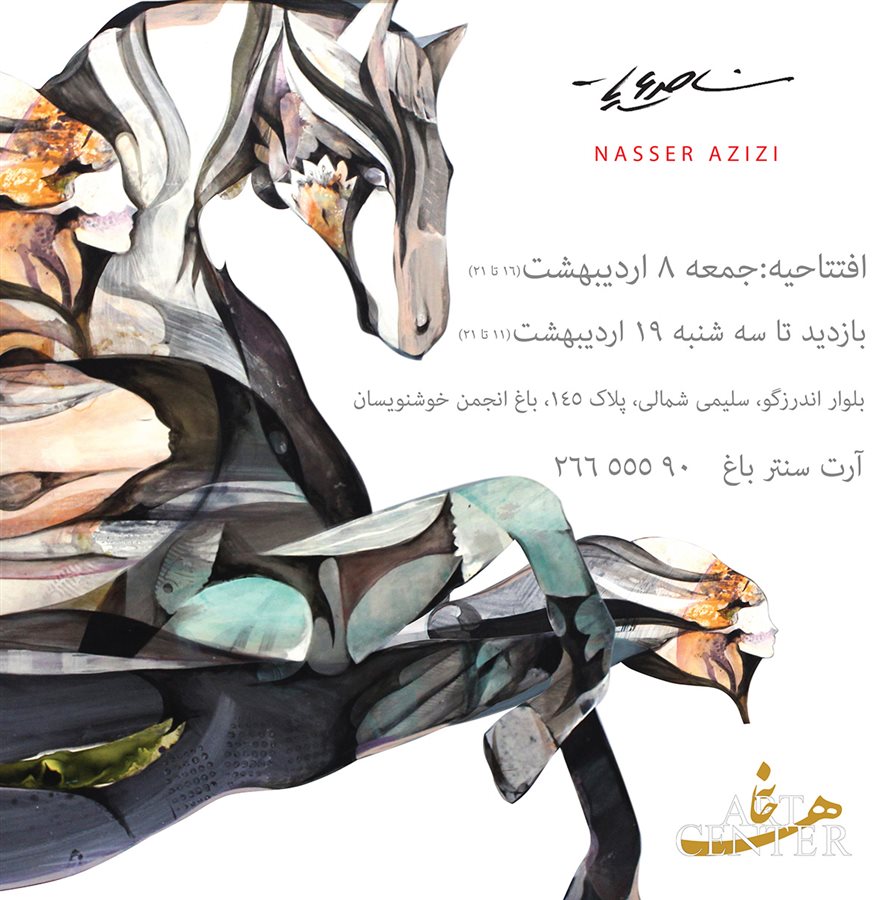
  12. Painting exhibition by Nasser Azizi at Tehran’s Art Center. Bio: mahartgallery.com
  13. “Copy-Paste”, curated by Shahram Entekhabi at Azad Art Gallery. The exhibition intends to review the phenomenon of reproduction, replication and transcription in art.
  14. “Outer Facade, Inner Essence”, painting exhibition by Hadi Farahani at Golestan Gallery. Bio: iranian.com
  15. “Immigration postal boxes”, painting exhibition by Mehrshad Khosravi Yekta at Saless Gallery
  16. “Night, daylight twilight”, painting exhibition by Pariyoush Ganji at Iranshahr Gallery
  17. “Human is the difficulty of duty (1); Ability of loving and to be loved”, group multimedia exhibition curated by Farshid Parsikia at Dena Gallery
  18. “The shadow inside”, painting exhibition by Niloufar Qaderinejad at Sareban Gallery. More: Sareban Gallery
  19. “Girls of the turquoise land”, painting exhibition by Behzad Bozorgi at Valir Art Gallery.
    Bio: Vali Art Gallery
  20. “Typography”, group calligraphy exhibition at Fereshteh Art Gallery. Artists: Mohammad Ehsaei, Nasrolah Afjehi, Salar Ahmadian, Omid Khakbaz, Babak Rashvand, Alireza Saadatmand, Eineddin Sadeghzadeh, Mehdi Falah and Kiarash Yaghubi

Sources: Honar Online (HO) 1, HO 2, HO 3, HO 4, HO 5, HO 6, HO 7, HO 8, HO 9, HO 10, HO 11, HO 12, HO 13, HO 14, HO 15, HO 16, HO 17, HO 18, HO 19, HO 20, Aria Gallery (Journey to Myself), Atbin Gallery, Azad Art Gallery (Copy-Paste), Emkan (Faraway), Fereshteh Art Gallery (Typography), Golestan Gallery (H. Farahani), Jaleh Gallery (Instagram), Shokou Gallery, Tehran Art Center, instagram @behzadbozorgi, instagram @davoodemdadian, instagram @Dena.gallery, instagram @fereshtehartgallery, instagram @iranshahrgallery, instagram @mehrshad_khosravi_yekta, instagram #نازنین_ازدیاری (Nazanine Ezdiari), instagram @rooberoo_mansion, instagram @salessgallery, instagram @sarebangallery, instagram @shiringallerytehran, instagram @VistaArtGallery, Honar Online (in Persian, about Bakhtiari, Bozorgi, Hedayat and Farahani), Mehr News (N. Azizi) (in Persian), Payvand (H. Farahani), Poster (N. Azizi), Poster (Horn), Poster (Vacuum Bag)

Art collective Slavs and Tatars’ first exhibition in Iran (Photos)

“Nose to Nose” will run from May 5 to July 14 featuring publications, lecture-performances and exhibitions at Pejman Foundation’s newly opened Argo Factory in downtown Tehran.

The installation looks to the Sufi notion of hamdami, the breathing together of sensuality and spirituality. Their “Not Moscow Not Mecca” installation, first exhibited at the Vienna Secession in 2012, will be restaged. A new Persian translation will be commissioned for their multi-channel audio installation “Lektor”, joining Aboriginal Yuggera, Arabic, Polish, German, Danish, Flemish and Spanish and a translation of David Joselit’s “On Aggregators” will be made available in Persian.

About Slavs and Tatars
Wishing to remain largely anonymous as a collective of unnamed artists, Slavs and Tatars was founded in 2006 by a Polish-Iranian duo. Over the years they have been joined by other artists from all over the world. The group’s work is centered on three activities: exhibitions, books and lecture performances, focusing on an often forgotten sphere of influence between Slavs, Caucasians and Central Asians. They refer to themselves as “archaeologists of the everyday”.
Their works are in collections including The Museum of Modern Art, New York; The Museum of Modern Art, Warsaw; Re Rebaudengo Foundation, Turin; Tate Modern, London and The Sharjah Art Foundation, UAE, among others.

Related articles on Slavs and Tatars (2016): The Brooklyn Rail, Houston Chronicle, Blouin Art Info

Sources: Pejman Foundation, instagram #slavsandtatars, instagram #pejmanfoundation, instagram @argofactory, instagram Pejman Foundation: Argo FactorySlavs and Tatars, culture.pl, Wikipedia, The Third Line

Tooma Art Group Exhibition at Iranian Artists Forum in Tehran

Tooma Art Group was formed by a number of Iranian artists concerned about environmental issues. The exhibition, that will run through May 5, features paintings, sculptures, drawings, photographs and tapestries with focus on Iran’s wildlife. Part of the event’s revenue will go towards environmental projects such as wildlife water holes and facilities for treatment of animals.

Participating artists include illustrators Negin Ehtesabian and Pejman Rahimizadeh, Ilgar Rahimi, Saeedeh Rezaee Badr, Saba Arabshahi, Mahnaz Saadatkia, Anis Soltani, Mahnaz Soleymannejad, Pedram Kazerooni as well as Afsaneh Khorramshahi and Alireza Owji. Nazanin Tahaee, Maryam Tahmasbi, Somayeh Alipour, Moslem Alamzadeh, Nastaran Anbari, Fereshteh Jafarimand and Mohanna Fazli are among others attending the event.

The current exhibition also features works by painters Asal Hazeqi and Leyla Refahi, as well as by graphic artist and photographer Homa Rostami, children’s book illustrator Mojgan Saeedian, graphic journalist Kamal Tabatabai, animator and caricaturist Sara Tayebzadeh and photographer Arezou Amidi.

Sources: Tavoos Online, instagram @tooma_art_group, instagram #tooma_art_group, Iranian Illustrators Society (in Persian)

Collage exhibition by five artists at Tehran’s Vista Art Gallery (Photos)

Shirin Ettehadieh, Tooran Zandieh, Talieh Kamran, Minoo Asaadi and Fereshteh Ghazirad presented their works at an exhibition titled “Singing Pieces” hosted in Tehran by Vista Art Gallery.

Sources: Honar Online, Vista Art Gallery

“Peace Symphony” at Ariana Gallery in Tehran (Photos)

Ariana Gallery showcased sculptures and paintings by Nasser Palangi, Saghar Masudi and Kaveh Afaq in an exhibition named “Peace Symphony”.

Sources: Tehran Times, Honar Online 1, Honar Online 2

Marcos Grigorian’s “Earthworks” on display in Tehran

Dastan +2 is hosting “Earth Works” by Iranian-Armenian artist Marcos Grigorian. The exhibition will be open from June 10th to July, 2nd.

Marcos (better known as Marco) Grigorian was an Iranian-Armenian artist, actor, teacher, gallery owner, and collector who played a pioneering role in the development of Iranian modern art. As a modernist pop artist, he turned to ordinary objects and popular ethnic forms and approaches. He used ethnic food such as “nan sangak” and “abghousht” to evoke authenticity in his work. Grigorian was a trend setter in experimenting with Earth Art in Iran.

Other posts on Iranian Armenians: https://theotheriran.com/tag/armenian/

Biography
Grigorian was born in Kropotkin, Russia in 1925, to an Armenian family from Kars who had fled that city when it was captured by Turkey in 1920. The family moved to Iran when Grigorian was five, living first in Tabriz, then Tehran and settling later in Julfa, the Armenian district of Isfahan. In 1940 his family moved back to Tehran where he attended Alborz College and later Kamal-al-Molk Art School in 1948.

After finishing pre-university education in Iran, in 1950, Grigorian went to Rome, and enrolled at the Academia di Belle Arti. He studied with cubist sculptor Roberto Melli (1885-1958). Upon graduation in 1954, he returned to Iran and opened Gallery Esthetique, one of the first modern galleries in Tehran.

In 1958, under the auspices of the Ministry of Culture, he organized the first Tehran Biennial. Grigorian was also an influential teacher at the Fine Arts Academy, where he disseminated his enthusiasm for local popular culture, including coffee-house paintings, a type of folk art named after the locations in which they were often displayed.

In 1959, after two years of intensive work, Grigorian completed a succession of enormous murals centering on the topic of the Holocaust. During the same period, he started applying dirt to the center of his canvases. This became the starting point of his celebrated “Earthworks Series”.

In 1960 he started acting in several Iranian films as Gregory Mark. An energetic and talented performer, he played villains in many movies, soon specializing in anti-hero roles and conspicuously contrary characters.

After moving to the USA in 1962 Grigorian started a new phase in his artistic career. He worked and lived in New York until 1970, when he returned to Tehran and joined the Faculty of Fine Arts at Tehran University. Grigorian left Iran in 1977.

In 1980 he returned to New York and established Arshile Gorky Gallery, named after the Armenian abstract expressionist painter who committed suicide in the U.S.A. in 1948. There he exhibited the works of Iranian and Armenian artists for several years.

In 1986 Grigorian lost his daughter to a massive heart attack. The tragedy caused a shift in Grigorian’s entire perspective and artistic priorities. He immersed himself in his other passion, that of Armenian folk art and rug weaving. He later donated 5,000 of his artworks to the government of Armenia.

In 1993 established the “Sabrina Near East Museum of Yerevan”, where he housed his own works and exquisite collection. Known as the Middle East Museum, the Museum displays 2,600 exhibits containing works of Russian, European and Middle Eastern applied arts. In particular the Persian Section is unique. Persian Pre-Islamic Zoroastrian culture, Islamic culture, Ghadjarac art is on display as well.

Some of his works are now on display at the Museum of Modern Art in New York, the Tehran Museum of Contemporary Art, the Museum of Contemporary Art in Kerman, and the National Gallery of Armenia. Grigorian died on August 2007 in Yerevan, Armenia.

Sources: dastan+2, Facebook | Dastan’s Basement, HonarOnline, Encyclopaedia Iranica | Grigorian, Marcos, Wikipedia | Marcos Grigorian, armeniainfo.am

Tehran was turned again into an art gallery (Photos)

Tehran hosted for its second consecutive year “A Gallery as big as a City”, an art event that turns the Iranian capital into a city-wide gallery where large-scale reproductions of hundreds of well-known artworks – both Western and Iranian – hang randomly along the city’s main arteries.

800 copies of artworks by artists across the world have been put on display on 2000 billboards in Tehran. Some of the billboards are dedicated to pictures of objects of cultural heritage, such as reproductions of traditional Persian miniatures, carpets and calligraphy but other also to paintings of Iranian artists like Jafar Rouhbakhsh.

Two-third of the works are from Iran and the rest have been selected from the world’s major artists, some of which may be famous enough to be recognized by nearly half of the population, such as Van Gogh’s The Starry Night or Johannes Vermeer’s Girl with a Pearl Earring.

Other international artists included are Americans Jackson Pollock and Andy Warhol, Austrians Egon Schiele and Joseph Anton Koch, Belgian René Magritte, British Lucian Freud, French Claude Monet, Camille Pissarro, Paul Cézanne and Henri Matisse, Germans Käthe Kollwitz and Caspar David Friedrich and Paul Klee, Italians Leonardo da Vinci (The last supper), Giorgio de Chirico, Japanese Gyokusen (artist name: Gyokkei) and Katsushika Hokusai and Spanish Pablo Picasso.

Related article: The other Iran | Photos compilation: A gallery as big as Tehran

Sources: kojaro.com, IRNA, shahrekhabar.com, Tehran Picture Agency, Payvand Iran News 1, Payvand Iran News 2, Hamshari Photo Agency, Iran Economist, Etemad Online, zibasazi.ir 1, zibasazi.ir 2, zibasazi.ir 3zibasazi.ir 4zibasazi.ir 5zibasazi.ir 6, Tehran Times, sothebys.com


Iranian cartoonist wins top award at contest in Luxembourg

The theme of the 9th International Contest of Caricature and Cartoon in Vianden, Luxembourg was “My Home Is My Castle”. A six-member jury selected the three winners and three trophies from 1312 submitted drawings by 504 artists from 33 countries, including caricaturists and cartoonists from Russia, Syria, Turkey, Poland, Portugal, Nicaragua, Peru, many artists from Iran, China, Croatia, Germany, Canada, Cuba, Italy, Portugal, Romania and Ukraine.

Iranian cartoonist Mohammad Habibi has won the first prize, Angel Boligan from Mexico and Klaus Pitter Austria were awarded the second and third prizes. Agim Sulaj from Italy, Raúl Zuleta from Colombia and Zbigniew Kolaczek from Poland received honorable mentions.

The winning works and a selection of entries were displayed at the Museum of Caricature and Cartoon of Vianden. The museum was initiated by Florin Balaban and his wife Sandra. Balaban is a known Luxembourgian political cartoonist.

Sources: Payvand Iran News, Der Trierer (in German),

Iran’s Fajr International Film Festival – Winners (Photos)

The closing ceremony of 34th Fajr International Film Festival was held at Tehran’s Vahdat Hall. 150 international guests from 20 countries attended the festival, watched films and participated at different sections of the six day long event.

In the main competition section, “Rams”, a humanist drama by Icelandic director Grimur Hákonarson, won the Golden Simorgh for Best Film and its protagonists, actors Sigurður Sigurjónsson and Theódór Júlíusson, shared the Best Actor award. “Frenzy” by Emin Alper from Turkey was awarded the Silver Simorgh for Best Director and Iranian actress Pantea Panahiha won the Best Actress award for her role in “Breath” by Narges Abyar.

Spanish film “Amama: When a tree falls” written and directed by Asier Altuna Iza won the Silver Simorgh for Best Script. “Arvand” by Iranian director Pouria Azarbayjani received the Special Jury Prize. “Seen” by Soheil Amirsharifi from Iran won the Best Short Film award.

In Eastern Vista Kazakh filmmaker Yerlan Nurmukhambetov received the Best Film Trophy for “Walnut Tree”. “Madam Courage” by Algerian director Merzak Allouache won the Best Director award. Iranian documentary “A157” by Behroz Nouranjipour received a Special Mention.

“Zemnaco” by Iranian director Mehdi Ghorbanpour won the Interfaith Award. “Hasti” directed by Kamal Parnak from Iran and “Love Marriage in Kabul” by Australian filmmaker Amin Palangi received a Special Mention Diploma. His film was the winner in the Muhammad Al-Ameen section.

“Dawn” by Latvian director Laila Pakalnina was awarded the Trophy for Best Film and “Figura” directed by Katarzyna Gondek from Poland received the   Trophy for Best Short Film in the Art and Experience category.

The 34th edition of Fajr International Film Festival was held from April 20th to April 25th, 2016 in Tehran’s Charsou Cineplex, under supervision of Iranian filmmaker, Reza Mirkarimi, current Managing Director of Khaneh Cinema, Iran’s Alliance of Motion Picture Associations.

Sources: FIFF 2016, Azad News AgencyBorna News, Fars NewsIRNA, ISCA, ISNAMehr News Agency (MNA) 1MNA 2, Tasnim News Agency, Young Journalists Club

Fajr International Film Festival: Overview (Photos)

A wide range of movies, documentaries and shorts by directors from around the globe were screened this April during the 34th Fajr International Film Festival.

Fifteen featured films competed in the official section, including “Guaraní” by Luis Zorraquín (Argentina, Paraguay), “1944” by Elmo Nüganen (Estonia, Finland), “El Clásico” by Halkawt Mustafa (Iraq, Norway), “Norfolk” by Martin Radich (United Kingdom) and “The Treasure” by Corneliu Porumboiu (Romania, France), the winner of the Prix Un Certain Talent prize at the Cannes Film Festival in 2015. (Details: FIFF 2016 | International competition | Featured films)

This section also included eighteen short films from Argentina, Belarus, Belgium, Czech Republic, Iran, Ireland, Russian Federation, Sweden, Taiwan, Turkey, United Kingdom and Venezuela. (Details: FIFF 2016 | International competition | Short films)

Directors Majid Majidi and Nasser Taqvai from Iran, Chinese filmmaker and producer Tian Zhuangzhuang, Spanish director José Luis Guerín, producers Ivo Felt from Estonia and Zeynep Ozbatur Atakan from Turkey and Canadian writer Emmanuel Prevost were the official competition’s jury members.

Eastern Vista, a segment dedicated to films from Asian and Muslim nations, included “Solomon” by Zaza Khalvashi from Georgia and “My Sister, the Pig Lady” by Jang Moon-il from South Korea. A jury formed by Iranian actress Golab Adine, Afghan filmmaker Sahra Karimi, Indian actor and producer Jaaved Jaaferi, French-Moroccan director Ismael Feroukhi and Italian writer Teresa Cavina selected the winners of Best Asian Film and Best Asian Director from a total of sixteen movies from twelve different countries. (Full list: FIFF 2016 | Eastern Vista)

Directors Andrew Lau from Hong Kong, Alexander Sokurov from Russia and French journalist and critic Jean-Michel Frodon attended the festival. Special Screenings, a section focusing on documentaries, presented Sokurov’s new feature, Francofonia and Jia Zhang-ke by Brazilian director Walter Salles, writtern by Salles and Frodon. (Full list: FIFF 2016 | Special screenings)

Ten films were screened outside competition, including “The Assassin”, a martial arts drama by Taiwanese director Hou Hsiao-Hsien and “Lamb” by American director Ross Partridge. (Full list: FIFF 2016 | Festival of Festivals)

The festival highlighted French cinema, as one of its side section programs, screening “The Fear” by Damian Odoul (2015), “Rabid Dogs” by Eric Hannezo (2015), “The Little Prince” by Mark Osborne (2015), “The Measure of a Man” by Stéphane Brizé (2015), “The Clearstream Affair” by Vincent Garenq (2014) and “Anton Chekhov 1890” Rene Feret (2015).

A restored version of Dariush Mehrjui’s acclaimed 1969 drama “The Cow” was screened along with “The Lover’s Wind” by French filmmaker Albert Lamorisse (1978) and “The Country of Lion and Sun: Persia” by Vladimir Erofeev (1935). A photo exhibition with selected scenes of “The Cow” and “The Lover’s Wind” was also held at Charsou Cineplex.

A number of top Iranian cineastes, including Oscar-winning director Asghar Farhadi , actress Fatemeh Motamed-Arya, actor Reza Kianian and Oscar-nominated filmmaker Majid Majidi, have held a series of workshops on the sidelines of the festival. Over 100 students from Afghanistan, Tajikistan, Iraq, Lebanon, Palestine, Syria, Turkey, Pakistan, Azerbaijan and Iran attended the six-day workshop program entitled “Dar ul-Funun”, the name of the Iranian polytechnic established in 1851.

The 34th edition of Fajr International Film Festival was held from April 20th to April 25th, 2016 in Tehran’s Charsou Cineplex, under supervision of Iranian filmmaker, Reza Mirkarimi, current Managing Director of Khaneh Cinema, Iran’s Alliance of Motion Picture Associations.

Sources: Tehran Times, Fajr International Film Festival, kinokultura.com, Mehr News Agency (MNA) 1, MNA 2, Young Journalists Club (YJC) 1, YJC 2, YJC 3, YJC 4, YJC 5, YJC 6, Azad News Agency (ANA) 1, ANA 2, Borna News Agency (BNA) 1, BNA 2, BNA 3, BNA 4, BNA 5, BNA 6, Fars News Agency (FNA) 1, FNA 2, FNA 3FNA 4, IRNA 1, IRNA 2, IRNA 3, IRNA 4, IRNA 5, IRNA 6. IRNA 7, IRNA 8, ISCA 1, ISCA 2, ISNA 1, ISNA 2, ISNA 3, ISNA 4, ISNA 5, ISNA 6, ISNA 7, Tasnim News Agency (TNA) 1, TNA 2, TNA 3, TNA 4, TNA 5, TNA 6, TNA 7, TNA 8, TNA 9, Borna News Agency (BNA) 1, BNA 2, BNA 3, BNA 4, BNA 5, BNA 6, Tehran Picture Agency (TPA) 1, TPA 2, TPA 3, TPA 4, TPA 5

Painting exhibition by Iranian students in Tehran

“Jokal”, a national art festival organized by Tehran University of Art addressed to young artists, was launched at Pardis Mellat Gallery in Tehran.

The members of the jury, veteran Iranian artists Farah Ossouli, Behnam Kamrani, Babak Etminani, Masoumeh Mozaffari and Jamal Arabzadeh, selected 79 out of 1.212 submitted works.

Sources: Financial Tribune, Honar Online 1, Honar Online 2, Honar Online 3 (in Persian)

Iran’s Fajr International Festival of Visual Arts: Exhibition

The 8th Fajr International Festival of Visual Arts displayed at Saba Art and Cultural Institute works by over 200 Iranian and foreign artists coming from different countries including Tunisia, Pakistan, Turkey, Italy, Cuba and Kyrgyzstan.

The Niavaran Cultural Center hosted a side-section exhibit of calligraphy and miniature works under the title “Fajr and National Art” and a selection of documentaries focusing on different visual arts including painting, sculpture, miniature, pottery and ceramics was screened at the Saba Institute as well as at the cinematheque of the Tehran Museum of Contemporary Art.

A day dedicated to Mexican art, organized in collaboration with the Mexican Embassy, included thirty five lithographies by José Guadalupe Posada (1852–1913), considered the precursor of Mexican folk art, photos by Tina Modotti (1896-1942) that reflect the struggle of the less privileged of the post-Mexican Revolution period and sculptures by Gabriela Rodríguez, fifteen pieces commemorating the International Year of Light, celebration promoted by Mexico at the United Nations.

Short video by PressTV dedicated to this year’s Fajr International Festival of Visual Arts:

Sources: Mehr News Agency (MNA) 1, MNA 2, IRNA 1, IRNA 2, Honar Online 1, Honar Online 2, Financial Tribune, Tehran Times 1, Tehran Times 2, El Universal (in Spanish)

Photos: Painted eggs across Tehran

Hundreds of Nowruz eggs painted by Iranian artists were placed in five of Tehran’s parks (Mellat, Laleh, Abbas Abad, Park Shahr and Bagh-e Ferdows) during Baharestan, an urban art event to welcome spring as part of the Persian New Year celebrations. Charities have organized a workshop at the Iranian Artists’ Forum where visual artists and 120 children have painted Nowruz eggs.

Painted eggs symbolize fertility and are displayed on the Nowruz table, called Haft-Seen together with various other symbolic objects. In ancient times Zoroastrians painted eggs for Nowruz, their New Year celebration, which falls on the Spring equinox. Nowadays this Nowruz tradition is common to Iranians of Islamic, Zoroastrian, and other faiths.

Related article: Urban art event to welcome spring in Tehran

Sources: Borna News, Fars NewsISNA, Tasnim News 1, Tasnim 2, Mashregh NewsWikipedia | Easter egg, Honar Online 1 (Persian), Honar Online 2, Honar Online 3, Honar Online 4, Honar Online 5, IRNA 1IRNA 2, Tehran Picture Agency (TPA) 1, TPA 2, TPA 3zibasazi.ir 1, zibasazi.ir 2, zibasazi.ir 3, zibasazi.ir 4, zibasazi.ir 5, zibasazi.ir 6, zibasazi.ir 7, Azad News AgencyYoung Journalists Club (YJC) 1, YJC 2, ISCA News, Mehr News Agency

Photos: Urban art event to welcome spring in Tehran

Baharestan, a spring urban art event, has started as part of the Persian New Year celebrations. Projects by five hundred artists are being displayed until late April across the Iranian capital.

Sources: Borna News, Fars News, ISNA 1, ISNA 2, IRNAHonar Online (in Persian), Honar Online 2, Honar Online 3, Honar Online 4, Honar Online 5, Honar Online 6, Mehr News Agency, Tehran Picture Agency (TPA) 1, TPA 2, Azad News Agency, Tasnim News 1, Tasnim News 2, zibasazi.ir 1, zibasazi.ir 2zibasazi.ir 3zibasazi.ir 4, zibasazi.ir 5, zibasazi.ir 6zibasazi.ir 7zibasazi.ir 8zibasazi.ir 9, zibasazi.ir 10, zibasazi.ir 11zibasazi.ir 12zibasazi.ir 13zibasazi.ir 14zibasazi.ir 15zibasazi.ir 16zibasazi.ir 17zibasazi.ir 18zibasazi.ir 19zibasazi.ir 20zibasazi.ir 21zibasazi.ir 22, zibasazi.ir 23zibasazi.ir 24zibasazi.ir 25zibasazi.ir 26zibasazi.ir 27zibasazi.ir 28

Iran’s Fajr International Theatre Festival: Performances

Fajr International Theater Festival (FITF) is a golden opportunity to enjoy theatre projects from other cultural backgrounds. This year over 300 plays from Japanese, Hungarian, Spanish, German, Norwegian, Polish, French as well as Iranian artists were presented on all theater stages as well as some outdoor public spaces in Tehran.

The members of the jury panel for the international section – Stefan Schmid from Germany, Jerzy Limon from Poland, Oleg Loevski from Russia and Iranians Masoud Delkhah and Farrindokht Zahedi – honored “Hamlet” with two awards; German director Thomas Ostermeier received the Grand Prix of the festival and Lars Eidinger won the Best Actor Award. The play had three completely sold-out performances.

Photos: “Hamlet” directed by Thomas Ostermeier, Germany

Norway participated with a powerful performance of Henrik Ibsen’s “Hedda Gabler” by Visjoner Teater, founded by Juni Dahr in 1988. The play was staged at a house and not at a theatre to allow the site specific artistic concept of this production. The shows were sold out, thus an extra performance was organized. Actress and artistic director Juni Dahr won in 2014 the Jury’s FITF Special Prize for “Ibsen Women”.

Photos: “Hedda Gabler” by Visjoner Teater, Norway

“The Shadow Game” written by Koichiro Iizuka and directed by Tatsuya Hasegawa from Japan’s Dazzle Dance Company took the stages by storm with four sold out shows at Tehran’s Vahdat Hall, leaving the audience breathless long after the actors have left the stage.

The play, about the clash between positive and negative energy to highlight the effects of the natural disasters in Japan, used a magnificent combination of street dance, electronic music, theater, elements of video games and anime plot with Japanese commentary all wrapped up in street and contemporary dance styles choreographed by Hasegawa himself. In 2012 Hasegawa’s “Misty Mansion” won the FITF Best Play Award.

Photos: “The Shadow Game” directed by Tatsuya Hasegawa, Japan

Hungary’s “Becoming Butterfly – Conspiracy” written and directed by Zsófia Bérczi, has taken the audience through an existential journey on the wings of imagination and visual aesthetics. There was something universal and deep about the play that made it connect with the audience no matter from which country and culture. “Human beings are not the most beautiful creation on earth, but they are the most beautiful dream of all creations on earth.” Bérczi also staged Living Surface at this year’s festival.

Photos: “Living Surface” and “Becoming a Butterfly – Conspiracy” directed by Zsófia Bérczi, Hungary

“Peregrinus” from Poland’s KTO Theater is a performance without dialogue, illustrated by music that depicts a single day in the life of an individual of the 21st century. The contemporary “Everyman”, whose life is “suspended” between home and work for a corporation, identifies his or her “pathway through life” as a “pathway to work”. Homo Peregrinus is a formatted human being, stripped of emotionality, predictable and bereft of individual characteristics. Perigrinus’s belongings can be packed in one piece of hand luggage.

Photos: “Peregrinus” from KTO Theater, Poland

“Katastrophe” and “A House in Asia” were presented by Agrupación Serrano, a Spanish theatre company that creates original productions based on stories drawn from contemporary times, blending stage performance, text, video, sound, and scale models to stage stories about discordant aspects of today’s human experience.

The FITF international section also included “Dance of Death B La La”, a joint Iranian-German production by Iranian director Yaser Khaseb from Crazy Body Group, “Body Revolution” by Belgium based Iraqi director Mokhallad Rasem, the monologue “Monsters” by Laurent Fraunie from France, Georgian “Me-Medea” written and directed by Salome Joglidze and more.

Photos: 34th Fajr International Theater Festival in Iran

Sources: Mehr News Agency (MNA) 1, MNA 2, MNA 3, MNA 4, Tehran Times 1, Tehran Times 2, srserrano.com, na-weekly.com, fitf.theater.ir, tiwall.com | 34th FITF (in Persian), tiwall.com | Dance of Death B La La (in Persian), teatrktro.pl, Honar Online, swr.de, Facebook | Visjoner Teater, Instagram @crazybodygroup, IRNA, Facebook | Teatr KTO

Iranian documentary wins Amnesty International Film Prize

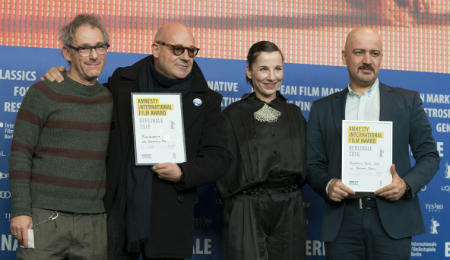
Mehrdad Oskouei’s ‘Starless Dreams’ (Royahaye Dame Sobh) along with ‘Fuocoammare’ (Fire at Sea) by Gianfranco Rosi have won the Amnesty International Film Prize at the 66th Berlin International Film Festival. Rosi’s documentary film about the refugee crisis in the Mediterranean off the Italian island of Lampedusa, won also the Golden Bear prize for Best Film.

Oskouei, one of Iran’s best documentary filmmakers, explores in ‘Starless Dreams’ the anguish and joys of girls in a juvenile correctional facility on the outskirts of Tehran. His small, all-male crew spent 20 days talking to the young women who gave them surprising access to their lives and feelings. The film won in Iran the Best Documentary Director Award at the 34th Fajr Film Festival earlier this year.

The German branch of Amnesty International has awarded the Amnesty International Film Prize for the first time at the Berlinale 2005. The aim of the prize is to draw the attention of audiences and representatives of the film industry to the theme of human rights and encourage filmmakers to tackle this topic. German actress Meret Becker, Swiss film maker Dani Levy and Markus Beeko, Director of Campaigns and Communications for Amnesty International Germany were the members of this independent jury at the Berlinale 2016.

Iranian filmmaker Mehrdad Oskouei (1st R) and Italian director Gianfranco Rosi (2nd L) with Jury members Dani Levy (1st L) and Meret Becker (2nd R) in Berlin - Feb 20, 2016. Photo credits: Henning Schacht / Amnesty International

Iranian filmmaker Mehrdad Oskouei (1st R) and Italian director Gianfranco Rosi (2nd L) with Jury members Dani Levy (1st L) and Meret Becker (2nd R) in Berlin – Feb 20, 2016. Photo credits: Henning Schacht / Amnesty International

About Mehrdad Oskouei
Oskouei, an independent producer, filmmaker, photographer and researcher, was born in Tehran, Iran in 1969. He has a B.A. in film direction from the University of Arts, starting in the theatre in 1981 and the film world in 1988. In 2010, Oskouei received the Prince Claus Award from the Netherlands.

Sources: Tavoos Online, Berlinale, Hollywod Reporter, Reuters, Wikipedia | Starless Dreams, Fajr Film Festival (in Persian)

Isfahan Music Museum (Photos)

The Music Museum in Isfahan is a private museum opened thanks to the efforts of two masters in traditional Iranian music. The museum is divided in different sectors: national and local instruments, photgraphs, a teaching music hall and a rehearsal hall.

Listen to traditional Iranian music here: The other Iran | Music

Sources: Mehr News Agency, isfahanmusicmuseum.com (in Persian)

‘Women without Men’ by Iranian artist Parastou Ahadi at Arte Gallery in Tehran

Arte Gallery in Tehran hosted ‘Women without Men’, a solo photography exhibition by Parastou Ahadi.

Parastou Ahadi is an Iranian painter and illustrator born on April 19th,1982. She got a diploma in Mathematics in 2000 and received a B.A. in Graphic Design in 2006. Ahadi lives and works in Tehran, Iran. She is currently pursuing a M.A. in Dramatic Literature at University of Tehran.
More information: parastouahadi.com

Sources: Honar Online, Facebook | Parastou Ahadi

‘Quantum Soup’ by Iranian artist Mohamadreza Ahmadi Monfared at Mohsen Gallery in Tehran

Mohsen Gallery hosted ‘Quantum Soup’ a solo painting and drawings exhibition by M. Ahmadi Monfared.

“Quantum Soup, is an informal expression for the linking of all matter and energy in the universe, and Demiurge, in Platonic philosophy is not exactly the Creator but a figure who constructs the world especially by using triangles. These two entitle my last two series of paintings and drawings of recent years and in this exhibition.” — Mohamadreza Ahmadi Monfared, Fall 2015

Born in 1983 in Iran, Ahmadi Monfared lives and works as a painter and art teacher in Tehran. After graduating in 2007 with a M.A. in Painting at Tehran University of Art, he has held numerous group and solo exhibitions in Iran. More information: ahmadimonfared.com

Sources: Honar Online, Facebook | M Ahmadi Monfaredsaatchiart.com | M. Ahmadi Monfared

Winners of the 32nd Tehran Short Film Festival (Photos)

The winners were announced during the closing ceremony of Tehran’s 32nd Short Film Festival held at Andisheh Hall.

The jury members of the International Competition Section were Andrzej Bednarek from Poland, Matthias Flügge from Germany, Seigo Tono from Japan, Gipsy Chang from Hong Kong and Alireza Shoja Noori from Iran.

“A Warm Spell” by Toshimichi Saito from Japan received the Grand Prix of the festival. Best Fiction Film was awarded to “It Will Be Alright” by Patrick Vollrath from Austria. “Songbirds’ Shop” by Anatoliy Lavrenishyn from Ukraine won the Best Animation Award. Best Documentary was awarded to “Touch of Freedom” by Sardar Arshad Khan from Poland.

Jessica Dürwald from Germany received the Best Experimental Award for “Eat My Dream”, “Survival” by Masoud Hatami from Iran won the Special Jury Prize, “Electronic Town” by Tony Mullen from Japan was chosen as the Best Film from Asian Countries. Saeed Nejati from Iran received the Best Film from Islamic Countries Award for “Prohibition” and “Angelus Novus” by Aboozar Amini from Netherlands won the Best Anti-Violence Film Award.

Sources: Tavoos Online, Tehran International Short Film Festival, Fars News, ISNA 1, ISNA 2, Tasnim News, Mehr News

‘Haft Negah’: Selection of works by Iranian artists displayed at Niavaran Cultural Center in Tehran (Photos)

The Niavaran Culture Center in Tehran hosted the 8th annual edition of Iran’s Seven Views (Haft Negah), an art expo coordinated since 2006 by seven major art galleries. A selection of paintings, sculptures and calligraphy works by about 400 contemporary Iranian artists were displayed during exhibition.

“Works by the giants of Iranian visual arts including Sohrab Sepehri, Mohammad Ehsai, Sedaqat Jabbari, Yadollah Kaboli, Ebrahim Haqiqi and Farah Osuli will be offered at reasonable prices,” said Lili Golestan, Secretary of Seven Views. According to Golestan, people’s trust in the galleries is one reason behind the success of Seven Views, while the reasonable prices also help.

Related article: The other Iran | Haft Negah art exhibition closes tomorrow (Nov 28th, 2014)

Source: Tehran Times, Honar Online

Commemoration of Iranian artist Morteza Momayez with French Graphic Designer Michel Bouvet

In honor of late Iranian graphic designer Morteza Momayez the Iranian Artist’s Forum in Tehran organized a series of events which included a commemoration ceremony, an exhibition of his work and an exhibit and workshop presented by the event’s special guest, French graphic designer Michel Bouvet.

The commemoration ceremony took place in the Ostad Shahnaz Hall at the Iranian House of Artists and it was followed by the opening of an exhibition of Momayez’s work. Michel Bouvet also displayed his work at the Iranian House of Artists and presented a workshop on poster design.

About Morteza Momayez
Morteza Momayez was an Iranian graphic designer, born on August 26, 1935 in Tehran, Iran. He got his bachelor in painting from the School of Fine Arts at University of Tehran in 1965 and his diploma from Ecole National Superier des Art Deco in Paris, France in 1968. He was Editor-in-chief of “Neshan”. Throughout his career, Momayez initiated many cultural institutes, exhibitions and graphic design publications. The renowned pioneer of graphic design in Iran, Momayez received the Art & Culture Award of Excellency from the president of Iran in 2004.

About Michel Bouvet
Michel Bouvet (born 1955 in Tunis) is a French designer and poster artist. He is professor of visual culture at ESAG Penninghen (Paris). Bouvet studied and graduated at École nationale supérieure des Beaux-Arts (ENSB-A). His design influences include Fernand Léger, Raymond Savignac, André François and Roman Cieslewicz. His posters are very often the result of a mixture of techniques (photography, collage, sculpture, painting), which gives them a highly poetic graphic dimension. Bouvet has won many national and international design awards in Poland, Finland, Japan, China and Czech Republic. Since 2002, he designs the corporate identity for the Rencontres d’Arles. He has been the curator of several international graphic design exhibitions.

Sources: Tavoos Online, Wikipedia | Morteza Momayez, Honar Online 1, Honar Online 2, Wikipedia | Michel Bouvet

Mixed exhibition of Iranian and Western art at the Tehran Museum of Contemporary Art (Photos)

The exhibition, entitled ‘Towards the Ineffable: Farideh Lashai’, presents a collection of 130 works including paintings, glassworks, drawings and video arts. It will be on display through February 26, 2016 at Tehran Museum of Contemporary Art.

Italian Germano Celant, Artistic Director of the Prada Foundation in Milan, co-curated the exhibition with the Iranian curator, architect, and filmmaker Faryar Javaherian. It marks the first time a non-Iranian curator of such stature has curated an exhibit at the museum since the revolution.

Javaherian and Celant have created an anthology of works by the Iranian modernist Farideh Lashai (1944-2013), who became one of Iran’s leading artists of the era. The Western works are being presented as context for Lashai’s retrospective. The intercultural exchange was achieved by hanging works by Western artists on gray walls, often across the room from Lashai’s works, which are hung on white walls.

Forty two works by Jackson Pollock, Alberto Giacometti, Mark Rothko, Andy Warhol, Roy Lichtenstein, Francis Bacon, Cy Twombly, Claude Monet, Willem de Kooning, René Magritte, and many others will surround Lashai’s art. Iranian artists are also represented, as works by Manoucher Yektai, Sohrab Sepehri, and Nasser Assar are included.

“I want to force the audience to see the context,” Celant said. “There’s a self-portrait by Farideh, and there’s a self-portrait by Giacometti. We’re trying to say, O.K., the identity of the Iranian art is related to another identity in the world. That’s a dialogue that needs to be established, and that’s my function as a non-Iranian curator.”

In addition, Catherine de Zegher, director of the Museum of Fine Arts Gent in Belgium, and Venetia Porter, the Assistant Keeper in the Department of the Middle East at the British Museum participated at a one-day seminar held at the museum. Art critics and historians Media Farzin, Marjan Tajeddini and the curators also discussed and reviewed the exhibition at the seminar.

In October, the museum signed a tentative agreement with the German government to send 60 artworks from Tehran – 30 Western and 30 Iranian – to Berlin for a three-month show next fall, which would mark the museum’s first exhibition overseas.

About Farideh Lashai
https://upload.wikimedia.org/wikipedia/en/a/a7/Farideh_Lashai.jpgBorn 1944 in Rasht, Farideh Lashai was among the most successful Iranian artists, writers and translators, best known for her abstract paintings. She studied art at the Academy of Decorative Arts in Vienna, Austria, and held over 100 solo and group exhibitions in Iran and many other countries, such as Italy, Germany, the US, Switzerland, Britain and France. After a long battle with cancer she passed away in the Iranian capital, Tehran, in 2013. She was 68 years old.

Lashai particularly won fame for her lyrical abstract paintings and multimedia installations that combined video projections and canvas works. Her works were mostly inspired by her personal experiences and modern Iranian art forms.

Sources: Tehran Times, Vanity Fair, IRNA, Tavoos Online, Honar Online 1, Honar Online 2, Honar Online 3, ISNA, The Telegraph

Asia Pacific Screen Awards (APSA) honors Iranian actress Fatemeh Motamed-Arya

The 2015 edition of Asia Pacific Screen Awards (APSA) has awarded Iranian actress Fatemeh Motamed-Arya during a ceremony held in Brisbane, Australia. She received the event’s Special Mention for the Best Performance by an Actress for her portrayal of a nurse in ‘Avalanche,’ directed by Iranian filmmaker Morteza Farshbaf.

Kirin Kiki won the award for Best Performance by an Actress for her role in “An” from Japan while the award for Best Performance by an Actor went to Jung Jaeyoung for his role in “Right Now, Wrong Then” from South Korea.

Apichatpong Weerasethakul from Thailand received the best film award for “Cemetery of Splendor” and Alexey German Jr. from Russia won the best director award for “Under Electric Clouds”. The award for best cinematographer went to Mark Lee Ping-bing from Taiwan for his collaboration in director Hou Hsiaohsien’s “The Assassin”.

The 2015 APSA International Jury was presided by South Korean filmmaker Kim Dong-Ho. He was joined by Mostofa Sarwar Farooki (Bangladesh), Zhang Xianmin (China), U-Wei Bin HajiSaari (Malaysia), Alexei Popogrebsky (Russia) and Negar Javaherian (Iran). Javaherian won the UNESCO Award at the APSA in 2013 for her performance in Maziar Miri’s “Painting Pool”.

Established in 2007, APSA is an international cultural initiative to honor and promote the films, actors, directors, and cultures of the Asia-Pacific region, under the auspices of UNESCO and FIAPF – International Federation of Film Producers Associations.

About Fatemeh Motamed-Arya
Born in 1961, Fatemeh Motamed-Aria is one of the most significant Iranian actresses, who has won numerous national and international awards, including the Best Actress Prize of the 2011 Montreal Film Festival in Canada and the Prix de Henri-Langlois award of the 2012 Vincennes International Festival in France. ‘Once Forever’ (1993), ‘Blue-Veiled’ (1995), ‘Gilaneh’ (2004) and ‘Here Without Me’ (2011) are among the films she has performed in so far.

Sources: Tehran Times, Payvandasiapacificscreenacademy.com, Instagram | apscreenawards, taghato.net

Iranian artist Pariyoush Ganji honored with Japan’s Order of the Rising Sun

Iranian artist Pariyoush Ganji has been honored with the Order of the Rising Sun by the Japanese government. She received the “3rd Class, Gold Rays with Neck Ribbon Order of the Rising Sun” at the Embassy of Japan in Tehran.

The 70-year old artist was commissioned by the Japan Foundation to conduct research in the city of Kyoto on Sassanid-era designs, which had been transferred via the Silk Road and appeared on the kimono, the traditional Japanese female costume, and the belt obi.

In addition, Ganji, who has been teaching in Iranian art universities, has long promoted the Japanese art of sumie (Japanese black ink painting) and shoi (traditional Japanese architecture) in her classes. She has had a big share in introducing and promoting Japanese art in Iran and has also helped elevate the artistic exchanges between Iran and Japan.

The Japanese government honored 89 foreign nationals on November 3rd, 2015. Iranian film director Abbas Kiarostami also received the Order of the Rising Sun in 2013.

The Order of the Rising Sun was established by Emperor Meiji of Japan in 1875 and was awarded in nine classes until 2003. The badge features rays of sunlight from the rising sun. The design of the Rising Sun symbolizes energy as powerful as the rising sun in parallel with the “rising sun” concept of Japan (“Land of the Rising Sun”).

The order is awarded to those who have made distinguished achievements in international relations, promotion of Japanese culture, advancements in their field, development in welfare or preservation of the environment.

Sources: Tavoos Online, Embassy of Japan in Iran, Honar Online I, Honar Online II, Wikipedia | Order of the Rising Sun

‘Curriculum Mortis’ by Iranian artist Barbad Golshiri in Tehran

Aaran Gallery hosted one of Barbad Golshiri’s versions of ‘Curriculum Mortis’, that portrays concepts related to death and graveyards.

“I am a taphographer [1], I make grave markers, for the past fifteen years I take pictures of graves and burials and I make frottages on epitaphs of those eliminated only to distribute them. I have also made cenotaphs [2]. Memorials too, for the dead and the living. All these frame Curriculum Mortis. It is true to say that Curriculum Mortis  is not a series. I cannot make series.” […]
– Barbad Golshiri on the catalogue of the exhibition

About Barbad Golshiri
Barbad Golshiri is an Iranian contemporary artist, born in 1982 in Tehran, Iran. His father was Houshang Golshiri, a famous Iranian writer. He studied painting at The School of Art and Architecture, Azad University, Tehran. He has worked both as a media artist and a critic. He works with video, digital media, installation, photography, the internet, graphic novels and Lettrism. He won the third prize of the 6th Tehran Contemporary Painting Biennial, Tehran Museum of Contemporary Art. (More information: Wikipedia | Barbad Golshiri)

To read the review of the New York Times (Sep 19th, 2013) of one of Barbad Golshiri’s versions of ‘Curriculum Mortis’ click here.

Comments
[1] Tapographer: A tapographer is a copier of tombstones.
[2] Cenotaph: A cenotaph is an “empty tomb” or a monument erected in honour of a person or group of people whose remains are elsewhere. It can also be the initial tomb for a person who has since been reinterred elsewhere.

Sources: Honar Online, Instagram @aarangallerytehran, tandismag.com, Tehran Times, Aaran Gallery, Wikipedia | Barbad Golshiri, Proceedings of the New Jersey Historical Society, Wikipedia | Cenotaph

‘Distant memories’ by Iranian artist Tara Behbahani in Tehran (Photos)

Golestan Gallery hosted ‘Distant memories’, a painting exhibition by Tara Behbahani.

Tara Behbahani (born 1983) has been learning tricks and techniques of sculpturing with her mother, and painting with her father, who himself is one of the most famous contemporary artists, Taha Behbahani, since early childhood. She has been studied Art and Mathematics along side each other and after completing her university studies in Mathematics she started to research the relationship between art and geometry in Eastern Art.

She has participated in several exhibitions in Iran and abroad and has written about Islamic and Eastern Art in various magazines. For the past 12 years she has been teaching painting to youth and children.

Sources: tarabehbahani.com, mopcap.com, Honar Online, Instagram @tarabehbahani, Golestan Gallery

‘Emigrants’ by Iranian artist Shirin Ettehadieh in Tehran (Photos)

Shirin Gallery hosted ‘Emigrants that carry away their memories’, a painting exhibition by Shirin Ettehadieh.

Autumn is the season of reminiscence, this time my paintings are the memory of flowers and the emigrants that carry away the memory of their homeland.
– Shirin Ettehadieh, Autumn 2015

Shirin Ettehadieh studied at École du Louvre in Paris. She has held exhibitions in France, Greece, the Netherlands and Switzerland, as well as numerous solo and group exhibitions in Iran.

Shirin Ettehadieh on Facebook, website

Sources: 360cities.net, Honar Online, Instagram @shiringallerytehran

Street Art in Iran: Mehdi Ghadyanloo (Photos & Video)

Iranian Mehdi Ghadyanloo’s canvas is the skyline. His illusions create windows to other — more magical — worlds. Seeking to combine minimalist architectural spaces with surreal scenes from another universe, he has painted over 100 murals across the Iranian capital, giving unsuspecting drivers good reason to do a double take, as the fantasy blends in with the real.

Like exaggerated dream sequences, his images portray gravity-defying figures and portholes to other dimensions, all from altered perspectives that meld sky and structure.

About Mehdi Ghadyanloo
Mehdi Ghadyanloo is an Iranian painter, born 1980 in Karaj, Iran. He moved to the capital to study at Tehran University’s College of Fine Arts. He graduated with a BA in 2005 and subsequently earned a MA in film studies from Tehran’s Teachers College (Tarbiyat-e Modarres).

Known primarily for his gigantic trempe l’oeil [1] style murals in central Tehran, Ghadyanloo also creates small scale paintings, with surreal and minimalistic themes. Through his works, Ghadyanloo opens a window into the mood of life in Iran today. At the same time, he provides an autobiographical perspective, portraying the landscapes of his youth, his memories of Iran-Iraq war (1980-1988), and his life experience in the Islamic Republic.

In 2015 he visited London for an exhibition of his “indoor” paintings, and painted murals there also, including one in Shoreditch.

A report from CNN about Mehdi Ghadyanloo:

Related articles:
1. The Guardian | Tehran’s answer to Banksy: Mehdi Ghadyanloo hits Britain,
2. Howard Griffin Gallery | Artists | Mehdi Ghadyanloo
3. Urban Outfitters Blog | Artist of the week: Mehdi Ghadyanloo
4. Facelifting Tehran | One Wall at a Time: Interview with Mehdi Ghadyanloo

Comments
[1] trompe-l’oeil: Art technique that uses realistic imagery to create the optical illusion that the depicted objects exist in three dimensions.

Mehdi Ghadyanloo on Facebook, Bēhance, Instagram and Twitter

Sources: CNN, Huffington Post, Howard Griffin Prints, Wikipedia | Mehdi Ghadyanloo, The Guardian, Facebook | Blue Sky Painters, Bēhance, fubiz.net, yourmiddleeast.com, Wikipedia | Trompe-l’oeil

Glassware and Ceramics Museum of Iran in Tehran (Photos)

The Glassware and Ceramics Museum of Iran is situated in a garden with a span of 7000 square meters. The building was constructed as a private residence about 90 years ago upon orders of Ahmad Qavam (Qavam-ol-Saltaneh). It later housed the Egyptian embassy and was converted into a museum in 1976 by three groups of Iranian, Austrian and French architects.

The museum’s main building, a two-storey octagonal construction with suspended pillars and a basement, occupies an area of 1040 square meters. Its architectural style is a combination of the traditional Iranian style and the European architecture of the 19th century.

The collection of glass and clay works that are on display at the museum is among the rare collections in Iran, mainly from Neishabur, Kashan, Rey and Gorgan. It comprises clay pots dating back from the 4th millennium BCE up to the present time as well as glass works from 1st millennium BCE up to the contemporary era. European glass works belonging to the 18th and 19th centuries are also parts of the collection.

Sources: Tehran Press Agency, Glassware and Ceramics Museum of Iran, Iran Chamber Society, Lonely Planet

‘Gate of Words’ by German artist Philipp Geist is lighting up the Azadi Tower in Tehran, Iran (Photos)

A performance consisting of projections of light titled ‘Gate of Words’ by German artist Philipp Geist is taking place at Tehran’s landmark Azadi Tower until October 5th.

The installation artistically visualizes the topics of freedom, peace, space and time in different languages. During the performance Azadi Tower is to become a three-dimensional light sculpture that can be crossed by visitors.

‘I tried to illustrate words one by one to make the reader pay more attention to them. Sometimes, words are legible and sometimes not. Using this method, I make great attempts to make each and every reader have his/her own interpretation of the subject,’ said the German artist.

Facts about Azadi Tower
– It is one of the most familiar landmarks of Tehran.
– The builduing includes a cultural centre with a library, a museum and several art galleries.
– The entrance of the tower is directly underneath the main vault and leads into the Azadi Museum on the basement floor.
– The main display is occupied by a copy of the Cyrus Cylinder (the original is in the British Museum).
– The monument acts as a grandiose gateway to the Iranian capital, and is surrounded by a large plaza (approx. 50,000 m²).
– Built in 1971 in commemoration of the 2,500th anniversary of the Persian Empire, this “Gateway into Iran” was named the Shahyad Tower, meaning “Kings’ Memorial”, but was dubbed Azadi (Freedom) after 1979. It is 50 meters (164 ft) tall and completely clad in cut marble.

Sources: Mehr News Agency, ISNA, IRNA, Borna News, Instagram @videogeist, Tavoos Online, Wikipedia | Azadi Tower

Screening of Documentary Film on Parviz Tanavoli in London on Friday, September 25th

The documentary film “Parviz Tanavoli: Poetry in Bronze” directed by Terrence Turner will be screening on Friday, September 25th, at Whitechapel Gallery in London. This documentary tells the story of how the artist was inspired to create his unique body of work. The screening will be followed by a Q&A between Parviz Tanavoli and writer, director and producer of the film, Terrence Turner.

About Parviz Tanavoli
With a career spanning three continents and more than half a century, Iranian sculptor Parviz Tanavoli has made an unparalleled contribution to art in the Middle East. Following his formal training as a sculptor in Italy, Tanavoli returned to Iran, where he was influenced by historic Persian and modern Iranian folk art, culture, and poetry. He broke with tradition and began creating modern art with a distinctly Iranian aesthetic.

Source: tavoosonline.com, wikipedia | Parviz Tanavoli, Bing Image Search

Youth Music Festival 2015 in Tehran, Iran – Part 1: Practice & Performance (Photos)

Close to 250 young musicians participated in this festival which was held in two main sections of classical and traditional Iranian music. The competition was held in three age groups ranging from 10-27 years old.

In the classical section, the highest number of instrumentalists played the piano, violin and guitar, while in the traditional section santur, tar and setar were mostly present. Traditional Persian music was held in eight sub-categories, including seven instrumental and a vocal section.

Sources: MEHR | Photos, nay.ir, honaronline.ir 1, honaronline.ir 2, Tavoos Online

Video: Spotlight on Iran’s film industry – BBC News

More posts about Iranian Cinema: click here

Tehran calligraphy show promoting Iranian calico art

An exhibition of works by calligraphers Omid Ganjali and Mohsen Soleimani opened at Tehran’ Niavaran Cultural Center on Sunday to promote qalamkari, Iranian calico art that the artists believe is being forgotten.

The artworks were previously showcased at “From Earth to Heaven”, an exhibition that the Salam Art Creations Institute, a Tehran-based private organization developing Iranian arts, held at Cemal Resit Rey Concert Hall in Istanbul in July.

Photos by Mona Hoobehfekr for ISNA

All 30 calligraphy works are huge in size with designs of qalamkari done on their margins. Qalamkari is passing into oblivion in the country, Salam Art Creations Institute Managing Director Rafi Razavi told the Persian service of ISNA. The exhibition was organized to turn the spotlight on Iranian art, he added. “We need to take serious action to support artisans and masters who are still active in this field of time-honored art,” he stated.

The exhibition will run until August 25.

Sources: Tehran Times | Art Desk News, ISNA | Photos

Iranian ‘Mehr Theatre Group’ is in Europe performing its new play ‘Hearing’

The Mehr Theatre Group, an Iranian troupe led by director/writer Amir-Reza Kuhestani, will be performing the play Hearing in Switzerland, the Netherlands, Germany and France. The show centers on events happening in a girls’ dormitory.

Hearing premiered at Tehran’s City Theater in July before going on stage in Zurich, Switzerland at the Zürcher Theater Spektakel. They are attending the Noorderzon Festival in Groningen, the Netherlands with performances on August 25th and August 26th.

The troupe will next return to Geneva, Switzerland to perform Hearing on August 29th and August 31st at the La Bâtie, a festival of theater performances and film screenings. In September they will be heading to Frankfurt, Germany and Marseille, France. Full schedule: Mehr Theatre Group | Tour dates

About Hearing (Synopsis)
The girls’ dormitory was always like an unattainable castle. […] After the entrance door, a female world begun in which the entree of any man was prohibited. […] Now, presume that in a situation like this, one day, a girl reported that she had heard a man in one of the rooms. This would be the starting point of the performance.
More about the show: Mehr Theatre Group | Hearing

About Mehr Theatre Group
Mehr Theatre Group was created in 1996. The aim was to create a new type of theater — far from the traditional Iranian theater — based on new stage direction and a new acting style influenced by film. At first, Amir Reza Koohestani joined the Mehr Theatre Group to participate in their acting workshop, but after 6 months of the workshop they decided to produce theater productions based on their training. Since Amir was the only one with writing background he dedicated his time to write for the theater. […] The Mehr Theatre Group is today one of the most well known Iranian theater companies in Iran and has gained international acclaim with successful performances across the world. More about the troupe: Mehr Theatre Group

Below, a trailer of Timeloss, their last work before Hearing, also presented at the Under The Radar Film Festival in New York, USA. Other trailers: Mehr Theatre Group | Videos

About Amir Reza Koohestani
Amir Reza Koohestani is one of Iran’s most successful and prolific playwright-directors. With his third play, Dance on Glasses (2001), in tour for four years, Amir Reza Koohestani gained international notoriety and found the support of several European theatrical artistic directors and festivals. In February 2012, the movie Modest Reception, which script was co-written by Koohestani and Mani Haghighi – actor and film director – wins the Netpac Award at the Berlin International Film Festival 2012. He is the first director to win two consecutive awards for the “Best theatre production of the year” in Iran (Ivanov, 2011 and The Fourth Wall, 2012). More about him: Mehr Theatre Group | Amir Reza Koohestani

Related articles: The other Iran | Theater

Sources: Tehran Times | Art Desk, Mehr Theatre Group

Works by Iranian artist Pariyoush Ganji on display in Tehran

The current exhibition ‘A decade of paintings” is a selection of works from Pariyoush Ganji’s Red, Night and Day Windows, Roses and Water series.

Over the past ten years Ganji has worked on several collections ‘Day, Night Windows’ (2012), ‘Day, Night Windows’ (2010), ‘Roses’ (2006), ‘Windows Red’ (2003), ‘Sumi-e, Ink Paintings’ (2000-2012) and ‘Windows, Memories of Childhood’ (1997-2007).

The exhibition will run until July 23rd at Aryana Gallery (No.9, Fayazi St.,(Fereshte St.), Tehran).

About Pariyoush Ganji
Pariyoush Ganji (1945 in Tabriz, Iran) studied painting from 1968 to 1975 in London (St. Martin School of Art, Sir John Cass Art School, Chelsea School) and Paris (École de Beaux Arts). Her research include ‘The History of Persian Textile’ (Italy, 2007), ‘The Influence of Sassanid Patterns on Kimono and Obi Patterns through the Silk Road’ (Kyoto, Japan, 1996) and ‘Saffavid tiles in Isfahan’ (London, England, 1974). She held exhibitions at Luci Makintosh Gallery (Switzerland, 2012), Bank Art Museum (Japan, 2006), Museum of Art and Science (USA, 2003) and National Museum of Tashkent (Uzbekistan, 1999).
A more detailed biography: Pariyoush Ganji | About or Caroun.com | Pariyoush Ganji.

Sources: Iran Daily | News, Art 360° | Ariana Gallery, Honaronline.ir | Featured

Iranian painter Abolghassem Saidi opens first solo exhibition in Iran

The newly-founded Tehran gallery “Shahrivar” is currently hosting an exhibition of 30 artworks by Abolghassem Saidi. The exhibition showcases 26 paintings which belong to his personal collection and the other four which are owned by private collectors.

On view since June 12, Abolghassem Saidi’s first solo exhibition in Iran, will run for one month at “Shahrivar” gallery: No. 9, Hormoz impasse, North Khazar Street, Elahieh, Tehran.

About Abolghassem Saidi
Abolghassem Saidi (August 15th, 1926 in Arak, Iran) graduated from the School of Fine Arts, Paris (École des Beaux-Arts de Paris) in 1956, where he still lives and works. He exhibited at the Salon de la jeune peinture (1954-66). Then, he worked in Iran for the Festival of Shiraz and after travelled to the United States. Awarded with the prize of the Salon of the Jeune Peinture (1959), the prize of the Biennale of Tehran (1960, 1986) and the prize of Monte-Carlo (1993). The largest concentration of his works can now be seen in the Contemporary Museum of London, at University of Shiraz, at the airport of Tehran and at the Saderat Bank of London.

Related pages: Facebook | Abolghassem Saidi

Sources: Tavoos Online | News, honaronline.ir | Featured, Gros & Delettrez

Iranian actress’ Motamed-Arya portrait displayed at UN exhibit in New York (Photos)

A portrait of the acclaimed Iranian actress Fatemeh Motamed-Arya is displayed besides 15 international figures at a multimedia exhibition titled ‘The Transformative Power of Art’ at the UN Exhibits in New York. The exhibition features sculptures and large fresco portraits of artists who have stood up for human rights.

Motamed-Arya, 54, is involved in humanitarian activities and helps raise funds for different charities. Her latest gesture is putting up her Crystal Simorgh award, presented to her for the role of best actress in ‘Gilaneh’ in 2005, on sale to support people deprived of a home in Iran. She has been nominated nine times for the best actress award at the Fajr International Film Festival and won the Crystal Simorgh four times. She had a role in Rakhshan Bani-Etemad’ celebrated film ‘The Tales’ and played the lead character in ‘Nabaat’, Azerbaijan’s nominee for the Best Foreign Language Film in the 2014 Academy Awards.

The objective of the exhibition – curated by painter and sculptor Fabrizio Ruggiero – is to demonstrate that art creates bridges where politics divide. It takes place under the United Nations “2015: Time for Global Action” campaign, primarily destined to raise awareness about climate change and our fragile ecosystems.

The sculptures are made of many natural elements and the 16 accompanying portraits represent people from all continents who, during their lifetime, contributed to the common good of humanity in one way or another and have transformed the way we think. The men and women who are represented never lost sight of the most vulnerable.

They are: Pierre-Claver Akendengué (Gabon), Maya Angelou (USA), Joan Baez (USA), Audrey Hepburn (UK), Vassily Kandinsky (Russia), Umm Kulthum (Egypt), Gong Li (China), Miriam Makeba (South Africa), Edgar Morin (France), Fatemeh Motamed-Arya (Iran), Okot p’Bitek (Uganda), Satyajit Ray (India), Sebastião Salgado (Brazil), Wole Soyinka (Nigeria), Ngugi Wa Thiong’o (Kenya), and Malala Yousafzai (Pakistan).

Sources: IRNA | News, United Nations | News

Photos: Exhibit at Laleh Gallery, Tehran, in memory of Iranian-Assyrian artist Hannibal Alkhas

Hannibal Alkhas (1930 – 2010) was a Christian Iranian sculptor, painter and author that lived in the US as well as in Iran. His work is deeply inspired by the ancient bas-reliefs and stone sculptures of Ancient Assyria, Babylon and Daric-Persia.

Alkhas’ students are displaying their latest works in an exhibit being held in memory of the artist. It will run until June 21 at Laleh Gallery in Tehran.

The exhibit showcases works by artists like Reza Bangiz, Bahram Dabiri, Rozita Sharafjahan, Taraneh Sadeghian, Niloufar Ghaderinejad, Ahmad Vakili, Ali Nedaee, Nasser Mohammadi, Masoud Saadeddin, Katayoun Moghaddam, Hadi ziaeddini, Hamed Sahihi, and others.

Sources: Honaronline.ir | Featured, Tavoos Art Magazine | News

Hannibal Alkhas: Christian Iranian painter, sculptor and author (Photos)

Hannibal Alkhas (1930 – 2010) was a Christian Iranian sculptor, painter and author. His work is deeply inspired by the ancient bas-reliefs and stone sculptures of Ancient Assyria, Babylon and Daric-Persia.

Alkhas was born in 1930 in Kermanshah, Iran, and died in California on Sept. 14, 2010. His father was Assyrian writer Rabi Adai Alkhas and his uncle, John Alkhas, is one of the most famous Assyrian poets in the 20th century.

After spending his childhood and teenage years in Kermanshah, Ahwaz and Tehran, Hannibal Alkhas moved in 1951 to the United States and studied philosophy for three years at Loyola University of Chicago, Illinois. In 1958 he received his Masters of Fine Arts from the Art Institute of Chicago.

In 1959, after the death of his father he returned to Iran and began to teach painting, drawing, and art history at The Tehran School of Fine Arts”. During this time he established the successful “Gilgamesh” gallery, the first modern art gallery in Iran where aspiring young artists were introduced.

In 1963 he returned to the United States and taught at “Monticello College” in Illinois where he became the chairman of the art department. In 1969 Alkhas again returned to Iran and spent the next eleven years teaching at Tehran University.

In 1980, back in the United States where he stayed for the next twelve years he taught art at the Assyrian American Civic Club in Turlock, private colleges, and at the University of California at Berkeley and Los Angeles.

From 1992 on, he taught at diferent campuses of the Azad Isalmic University of Iran while he also taught painting privately and worked as an art critic writer in various Iranian magazines. His painting style sought to vitalize the historic processes within the passing moment, using past and present separately and simultaneously whether through content or form, he mixed expressions from six thousand years ago, today and the future.

Alkhas also illustrated book covers and translated Hafez’ lyrics into Assyrian. Before his death he was working on the completion of his Assyrian reproduction of the tragedy of Rustam and Sohrab, which was to have a happy ending. He hold a number of one-man shows, group art exhibitions, and traveling exhibitions in Southern Iran, South Korea, Europe, Canada, Australia, Cyprus and Israel. Aside from being displayed in his own gallery, his paintings are featured in the Fine Arts Museum and Gallery of Modern Art in Tehran and the Helena d’ Museum in Tel Aviv.

Sources: Iran Chamber Society | Visual Arts | Hannibal Alkhas, Payvand News of Iran | Sculptor and painter Hannibal Alkhas dies at 80, Mash Gallery | Artists | Hannibal Alkhas, Hannibal Alkhas

Monir Shahroudy Farmanfarmaian: First Iranian artist to have a solo exhibition at the Guggenheim, New York

Farmanfarmaian, now 92, is a renowned Iranian visual artist known for her geometric style and mirror sculptures. She became the first Iranian artist to have her work featured in a solo exhibition at the Guggenheim; a retrospective, spanning four decades of work: “Infinite Possibility: Mirror Works and Drawings 1974–2014”, organized by the Serralves Museum of Contemporary Art, Porto, Portugal.

In 2011, Vogue — where she worked early on as a freelance illustrator — featured her when she was the subject of an art book. “Whatever time I have left, I want to make art,” she said in the Vogue interview. “And I hope it will be worthwhile to see it.”

Contemporary Iranian art has a decades-long history in the West — though artists are now exhibiting their work with increasing frequency in the United States and Europe.

From September 2013 to January 2014, the Asia Society in New York exhibited Iran Modern. The show featured a diverse body of work from numerous artists that spanned the three decades leading up to the revolution of 1979.

In January and February of this year, the Taymour Grahne Gallery presented Traveling Demons, a collection of colorful and haunting pieces by Malekeh Nayiny, who was born in Tehran and currently lives in Paris.

And while Farmanfarmaian’s work was at the Guggenheim, the works of famed sculptor Parviz Tanavoli was on display at the Davis Museum at Wellesley College. Like Farmanfarmaian, Tanavoli is also the first Iranian artist to have a solo show at that space.

Shiva Balaghi co-curated the Tanavoli exhibition, and is a visiting scholar in Middle Eastern studies at Brown University. As one of the few academics in the country who specializes in Middle Eastern art history, Balaghi is quick to debunk notions of an Iranian art renaissance in the U.S., despite its recent popularity in the American art world.

“A reemergence is not really true,” she told BuzzFeed News. “The fact that there’s a growing interest in the West is key, not that this art hasn’t been made before.” Balaghi’s theory is that art institutions are beginning to look beyond Iran’s current political climate and explore the country through its art.

“It’s almost like museums are taking on this cultural diplomacy role,” she said. “There’s a cultural life in that country that continues and flourishes, one that doesn’t have to do with nuclear negotiations.”

Related articles to Monir Shahroudy Farmanfarmaian:
Iranian Roots | Monir Shahroudy Farmanfarmaian – Iranian Artist (Bio)
The Huffington Post | 90-Year-Old Iranian Artist Monir Shahroudy Farmanfarmaian Gets Her First Comprehensive U.S. Exhibition
The Guardian | Infinite Possibility: Monir Shahroudy Farmanfarmaian

Source: BuzzFeed News | This Iranian Artist Is Making History At The Guggenheim

The Great Game: Iran’s pavillion at the Venice Biennale

In a 2000 square meter old storage for marine engines are works by Iranian Farhad Ahrarnia, but also Iraqis Adel Abidin and Wafaa Bilal, and the Indians Hema Upadhyay and Riyas Komu on display. These are some of the forty-nine artists invited to interpret The Great Game, the exhibition project of the Iran Pavilion, curated by Marco Meneguzzo and Mazdak Faiznia for the 56th Venice Biennale.

“The Great Game” is followed by the Iranian Highlights exhibit with works by Samira Alikhanzaradeh, Mahmoud Bakhshi Moakhar, Jamshid Bayrami and Mohammed Ehsai.


The Great Game is an expression used to indicate the strategic rivalry and conflict between the British Empire and the Russian Empire for supremacy in Central Asia. The path evoking this expression provides a look at authors from India to Iran and Azerbaijan, testifying to the existence of a cultural flow and creating a shared, universal language.

The 56th Venice Biennale “All the World’s Futures”, curated by Okwui Enwezor, runs from May 9th to November 22nd, 2015.

Artists in Iran’s pavilion
Iranian Highlights
Samira Alikhanzaradeh, Mahmoud Bakhshi Moakhar, Jamshid Bayrami, Mohammed Ehsai

The Great Game
Lida Abdul, Bani Abidi, Adel Abidin, Amin Agheai, Ghodratollah Agheli, Shahriar Ahmadi, Parastou Ahovan, Farhad Ahrarnia, Rashad Alakbarov, Furat al Jamil, Nazgol Ansarinia, Reza Aramesh, Alireza Astaneh, Sonia Balassanian, Mahmoud Bakhshi Moakhar, Wafaa Bilal, Mehdi Farhadian, Shadi Ghadirian, Shilpa Gupta, Ghasem Hajizadeh, Shamsia Hassani, Sahand Hesamiyan, Sitara Ibrahimova, Pouran Jinchi, Amar Kanwar, Babak Kazemi, Ryas Komu, Farideh Lashai, Farokh Mahdavi, Ahmad Morshedloo, Mehrdad Mohebali, Huma Mulji, Azad Nanakeli, Jamal Penjweny, Imran Qureshi, Sara Rahbar, Rashid Rana, Atefeh Samaei, T.V. Santhosh, Walid Siti, Monir Shahroudy Farmanfarmaian, Mohsen Taasha Wahidi, Mitra Tabrizian, Parviz Tanavoli, Newsha Tavakolian, Sadegh Tirafkan, Hema Upadhyay, Saira Wasim

Related information:
The Guardian | Iran goes back to the future at Venice Biennale
Sothebys | Highlights From The Venice Biennale’s Iran Pavilion

Sources: La Biennale di Venezia | National participations, Artribune | Il padiglione dell’Iran raccontato da Marco Meneguzzo (Italian), Facebook | Iranian Pavilion – La Biennale di Venezia 2015 | Photos, ISNA | News photo

2015 Tehran Auction: Sohrab Sepehri’s painting sold for $965k

The fourth Tehran Auction has broken the all-time record of Iran’s art auctions thanks to the sale of a painting by Sohrab Sepehri for over $965,000 (€865,000), which brought the total revenue of the sales to over $7.25 million (€6.5 million).

The second most expensive sale of the event was another painting by the late Iranian poet and painter, which was sold for about $600,000. A total of 126 works by various artists, including Masoud Arabshahi, Mohammad Ehsaii, Jalil Rasouli, Behjat Sadr, and Parviz Kalantari went under the hammer.

The event, dubbed Modern and Contemporary Iranian Art Auction, was hosted by Iranian actor Reza Kianian at Tehran’s Grand Azadi Hotel.

Related articles:
The other Iran | 2014 Tehran Art Auction grosses over $4 million,
The Guardian | Tehran auction shifts millions of pounds worth of art in spite of sanctions

Sources: Press TV | Iran | Culture, IRNA | Photos, ISNA | Photos, Fars News Agency | Photos, Tehran Auction | 2015 Lot

Photos compilation: A gallery as big as Tehran

In a project, called ‘A Gallery As Big As a Town’, aiming to encourage people to visit museums, the city’s billboard ads were home for artworks by renowned local and foreign artists for 10 days, turning the Iranian capital into a giant urban art gallery.

There were more than 1,500 billboards dotted across the capital’s streets, displaying a total of 700 works that also included reproductions of traditional Persian miniatures, carpets, calligraphy and various other art pieces.

Iranian artworks were selected from different periods of Islamic and pre-Islamic arts including potteries, glassware, etc. and contemporary and modern period which displayed works by Kamal-ol-Molk and his students.

Related articles:
The Guardian | Tehran swaps ‘death to America’ billboards for Picasso and Matisse
The New York Times | Suddenly, Tehran’s Mayor Becomes a Patron of the Arts
The Huffington Post | Tehran Becomes Giant Open-Air Art Gallery

Sources: Mehr News Agency | News, Tehran Picture Agency 1, Tehran Picture Agency 2, Mehr News Agency | Photos, Tasnim News Agency | Photos 1, Tasnim News Agency | Photos 2

Retrospective of Iranian artist Bahman Mohasses at Tehran galleries

Two galleries in Tehran are holding a retrospective of painter and sculptor Bahman Mohasses (1921-2010) in a joint project entitled 60 Pieces of a Lost Object from May 22 to June 12, 2015.

A selection of artworks containing pieces from different periods are put on display at the Arya and Ab-Anbar galleries. Rare abstract works by Mohasses along with his lithographs, sculptures and paintings are on display in both exhibits.

The exhibit is a follow up to the extensive project of reviewing works by contemporary Iranian artists initiated by Arya and Ab-Anbar galleries, the first of which was dedicated to painter Sirak Melkonian.

Related article: The other Iran | Fifi Howls from Happiness: Documentary on B. Mohasses

About Bahman Mohasses
Born in 1921 in Rasht, Gilan Province, Mohasses was an outstanding painter and sculptor as well as a good translator. Persian translations of works by Italian authors Italo Calvino and Curzio Malaparte, and French authors Eugène Ionesco and Jean Genet are some of his other accomplishments. He studied at the Academy of Art in Rome, and held several solo and group exhibitions in Italy and other countries.

Mohasses returned to Iran in 1963 and staged the play “The Chairs” by Ionesco. Some years later in 1967, he decided to go back to Italy and continued living in Rome until he died. He used to visit Tehran every now and then but few were in touch with him.

Some of his valuable artworks are preserved in Italy and the United States while others are kept in Iran at the Jahan-Nama Museum of the Niavaran Palace and the Tehran Museum of Contemporary Art.

Sources: Tehran Times | News, Mehr News Agency | Photos, Honaronline | News

Photo and cartoons exhibition in Tehran reviews urban space

Over 200 works are currently on display at the Iranian Artists Forum on a showcase entitled Exhibition of Urban Space and Structures.

The exhibit, which aims to lay the groundwork for further urban aesthetics and a safer environment, will end on May 30.

Sources: Tavoos Online | News, Mehr News Agency | Photos

Contemporary posters by Swiss graphic designers displayed at Tehran exhibit

The exhibition took place at the Iranian Artists Forum in Tehran and displayed fresh look at the typography, posters and contemporary Swiss design.

There were works by a number of Swiss graphic designers on display, including Flavia Cocchi, Nadine Kamber, Claude Kuhn, Felix Pfäffli, Melchior Imboden, Erich Brechbühl, K. Domenic Geissbühler, Megi Zumstein, Claudio Barandun, Jean-Benoit Levy and Roger Pfund.

Iranian artists Ebrahim Haghighi, Ghobad Shiva, Amrollah Farhadi, Saeed Babavand and Ambassador of Switzerland to Iran Giulio Haas attended to the opening ceremony.

Sources: Tehran Times | News, Mehr News Agency | Photos, Iranian Artists Forum | Gallery (Photos: Leila Ebrahimi), Iranian Artists Forum | News (Photos: Leila Ebrahimi), Mehr News Agency | News