Category Archives: music and arts

Iranian painter Abolghassem Saidi opens first solo exhibition in Iran

The newly-founded Tehran gallery “Shahrivar” is currently hosting an exhibition of 30 artworks by Abolghassem Saidi. The exhibition showcases 26 paintings which belong to his personal collection and the other four which are owned by private collectors.

On view since June 12, Abolghassem Saidi’s first solo exhibition in Iran, will run for one month at “Shahrivar” gallery: No. 9, Hormoz impasse, North Khazar Street, Elahieh, Tehran.

About Abolghassem Saidi
Abolghassem Saidi (August 15th, 1926 in Arak, Iran) graduated from the School of Fine Arts, Paris (École des Beaux-Arts de Paris) in 1956, where he still lives and works. He exhibited at the Salon de la jeune peinture (1954-66). Then, he worked in Iran for the Festival of Shiraz and after travelled to the United States. Awarded with the prize of the Salon of the Jeune Peinture (1959), the prize of the Biennale of Tehran (1960, 1986) and the prize of Monte-Carlo (1993). The largest concentration of his works can now be seen in the Contemporary Museum of London, at University of Shiraz, at the airport of Tehran and at the Saderat Bank of London.

Related pages: Facebook | Abolghassem Saidi

Sources: Tavoos Online | News, honaronline.ir | Featured, Gros & Delettrez

Photos: Exhibit at Laleh Gallery, Tehran, in memory of Iranian-Assyrian artist Hannibal Alkhas

Hannibal Alkhas (1930 – 2010) was a Christian Iranian sculptor, painter and author that lived in the US as well as in Iran. His work is deeply inspired by the ancient bas-reliefs and stone sculptures of Ancient Assyria, Babylon and Daric-Persia.

Alkhas’ students are displaying their latest works in an exhibit being held in memory of the artist. It will run until June 21 at Laleh Gallery in Tehran.

The exhibit showcases works by artists like Reza Bangiz, Bahram Dabiri, Rozita Sharafjahan, Taraneh Sadeghian, Niloufar Ghaderinejad, Ahmad Vakili, Ali Nedaee, Nasser Mohammadi, Masoud Saadeddin, Katayoun Moghaddam, Hadi ziaeddini, Hamed Sahihi, and others.

Sources: Honaronline.ir | Featured, Tavoos Art Magazine | News

Hannibal Alkhas: Christian Iranian painter, sculptor and author (Photos)

Hannibal Alkhas (1930 – 2010) was a Christian Iranian sculptor, painter and author. His work is deeply inspired by the ancient bas-reliefs and stone sculptures of Ancient Assyria, Babylon and Daric-Persia.

Alkhas was born in 1930 in Kermanshah, Iran, and died in California on Sept. 14, 2010. His father was Assyrian writer Rabi Adai Alkhas and his uncle, John Alkhas, is one of the most famous Assyrian poets in the 20th century.

After spending his childhood and teenage years in Kermanshah, Ahwaz and Tehran, Hannibal Alkhas moved in 1951 to the United States and studied philosophy for three years at Loyola University of Chicago, Illinois. In 1958 he received his Masters of Fine Arts from the Art Institute of Chicago.

In 1959, after the death of his father he returned to Iran and began to teach painting, drawing, and art history at The Tehran School of Fine Arts”. During this time he established the successful “Gilgamesh” gallery, the first modern art gallery in Iran where aspiring young artists were introduced.

In 1963 he returned to the United States and taught at “Monticello College” in Illinois where he became the chairman of the art department. In 1969 Alkhas again returned to Iran and spent the next eleven years teaching at Tehran University.

In 1980, back in the United States where he stayed for the next twelve years he taught art at the Assyrian American Civic Club in Turlock, private colleges, and at the University of California at Berkeley and Los Angeles.

From 1992 on, he taught at diferent campuses of the Azad Isalmic University of Iran while he also taught painting privately and worked as an art critic writer in various Iranian magazines. His painting style sought to vitalize the historic processes within the passing moment, using past and present separately and simultaneously whether through content or form, he mixed expressions from six thousand years ago, today and the future.

Alkhas also illustrated book covers and translated Hafez’ lyrics into Assyrian. Before his death he was working on the completion of his Assyrian reproduction of the tragedy of Rustam and Sohrab, which was to have a happy ending. He hold a number of one-man shows, group art exhibitions, and traveling exhibitions in Southern Iran, South Korea, Europe, Canada, Australia, Cyprus and Israel. Aside from being displayed in his own gallery, his paintings are featured in the Fine Arts Museum and Gallery of Modern Art in Tehran and the Helena d’ Museum in Tel Aviv.

Sources: Iran Chamber Society | Visual Arts | Hannibal Alkhas, Payvand News of Iran | Sculptor and painter Hannibal Alkhas dies at 80, Mash Gallery | Artists | Hannibal Alkhas, Hannibal Alkhas

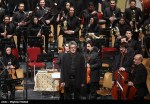
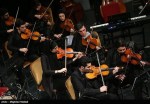
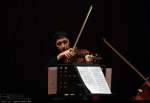
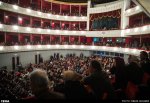
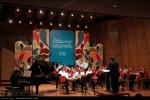
Photos: Rehearsal of Tehran’s Symphony Orchestra

“I walked on to the stage and the audience rose to its feet,” said Alexander Rahbari, the principal conductor. “I’ve performed for 40 years outside Iran and never seen a standing ovation before the performance. This was something totally different. It showed what having the orchestra back meant to them. I was close to tears.”

The photos were taken during rehearsals at Vahdat Hall, Tehran, before performing for the first time after three years.

Related article:
The Guardian | Tehran’s reborn symphony orchestra: an ovation before playing a note

Sources: Honaronline | Photos, musicboard.ir | News (in Persian)

Monir Shahroudy Farmanfarmaian: First Iranian artist to have a solo exhibition at the Guggenheim, New York

Farmanfarmaian, now 92, is a renowned Iranian visual artist known for her geometric style and mirror sculptures. She became the first Iranian artist to have her work featured in a solo exhibition at the Guggenheim; a retrospective, spanning four decades of work: “Infinite Possibility: Mirror Works and Drawings 1974–2014”, organized by the Serralves Museum of Contemporary Art, Porto, Portugal.

In 2011, Vogue — where she worked early on as a freelance illustrator — featured her when she was the subject of an art book. “Whatever time I have left, I want to make art,” she said in the Vogue interview. “And I hope it will be worthwhile to see it.”

Contemporary Iranian art has a decades-long history in the West — though artists are now exhibiting their work with increasing frequency in the United States and Europe.

From September 2013 to January 2014, the Asia Society in New York exhibited Iran Modern. The show featured a diverse body of work from numerous artists that spanned the three decades leading up to the revolution of 1979.

In January and February of this year, the Taymour Grahne Gallery presented Traveling Demons, a collection of colorful and haunting pieces by Malekeh Nayiny, who was born in Tehran and currently lives in Paris.

And while Farmanfarmaian’s work was at the Guggenheim, the works of famed sculptor Parviz Tanavoli was on display at the Davis Museum at Wellesley College. Like Farmanfarmaian, Tanavoli is also the first Iranian artist to have a solo show at that space.

Shiva Balaghi co-curated the Tanavoli exhibition, and is a visiting scholar in Middle Eastern studies at Brown University. As one of the few academics in the country who specializes in Middle Eastern art history, Balaghi is quick to debunk notions of an Iranian art renaissance in the U.S., despite its recent popularity in the American art world.

“A reemergence is not really true,” she told BuzzFeed News. “The fact that there’s a growing interest in the West is key, not that this art hasn’t been made before.” Balaghi’s theory is that art institutions are beginning to look beyond Iran’s current political climate and explore the country through its art.

“It’s almost like museums are taking on this cultural diplomacy role,” she said. “There’s a cultural life in that country that continues and flourishes, one that doesn’t have to do with nuclear negotiations.”

Related articles to Monir Shahroudy Farmanfarmaian:
Iranian Roots | Monir Shahroudy Farmanfarmaian – Iranian Artist (Bio)
The Huffington Post | 90-Year-Old Iranian Artist Monir Shahroudy Farmanfarmaian Gets Her First Comprehensive U.S. Exhibition
The Guardian | Infinite Possibility: Monir Shahroudy Farmanfarmaian

Source: BuzzFeed News | This Iranian Artist Is Making History At The Guggenheim

The Great Game: Iran’s pavillion at the Venice Biennale

In a 2000 square meter old storage for marine engines are works by Iranian Farhad Ahrarnia, but also Iraqis Adel Abidin and Wafaa Bilal, and the Indians Hema Upadhyay and Riyas Komu on display. These are some of the forty-nine artists invited to interpret The Great Game, the exhibition project of the Iran Pavilion, curated by Marco Meneguzzo and Mazdak Faiznia for the 56th Venice Biennale.

“The Great Game” is followed by the Iranian Highlights exhibit with works by Samira Alikhanzaradeh, Mahmoud Bakhshi Moakhar, Jamshid Bayrami and Mohammed Ehsai.


The Great Game is an expression used to indicate the strategic rivalry and conflict between the British Empire and the Russian Empire for supremacy in Central Asia. The path evoking this expression provides a look at authors from India to Iran and Azerbaijan, testifying to the existence of a cultural flow and creating a shared, universal language.

The 56th Venice Biennale “All the World’s Futures”, curated by Okwui Enwezor, runs from May 9th to November 22nd, 2015.

Artists in Iran’s pavilion
Iranian Highlights
Samira Alikhanzaradeh, Mahmoud Bakhshi Moakhar, Jamshid Bayrami, Mohammed Ehsai

The Great Game
Lida Abdul, Bani Abidi, Adel Abidin, Amin Agheai, Ghodratollah Agheli, Shahriar Ahmadi, Parastou Ahovan, Farhad Ahrarnia, Rashad Alakbarov, Furat al Jamil, Nazgol Ansarinia, Reza Aramesh, Alireza Astaneh, Sonia Balassanian, Mahmoud Bakhshi Moakhar, Wafaa Bilal, Mehdi Farhadian, Shadi Ghadirian, Shilpa Gupta, Ghasem Hajizadeh, Shamsia Hassani, Sahand Hesamiyan, Sitara Ibrahimova, Pouran Jinchi, Amar Kanwar, Babak Kazemi, Ryas Komu, Farideh Lashai, Farokh Mahdavi, Ahmad Morshedloo, Mehrdad Mohebali, Huma Mulji, Azad Nanakeli, Jamal Penjweny, Imran Qureshi, Sara Rahbar, Rashid Rana, Atefeh Samaei, T.V. Santhosh, Walid Siti, Monir Shahroudy Farmanfarmaian, Mohsen Taasha Wahidi, Mitra Tabrizian, Parviz Tanavoli, Newsha Tavakolian, Sadegh Tirafkan, Hema Upadhyay, Saira Wasim

Related information:
The Guardian | Iran goes back to the future at Venice Biennale
Sothebys | Highlights From The Venice Biennale’s Iran Pavilion

Sources: La Biennale di Venezia | National participations, Artribune | Il padiglione dell’Iran raccontato da Marco Meneguzzo (Italian), Facebook | Iranian Pavilion – La Biennale di Venezia 2015 | Photos, ISNA | News photo

2015 Tehran Auction: Sohrab Sepehri’s painting sold for $965k

The fourth Tehran Auction has broken the all-time record of Iran’s art auctions thanks to the sale of a painting by Sohrab Sepehri for over $965,000 (€865,000), which brought the total revenue of the sales to over $7.25 million (€6.5 million).

The second most expensive sale of the event was another painting by the late Iranian poet and painter, which was sold for about $600,000. A total of 126 works by various artists, including Masoud Arabshahi, Mohammad Ehsaii, Jalil Rasouli, Behjat Sadr, and Parviz Kalantari went under the hammer.

The event, dubbed Modern and Contemporary Iranian Art Auction, was hosted by Iranian actor Reza Kianian at Tehran’s Grand Azadi Hotel.

Related articles:
The other Iran | 2014 Tehran Art Auction grosses over $4 million,
The Guardian | Tehran auction shifts millions of pounds worth of art in spite of sanctions

Sources: Press TV | Iran | Culture, IRNA | Photos, ISNA | Photos, Fars News Agency | Photos, Tehran Auction | 2015 Lot

Photos compilation: A gallery as big as Tehran

In a project, called ‘A Gallery As Big As a Town’, aiming to encourage people to visit museums, the city’s billboard ads were home for artworks by renowned local and foreign artists for 10 days, turning the Iranian capital into a giant urban art gallery.

There were more than 1,500 billboards dotted across the capital’s streets, displaying a total of 700 works that also included reproductions of traditional Persian miniatures, carpets, calligraphy and various other art pieces.

Iranian artworks were selected from different periods of Islamic and pre-Islamic arts including potteries, glassware, etc. and contemporary and modern period which displayed works by Kamal-ol-Molk and his students.

Related articles:
The Guardian | Tehran swaps ‘death to America’ billboards for Picasso and Matisse
The New York Times | Suddenly, Tehran’s Mayor Becomes a Patron of the Arts
The Huffington Post | Tehran Becomes Giant Open-Air Art Gallery

Sources: Mehr News Agency | News, Tehran Picture Agency 1, Tehran Picture Agency 2, Mehr News Agency | Photos, Tasnim News Agency | Photos 1, Tasnim News Agency | Photos 2

Interview with US Jazz saxophonist Bob Belden (first American musician to perform in Iran after 35 years)

Before the New York-based multi-instrumentalist, composer and producer Bob Belden brought his band ANIMATION to Tehran, Iran, last month, it had been more than 35 years since American musicians had performed in the Middle Eastern country. Belden and his group performed to a sold-out, ecstatic audience of appreciative fans at Tehran’s Vahdat Auditorium and also got the chance to see parts of the country and meet with local residents.

Here parts of the Interview with the bands lead Bob Belden:

Did you have any resistance or other challenges from either American or Iranian officials?
BB: We never met nor saw any American officials and the Iranians officials we met and worked with were fantastic; a beautiful sense of humor, visionary, erudite and very open about our music. No challenges at any point during our stay in Iran. None! Smooth sailing from day one till we left on day nine, excepting some logistical issues beyond our control (huge traffic jams and the lingering effects of jet lag). Actually the only real challenge we had was eating all of the food that was laid out before us for breakfast, lunch and dinner. The city of Isfahan gave us credit to purchase gifts to take back home.

Where did you perform and what was the venue and the audience like?
BB: We had three gigs, only one with ANIMATION. The first “gig” was at a private school in Isfahan where young kids (ages 6-14) learn classical Iranian music. We listened to them perform and then jammed with them at the end of the informal concert. The second gig was only myself and Pete Clagett on trumpet and we performed at the Azadi Sports Complex in Tehran during the World Greco-Roman Championships. What was significant about that gig was the group we played with: eight Iranian musicians including three women in the group. We performed the traditional Iranian national anthem (“Ey Iran”) but what made this moment special was the inclusion of women at a sporting event in a Muslim country. Never happened before. Our final gig, the gig that was our purpose for being in Iran, was held at the old Tehran Opera House now named Vahdat Hall. A classical opera house by German design, the acoustics and the sound system were perfect. The stage crew was first-rate all the way. Great gear and a fantastic Iranian-American engineer Hamidreza Maleki recorded the event.

Were the Iranian people welcoming to American musicians?
BB: Incredibly welcoming. Everywhere we went the people we met we very happy to see us and then astounded that we were musicians and then euphoric that we played jazz. The word jazz means a lot to people outside the U.S. And we did come in contact with a lot of Iranians from all walks of life. We hung out at a Starbucks in Isfahan and met a lot of younger Iranians and we ended up posing for a lot of photos with those at the cafe. The Starbucks is not official but a personal note to Starbucks in the U.S.: huge market in Iran for your coffee and brand! (I don’t drink coffee but the cafe also had tea!).

There’s a photo of the audience giving the band a standing ovation. What did the people you spoke to there say about the music?
BB: The applause spoke for everyone at the concert. We got a lot of hits on Facebook from Iran and even people from the audience posting photos and sending pictures to the guys in the band. We did not go there to find exacting understanding of what we played (this does not exist in the U.S. either) but to find a common need for expression. Everyone in the audience at the hall just enjoyed the music outright and, most important, the Ministers of Culture and Guidance were in the front row applauding not only our concert but their effort to bring us there. We all made the gig!!

What was your perception of the Iranian people’s understanding of and appreciation for jazz?
BB: There has been a gap of information as to the specific development and nature of jazz in the U.S. since the Iranian Revolution in 1979. Mostly the Iranians have been exposed to Europeans as the travel restrictions were not as difficult for musicians from Europe. That is why in Europe what we did is not deemed so important. I can’t speak for an entire country’s understanding of any music so I have no real idea of their appreciation of what anyone in the U.S. calls “jazz.” But it did not matter as the music culture in Iran is very deep and is thousands of years old. So they could relate to us based on pure musicianship, beyond the contextually limited language of jazz.

Did you get a chance to interact with Iranian musicians, and if so, what did they tell you?
BB: We interacted with some kids in Isfahan and also some classical musicians in Tehran. As this was an expeditionary trip we could not meet with musicians en masse. We did play with Iranian musicians at the Azadi Sports Complex. We did meet some Iranian musicians backstage at our concerts with the promise of returning to work with and record with Iranian musicians.

What would you like Americans, many of whom have been taught that Iran is not a U.S.-friendly nation, to know about the country and its people now that you’ve seen it first-hand?
BB: Perception is easy to create. Misperception is hard to break. In the U.S., for the most part since the Iranian Revolution, Iran has been subjected to a political and cultural analysis that is always shone in a negative light. It was as if thousands of years of history were negated to a footnote and the only history we intend to maintain in the U.S. is from 1979 onwards. This myopic view is not based on logic but composed of a systemic ignorance of global culture that is enabled by a weak education system in the U.S. and intense partisan calibrations meant to maintain a dark cloak of intrigue about Iran by people or entities that have agendas not expressed in their public statements. But a country is also made up of people, actual human beings, and this is what is most important for American citizens to understand. At the human level Iranians are the same as Americans. They eat food, they drink water, they have children and send them to schools. The parents fret over their kids just as parents here. People work for a living, they go to the movies, watch TV, ride the subways or buses to get to and from work. Young women scream at rock concerts for their favorite band. The traffic is similar to Los Angeles. English is spoken openly and quite well. Street signs are in Farsi and English. Magazines are in English and there are English newspapers. They have their own Burger Kings (called King Burger!), KFCs and pizza joints mixed with traditional Iranian food. And we ate at a truck stop that was emblazoned with the words FAST FOOD. For jazz musicians the words Truck Stop and Fast Food make you homesick!!

We could not sum up an entire country’s psyche in a week’s experience inside the country. Iran is a glorious and complicated country that lives in many different worlds at the same time, from the ancient to the modern. The people we met and worked with are beautiful people by any cultural definition. Sincere charm, subtle elegance and a very cosmopolitan demeanor were common in many of the people we met. Iran possesses a graceful and pastoral understanding of Islam. What we understood from being in an Islamic country is that if you use common sense and display an open respect for others then there is no problem at all reconciling the two views.

Source: Jazz Times | Bringing cultures together in peace

German guitarists joined tar virtuoso Keyvan Saket in Tehran concert

Seventeen guitarists led by conductor Helmut Oesterreich and supported by German’s Goethe Institute joined Iranian tar and setar virtuoso Keyvan Saket to give a fusion concert at Tehran’s Vahdat Hall.

The program was composed of three sections, the first contained compositions from the Baroque and Renaissance eras. In the second part Keyvan Saket accompanied the group as a soloist. The fusion concert “Meeting East and West in Mirror of Tar and Guitar” had Keyvan Saket, the orchestra and the guitarists performing together on the third section.

Other Germany related articles: https://theotheriran.com/tag/germany/

Sources: Tehran Times | News, Mehr News Agency | Photos, Honaronline.ir | News (in Persian)

Photography: Sheed Award – Exhibition in Tehran

Selected photos of the 5th edition of SHEED Award (Independent Award for Social Documentary Photography) were exhibited at the Iranian Artist’s Forum. Workshops, meetings and lectures by experts and professionals were also held parallel to the event.

The selected works have been chosen by a jury composed of five members including Mehran Mohajer, Peyman Hooshmandzadeh, Jalal Shams Azaran, Mehdi Vosughnia and Arash Khamushi.

About Sheed Award
Founded in 2010, Sheed Award is an independent, non-profit and non-governmental photography award presented annually to a social documentary photographer. The award aims to encourage and promote social documentary photography among Iranian photographers.

Sources: Tavoos Online | News, Facebook Sheed Award | Photos, ISNA | Photos, Honaronline 1, Honaronline 2

Retrospective of Iranian artist Bahman Mohasses at Tehran galleries

Two galleries in Tehran are holding a retrospective of painter and sculptor Bahman Mohasses (1921-2010) in a joint project entitled 60 Pieces of a Lost Object from May 22 to June 12, 2015.

A selection of artworks containing pieces from different periods are put on display at the Arya and Ab-Anbar galleries. Rare abstract works by Mohasses along with his lithographs, sculptures and paintings are on display in both exhibits.

The exhibit is a follow up to the extensive project of reviewing works by contemporary Iranian artists initiated by Arya and Ab-Anbar galleries, the first of which was dedicated to painter Sirak Melkonian.

Related article: The other Iran | Fifi Howls from Happiness: Documentary on B. Mohasses

About Bahman Mohasses
Born in 1921 in Rasht, Gilan Province, Mohasses was an outstanding painter and sculptor as well as a good translator. Persian translations of works by Italian authors Italo Calvino and Curzio Malaparte, and French authors Eugène Ionesco and Jean Genet are some of his other accomplishments. He studied at the Academy of Art in Rome, and held several solo and group exhibitions in Italy and other countries.

Mohasses returned to Iran in 1963 and staged the play “The Chairs” by Ionesco. Some years later in 1967, he decided to go back to Italy and continued living in Rome until he died. He used to visit Tehran every now and then but few were in touch with him.

Some of his valuable artworks are preserved in Italy and the United States while others are kept in Iran at the Jahan-Nama Museum of the Niavaran Palace and the Tehran Museum of Contemporary Art.

Sources: Tehran Times | News, Mehr News Agency | Photos, Honaronline | News

Photo and cartoons exhibition in Tehran reviews urban space

Over 200 works are currently on display at the Iranian Artists Forum on a showcase entitled Exhibition of Urban Space and Structures.

The exhibit, which aims to lay the groundwork for further urban aesthetics and a safer environment, will end on May 30.

Sources: Tavoos Online | News, Mehr News Agency | Photos

Hamid Saeid: Iranian musician

Since his Internet hit, “Bad Shans” (hard luck), Hamid Saeid has become one of the best-known Iranian musicians with African roots. He’s traveled by motorbike across the province of Hormozgan, which is situated in the South of the country on the Persian Gulf, in order to realize his dream; to organize a concert with the best black musicians in the country. The documentary Dingomaro – Iran’s Black South by Kamran Heidari is a testimony of this trip.

Listen to Hamid Saeid performing Bad Shans (Hard luck):

Source: Autentic | Dingomaro – Iran’s Black South

Contemporary posters by Swiss graphic designers displayed at Tehran exhibit

The exhibition took place at the Iranian Artists Forum in Tehran and displayed fresh look at the typography, posters and contemporary Swiss design.

There were works by a number of Swiss graphic designers on display, including Flavia Cocchi, Nadine Kamber, Claude Kuhn, Felix Pfäffli, Melchior Imboden, Erich Brechbühl, K. Domenic Geissbühler, Megi Zumstein, Claudio Barandun, Jean-Benoit Levy and Roger Pfund.

Iranian artists Ebrahim Haghighi, Ghobad Shiva, Amrollah Farhadi, Saeed Babavand and Ambassador of Switzerland to Iran Giulio Haas attended to the opening ceremony.

Sources: Tehran Times | News, Mehr News Agency | Photos, Iranian Artists Forum | Gallery (Photos: Leila Ebrahimi), Iranian Artists Forum | News (Photos: Leila Ebrahimi), Mehr News Agency | News

Interview with German cellist Anja Lechner about her concerts in Iran

Anja Lechner, along with François Couturier – a veteran French pianist, previously performed concerts with the Tarkovsky Quartet during the 28th Fajr International Music Festival in Tehran in February 2013 and she also joined Armenian pianist Artur Avanesov in February 2014 to perform Garden II composed by Hushyar Khayyam in Tehran.

The following is an excerpt of an interview with the German musician translated by Iran Front Page:

Ms. Lechner, have you had a good time in Iran?
I must answer your question in one word: absolutely. Its attractiveness has made me travel to Tehran for a third time. During my trips to Iran, I have found it easy to establish a bond with the local culture and traditions. If I research my genealogy, I might come across my Eastern stock.

Were you satisfied with your two performances at Niavaran Cultural Center?
First of all, I found it unusual to stage solo performances for two nights in a row; it’s uncommon even in places where there is a mass audience. All tickets were sold out for the two solo performances, something which I had never experienced throughout my musical career. It struck me as unusual. To me, it’s one of the reasons why I consider performing in Iran appealing.

How was your performance received?
What was more important than the packed house was the way the audience formed a bond with us. That how much listeners concentrate on the quality of performance or digest the music in a heartfelt manner differs from audience to audience. For instance, I have not seen it much in Germany or other countries. People there might have considerable knowledge of previous works, but they listen to music, relying more on their prior knowledge than listening to the music. Musicians do not experience what happens in Iran very often; particularly in my case, because I opted for pieces which had not been heard much.

Germany related posts: The other Iran | Germany

Sources: Iran Front Page | Interviews, musicboard.ir | Anja Lechner Apr. 2015 (Photos: Ali Tajik), Mehr News Agency | News, Honaronline.ir | Anja Lechner at Niavaran 2015 (in Persian), Honaronline interview with Anja Lechner (in Persian)

Video: Impressions of US musician Bob Belden on Iran

The audience members in Tehran’s Vahdat concert hall rose from their seats, clapping wildly as the frontman Bob Belden, a fun-loving New Yorker with a predilection for loud shirts, rested his soprano saxophone on a nearby stand.

“We love you Bob!” someone shouted in English from the balcony after Mr. Belden, 58, finished his third song of the night. A Grammy Award-winning producer, composer and jazz performer, he smiled broadly. “It is an utter honor to be here in Iran,” Mr. Belden said, drawing even more cheers.

The concert last Friday was the first by an American musician in Iran since the 1979 revolution.

View Bob’s impressions on Video (Playlist: 4 short videos – keep on watching):

Officials from the Ministry of Culture and Islamic Guidance sat in the front row, nodding their heads to renditions of tunes by Miles Davis, Herbie Hancock and Mr. Belden’s own compositions. The Iranians who filled the 1,200-seat theater clapped and cheered. They recorded video with their mobile phones of Mr. Belden and his four bandmates, who did little to suppress their own enthusiasm, waving, smiling and taking their own pictures of the audience.

The Tehran gig was the end of a short, wild tour through a country that officially considers the United States its enemy, but where people go out of their way to please guests, especially when they are American.

“This guy comes up to me, an Iranian; asks me where I’m from. I say, ‘America!’ He says, ‘I love you!’ ”

Mr. Belden said before Friday’s concert. “I tell him I’m a jazz musician. He says, ‘I love jazz!’ ”. “Everybody is nice to us here,” he added.

Source: The New York Times | Rebirth of the cool: American music makes a return to Iran

Photo gallery: Iran Fajr Music Festival 2015 – Summary, Winners & Closing Ceremony

Fajr International Music Festival is Iran’s most prestigious Music Festival founded in 1986. The festival is affiliated with UNESCO and includes national and international competition sections.

Since its establishment, many musicians from several countries like Austria, Germany, France participated in the event. The festival have enjoyed a strong presence of Asian countries as well.

This year ten foreign groups performed 15 concerts. The groups were from USA, Germany, Austria, the Netherlands, Italy, Switzerland, Estonia, Armenia, Tunisia and Iraq:

[Click the names of the artists to see the according posts and photo galleries on this blog]
US American saxophonist and Grammy Award winner Bob Belden and his band Animation
Austria-based German clarinet virtuoso Ulrich Drechsler. Italian jazz pianist Stefano Battaglia.
Italian quartet Maurice led by violinist it Georgia Privera. Laura Bertolino, Francesco Vernero and Aline Privitera are the other members of the quartet. The Iraqi National Symphony Orchestra. German Jazz-pianist and composer Johan Wendt, also known as Joja Wendt.
A string orchestra from Estonia, two duets from Armenia and musicians from Austria and Tunisia. Dutch quartet composed of tenor and soprano saxophonist Yuri Honing, pianist Wolfert Brederode, double bassist Ruben Samama and drummer Joost Lijbaart.

In the National Music section, Mohammad Reza Amou-Javadi was selected as the best composer. While, Kourosh Matin, Keyvan A’laei, Massoud Najafi and Hassan Soleimani were honored.

Houman Rofrof and Mohammad Hadi Ayanbod were jointly awarded as best composers in the non-Iranian Classical Music section. Ali Afshari was also honored. The Hamnavazan ensemble topped the Iranian Classical Music section.

Amir Hossein Ramezani and Maryam Sharifzadeh topped the Music Theses section, while Pirouzan Kouhi was honored.

The Ava-ye Mahan Choir, conducted by Nima Fatehi, was honored as the best vocal.

Sources: wikipedia | Fajr International Music Festival, Tehran Times, Iran Daily, IRNA | Photos, IRIB | Galleries, Tasnim News | Photos

30th Fajr International Music Festival in Iran – Photo gallery (part 2)

Some of the performers shown in the photo gallery below were covered earlier in this blog. To get some back ground and more photos or videos, please click:
https://theotheriran.com/tag/music/

Click on a photo to open in original size, and navigate through the gallery.

Sources:
IRNA| Photos 1, 2, 3, 4, 5, 6, 7, 8, 9, 10,
ISNA | Photos 1, 2, 3
Tasnim News | Photos 1, 2

German artist Otto Piene’s “Rainbow” exhibited in Tehran Museum of Contemporary Art in Iran

A collection from the “Rainbow” series by German artist Otto Piene is currently being showcased at Tehran Museum of Contemporary Art.

Tehran Museum of Contemporary Art is hosting a collection of artworks by the German painter, printmaker and environmental artist, as well as the founder of the influential European postwar movement Group Zero Otto Piene.

This is the fourth time this museum hosts German artists’ artworks. But this is Piene’s first ever exhibit in the Middle East which opened at Tehran Museum of Contemporary Art on Tuesday evening, revealing a variety of artworks ranging from paintings to light sculptures, smoke and fire paintings, and beautiful environmental “sky art.”

Sky art is a term he coined in 1969, which allowed him to use landscape and cities themselves as the focal point of his work.

Most of Piene’s works have been inspired by nature and based on the four elements of ‘light, fire, air and earth’ which points to the philosophical viewpoint of this avant-garde artist.

The first galleries of the museum is dedicated to his rainbow works and silkscreen prints. Then his other works are put on display which are the combination of grids with sources of fire (candles, gas-burners) producing smoke-traces and fire paintings, in which the paint was burnt.

One of his works in particular is said to have been specially made for Tehran exhibition. It is the light sculpture inspired by tile works of Imam Mosque which has been created from glass.

With much regret, Piene passed away in July 2014, and did not get the chance to attend the exhibition in Tehran.

He always sought a better world in his dreams and believed his most brilliant work was to light up the dark sky.

The exhibit of this German artist will be running until April 17 at the museum located on North Kargar St., next to Laleh Park.

Sources: Deutsche Welle | Farsi, Deutsche Welle, Mehr News Agency

Italian jazz pianist Stefano Battaglia performed in Iran

The two-part rendition by the famous Italian pianist Stefano Battaglia and the renowned German clarinet player Ulrich Drechsler saw music fans fill the hall leaving no vacant seats.

The duet, performed Saturday night, in the international section of the festival at Tehran’s Rudaki Hall, had the audience mesmerized for the high quality musical by the two virtuosos, IRNA reports.

Read more what Ulrich Drechsler said about Iran and Iranians here

Sources: Italian Embassy Tehran, Financial Tribune, IRNA | Photos


Austria-based German clarinet virtuoso Ulrich Drechsler: “I like Iranians for their kindness, politeness, and hospitality.”

Austria-based German clarinet virtuoso Ulrich Drechsler attended the 30th Fajr International Music Festival in Iran.

Austria based German clarinet virtuoso Ulrich Drechsler

Austria based German clarinet virtuoso Ulrich Drechsler

“I am addicted to food. When I came to Iran and a friend took me to a restaurant in northern district of Tehran and had kebab with a taste of saffron, I was in high spirits,” Ulrich Drechsler told the Persian service of ISNA on Sunday.
“Pomegranate juice and saffron ice cream, these are incredible and awesome. You make use of a variety of spice and vegetables in your food. I think I would own a restaurant in Iran if I could come back to this world once again,’ he exclaimed.

He continued that this is his second trip to Iran and hoped to return again in spring or summer.

“I have only stayed in Tehran during these days and have got to know only a little part of your culture. My friends have shown beautiful places like the Music Museum of Iran, and I was surprised to see such numbers of Iranian musical instruments,” he stated.

“I must say that the main thing in my life is my family, then food and after that music. I have fallen in love with Iranian life and the Iranian mentality,” he stated.

Drechsler also noted that he has got familiar with Iranian traditional music through works of Kayhan Kalhor, the famous Kamancheh (knee fiddle) player, and is a big fan of his works. He believes that music in Iran comes from the heart of the players so the factor of emotion “is so prominent in it.” Coming for the second time to Iran, he said, “I like Iranians for their kindness, politeness, and hospitality.”

Ulrich Drechsler and Italian jazz pianist Stefano Battaglia have given two performances at the festival, which will come to an end on February 20.

The Iranian audience was highly entertained by a series of lullabies that Ulrich Drechsler performed at his concerts during the festival.

All posts about Music and foreign musicians in Iran on this blog:
https://theotheriran.com/tag/music/

Sources: Financial Tribune, Tehran Times

30th Fajr International Music Festival in Iran – Photo gallery (part 1)

Fajr International Music Festival is Iran’s most prestigious Music Festival founded in 1986. The festival is affiliated with UNESCO and includes national and international competition sections.

Since its establishment, many musicians from several countries like Austria, Germany, France participated in the event. The festival have enjoyed a strong presence of Asian countries as well.

In addition to Iranian groups, this year ten foreign groups performed 15 concerts.

We had already posts about:
Dutch saxophonist Yuri Honing and his band
US American saxophonist and Grammy Award winner Bob Belden

Sources: wikipedia | Fajr International Music Festival, Tehran Times, ISNA | Photos 1, ISNA | Photos 2, ISNA | Photos 3

Dutch saxophonist Yuri Honing and Band at Fajr Music Festival in Tehran, Iran

Dutch jazz saxophonist Yuri Honing performed a quartet at Tehran’s Vahdat Hall on February 15 during the 30th edition of Fajr International Music Festival

An interesting statement Yuri did during his visit in Tehran was the following: “What one hears and reads about the Middle East in Europe does not conform to realities on the ground, including in Iran.”

About Yuri Honing
Yuri Honing is one of Holland’s most important saxophone players (according to the Penguin Guide to Jazz on CD and the Oxford Introduction to jazz). Yuri Honing started his own Trio in 1990, with bassist Tony Overwater and drummer Joost Lijbaart. The absence of a chordal instrument in the band gives the threesome great harmonic freedom.

Honing had his first major success in 1996 with his album Star Tracks, which comprised recordings of pop songs as an alternative to the American Songbook. The album became a hit in the Netherlands and Germany, and gained significant notice in the UK as well.

His album ‘Seven’ recorded with Paul Bley, Gary Peacock and Paul Motion received the Edison Jazz Award (Dutch Grammy) in 2001.
In 2012 Yuri Honing was awarded with the Boy Edgar Prize, the most prestigious jazz prize in the Netherlands.

Other career highlights:
2001 Honing toured with Bley and bassist Charlie Haden.
2003 He performed with guitarist Pat Metheny and bassist Scott Colley.
2006 He recorded Symphonic with arranger and composer Vince Mendoza.

More photos including other artists: ISNA Photos

Sources: ISNA Photos, wikipedia | Yuri Honing, Iran Front Page

Ten-year-old Iranian girl Fatemeh Mahallati honored at Japanese drawing competition

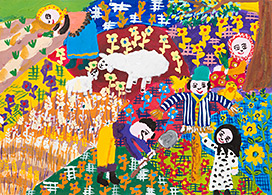
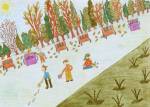
15th International Environmental Children's Drawing Contest - First Prize - International Section - by 10-year-old Fatemeh Mahallati  from Iran

by 10-year-old Fatemeh Mahallati from Iran

Ten-year-old Iranian girl Fatemeh Mahallati has won one of 45 first prizes in the international section of the 14th International Environmental Children’s Drawing Contest in Japan. Her work depicts a number of people working on a farm.

“In my painting, I drew animals, flowers and people who are working on a farm and they are happy as they are living in nature,” Fatemeh told the Persian service of ISNA on Sunday.

“What I drew in my painting were the things I have previously seen in my visits to farms and green areas,” she added. “The environment and nature are important and we should protect the things concerning nature,” she stated.

Fatemeh has been a member of the Institute for the Intellectual Development of Children and Young Adults (IIDCYA) in Raine, a town near the southern Iranian city of Kerman, since 2009.

In a message sent to Fatemeh last week, the director of Iran’s Department of Environment, Masoumeh Ebtekar, congratulated her for achievement at the competition.

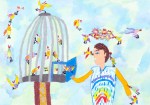
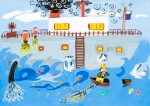
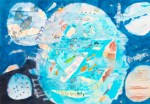
Iranian successes in the previous 14 years (click on the pictures to see them in full size with age of the kid and prize that was won):

The contest was organized the Japan Quality Assurance Organization (JQA), the International Certification Network (IQNet) and the Tokyo branch of UNICEF.

The 6-year-old Japanese child, Kusaka Nana, won the Environmental Best Prize, which is the top honor of the contest.

The best prize of the international section was presented to the 12-year-old Ukrainian boy, Oleksiy Rakoma, and the UNICEF special prize went to the 7-year-old Bangladeshi boy, Raihan Fairooz Tarannum.

About the contest:
Since 1999, Japan Quality Assurance Organization (JQA) and International Certification Organization Network (IQNet) have been hosting the International Environmental Children’s Drawing Contest for children aged 7 to 15 years old from around the world, supported by UNICEF Tokyo Office.
So far, the contest has been held 15 times with over 21,000 entries that this year we’ve had entries from a record breaking 81 countries. In total, we have received more than 220,000 drawings up to now.
Full of imagination and artistic sensitivity, children drew pictures about nature and animals, their families and the surrounding area. The pictures also contain the message towards global environment, beyond borders and difference in their background cultures and languages.

Sources: Tehran Times , The International Environmental Children’s Drawing Contest

Hossein Alizadeh: Iranian Grammy Award nominee tours Sweden, Denmark, Norway and Italy starting Feb 27

Alizadeh, Hossein - Iranian tar virtuosoIranian tar virtuoso Hossein Alizadeh is scheduled to tour Europe to perform a series of concerts entitled “The Art of Improvisation”.

Kamancheh player Saba, who is Alizadeh’s son, and tombak virtuoso Behnam Samani will accompany him during the tour, which will begin at the Gothenburg Symphony Orchestra in Gothenburg, Sweden on February 27.

The group will then perform at the Hvidovre Main Library in Copenhagen, the most populated city in Denmark.

Cosmopolite Scene in Oslo, Norway, will be the next stop for the ensemble on March 1 and then the group will leave for Venice to perform at the Centro Culturale Candiani on March 6.

The tour will come to an end at San Luigi Guanella, a major theater in Rome, on March 7.

The concerts will offer an attractive combination of traditional Persian music with an amalgam of percussion and stringed indigenous Iranian instruments.

About Hossein Alizadeh:
Hossein Alizâdeh , is an Iranian composer, radif-preserver, researcher, teacher, and tar and setar instrumentalist and improviser, described by Allmusic as a leading Iranian classical composer and musician.

He has made numerous recording with prominent musicians including Shajarian, Nazeri, Madjid Khaladj, and Gasparyan, and is a member of the Musical group, Masters of Persian Music.

Alizadeh was born in 1951 in Tehran to Azeri and Persian parents. He graduated from the music conservatory in 1975 and entered the school of fine arts in the University of Tehran where he studied composition and Persian music. He continued his education at the Berlin University of the Arts in composition and musicology. He studied with various masters of Traditional Persian Music such as Houshang Zarif, Ali Akbar Shahnazi, Nur-Ali Borumand, Mahmoud Karimi, Abdollah Davami, Yusef Forutan, and Sa’id Hormozi. From these masters he learned the radif of Persian classical music.

Alizadeh has performed extensively throughout the United States, Europe, and Asia and has appeared on many radio and television programs, including Radio France, RIAS in Berlin, WDR in Cologne, the BBC, KCRW in Los Angeles, and KPFA in Berkeley. Some of Alizadeh’s most noted compositions are, The Nava Improvisations (1976), Riders of the Plains of Hope (1977), Hesar (1977), Revolt (1983) for harp, string orchestra, and percussion, NeyNava (1983), Dream (1986) for harp and flute, Torkaman (1986), Raz-O-Niaz (1986), and Song of Compassion (1991).

He has been nominated for the 2007 Grammy Award along with Armenian musician, Djivan Gasparyan, for their collaboration album, The Endless Vision. In 2008, he was voted as “Iran’s most distinguished musician of the year”.

Listen to his music on last.fm: http://www.last.fm/music/Hossein+Alizadeh

Sources: Tehran Times , Wikipedia | Hossein Alizadeh , Iran Chamber

US American saxophonist and Grammy Award winner Bob Belden: “I will never forget Iran”

American saxophonist Bob Belden, who gave performances with his band Animation in Tehran, says he will never forget Iran.

Trumpeter Pete Clagett, keyboardist Roberto Verastegui, drummer Matt Young, and bassist Jair-Rohm Parker Wells are other members of ‘Animation’ who accompanied Belden in the Tehran performances.

In his short speech before the concert, he expressed his happiness to have been visiting Iran, adding that he and his companions found love and happiness in the presence of the Iranian audience. The musician also referred to their trips to the historical cities of Isfahan and Shiraz and added that they were delighted to see the cities and meet their good people.

In addition, Belden said that during their trips, they met several young Iranian musicians who were very talented. He asserted that he liked Iran and its people very much and especially enjoyed Persian kebab.

He called music the common language among all nations and said that he has found many friends through music in different countries. His speech was followed by performances of several pieces, some of which were from his Grammy nominee compositions.

Speaking of his interest in visiting Iran again, he said that he would download their performance in Tehran on internet sites to let other people watch and see where the concert was performed.

The 30th edition of Fajr International Music Festival ran from February 13 to 20 in different venues across the Iranian capital Tehran.

About Bob Belden:
James Robert Belden (born October 31, 1956) is an American saxophonist, arranger, composer, bandleader and producer. He is noted for his Grammy Award winning jazz orchestral recording titled The Black Dahlia. He is also a past head of A & R for Blue Note Records.

Sources: Payvand News of Iran, Wikipedia | Bob Belden

Iran’s 33rd Fajr Film Festival – winners and closing ceremony

The 33rd edition of Iran’s Fajr International Film Festival has come to an end with “Crazy” by the renowned Abolhasan Davoodi winning the Best Director and the Best Film awards. Produced by Bita Mansuri, Crazy received 11 nominations, including best film, best director for Abolhassan Davudi, best actress for Tannaz Tabatabaii, best cinematographer, best screenplay and best music.

Winners for the national main competition section:

Best Supporting Role Actor – Houman Seyyedi for ‘I Am Diego Maradona’
Best Main Role Actor – Saeed Aghakhani for ‘The Long Farewell’
Best Screenplay – ‘A Time for Love’ by Roya Mohaghegh
Best Director – Abolhasan Davoodi for ‘Crazy’
Best Film – ‘Crazy’ produced by Bita Mansuri
Best Main Role ActressBaran Kousari for ‘Binam Alley’

Sources: Payvand, ISNA | Photos, ISNA | Photos 2, Tasnim News Agency | Photos

Reza Dormishian: Iranian film director, screenwriter and producer

https://i0.wp.com/en.qantara.de/sites/default/files/styles/editor_large/public/uploads/2014/03/10/reza_dormishian-berlinale_foto_0.jpg

Reza Dormishian is an Iranian film director, screenwriter and producer. He has worked as assistant director with remarkable directors such as Dariush Mehrjui, Fereydoun Jeyrani, and Alireza Davood Nejad.

He is one of the most prominent and distinguished directors of the new generation of the Iranian cinema, whose films have always been received well by the people, critics, and international festivals because of their social themes and modern structure.

He started writing as a film critic in 1997 for several newspapers. He later worked as an executive editor for cinema books and magazines. He was an assistant to some prestigious Iranian filmmakers, including Dariush Mehrjui and Alireza Davood Nejad. He has also worked as a screenwriter. He started making short films and documentaries in 2002. Hatred is his first feature film, produced independently in Istanbul. Hatred displays the frenzied love and hatred and two accounts from two phases in the life of an Iranian refugee couple in Istanbul, Turkey. The film was received well by critics and cinema writers and the Iranian critics gave it three awards (Best Directing, Best Cinematography, and Best Editing). Although Hatred was censored to be screened in Iran, it was screened and praised in various festivals such as Competition Section of 36th Montreal Film Festival in Canada, Competition Section of 28th Warsaw Film Festival in Poland, and Competition Section of Camerimage Film Festival in Poland.

Source: Wikipedia | Reza Dormishian

Baran Kosari: Awarded Iranian actress

Baran Kosari, born on October 17th 1985 in Tehran, is an award winning Iranian actress. She is the daughter of director Rakhshan Bani Etemad, and film producer Jahangir Kosari.

She graduated from Soureh academy. The Best Papa of the World (1991) is her first acting experiment. She had appearances in some of her mother’s films, Nargess (1991), Rusari-ye Abi (The Blue-Veiled, 1994), May Lady (1997), Kish Stories (Rain and Ladsman episode – 1998), Under the Skin of the City (2000), Our Times (documentary, 2001).

In 2007 she was nominated for the best performance by an actress in Asia Pacific Screen Award for her performance in Mainline. Baran Kosari also ascertained her abilities as a theater actress with playing in Over the Mirror (1997), with Azita Hajian directing.

Awards
Best Actress / 33rd Fajr International Film Festival / The Nameless Alley (2015)
Best Actress / 1st National Young Iranian Film Festival / Ablah (2010)
Best Actress / 11th Iran Cinema Celebration / Khunbazi (2007)
Best Actress / 25th Fajr International Film Festival / Iran Competition / Khoon Bazi and Ruz-e sevvom (2007)
Honorary Diploma / 25th International Fajr Film Festival / Khoon Bazi (2007)
Best Teenage Actress / Critic’s Choice / Baran-o-Bumi, Zir-e puste shahr (2000)

Other activities
Screenwriter (Ablah – 2007)
Secretary of Scene (Gilaneh – 2004)
Festival Arbiter, 17th Teenage Film Festival (Isfahan – 2002)

Source: Wikipedia | Baran Kosari

Nima Javidi: Awarded Iranian Filmmaker (Biography, scenes from Melbourne and it’s premiere in Iran)

Nima Javidi - Iranian Film directorNima Javidi was born in 1980. A qualified mechanical engineer, Javidi began making short films in 1999 and has made six to date: Marathon Paralyzed Champion (1999), A Call for O (2001), The Poor Earth (2004), Changeable Weather (2007), Crack (2009) and Catnap (2010).

He has also directed two documentaries, Person (2007) and An Ending to an Ancient Profession (2007) and more than 30 television commercials.

Melbourne (2014), which he wrote and directed, is his feature film debut. It recently won Best Film at the Cairo Film Festival and Best Script at the Stockholm Film Festival and opened the Venice Film Critic’s Week.

The following video might be interesting for non Iranians, just to see how Iranian celebrities in Iran visited the premier of the movie. Scenes and Interview with the crew of “Melbourne”:

http://www.youtube.com/watch?v=id-GK_C92K4

Source: Asia Pacific Screen Awards | Nominees & Winners 2014

Two galleries in Tehran are holding a retrospective of awarded Iranian painter Sirak Melkonian

Iranian painter Sirak-Melkonian-1-HR

Iranian painter Sirak Melkonian

Two galleries in Tehran are holding a retrospective of painter Sirak Melkonian in a joint project. A collection of paintings created over the past 70 years by the 85-year-old artist are on display at the Aria and Ab Anbar galleries, the Persian service of ISNA reported on Tuesday.

The two exhibitions opened on January 30 and will run until February 19.

Aria Gallery: 10 Zarrin Alley, off Vali-e Asr Ave.
Ab Anbar Gallery: 2 Roshan Manesh Alley, Khaqani St., off Enqelab Ave.

Biography
Sirak Melkonian was born in Iran in 1931. He gained national recognition in 1957, winning a prize in the Contemporary Iranian Artist Exhibition of the Iran American Society. That achievement was followed by the Imperial Court Prize Tehran Biennale in 1958 and first prize in 1959 for the Tehran Paris Biennale. First prize in 1974 International Art Exhibition In Tehran brought him International acclaim and he was subsequently invited to exhibit his work at the International Exhibit in Basil, Switzerland.
Throughout 1976 and 1977 he exhibited internationally, most notably at the exhibition of Grand Palais and the Salon De Montrouge in Paris, as well as the Washington International Artfair in the United States. Sirak currently lives and teaches in Toronto, Canada.

Awards
1957- Winning a prize in the Contemporary Iranian Artist Exhibition of the Iran American Society.
1958- The Imperial Court Prize Tehran Biennale
1959- First prize for the Tehran Paris Biennale.
1974- First prize for International Art Exhibition In Tehran

Some works by Sirak Melkonian

More works by Sirak Melkonian: Mahart Gallery | Sirak Melkonian

Sources: Facebook | Sirak Melkonian, Payvand News of Iran

Keyhan Kalhor: Iranian music maestro and former Grammy awards nominee to perform in the US and Canada

Iranian musician and Kamancheh virtuoso Kayhan Kalhor along with Indian sitar maestro Shujaat Husain Khan is slated to perform in New York, Boston and Irvine

The duo is planning to present their program accompanied by Ghazal Ensemble in the Michael Schimmel Center for the Arts at Pace University on March 22, 2015.

Ghazal (with Shujaat Hussein Khan and Sandeep Das) March 2015 events are:
13 Mar: Kay Meek Theater, Vancouver, Canada
15 Mar: Skirball Center, Los Anegeles, CA
17 Mar: Irvine Barclay Theater, Irvine, CA
19 Mar: Freer Gallery, Washington, DC
21 Mar: Berklee Performance Center, Boston, MA
22 Mar: Schimmel Center at Pace University, NY
25-28 Mar: Agha Khan Museum, Toronto, Canada
29 Mar: Asia Society Texas Center, Houston, TX

Other Kayhan Kalhor early 2015 events (Europe, US): www.facebook.com/kalhor.kayhan

Iranian Kamancheh virtuoso Kayhan Kalhor

Ghazal Ensemble, formed in 1997 by Kalhor and Husain Khan, has been touring the world and it is acclaimed for performing Indo-Persian music.

Described by the Los Angeles Times as “utterly captivating…an irresistible expression of creative musical passion,” Ghazal’s performances and recordings have garnered critical acclaim as well as a 2004 Grammy nomination for Best Traditional World Music Album for their 2003 live album The Rain. Amazon named Ghazal’s first CD, Lost Songs of the Silk Road, to its list of the best 100 world music albums ever recorded.

Kalhor is known for his brilliant performances on the traditional instrument Kamancheh and creating a unique mixture of classical Persian music with folk tunes of the Kurdistan region.

He held many concerts along with the world-renowned musicians and ensembles such as the string quartet, Brooklyn Rider ensemble, in Minneapolis, United States, in 2012.

Kalhor also presented joint programs with the veteran Turkish Baglama player Erdal Erzincan in New York’s GlobalFest held at the Marlin Room on January 13, 2013.

He also performed introspective performances with a number of world-class Asian musicians at BT River of Music in London.

Shujaat Husain Khan is one of today’s greatest North Indian artists, who represent the seventh generation of illustrious musicians, which includes his father, the great sitarist Ustad Vilayat Khan.

BIOGRAPHY – KAYHAN KALHOR
Kayhan Kalhor is an internationally acclaimed virtuoso on the kamancheh (Persian spiked fiddle). His performances of Persian music and his many collaborations have attracted audiences around the globe.

Born in Tehran, Iran, he began his musical studies at the age of seven. At thirteen, he was invited to work with the National Orchestra of Radio and Television of Iran, where he performed for five years. When he was seventeen he began working with the Shayda Ensemble of the Chavosh Cultural Center, the most prestigious arts organization in Iran at the time.  At a musical conservatory in Tehran around age 20 Kalhor worked under the directorship of Mohammad-Reza Lotfi who is from Northern Khorasan. He has traveled extensively throughout Iran, studying the music of its many regions, in particular those of Khorason and Kordestan. He later moved to Rome and Ottawa to study European classical music.

Kayhan has toured the world as a soloist with various ensembles and orchestras including the New York Philharmonic and the Orchestre National de Lyon.  He is co-founder of the renowned ensembles Dastan, Ghazal: Persian & Indian Improvisations and Masters of Persian Music. Kayhan has composed works for Iran’s most renowned vocalists Mohammad Reza Shajarian and Shahram Nazeri and has also performed and recorded with Iran’s greatest instrumentalists.

Kayhan has composed music for television and film and was most recently featured on the soundtrack of Francis Ford Copolla’s Youth Without Youth in a score that he collaborated on with Osvaldo Golijov. In 2004, Kayhan was invited by American composer John Adams to give a solo recital at Carnegie Hall as part of his Perspectives Series and in the same year he appeared on a double bill at Lincoln Center’s Mostly Mozart Festival, sharing the program with the Festival Orchestra performing the Mozart Requiem. Kayhan is an original member of Yo-Yo Ma’s Silk Road Project and his compositions Blue as the Turquoise Night of Neyshabur, Silent City and Mountains Are Far Away, appear on all three of the Ensemble’s albums. His most recent commission for the Kölner Philharmonic in Germany will be premiered in October 2009.

Three of his recent recordings have been nominated for Grammys, Faryad, Without You and The Rain.  His new CD Silent City, with the innovative ensemble Brooklyn Rider, was released on the World Village label in September 2008 to critical acclaim.

Compositions
– Blue as the Turquoise Night of Neyshabur
– Gallop of a Thousand Horses
– I was There
– The Silent City
– Mountains Are Far Away

Sources: Press TVwww.kayhankalhor.net, Tehran TimesKODOOM.com, Philharmonic Society

Majid Derakhshani: Iranian composer and tar expert

Iranian-tar-musician-Majid-Derakhshani-HRMajid Derakhshani (born 13/09/1957 in Sangesar, Iran) is an acclaimed Iranian musician and composer.

He was born into a family of artists from the Iranian province Semnan. During his studies of string instruments and composition at the University of Tehran, the legendary Mohammad Reza Lotfi became his teacher.

Subsequent to his emigration to Germany he founded the Nawa Musikzentrum in Cologne; the primary and most active center for Persian classical music outside of Iran. In Iran Majid Derakhshani is deemed to be amongst the best on his instrument – the tar. Hence he carries the venerable title Ostad, denoting him as a master of his instrument. His virtuosity has been celebrated worldwide in festivals, concerts, radio and television productions. He is now considered as the best tar player in the world. He has composed for myriads of international musicians, such as the greatly renowned Iranian singer Mohammad Reza Shajarian (Album Dar Khial).

Here a video of his performance with the wonderful Mah Banoo ensemble:

http://www.youtube.com/watch?v=LXC-XPk8Ets

More information and a list of his CDs: wikipedia | Majid Derakshani

More music-related posts: The other Iran | Music


Iranian-American music conductor and composer Shahrdad Rohani directed orchestra in Tehran

Acclaimed music conductor Shahrdad Rohani performed an orchestra for a big audience Friday night at Tehran’s Grand Hall of the Interior Ministry.

Shahrdad Rohani, born May 27, 1954 in Tehran, Iran is an Iranian-American composer, violinist/pianist, and conductor. His style is contemporary and he is well known for composing and conducting classical, instrumental, adult contemporary/new age, film soundtrack as well as pop music.

Early life
His father, Reza Rohani, was an accomplished musician and Shahrdad followed in his father’s footsteps. He started down the path of becoming a musician at the age of five when he learned to play the violin under the instruction of his father.

He was a student to a well-known Persian violinist, Ebrahim Rouhifar. At age 10 he attended the Persian National Music Conservatory of Tehran. He studied with a Swiss teacher named Basil as well as an Armenian teacher named Hagh Nazarian, who taught him to play the piano; they worked together for seven years.

After studying at the Tehran Conservatory, Shahrdad Rohani left his family, many of whom still remain in Iran, and traveled in 1975 to Austria where he attended the Academy and Conservatories of Music in Vienna. Then, in the early 1980’s, he accepted a scholarship to study music at UCLA and moved to the United States.

Musical career
From 1987 until 1991 Mr. Rohani served as the music director and conductor of the COTA symphony orchestra in Los Angeles. He has appeared as a guest conductor with a number of prestigious orchestras including London’s Royal Philharmonic Orchestra, Minnesota Orchestra, Colorado Symphony Orchestra, San Diego Symphony, Indianapolis Symphony Orchestra, New Jersey Symphony, Zagreb Philharmonic Orchestra, the American Youth Philharmonic Orchestras and many others.

Shahrdad arranged the music and conducted the orchestra to supplement Yanni’s keyboard compositions during the Yanni Live at the Acropolis concert in 1993, an open-air concert with the London Royal Philharmonic Concert Orchestra in the Parthenon, Athens, Greece. Shahrdad also played the violin in all but two of the tracks during this concert. Yanni Live at the Acropolis was acclaimed by both critics and audience and became the most widely viewed program ever shown on Public Television in United States and is the second best-selling music video of all time.

Rohani was commissioned in 1998 by the government of Thailand and the committee of the 13th Asian Games to compose and conduct the music for opening ceremonies. The composition became the most popular song of the Asian Games.

In 1999 Rohani received the Thailand’s Pikanes award, the country’s most prestigious music award for an outstanding orchestral performance. The award is considered the highest artistic achievement.

Sources: Mehr News Agency, wikipedia, IIP Digital | U.S. Department of State

Newsha Tavakolian: Iranian photojournalist and documentary photographer

Newsha Tavakolian - Iranian photojournalistNewsha Tavakolian (born 1981 in Tehran) is an Iranian photojournalist and documentary photographer. She has worked for Time Magazine, The New York Times, Le Figaro, and National Geographic. She is particularly known for focusing on women’s issues in her work, and has been a member of the Rawiya women’s photography collective, she co-established in 2011. She lives and works in Tehran.

Career
Born and brought up in Tehran, Tavakolian is a self-taught photographer. She began working professionally in the Iranian press at age of 16, at women’s daily newspaper ‘Zan’, after a 6-month photography course. At the age of 18, she was the youngest photographer to cover the 1999 student uprising, using her Minolta with 50mm lens, her photographs were published in several publications.

She got her international break in 2001 at age 21, when she met J.P. Pappis, founder Polaris Images, New York at photography festival in Perpignan, France. Thereafter, she began covering Iran for Polaris Images, in the same year, and started working as a freelancer for The Times in 2004.

In 2002 she started working internationally, covering the war in Iraq for several months. She has since covered regional conflicts, natural disasters and made social documentary stories in Iraq, Lebanon, Syria, Saudi Arabia, Pakistan and Yemen. Her work is published in international magazines and newspapers such as Time Magazine, Newsweek, Stern, Le Figaro, Colors, The New York Times, Der Spiegel, Le Monde, NRC Handelsblad and The New York Times Magazine.

Countering the predominantly male western dominance on photojurnalism in her region, she brought together a group of six Middle Eastern women photographers, uniting them in the RAWIYAH collective.

A common theme in her work is photo stories of women, friends and neighbours in Iran, evolving role of women in overcoming gender-based restrictions, and contrasts the stereotypes in western media. Her photo projects include Mother of Martyrs (2006), Women in the Axis of Evil (2006), The Day I Became a Woman (2010) and Look (2013), which opened at Thomas Erben Gallery, New York City.

She was part of the 2006 Joop Swart Masterclass organized by World Press Photo. In 2007 she was a finalist for the Inge Morath Award. Her work has been exhibited and collected at institutions such as the British Museum, the Victoria and Albert Museum, Los Angeles County Museum of Art, the Museum of Fine Arts, Boston and Somerset House, London (April 2014), where she was one of eight Iranian photographers featured in the critically acclaimed “Burnt Generation” exhibition.

In 2012, her first book “The Fifth Pillar” was published by Gilgamesh publishers in London, covering her personal take on the annual Muslim pilgrimage, the Hajj. More recently, Newsha was commissioned by the Qatar Foundation to travel around the world for 3 months taking photographs for a book about education to be published in March 2014. Also in 2014 Newsha was a member of the 2014 World Press Photo competition jury. Her work will be exhibited in Paris in November 2014, where also her new book will be launched. After Paris the work will go on a tour to London, Frankfurt and Milan.

Awards
2014 Fifth laureate of the Carmignac Gestion Photojournalism Award.
2009 Magic of Persia Contemporary Art Prize Finalist, United Kingdom
2007 Inge Morath Award, Finalist, Magnum Photo Agency, New York, United States
2006 Joop Swart Masterclass, World Press Photo, Amsterdam, The Netherlands
2006 Still Photography Award from the All Roads Film Project, National Geographic, Washington, D.C, USA
2003 Runner-up in Picture of the Year International Competition, Magazine Feature Category, National Press Photographers Association and Missouri School of Journalism, USA

Books
She Who Tells a Story – Women Photographers from Iran and the Arab World, Kristen Gresh with a foreword by Michket Krifa. MFA Publications, 164 pages, 110 color illustrations
2012 Fifth Pillar, Hajj Pilgrimage, by Newsha Tavakolian, Gilgamesh Publishing House
2010 A History of Women’s Photographers, by Naomi Rosenblum, Abbeville Press.
2008 Iranian Photography Now, by Rose Issa, Hatje Cantz Verlag
2009 Transit Tehran: Young Iran and Its Inspirations, by Malu Halasa and Maziar Bahari, Garnet Publishing

Sources: Newsha Tavakolian Photography, Wikipedia | Newsha Tavakolian

“A Few Cubic Meters of Love” an award winning movie produced by two Afghan refugees that fled to Iran 30 years ago

“A Few Cubic Meters of Love” is a drama on migration and love directed and produced by Afghan brothers Jamshid Mahmudi and Navid Mahmudi who have lived in Iran for the past 30 years. The story of the film is set somewhere in the outskirts of Tehran, where a small factory illegally employs Afghan asylum seekers, who live with their families in old containers or modest shacks in nearby shanty towns. Saber, a young Iranian worker, secretly meets Marona, daughter of Abdolsalam, an Afghan worker. A love story unfolds. “A Few Cubic Meters of Love” is Jamshid Mahmudi’s debut film, which premiered at the 32nd Fajr International Film Festival in Tehran in February 2014. The film won him the Simorgh for best director in the New View section of the festival. “I would have felt bad had we not won any award at this event,” Jamshid Mahmudi said during the review session. “Because we did our best to make the film be warmly received,” he added.

The film is currently on screen at Iranian movies theaters. “The reason behind why Iranian people like this film, is that it is a real-life drama,” Jamshid Mahmudi stated. The film was selected to represent Afghanistan at the 87th Academy Awards in the Best Foreign Language Film category, but was not nominated. http://www.youtube.com/watch?v=Fqz41QkdG4c UNHCR about refugees in Iran: Iran is host to one of the world’s largest and most protracted refugee populations. […] The global economic downturn, removal of subsidies, and intensified international sanctions have caused hyperinflation, affected the delivery of basic services, and resulted in a dramatic rise in living costs in the Islamic Republic of Iran. Some 24 per cent of registered refugees are considered vulnerable, a rate that is expected to increase due to the economic situation. […] Sanctions also continue to negatively impact UNHCR’s ability to provide humanitarian assistance in an effective and timely manner. High inflation rates have substantial consequences for both the operation and partners. Comparison: Refugee numbers – GDP (nominal) per capita with richer and bigger regional neighbor country

Country GDP (nominal) per capita in US dollars Number of hosted refugees
Iran   6,363$ 868,242
Saudi Arabia 25,962$ 550

Must read regarding Afghan refugees in Iran: https://theotheriran.com/tag/afghanistan/ Sources: Payvand News of Iran United Nations High Commissioner for Refugees The Guardian

Photo gallery + Video: Rastak – Iranian Band plays in Gorgan

Here you can enjoy them in action:

http://www.youtube.com/watch?v=zZAQe8jKhwg

Rastak a new ensemble for contemporary Persian folk music was formed as an experimental music group in 1997. The group seeks to collect, record and interpret traditional Persian folk music for a global audience, incorporating language, culture and history also merging traditional instruments and forms with contemporary rhythms. The musicians who comprise Rastak have graduated from the best universities in Iran and have done extensive research into Persian folk music.

History
It all began when Siamak and Behzad became friends on a winter’s day in 1994. Three years later, Siamak and Behzad were discussing the idea of forming an ensemble for folk music based on research, collection and interpretation. In 1997 Rastak Music Group was founded in Tehran. …
2002 marks Rastak’s meeting with renowned musicians in folk music from all around Iran such as: Khalifeh Aghe Ghosi from Kurdistan, Noor Mohammad Dorpoor from Khorasan, Shir Mohammad Espandar From Sistan and Balouchestan, Mohsen Heidarieh from Booshehr, Ashigh Imran & Ashigh Hasan from azerbaidjan, Faroogh Kiani from Khorasan, Abolhasan Khoshroo & Mohammadreza Es’haghi from Mazandaran, Dr. Tekkeh & Ghlich Anvar from Turkemen Sahra. Along with these meetings, Rastak began field recording and collecting folk music pieces. These endeavors prepared the material for one of Rastak’s major productions published under the name of ” minimalism in persian folk music “. These recordings demanded a studio, therefor the group made one.

In 2006, Rastak took new members: Mohammad Mazhari, Yavar Ahmadifar, Akbar Esmaeelipour, Sahar Ebrahim, Sara Naderi, Kaveh Sarvarian and Hale Seyfizade. In addition to the new album, two concerts were conducted which gained considerable popularity.After Majid left and Sara Ahmadi joined the group , Rastak continued hiring educated and versatile musicians in terms of vocal and instrumental skills and capabilities for its international appearances. Eversince this time, Rastak has held worldwide concerts and made numerous recordings.

Sources:

http://irna.ir/fa/Photo/2799616/

http://www.whatsupiran.com/Profile/Rastak/About

Another good read is this beautiful travel blog by a german mexican couple who met Rastak accidently while traveeling through Iran:

http://www.tastingtravels.com/rastak-iranian-music/


“Timeloss” by Iranian theater group Mehr to go on stage in New York and Los Angeles

The Mehr Theater Group led by Iranian director and writer Amir-Reza Kuhestani will perform “Timeloss” in the American cities of New York and Los Angeles. “Timeloss”, a fiery story about the passage of time, is another version of “Dance on Glass”, which Kuhestani staged in 2001.

Iranian play “Timeloss” on stage in the US: 16th to 18th January 2015 / Under The Radard Festival, New York 21st and 22nd January 2015 / Off Center Festival, Segerstrom Center for the Arts, Los Angeles

The play is an entry to “Under the Radar Festival”, a festival tracking new theater from around the world that is taking place at the Public Theater in New York from January 7 to 18.

The troupe will have their first performance Friday night. They will have three more performances at the Public Theater until January 18. Their next performance will be in the Segerstrom Center for the Arts in Los Angeles on January 21 and 22.

Starring Hassan Majuni and Mahin Sadri, the play will be performed in Persian with English supertitles. The play was staged at the Paris Autumn Festival in November 2014. It has also been staged in Hamburg, Brussels, Frankfurt, Geneva and Rotterdam.

Kuhestani is one of Iran’s most successful and prolific playwright-directors. His “Dance on Glass” won international acclaim and toured for four years. He is the first director to win two consecutive awards for the best theater production of the year in Iran for his play “Ivanov” (2011) and “The Fourth Wall” (2012).

Source: Payvand News of Iran

Other interesting related read:
The Guardian | Intimacy, love and separation in contemporary Iranian theatre

Sussan Deyhim Performance at UCLA: The House is Black, on January 23 in Royce Hall Los Angles, USA

Sussan Deyhim, performance artist/vocalist and composer presents her latest work, inspired by the life and poetry of Forugh Farrokhzad, one of Iran’s most influential feminist poets and filmmakers of the 20th Century.

“For me, the most inspiring aspect of this project is the opportunity to introduce the great work and sensibility of an Iranian female icon to the international community. Many Iranian intellectuals consider Forough a cultural godmother of modernist literature in Iran, but she died so young (at the age of 32) that I also think of her as our cultural daughter. A rebel with a cause, Forough spoke with awe-inspiring rawness and maturity. She was an existentialist, feminist provocateur. She was Iran’s Simone de Beauvoir, Frida Kahlo, Maya Deren and Patti Smith all rolled into one. Her work has given me the inspiration to continue my own artistic journey during my 30 years in exile from Iran.”

Biography
Singer Sussan Deyhim was born in Tehran and has had a full career as a dancer. From 1971 to 1975, she was a part of Pars National Ballet, affiliated with Persian National Television. In 1976, she received a scholarship to MUDRA (Maurice Bejart’s School of Performing Arts). She then performed with Bejart’s Ballet of the XX Century.

Since 1980, Deyhim has been based in New York and has performed internationally as a vocalist, performance artist, and composer. She has collaborated with composers Mickey Hart, Jerry Garcia, Peter Gabriel (The Last Temptation of Christ soundtrack), Jaron Lanier, Branford Marsalis, Peter Seherer, Naut Humon, and others. She has also appeared in many international productions, including Jean Claude Van Italie’s The Tibetan Book of the Dead, directed by Assur Banipal Babilla, La Scala in Milan by Micha Van Heugh, and A Midsummer Night’s Dream and Nijinksi with Lindsay Kemp’s English Theatre Group in South America and Italy.

Her primary collaborator is composer and multi-instrumentalist Richard Horowitz. They began their collaboration in 1981 with Azaxattra: Desert Equations, and they have performed together since 1984. They have also created two media theatre pieces, ballets, and many feature and short film projects. In 1997, they released Majoun on the Sony Classical label. Deyhim can also be heard as a member of the improvising ensemble on Bobby McFerrin’s Circlesongs.

Sources: Payvand News of Iran, allmusic.com

The wrinkled Mona Lisa on display in a gallery in Tehran, Iran

Wrinkles are not a reflection of death, annihilation; rather they are a sure sign of life. They represent aging which is still beautiful.

In an introductory booklet of the exhibition, Omid Rouhani, an art critic and actor said, “These portraits depict centuries-old aristocrats and the elite of the Renaissance who are still bathed in glow of pride. They have been detached from their world to appear on a background which is devoid of time and space to let their beauty and glory shine and reflect the height of their individuality, elegance and grandeur. […] By marring their apparent beauty, the artist has sought to explore new esthetics.”

Mohammad Hamzeh is 51 years old. The exclusive exhibition which displays his wrinkled portraits painted through the acrylic technique is his 12th. Earlier, Tehran Museum of Contemporary Art and art galleries in New York and Germany displayed his works along with those of other artists.

Read more on IRAN FRONTPAGE

Vocalist Hengameh Akhavan gives a concert in Tehran on December 26


Iranian vocalist Hengameh Akhavan will give a concert at Tehran’s Vahdat Hall on December 26.
Tar player Azadeh Amiri, kamancheh players Shima Bolukifar and Nasim Arbabi, tonbak player Nazanin Pedarsani, and oud player Marjan Ravandi will accompany her during the Performance.

Hengameh Akhavan was born in Fuman, Gilan, Iran in 1955. She started singing at the age of ten. Her father taught her “Avaz-e Dashti” (One of the modes in Iranian modal system of music). She and her brother were part of their school singing group.

[…]

After finishing the elementary School she went to Tehran to visit her sister and her sister’s family. During her stay she was encouraged by her sister and her brother-in-law to stay in Tehran to continue her musical training and studies. […] For about ten years (1972-1982) she was the student of Ostad Adib-Khansari.

[…]

She started singing for Radio in 1975 collaborating with the Shayda, Aref and Samai Ensembles, recreating the works of Ghamar. In 1984 she was invited to collaborate with the Archive of Iranian national Radio and TV. She has performed many concerts in Iran and Europe.

Now she teaches vocal music. Nasrollah Nasehpoor has declared: “Hengameh Akhavan is one of the best female singers of Iran. She is the Second Ghamar.”

Sources
http://www.payvand.com/news/14/dec/1053.html
http://www.iranchamber.com/music/hakhavan/hengameh_akhavan.php

Iranian director Bahram Beyzaie to present “Ardaviraf’s Report” at Stanford University

Bahram Beyzaie - Film Director, Screenwriter, Playwright and ResearcherProminent Iranian playwright and director Bahram Beyzaie will stage reading performances of his latest play “Ardaviraf’s Report” at Stanford University on Jan 24 and 25, 2015 at 04:30pm.

The play is Beyzaie’s theatrical rendition of an ancient Zoroastrian text that chronicles the journey of pious Ardaviraf to the other world where he travels through paradise, purgatory and the inferno. Ardaviraf meets many of the mythic and historic figures of Iran on his journey

The play is based on “The Book of Arda Viraf”, a Zoroastrian religious text from the Sassanid era in the Middle Persian language. It is considered an early precursor to Dante’s “Divine Comedy”.

“Ardaviraf’s Report” will be performed at the Cubberley Auditorium of the University in Persian language.

Beyzaie previously performed a shadow play performance of “Jana and Baladoor” at Stanford University in June 2012.

“When We Are All Sleeping” was the last film Beyzaie directed in Iran in 2009. A few years after, he left the country to pursue an educational career at Stanford University as a visiting professor of Persian studies in the United States of America.

Considered as one of the most intellectual auteurs in Iranian cinema, Beyzaie has written and directed several films including “Killing Mad Dogs”, “Travelers”, “Bashu, the Little Stranger”, “The Journey” and “The Downpour”.

Here you can read a more detailed biography of Bahram Beyzaie:
http://theotheriran.com/2014/11/28/bahram-beyzaie-iranian-film-director-playwright-and-researcher

Source:
Tehran Times through Payvand Iran News

Bahram Beyzaie: Iranian film director, playwright and researcher

Bahram BeyzaieBahram Beyzaie was born in Tehran, Iran on Dec 26 1938. He is an Iranian film director, theatre director, screenwriter, playwright, film editor, producer, and researcher.

Beyzaie is part of a generation of filmmakers in the Iranian New Wave, a Persian cinema movement that started in the late 1960s and includes other pioneering directors such as Abbas Kiarostami, Forough Farrokhzad, Sohrab Shahid Sales, and Parviz Kimiavi. The filmmakers share many common techniques including the use of poetic dialog, references to traditional Persian art and culture and allegorical story-telling often dealing with political and philosophical issues.

After beginning Persian literature at Tehran University, Bahram Beyzaie turned to Visual Arts. Here he studied the Book of Kings (Shahname), the Shiite passion plays (Ta’zieh) , the traditional Persian Theatre including the puppet theatre, the pre-Islamic culture and Persian miniature painting. All of this combined with his interest in the far Eastern theatre helped him to develop of a new direction for the Iranian theatre.

Beyzaie’s “Drama in Iran” (Namayesh dar Iran), published in late 1960s is still considered the most important text on the history of Iranian theater. Beyzaie is also the first scholar in Iran to publish books on theater in China and Japan. Some of his plays such as his masterpiece “Marg-e Yazdgerd” (“Death of Yazdgerd”) have been made into films.

In 1964 he published the first of three pieces “Seh Namāyesch-e Arusak” (Three Puppet Plays), where the influence of Pirandello and the Theatre of the Absurd is reflected.

In 1969 he began his film career by directing the short film Amu Sibilou (Uncle Moustache) followed by Safar (The Journey) in 1970. Immediately after, in 1971, he made his first feature film “Ragbar” (“Downpour”) which is regarded by critics to this day as one of the most successful Iranian films ever made. The successful film addresses the late Parviz Fannizadeh as its central character and protagonist. Since then he produced and directed a number of films, including “Bashu, the little Stranger”.

He is known as the most intellectual and conspicuous “author” in Iranian cinema. The main theme of his works is the history and “crisis of identity” which is related to Iranian cultural and mythical symbols and paradigms.

Beyzaie lives and works in Iran, but is spending an academic year at Stanford University as the Bita Daryabari Visiting Professor of Persian Studies.

Selection of works and publications:
– numerous articles on literary and art magazines,
– Theatre in Japan
– Gorob dar Diari Garib (Sunset in a strange Land)
– Chahar Sandoogh (Four Chests)
– Hashtomin Safar-e Sandbad (Sinbad’s Eighth Voyage)
– Ziafat va Miras (1967 – aka Heritage and The Feast)
– Soltan-Mar (1969 – aka The King Snake)
– Dolls
– Story of the hidden Moon
– Seh Namayesh-e Arusak (Three Puppet Plays)
– Marg-e Yazdgerd (1979 – aka Death of Yazdgerd)
– Karname-ye Bandar Bidakhsh (1997 and 1998)
– Banu Aoi (1997 and 1998) (based on The Lady Aoi by Yukio Mishima)
– Shab-e Hezar-o-yekom (2003)
– Afra ya Rooz migozarad (2007 – aka Afra, or the day passes)

Filmography (as a director):
– 1969: Amu Sibilu (short – aka Uncle Moustache)
– 1970: Safar (short – aka The Journey)
– 1971: Ragbār (aka Downpour)
– 1974: Qaribé va Meh (aka The Stranger and the Fog)
– 1976: Kalāq (aka The Crow or The Raven )
– 1979: Charike-ye Tārā (aka Ballad of Tara)
– 1982: Marg-e Yazdgerd (aka Death of Yazdgerd)
– 1986: Bashu, Gharibe-ye Koochak (aka Bashu, the Little Stranger – released 1989)
– 1988: Shayad Vaghti digar (aka Maybe Some Other Time)
– 1992: Mosaferan (aka Travellers)
– 1998: Goft-o-gu ba Bad (short – aka Talking with the Wind)
– 2001: Sagkoshi (aka Killing Mad Dogs)
– 2006: Qāli-ye Sokhangū (The narrative rug)
– 2009: Vaqti hame khābim (When we are all sleeping)

Awards
– 1973: Chicago International Film Festival, Moscow International Film Festival: “The Journey”: Silver Hugo, Silver Award
– 1990: Aubervilliers Film Festival: “Bashu, the little stranger” – Best film
– 2001: 19th International Fajr Film Festival: “Killing Mad Dogs” – Screenplay
– 2004: International Istanbul Film Festival: Award for lifetime achievement

Sources:
Wikipedia (English and German)
Stanford University – Division of Literatures, Cultures and Languages

Iran-USA Simultaneous Art Installation: A Portal Between Tehran and New York City

Shared Studios is launching the first public installation of Amar Bakshi’s Shared Studio project “A Portal BetweenTehran & NYC: Open for Conversation” by conversing through a live audio-visual connection with an individual in Tehran.

Portals are shipping containers equipped with specialized communications technology. Individuals enter one at a time and converse with a person in the other location as if they were in the same room. Simultaneous text translation is available. This first pairing unites the Lu Magnus Gallery in NYC and the M-40 Studio in Tehran.

OPEN FOR CONVERSATION
DECEMBER 5 – 19, 2014
Special Open Hours: 7:30A – 1:30P, Mon – Sun
LU MAGNUS GALLERY and M-40 STUDIO TEHRAN

Each individual is invited to enter a Portal and converse with whoever happens to be in the Tehran location, or with someone in particular upon advance request. To schedule your visit, please visit SHAREDSTUDIOS.SCHEDULISTA.COM

Powerful new technologies allow us to connect across boundaries as never before; yet we too often use them to cocoon ourselves in our own cultural, political, or ideological communities. Portals puncture hardened stereotypes of the other by facilitating one-on-one encounters. They serve as a catalyst for conversation between communities that would not typically engage with one another due to language barriers, technological limitations and hardened stereotypes of the other meeting people whom they only hear about unidirectionally in the news.

Visit the gallery for special Q&A sessions with the artist and the following New York guests:

Amy Chua and Jed Rubenfeld (Fri Dec 5, 1:00pm-2:00pm)
Yale Law professors and bestselling authors Amy Chua and Jed Rubenfeld. Chua’s books include Battle Hymn of the Tiger Mother and World on Fire. Rubenfeld’s books include The Death Instinct and Freedom and Time.

Jonah Bokaer & James Koroni (Sat Dec 6, 1:30pm-2:30pm)
Jonah & James perform a curated dance live in the New York space, streamed live to Tehran.

Fareed Zakaria (Mon Dec 8, 10:30am-11:30am)
CNN host, Atlantic Monthly writer and bestselling author of The Post-American World and The Future of Freedom

Morgan Spurlock (Wed Dec 10, 10:00am-11:00am)
Documentary filmmaker whose titles include Supersize Me and The Greatest Movie Ever Sold.

Tania Bruguera (Thu Dec 11, 1:30pm-2:30pm)
Tania Bruguera is a Cuban installation and performance artist.

Rob Storr (Fri Dec 12, 9:00am-10:30am)
Robert Storr is the Dean of the Yale School of Art. Formerly, he was Senior Curator at the Museum of Modern Art.

Mohsen Namjoo (Sat Dec 13, 1:30pm-2:30pm)
Mohsen Namjoo is an Iranian artist, songwriter, singer, music scholar and setar (traditional Persian lute) player based in California.

Nicky Nodjoumi (Sun Dec 14 – Dec 15, 11:30pm)
Nicky Nodjoumi’s works are conceived of as theatrical stages, where compositions of figures both serious and ridiculous, in the words of Phong Bui, “house meanings without irony, narratives without stories, humor without morality, above all creating a space that heightens the awareness of old and new history.”

Keller Easterling (Wed Dec 17, 9:00am-10:15am)
Architect, professor and author of books including Extrastatecraft: the Power of Infrastructure Space and Enduring Innocence: Global Architecture and Its Political Masquerades.

Sources: Shared Studios, Lu Magnus Gallery, Spacesmith


Theater Performance: “London, Tehran, Rome, Amsterdam” opened in Tehran, Iran

“London, Tehran, Rome, Amsterdam, Reconsider Your Image Of Me” will play from November 16 to December 12 of 2014, every night (apart from Saturdays), at 21:00 o’clock in the Hafez Hall, Tehran.

This performance, a co-production between the Virgule Performing Arts Company (Iran) and STET The English Theatre (Netherlands) is supported by the Embassy of the Kingdom of the Netherlands. The opening ceremony was held on Sunday, Nov. 16 with the Dutch ambassador to Tehran attending the ceremony.

The performance examines a current topic between Iran and the West, namely what are the images that we have of ‘the Other’ and to what extent fears, fantasies and imaginations are based on truth. By initiating a direct meeting with the Other and listening to each other’s stories, this group aims to create new images, based on the stories of the people who wouldn’t usually make the headlines.

The piece is a multi-media, highly physical, speech performance. It includes the actors’ own stories, dialogue between the actors, video installations with short documentaries about daily life in the countries of origin of the actors and video collages of cultural milestones from these cultures. The physical form of the piece produces a third language.

The project has brought together an international cast to create this piece during a 2 month rehearsal period in Tehran. The company includes Dutch actress Marene van Holk, Italian actress Marta Paganelli, British actress Amy Strange, Iranian actresses Melodie Aramnia and Neda Jebreilli and Iranian actor Meysam Mirzaei, and the piece has been conceived and directed by Arvand Dashtaray.

The production will be performed in the Netherlands in the autumn of 2015.

Sources
Embassy of the Kingdom of the Netherlands in the Islamic Republic of Iran
Mehr News Agency

Iranian author Mahmud Dowlatabadi receives France’s Chevalier of Legion of Honor

Iranian author Mahmud Dowlatabadi, mostly famous for his novel “Kalidar”, received the Chevalier of the Legion of Honor during a ceremony held in Tehran on Sunday evening. The medal, which is the highest decoration awarded by the French government, was presented to the author by French Ambassador Bruno Foucher during a ceremony at his residence in Tehran.

The ambassador gave a brief speech about the life and works of Dowlatabadi. He also praised his artistic career in theater and storytelling.

Wearing the medal, Dowlatabadi talked about French literature and civilization in his short speech, and pointed to the issues of writing and the pains of writing.

Iranian author Mahmud Dowlatabadi (R) stands beside French Ambassador Bruno Foucher before receiving the Chevalier of the Legion of Honor at the ambassador’s residence in Tehran on November 16, 2014.

A number of scholars and literati including Dariush Shayegan, Kambiz Dermabakhsh, Omid Rohani, Lili Golestan, Javad Mojabi and Hassan Kianian attended the ceremony.

Born in 1940, short-story writer and novelist Dowlatabadi was the most prominent Iranian novelist of the 1980s. Self-educated and forced to work from childhood, he spent part of his younger adult years as a stage actor in Tehran.

“The Colonel”, “Kalidar”, “Desert Strata”, “The Trip”, “The Legend of Baba Sobhan”, “The Cowherd”, “Aqil”, “Man” and “Missing Soluch” are among Dowlatabadi’s credits.

http://www.payvand.com/news/14/nov/1110.html

Sistanagila – The Rare Place Where Israelis And Iranians Play Together

by Soraya Sarhaddi Nelson for npr

What do you get when three Israelis, two Iranians and a German walk into a room? A Berlin-based world music ensemble known as Sistanagila, named after an Iranian province — Sistan and Baluchestan — and the popular Jewish folk song "Hava Nagila."

What do you get when three Israelis, two Iranians and a German walk into a room? A Berlin-based world music ensemble known as Sistanagila, named after an Iranian province — Sistan and Baluchestan — and the popular Jewish folk song “Hava Nagila.” (courtesy of Sistanagila)

Like many Iranians, Babak Shafian cringed over Mahmoud Ahmadinejad, his country’s former president, rhetoric about Israel. The 33-year-old computer scientist says the diatribes ignored thousands of years of shared history between Jews and Persians.

“The main thing which annoyed me really is that Ahmadinejad was presented in the Western media as the main voice of Iranian society,” says Shafian, who moved to Germany 14 years ago.

He decided the best antidote would be a musical collaboration with the alleged enemy. The problem, however, is that he didn’t know how to play a musical instrument. So three years ago, Shafian talked to friends and scoured the Internet to find Israelis and Iranians living in Berlin who did.

Yuval Halpern, a 34-year-old lsraeli composer there, recalls getting Shafian’s invitation through couchsurfing.org, a website that connects travelers with locals offering a place to crash.

“At first I thought he’s a terrorist wanting to kidnap me, as most Israelis think when they think of Iran,” Halpern says. “But then I thought I would just meet him and see how it is because I thought the idea was a nice one, and that is how it started.”

Shafian, his German wife, two other Israelis and two Iranians now form the band Sistanagila, which plays what members describe as world music with improvisations and a folksy flair. The name, like the group, is a mix of Israel and Iran, combining the names of an Iranian province and a popular Jewish folk song played at bar mitzvahs, bat mitzvahs and weddings.

Source: NPR

An exhibition of contemporary Iranian paintings at Tara Gallery in Santa Monica, October 25 – November 22

October 25 – November 22

An exhibition of contemporary Iranian paintings celebrating the splendor of nature.

Opening reception: Saturday, October 25, 6 – 9 PM

About this Exhibition

The multifaceted assemblage includes a medley of celebrated artists currently living in Iran. Tara Gallery is honored for the rare privilege to showcase the prodigious works of Hoonaz Afaghi, Elika Ebrahimi, Pooneh Jafarinejad, Mahvash Joorabchi, Hossein Khoshraftar, Einoddin Sadeghzadeh, and Ahmad Vakili.

Each artist practices a unique and personal interpretation of nature by escaping the polluted urban life in search of the enchanting and unadulterated landscape of Iran.

Contact

1202 Montana Avenue, Suite B
Santa Monica, CA 90403
t: 310.451.2417 | m: 310.489.2417
e: info@taragallery.org

http://taragallery.org/blog/

BBC: The book in every Iranian home

Iranian poet Hafez (1320-1389). He influenced centuries later Thoreau, Goethe, and Ralph Waldo Emerson among others. Emerson referred to him as

Iranian poet Hafez (1320-1389). He influenced centuries later Thoreau, Goethe, and Ralph Waldo Emerson among others. Emerson referred to him as “a poet’s poet”.

The works of the 14th Century poet Hafez can be found in almost every Iranian home – more than 600 years after his death, the writer still offers an insight into his country’s identity.
In Iran they say there are two books in every household – the Koran and Hafez. One is read, the other is not.

To understand this joke you need do no more than join the millions who regularly throng the tomb of Hafez, the 14th Century poet of Shiraz and Iran’s national hero, as I did one recent afternoon. The atmosphere was buzzing, happy and relaxed – Iran at its best.

Day and night the tomb, raised up on a beautifully decorated dais surrounded by its own fragrant rose gardens, water channels and orange trees, is crowded with devotees stroking Hafez’s alabaster sarcophagus, declaiming his verses, relishing his clever plays on words.

Hafez represents all the rich complexities of the Iranian identity. His brilliant use of metaphors in their native Farsi language unites them. […]

Thanks to Hafez, Shiraz is Iran’s most liberal city. […] the lively groups both young and old, men and women mix freely, laughing and chatting together. […]

As the sun disappears from the sky and the illuminations come on round the tomb, the atmosphere becomes ever more festive. People start singing and reciting their favourite poems. Children dangle their feet in the pools, giggling and soaking up their parents’ infectious high spirits.

The scene conceals the paradoxes of Iran but, thanks to the Mullah’s policy of education for all, there are some surprising changes afoot in Iranian society.

More women than men now graduate from university. The birth rate has dropped so dramatically, to one child per family, that the clerics have introduced financial incentives for couples to breed more. Most refuse, saying that it is still too expensive to have more than one child.

While the west remains obsessed with Iran’s nuclear enrichment it is an open secret that the well-connected clerics and businessmen enrich themselves through sanction busting. […]

Rubaiyee 21, by Hafez
Don’t make me fall in love with that face.
Don’t let the drunk the wine seller embrace.
Sufi, you know the pace of this path.
The lovers and drunks don’t disgrace.

Unfortunately for the mullahs the mystic poetry of Hafez, besides lauding the joys of love and wine, also targeted religious hypocrisy.

“Preachers who display their piety in prayer and pulpit,” he wrote 600 years ago, “behave differently when they’re alone. Why do those who demand repentance do so little of it?”

[…]

Read the complete article: BBC | News | The book in every Iranian home by Diana Darke