Author Archives: socialinform

Iran’s Sistan and Baluchestan Province: Lipar’s pink wetland (Photos)

The pink wetland of Lipar in southeastern Iran is a great place for those fond of marine environment.

The pink wetland of Lipar is located just 200 meters from the northern edge of the Sea of Oman and south of a namesake village in Chabahar, in Sistan and Baluchistan province.

The wetland is one of the alluring natural attractions of the area where those who are fond of the marine environment can catch a glimpse of beautiful scenery. What stands out about the wetland, which sits on the edge of Lipar’s seasonal lagoon 20 kilometers to the east of Chabahar, is its water which looks pink.

This body of water which is 10 hectares in area accounts for 90 percent of herbal planktons in the region and is home to a large number of species, flora and fauna.

The following is a collection of the pictures of the wetland Irandesert.com posted online:

Source: Iran Front Page

Iranian actress Merila Zarei wins award at the 2014 Asia Pacific Screen Awards in Australia

Merila Zarei has won the Best Actress Award at the 8th Asia Pacific Screen Awards for her role in the Iranian war drama ‘Track 143’ directed by female filmmaker Narges Abyar.

Iranian actress Merila Zarei has been honored at the 8th Asia Pacific Screen Awards (APSA) festival held in Australia. She won the APSA for Best Actress for her role in the acclaimed Iranian war drama ‘Track 143’ directed by female filmmaker Narges Abyar.

The movie premiered at Iran’s 2014 Fajr International Film Festival and garnered rave reviews from critics and audiences. Track 143 is a screen adaptation of Abyar’s novel, The Third Eye, which tells the story of a woman during Iran’s sacred defense. The film has been presented at a number of international festivals and has won several awards.

Iranian film ‘I’m Not Angry’ directed by Reza Dormishian was also awarded the APSA Academy NETPAC Development Prize.

Iranian cinematic productions were nominated for awards in five categories at this year’s APSA. ‘Melbourne’, directed by Nima Javidi, was nominated for the best screenplay award. Rakhshan Bani-Etemad was also one of the nominees for the best director at this year’s festival for her celebrated drama ‘The Tales’.

Award-winning Iranian filmmaker Asghar Farhadi presided over the six-member jury panel of this year’s APSA. He is a three-time APSA winner including Best Screenplay and the Jury Grand Prize for ‘About Elly’ in 2009, as well as Best Film for ‘A Separation’ in 2011.

Some 36 screen productions from 21 regional countries competed in this year’s festival. The 2014 APSA was held in Brisbane’s historic City Hall on December 11.

Sources: Iran Front Page, Bing Image Search

Works by three US American painters exhibited at Tehran’s Ovissi gallery

"Winter Opera" by Fernando DeOliveira

“Winter Opera” by Fernando DeOliveira

An exhibition displaying works by three U.S. abstract painters are currently underway at Tehran’s Ovissi Gallery. Thirteen works by Sheila Rice, Fernando DeOliveira and Brian Xavier will be on display until December 17 at the exhibit.

“My work is about the flow of joy and consciousness that animates my inner world,” DeOliveira wrote in a catalogue for his exhibition, which was held at the Alternative Art Space in Boston from December 2 to 7.

“I am an emotional person who believes that we can meet through art, and my art attempts to share my emotions and perceptions with each viewer in a very personal, intimate way,” he added.

Ovissi Gallery is located at 7 Azar Alley, Nateq-Nuri St., Gol-Nabi St., Pasdaran Ave.

The works are scheduled to another exhibition, which will open at Tehran’s Sheis Gallery on December 18.

The exhibition will run for five days at the gallery, which can be found at 10 Shirzad Alley, near Daneshju Park, Vali-e Asr Ave.

Source: Payvand News of Iran

Iran’s Gilan Province: Masuleh Village

Masuleh is a village in Gilan Province, Iran, founded in the 10th century AD. Historical names for the city include Masalar and Khortab. It has 554 inhabitants (as of 2006). The native people of Masuleh speak Talysh.

Masuleh is near the southern coast of the Caspian Sea, approximately 60km southwest of Rasht and 32km west of Fuman. It is 1.050m above sea level in the Alborz (or Elburz), surrounded by forest from valley to mount. The village itself has a difference in elevation of 100 meters. Fog is the predominant weather feature.

Masouheh-Rood-Khan is the river passing through the city, with a waterfall located just 200 meters away from the village. Many other springs are found nearby.

The  architecture in Masuleh is unique. The buildings have been built into the mountain and are interconnected. Courtyards and roofs both serve as pedestrian areas similar to streets. Masuleh does not allow any motor vehicles to enter, due to its unique layout popularly known as “the yard of the building above is the roof of the building below”.

Yellow clay coats the exterior of most buildings in Masuleh. This allows for better visibility in the fog. Buildings are mostly two stories (1st floor and ‘ground’ floor) made of adobe, rods and bole. A small living room, big guest room, winter room, hall, WC and balcony are usually found in 1st floor. A cold closet, barn and stable are located on the floor below, which are connected to the upper floor by several narrow steps inside the building.

Although it has been written that the community was established around 10 AD, the first village of Masuleh was established around 1006 AD, 6 km northwest of the current city, and it is called Old-Masuleh (Kohneh Masuleh in Persian). People moved from Old-Masuleh to the current city because of pestilence and attacks from neighbouring communities.

There are four main local communities at the city named: “Maza-var” (meaning beside the Mosque) at the south, “Khana-var” (beside homes) at the East, “Kasha-sar” (stretched on top) at the North, and, “Assa-mahala” (Assad community) at the West. Apparently, down town is the Market (Bazaar) area and also the main mosque of the city built in 969 AD.

Sources: Wikipedia | Masuleh, Wikicommons | Masouleh, Mehr News | Photos, IRNA | Photos

Vocalist Hengameh Akhavan gives a concert in Tehran on December 26


Iranian vocalist Hengameh Akhavan will give a concert at Tehran’s Vahdat Hall on December 26.
Tar player Azadeh Amiri, kamancheh players Shima Bolukifar and Nasim Arbabi, tonbak player Nazanin Pedarsani, and oud player Marjan Ravandi will accompany her during the Performance.

Hengameh Akhavan was born in Fuman, Gilan, Iran in 1955. She started singing at the age of ten. Her father taught her “Avaz-e Dashti” (One of the modes in Iranian modal system of music). She and her brother were part of their school singing group.

[…]

After finishing the elementary School she went to Tehran to visit her sister and her sister’s family. During her stay she was encouraged by her sister and her brother-in-law to stay in Tehran to continue her musical training and studies. […] For about ten years (1972-1982) she was the student of Ostad Adib-Khansari.

[…]

She started singing for Radio in 1975 collaborating with the Shayda, Aref and Samai Ensembles, recreating the works of Ghamar. In 1984 she was invited to collaborate with the Archive of Iranian national Radio and TV. She has performed many concerts in Iran and Europe.

Now she teaches vocal music. Nasrollah Nasehpoor has declared: “Hengameh Akhavan is one of the best female singers of Iran. She is the Second Ghamar.”

Sources
http://www.payvand.com/news/14/dec/1053.html
http://www.iranchamber.com/music/hakhavan/hengameh_akhavan.php

Iran’s Golestan Province: Gorgan County – Sunflower Farm (Photos)

Beautiful pictures from a sunflower farm in Gorgan County

Source: IRNA

Iran’s Kurdistan Province: Zhivar – Pomegranate Harvest

Zhivar is a village in Iran, Kurdistan Province, approximately 750km west of Tehran Province. At the 2006 census it had 1.764 inhabitants. Pomegranate is one of the quality products of Zhivar and the majority of people of this village earn a living from this product.

Sources:
wikipedia
IRNA

Farzan Ashourzadeh Fallah aka “Tsunami”: the Iranian highscholer who won the World Taekwondo Grandprix 2014 in Mexico

In the final bout of the men’s -58kg category on Dec. 3, 2014 in an event that is considered the pinnacle of elite taekwondo, the gold medal was won by an Iranian who can boast skill and talent in spades – but is a mere lad who is not only still at high school, but as a 4th poom, does not even hold a black belt.

[…] Despite his soaring ambition and remarkable talent, off the mats “The Tsunami” is menacing neither to look at nor to listen to: The laid-back teenager is tall and gangly, softly spoken and polite.

[…] With regards to his personal training, he takes two rest days a week. His conditioning focuses on bodybuilding for strength (his tall, thin frame looks deceptively fragile); plyometrics for explosiveness; and of course running: long distance for overall endurance and sprint work in the run-up to competitions.

He started with Taekwondo at the age of six and made it onto the junior national team at the age of 12. The year 2014 – Ashour Zadeh Fallah’s 18th year – has seen him reach maturity as both a man and an athlete. In addition to his Queretaro first- place finish, he struck gold at both the Manchester Grand Prix and the Incheon Asian Games.

[…] After graduating from high school, the 18-year old plans to study physical education at university. In his down time, Ashour Zadeh Fallah likes to hang out with friends and travel with his family.

Source: World Taekwondo Federation


Photo Gallery: Veterinary Hospital in Tehran, Iran

The Tehran Pet Hospital was opened in 2004 as the first private pet hospital in Iran.

Sources: IRNA

Iran hosts Nelson Mandela poster exhibition

An exhibition entitled ‘Nelson Mandela, Bird of Liberty’ is being held at the Iran Artists Forum to commemorate the first anniversary of Mandela’s death.

Iran has launched an international poster exhibition in the capital, Tehran, in honor of anti-apartheid legend Nelson Mandela.

The exhibition entitled ‘Nelson Mandela, Bird of Liberty’ is being held at the Iran Artists Forum to commemorate the first anniversary of his death.

Some 76 designs, selected out of 422 works submitted by 63 artists, are being showcased at the exhibition scheduled to run from December 5 to December 12.

The posters represent countries including Spain, Germany, Argentina, Ecuador, Italy, England, the US, Peru, Turkey, Denmark and Japan.

South Africa has marked the first anniversary of Nelson Mandela’s death at Freedom Park in Pretoria in remembrance of the country’s freedom icon.

“South Africans have to continue building on Mandela’s legacy, which includes playing an active role in the international community,” said Minister of Science and Technology Naledi Pandor during a speech at the ceremony.

“Nelson Mandela might not be here any longer to guide South Africa, but for many, it’s hoped his positive memory can still have an impact on how the country develops,” Pandor also stated.

South Africa’s former president passed away at age 95 in his Johannesburg home on December 5, 2013.

After years of resistance against the apartheid rule in South Africa, Mandela was arrested in 1962. He was sentenced to life in prison, where he served over 27 years.

Nelson Mandela served as president of South Africa from 1994 to 1999, and was the first South African president to be elected in a fully representative democratic election.

Sources
Mehr News Agency
Iran Front Page

Iranian director Bahram Beyzaie to present “Ardaviraf’s Report” at Stanford University

Bahram Beyzaie - Film Director, Screenwriter, Playwright and ResearcherProminent Iranian playwright and director Bahram Beyzaie will stage reading performances of his latest play “Ardaviraf’s Report” at Stanford University on Jan 24 and 25, 2015 at 04:30pm.

The play is Beyzaie’s theatrical rendition of an ancient Zoroastrian text that chronicles the journey of pious Ardaviraf to the other world where he travels through paradise, purgatory and the inferno. Ardaviraf meets many of the mythic and historic figures of Iran on his journey

The play is based on “The Book of Arda Viraf”, a Zoroastrian religious text from the Sassanid era in the Middle Persian language. It is considered an early precursor to Dante’s “Divine Comedy”.

“Ardaviraf’s Report” will be performed at the Cubberley Auditorium of the University in Persian language.

Beyzaie previously performed a shadow play performance of “Jana and Baladoor” at Stanford University in June 2012.

“When We Are All Sleeping” was the last film Beyzaie directed in Iran in 2009. A few years after, he left the country to pursue an educational career at Stanford University as a visiting professor of Persian studies in the United States of America.

Considered as one of the most intellectual auteurs in Iranian cinema, Beyzaie has written and directed several films including “Killing Mad Dogs”, “Travelers”, “Bashu, the Little Stranger”, “The Journey” and “The Downpour”.

Here you can read a more detailed biography of Bahram Beyzaie:
http://theotheriran.com/2014/11/28/bahram-beyzaie-iranian-film-director-playwright-and-researcher

Source:
Tehran Times through Payvand Iran News

Photo Gallery: Saffron Farms in Iran

Four corners of Iran, home to saffron

Northeastern provinces of Iran are known for being saffron producers in Iran while the most expensive spice of the world is planted in four corners of the country, wherever the climate agrees with its requirements. Saffron requires little water and saffron plant blossoms several times a year.

The product is used for both treatment and nutrition. Derived from the dried stigmas of the purple saffron crocus, it takes anything from 70.000 to 250.000 flowers to make one pound of saffron. Moreover, the flowers have to be individually hand-picked in the autumn when fully open. Fortunately, only a little needs to be added to a dish to lend it color and aroma.

Iran now accounts for approximately 90% of the world production of saffron followed by Spain, Egypt, Kashmir, Morocco and Turkey.

Sources:
ISNA
Mehr News Agency
Mehr News Agency Photos

Iran’s Fars Province: Margoon Waterfall

Margoon (Margun) Waterfall (in Farsi: Abshare Margoon) is located in the Fars Province of Iran near the city of Sepidan, in the village Margoon, 48 kilometers far from the city Ardakan.

Its name means in Persian “snake like”. This waterfall is the main attractive of the Abshare Margoon protected area. It falls from the heart of a rocky mountain and has about 70m height and 100m width. It is one of the largest and most beautiful waterfalls in Iran. The area is mountainous and has an elevation of over 2.200m above sea level.

The weather is cold between November and April and in winter parts of the waterfall often freezes. Most tourists visit this area in the hot months of the year, when the temperature is 40°C in most of the country but hardly reaches 25°C at Abshare Margoon. Besides visiting the waterfall there are several activities to enjoy in this area: mountain climbing, rock climbing, camping, landscape photography etc.

As Abshare Margoon lies within the Zagros Mountain range, it has diverse flora and fauna. Oak is the main plant of the forests of the area and brown bear, Persian leopard, wolf, fox, wild boar, wild goat and porcupine are some of its fauna.

Sources:
wikivoyage
sh.wikipedia.org
en.wikipedia.org
Tasnim News

International Conference on Shakespeare Studies held in Tehran, Iran

Prof. Stephen Greenblatt: “I never thought that Shakespeare would become my magic carpet to the land of Persia”

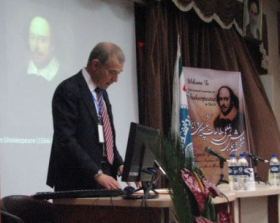
The First International Conference on Shakespeare Studies was held on November 26 to 27, 2014 in Iran.

The conference, organized by the Faculty of Foreign Languages and Literatures from the University of Tehran, explored themes such as ‘Shakespeare and Political Discourse’, ‘Shakespeare under the Iranian Eye’, ‘Shakespeare and Adaptation’, ‘Radical Shakespeare’, ‘Shakespeare and Mysticism’ and ‘Shakespeare and Popular Culture’.

Tehran, Iran - University of Tehran, Conference on Shakespeare Studies 2014 - 00Professor Stephen Greenblatt took part in the conference and delivered a keynote speak focused on Shakespeare and the human condition on November 26. He is one of the world’s most celebrated Shakespearean scholars and best known for Shakespeare biography titled Will in the World: How Shakespeare became Shakespeare, which was on the New York Times Best Seller List for nine weeks. In 2012 he won the Pulitzer Prize for his book, The Swerve: How the World Became Modern.

“I never thought that Shakespeare would become my magic carpet to the land of Persia” said Harvard scholar Prof. Greenblatt when he expressed his enthusiasm for Iran and Persian cultural and historical heritage during the conference.

Prof. Mark Burnett from Queen’s University in Belfast, was another keynote speaker whose discussion focused on cinematic representations of Shakespeare in Iran. He talked about an Iranian adaptation of Shakespeare’s Hamlet entitled Doubt (Tardid), a 2009 Iranian Crystal Simorgh-winning film directed by Varuzh Karim Masihi.

Iranian scholar Hossein Elahi Ghomshei, author and lecturer on literature, art and mysticism, also spoke at the conference.

The event was organized by Dr. Ismail Salami and Dr. Maryam Soltan Beyad, professors at the University of Tehran.

Source: Iran Front Page

Iran’s Vice-President has been awarded Italy’s Minerva Award in the section “Women in the World”

Anna Maria Mammoliti Minerva PrizeMasoumeh Ebtekar has been awarded Italy’s Anna Maria Mammoliti Minerva Prize on its XXV Edition

Iranian Vice President and Head of the Environmental Protection Organization Masoumeh Ebtekar’s endeavors on political and environmental fronts have been recognized in Italy.

The Minerva Prize, renamed in 2009 after its founder Anna Maria Mammoliti, an Italian journalist and social activist, is the first Italian award dedicated predominantly to women who operate in “knowledge” fields, which they represent symbolically, and who because of their professional capability and the positive values which they uphold are female role models. Each year a man also receives this recognition for his professional and human contribution given to society.

The award is divided into different categories such as art, information, innovation or political management and consists of a precious brooch depicting the goddess Minerva designed by Maestro Renato Guttuso in 1983 on its first edition.

On its XXV Edition eight women and one man have been awarded in Rome at the Sala della Protomoteca in Campidoglio – under the patronage of the President of the Republic and with the support of the Senate, the House and the Presidency of the Council.

Masoumeh Ebtekar Vice President of the Islamic Republic of Iran and Khadija Cherif, vice secretary for women in the International Federation for Human Rights (FIDH), were awarded in the section “Women in the World”.

Following categories have been recognized in 2014:
Political Commitment and Reformer Award: Masoumeh Ebtekar (Iran)
Human Rights Award: Khadija Cherif (Tunisia)
Management Award: Laura Donnini
Entrepreneurship Award: Daniela Ducato
Economics Award: Donatella Ceccarelli
Leadership Award: Emanuela Ortolani
Information Award: Barbara Parodi Delfino
Arts Award: Loretta Goggi
Franco Vaccari, founder and President of the Associaton “Rondine Cittadella della Pace”.

Related article about Masoumeh Ebtekar in this blog:
https://theotheriran.com/2014/01/31/irans-environment-chief-the-first-woman-to-receive-the-energy-globe-foundation-award/

Sources
IRNA through Iran Front Page
Minerva Online (English and Italian)

Bahram Beyzaie: Iranian film director, playwright and researcher

Bahram BeyzaieBahram Beyzaie was born in Tehran, Iran on Dec 26 1938. He is an Iranian film director, theatre director, screenwriter, playwright, film editor, producer, and researcher.

Beyzaie is part of a generation of filmmakers in the Iranian New Wave, a Persian cinema movement that started in the late 1960s and includes other pioneering directors such as Abbas Kiarostami, Forough Farrokhzad, Sohrab Shahid Sales, and Parviz Kimiavi. The filmmakers share many common techniques including the use of poetic dialog, references to traditional Persian art and culture and allegorical story-telling often dealing with political and philosophical issues.

After beginning Persian literature at Tehran University, Bahram Beyzaie turned to Visual Arts. Here he studied the Book of Kings (Shahname), the Shiite passion plays (Ta’zieh) , the traditional Persian Theatre including the puppet theatre, the pre-Islamic culture and Persian miniature painting. All of this combined with his interest in the far Eastern theatre helped him to develop of a new direction for the Iranian theatre.

Beyzaie’s “Drama in Iran” (Namayesh dar Iran), published in late 1960s is still considered the most important text on the history of Iranian theater. Beyzaie is also the first scholar in Iran to publish books on theater in China and Japan. Some of his plays such as his masterpiece “Marg-e Yazdgerd” (“Death of Yazdgerd”) have been made into films.

In 1964 he published the first of three pieces “Seh Namāyesch-e Arusak” (Three Puppet Plays), where the influence of Pirandello and the Theatre of the Absurd is reflected.

In 1969 he began his film career by directing the short film Amu Sibilou (Uncle Moustache) followed by Safar (The Journey) in 1970. Immediately after, in 1971, he made his first feature film “Ragbar” (“Downpour”) which is regarded by critics to this day as one of the most successful Iranian films ever made. The successful film addresses the late Parviz Fannizadeh as its central character and protagonist. Since then he produced and directed a number of films, including “Bashu, the little Stranger”.

He is known as the most intellectual and conspicuous “author” in Iranian cinema. The main theme of his works is the history and “crisis of identity” which is related to Iranian cultural and mythical symbols and paradigms.

Beyzaie lives and works in Iran, but is spending an academic year at Stanford University as the Bita Daryabari Visiting Professor of Persian Studies.

Selection of works and publications:
– numerous articles on literary and art magazines,
– Theatre in Japan
– Gorob dar Diari Garib (Sunset in a strange Land)
– Chahar Sandoogh (Four Chests)
– Hashtomin Safar-e Sandbad (Sinbad’s Eighth Voyage)
– Ziafat va Miras (1967 – aka Heritage and The Feast)
– Soltan-Mar (1969 – aka The King Snake)
– Dolls
– Story of the hidden Moon
– Seh Namayesh-e Arusak (Three Puppet Plays)
– Marg-e Yazdgerd (1979 – aka Death of Yazdgerd)
– Karname-ye Bandar Bidakhsh (1997 and 1998)
– Banu Aoi (1997 and 1998) (based on The Lady Aoi by Yukio Mishima)
– Shab-e Hezar-o-yekom (2003)
– Afra ya Rooz migozarad (2007 – aka Afra, or the day passes)

Filmography (as a director):
– 1969: Amu Sibilu (short – aka Uncle Moustache)
– 1970: Safar (short – aka The Journey)
– 1971: Ragbār (aka Downpour)
– 1974: Qaribé va Meh (aka The Stranger and the Fog)
– 1976: Kalāq (aka The Crow or The Raven )
– 1979: Charike-ye Tārā (aka Ballad of Tara)
– 1982: Marg-e Yazdgerd (aka Death of Yazdgerd)
– 1986: Bashu, Gharibe-ye Koochak (aka Bashu, the Little Stranger – released 1989)
– 1988: Shayad Vaghti digar (aka Maybe Some Other Time)
– 1992: Mosaferan (aka Travellers)
– 1998: Goft-o-gu ba Bad (short – aka Talking with the Wind)
– 2001: Sagkoshi (aka Killing Mad Dogs)
– 2006: Qāli-ye Sokhangū (The narrative rug)
– 2009: Vaqti hame khābim (When we are all sleeping)

Awards
– 1973: Chicago International Film Festival, Moscow International Film Festival: “The Journey”: Silver Hugo, Silver Award
– 1990: Aubervilliers Film Festival: “Bashu, the little stranger” – Best film
– 2001: 19th International Fajr Film Festival: “Killing Mad Dogs” – Screenplay
– 2004: International Istanbul Film Festival: Award for lifetime achievement

Sources:
Wikipedia (English and German)
Stanford University – Division of Literatures, Cultures and Languages

Photo Series: Autumn in Iran – Gorgan’s Alang Darreh Park, Golestan Province

Gorgan is the capital of Golestan Province, Iran. It lies approximately 400km to the north east of Tehran and some 30km away from the Caspian Sea. It has a population of ca. 270.000 inhabitants. Some 150 km (93 mi) east of Gorgan is the Golestan National Park.

The city was named Hyrcania in ancient Greek records, the equivalent of the local name Varkâna “Land of the Wolves” in Old Persian. Although modern Gorgan is only a city and county sharing the same name, ancient Hyrcania was the name of a greater region on the southern shores of the Caspian Sea (encompassing all of the present day Golestan province, as well as some eastern parts of the Mazandaran province, and some southern parts of the present day Republic of Turkmenistan). Until 1937 the city used to be known as Astarabad.

Only 5km southwest from Gorgan, covering an area of approximately 185 hectares is Alangdareh Park. These beautiful autumn pictures were taken there.

In general, Golestan has a moderate and humid climate known as “the moderate Caspian climate.” There exist three different climates in the region: plain moderate, mountainous, and semi-arid. Gorgan valley has a semi-arid climate.

Gorgan (as well as the whole Golestan province) has a world-famous carpet and rug industry, made by Turkmen. The patterns of these carpets are derived from the ancient Persian city of Bukhara, which is now in Uzbekistan. Jajim carpets are also crafted in this province.

Sources: Wikipedia | Gorgan, Mehr News Agency | Photos

Iran-USA Simultaneous Art Installation: A Portal Between Tehran and New York City

Shared Studios is launching the first public installation of Amar Bakshi’s Shared Studio project “A Portal BetweenTehran & NYC: Open for Conversation” by conversing through a live audio-visual connection with an individual in Tehran.

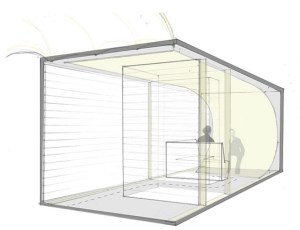
Portals are shipping containers equipped with specialized communications technology. Individuals enter one at a time and converse with a person in the other location as if they were in the same room. Simultaneous text translation is available. This first pairing unites the Lu Magnus Gallery in NYC and the M-40 Studio in Tehran.

OPEN FOR CONVERSATION
DECEMBER 5 – 19, 2014
Special Open Hours: 7:30A – 1:30P, Mon – Sun
LU MAGNUS GALLERY and M-40 STUDIO TEHRAN

Each individual is invited to enter a Portal and converse with whoever happens to be in the Tehran location, or with someone in particular upon advance request. To schedule your visit, please visit SHAREDSTUDIOS.SCHEDULISTA.COM

Powerful new technologies allow us to connect across boundaries as never before; yet we too often use them to cocoon ourselves in our own cultural, political, or ideological communities. Portals puncture hardened stereotypes of the other by facilitating one-on-one encounters. They serve as a catalyst for conversation between communities that would not typically engage with one another due to language barriers, technological limitations and hardened stereotypes of the other meeting people whom they only hear about unidirectionally in the news.

Visit the gallery for special Q&A sessions with the artist and the following New York guests:

Amy Chua and Jed Rubenfeld (Fri Dec 5, 1:00pm-2:00pm)
Yale Law professors and bestselling authors Amy Chua and Jed Rubenfeld. Chua’s books include Battle Hymn of the Tiger Mother and World on Fire. Rubenfeld’s books include The Death Instinct and Freedom and Time.

Jonah Bokaer & James Koroni (Sat Dec 6, 1:30pm-2:30pm)
Jonah & James perform a curated dance live in the New York space, streamed live to Tehran.

Fareed Zakaria (Mon Dec 8, 10:30am-11:30am)
CNN host, Atlantic Monthly writer and bestselling author of The Post-American World and The Future of Freedom

Morgan Spurlock (Wed Dec 10, 10:00am-11:00am)
Documentary filmmaker whose titles include Supersize Me and The Greatest Movie Ever Sold.

Tania Bruguera (Thu Dec 11, 1:30pm-2:30pm)
Tania Bruguera is a Cuban installation and performance artist.

Rob Storr (Fri Dec 12, 9:00am-10:30am)
Robert Storr is the Dean of the Yale School of Art. Formerly, he was Senior Curator at the Museum of Modern Art.

Mohsen Namjoo (Sat Dec 13, 1:30pm-2:30pm)
Mohsen Namjoo is an Iranian artist, songwriter, singer, music scholar and setar (traditional Persian lute) player based in California.

Nicky Nodjoumi (Sun Dec 14 – Dec 15, 11:30pm)
Nicky Nodjoumi’s works are conceived of as theatrical stages, where compositions of figures both serious and ridiculous, in the words of Phong Bui, “house meanings without irony, narratives without stories, humor without morality, above all creating a space that heightens the awareness of old and new history.”

Keller Easterling (Wed Dec 17, 9:00am-10:15am)
Architect, professor and author of books including Extrastatecraft: the Power of Infrastructure Space and Enduring Innocence: Global Architecture and Its Political Masquerades.

Sources: Shared Studios, Lu Magnus Gallery, Spacesmith


Theater Performance: “London, Tehran, Rome, Amsterdam” opened in Tehran, Iran

“London, Tehran, Rome, Amsterdam, Reconsider Your Image Of Me” will play from November 16 to December 12 of 2014, every night (apart from Saturdays), at 21:00 o’clock in the Hafez Hall, Tehran.

This performance, a co-production between the Virgule Performing Arts Company (Iran) and STET The English Theatre (Netherlands) is supported by the Embassy of the Kingdom of the Netherlands. The opening ceremony was held on Sunday, Nov. 16 with the Dutch ambassador to Tehran attending the ceremony.

The performance examines a current topic between Iran and the West, namely what are the images that we have of ‘the Other’ and to what extent fears, fantasies and imaginations are based on truth. By initiating a direct meeting with the Other and listening to each other’s stories, this group aims to create new images, based on the stories of the people who wouldn’t usually make the headlines.

The piece is a multi-media, highly physical, speech performance. It includes the actors’ own stories, dialogue between the actors, video installations with short documentaries about daily life in the countries of origin of the actors and video collages of cultural milestones from these cultures. The physical form of the piece produces a third language.

The project has brought together an international cast to create this piece during a 2 month rehearsal period in Tehran. The company includes Dutch actress Marene van Holk, Italian actress Marta Paganelli, British actress Amy Strange, Iranian actresses Melodie Aramnia and Neda Jebreilli and Iranian actor Meysam Mirzaei, and the piece has been conceived and directed by Arvand Dashtaray.

The production will be performed in the Netherlands in the autumn of 2015.

Sources
Embassy of the Kingdom of the Netherlands in the Islamic Republic of Iran
Mehr News Agency

Photo Series: Autumn in Iran – Hamedan Province (Part 1)

Hamedan Province is one of the 31 provinces of Iran. It covers an area of 19,546 km² and has a population of over 1,82 million (2008). Its capital is Hamedan city. Hamedan province is one of the most ancient parts of Iran and its civilization. The city of Hamedan laid on the Silk Road.

The province lies in an elevated region with the ‘Alvand’ mountains running from the north west to the south west. These are part of the Zagros mountain range. Hamedan enjoys temperate warm summers and relatively cold winters.

According to local Jewish traditions, the City of Hamedan is mentioned in the Book of Esther as the capital of Ancient Persia in the days of King Ahasuerus. It was then known as Shushan. The Tombs of Mordecai and Esther are located in modern-day Hamedan.

Today’s Hamedan is what is left of Ecbatana, The Medes’ capital before they formed a union with the Persians. The poet Ferdowsi says that Ecbatana was built by King Jamshid. During the Parthian era Hamedan became the summer capital and residence of the Parthian rulers. After the Parthians, the Sassanids constructed their summer palaces in Hamedan as well.

Sources: ISNA, Mehr News Agency, Wikipedia | Hamedan Province

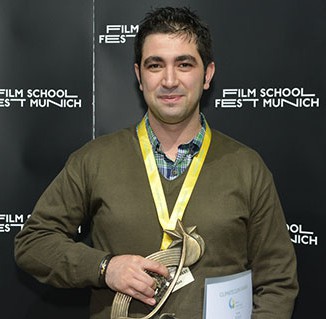
Iranian Director Amin Rahbar receives the “Climate Clips Award” at the 2014 International Film School Fest Munich

Rahbar, Amin - Iranian Film Director, Azad University of Central Tehran - Scale (Tarazoo)Amin Rahbar’s animation Scale scooped the prestigious Climate Clips Award at the 2014 International Festival of Munich Film Schools, running from November 16-22 in Germany. […]

“Some 42 films from 22 countries took part in this festival, and my production with an environmental theme was selected among the top three and ultimately managed to win the best film award” said Amin Rahbar to Mehr News.

“Scale is 2-minute long and produced with cutout animation technique. In this technique, flat characters and backgrounds are cut from materials such as paper, or if on a computer, with scanned images” explained Rahbar.

Climate-Clips-Jury (Brigitte Bruns, Veronika Nagelschneider and Beatrice Scola): Amin Rahbar’s enchanting animated film SCALE (in Farsi TARAZOO), shows us the dramatic changes industrialization has wrought upon our planet. Our transformation from an agricultural society to today’s skyscraper-studded megacities is brought to life by the sophisticated and original use of an old and relatively simple technique: paper cutouts. In just one and a half minutes, the clip illustrates how drastically our environment has changed, the severe damage that has been done to it and the current consequences such as climate change. The jury congratulates Amin Rahbar on the successful artistic and technical realization of his film.

Winner: Scale | Tarazoo
The story of human life from the beginning to the beginning…
by Amin Rahbar from Azad University of Central Tehran, Iran

Scale has been previously featured and awarded in other international festivals including Hamburg Festival in Germany, con i minuti contati Festival in Italy, and SHNIT Festival in Switzerland. It has also won the Best Film Award at Iran’s Short Film Festival for Children.

The International Festival of Film Schools established in 1981 is now one of the most important festivals for young filmmakers in the world. About 60 films are presented at the festival annually, and each year approximately 100 foreign students and professors have the opportunity to meet, enter into discussions and share their experiences with each other.

Sources: Film School Fest Munich, Mehr News Agency

Haft Negah art exhibition, held in Tehran, closes tomorrow (Nov 28)

The Niavaran Culture Center in Tehran is hosting the 7th annual edition of Iran’s Seven Views (Haft Negah), an art expo coordinated since 2006 by seven major art galleries.

This year, fourteen galleries  take part in the expo. The Aria, Elaheh, Dey, Golestan, Haft Samar, Valli, Mah-e Mehr, The Aran, Etemad, Hanna, Dastaan Basement, Seen, Seyhun, and Tarrahan-e Azad galleries will all participate in this years celebrations taking place from November 14 to 28.

The exhibition will showcase paintings, sculptures, and calligraphy from 350 artists featuring 400 works that respond to this year’s exhibition motto, “Every Iranian Home, One Artwork”.

Some of the well-known artists showcasing their artworks this year include Sohrab Sepehri, Mohammad Ehsaii, Aidin Aghdashlu, Parviz Tanavoli, Iran Darrudi, Farideh Lashaii and Parvaneh Etemadi.

Make sure not to miss this one of a kind artistic event!

Sources: Tara Gallery, Mehr News Agency

Photo Series: Autumn in Iran – Golestan Province

Golestan Province is one of the 31 provinces of Iran, located in the north-east of the country south of the Caspian Sea. It has a population of 1.6 million (2006) and an area of 20,380 km². Its capital is Gorgan. Present-day Gorgan was called Esterabad or Astarabad until 1937.

Golestan enjoys mild weather and a temperate climate most of the year. Geographically, it is divided into two sections: The plains, and the mountains of the Alborz range. In the eastern Alborz section, the direction of mountains faces northeast and gradually decreases in height. The highest point of the province is Shavar, with a height of 3,945 meters.

Sources: Wikipedia | Golestan, Tasnim News Agency | Photos

Photo Gallery: Iranian Cyclists Mark World Diabetes Day

TEHRAN (Tasnim) – Iranian cyclists gathered to pedal in the streets of the capital, Tehran, to mark the World Diabetes Day (WDD).

World Diabetes Day is the primary global awareness campaign of the diabetes world and is held on November 14 of each year. It was introduced in 1991 by the International Diabetes Federation and the World Health Organization in response to the alarming rise of diabetes around the world. World Diabetes Day is a campaign that features a new theme chosen by the International Diabetes Federation each year to address issues facing the global diabetes community. While the campaigns last the whole year, the day itself marks the birthday of Frederick Banting who, along with Charles Best, first conceived the idea which led to the discovery of insulin in 1922.

Sources:
http://multimedia.tasnimnews.com/Media/Gallery/557647
http://en.wikipedia.org/wiki/World_Diabetes_Day

Iran’s Sareh Javanmardi named Asia’s top female athlete of 2014

Sareh Javanmardi

Iran’s Paralympic shooter, Sareh Javanmardi, has been named Asia’s best female athlete of the year thanks to two gold medals she won at the 2014 Asian Para Games which were held in Incheon, South Korea in October.

The Iranian Student News Agency (ISNA) reported on November 22 that Sareh’s brilliant performance in the Asian Games earned her the much-coveted title.

She claimed a gold medal in the Mixed 50 meter pistol SH1 and finished first in the Women’s P2-10m Air Pistol-SH1.

Also, Iran’s Paralympic Committee won the Asian Paralympic Committee (APC) award in 2014. It was credited for the remarkable showing of the Iranian Men’s Team in Incheon Asian Para Games.

The awarding ceremony will take place in Asian Paralympic Committee (APC) on December 2 in Abu Dhabi, UAE.

Source: Iran Front Page

Iran beach soccer team claims gold in Asian Beach Games in Thailand

Iran’s beach soccer team defeated Japan 4-3 and won the gold medal in the 4th edition of the Asian Beach Games on Friday.

Shahriar Mozhdeh Roudsari, Ali Naderi, Amir Hossein Akbari and Hassan Abdollahi scored for the Iranian outfit at the Saphan Hin. Moreira Ozu (twice) and Takasuke Goto scored for the Japanese team. […]

Iran has already won five gold medals in the games which is underway in Phuket, Thailand. The Iranian athletes are competing in 17 out of 26 sports in the event.

Kamran Hosseini Jam at the Men’s Freestyle -80kg, Mohammad Naderi at the Men’s Freestyle -70kg, Jaber Sadeghzadeh at the Men’s Freestyle +80kg, Ghanbar Ali Ghanbari at the Men’s -66kg and Sobhan Taherkhani at the Men’s Long Jump Final have previously won a gold medal in the games.

The 4th Asian Beach Games opened in Thailand on November 14, attracting 3,272 athletes from 43 Asian countries and territories. There are a total of 196 categories in 26 sports. The first Asian Beach Games was held in Indonesia in 2008. Vietnam will host the fifth edition in Khanh Hoa Province and Da Nang City in 2016.

Source: Payvand News

Business Insider – Jewish Australian writer Ben Winsor about visiting Iran

There's a lot to see in Tehran, but make sure you get out to see the Darband waterfalls and the nearby ski resorts, all popular with the locals.

There’s a lot to see in Tehran, but make sure you get out to see the Darband waterfalls and the nearby ski resorts, all popular with the locals.

While Iran is seen by some in the West as a country full of crazy fundamentalists hell-bent on America’s nuclear destruction, the reality you’ll see inside the country couldn’t be further from the truth.

The fact is, the majority of the Iranian public love Westerners — Americans in particular — making Iran one of the safest countries on our list even for female travelers. Opinion polls show the majority of Iranians hold a favorable opinion of Americans, making Iran second only to Israel as the most supportive population in the Middle East.

The Azadi tower (freedom tower) is an impressive gateway to the city, built to symbolize 2,500 years of Persian culture.

The Azadi tower (freedom tower) is an impressive gateway to the city, built to symbolize 2,500 years of Persian culture.To travel as a Westerner is to be routinely stopped on the street and welcomed by curious and generous Iranians. When I was there last summer I was constantly offered with cold drinks, invited to parties, and given free tours by locals.


There is a ton to see there: cheap ski resorts in the Alborz mountains north of Tehran, ancient clay-baked mosques in Kashan, the stunning central square of Isfahan, the Tatooine-like ruins of Na’in, and the ancient ruins of Persepolis near Shiraz.

While Western sanctions mean you can’t use your Visa or MasterCard in the country, you won’t have to take much cash. All expenses — including transport, food, and accommodation — amounted to less than $200 for my 11-day trip last year. 

Inexpensive, air conditioned buses run frequently between most cities, and a full falafel sandwich will often only set you back 25 cents. There’s amazing rosewater ice cream almost everywhere in summer for about 10 cents a cone.

persepolisJohn Moore/GettyPersepolis, literally “city of the Persians,” was the capital of the first Persian empire 2,500 years ago.

Iran is safe for female travelers. Iranian women dress fashionably, and the level of respect on the streets could be considered high even by Western standards. However, it is mandatory to wear a headscarf in public at all times. Headscarves are skimpy, colorful, and barely attached in Tehran, but in regional areas more conservative coverings are the norm.

Nain Na'in IranThe old city of the tiny town of Na’in.

Source:

Iranian Lili Golestan received France’s Order of Academic Palms

French Order of Academic Palms awarded to Lili Golestan
Source: Tehran Times

Iranian translator Lili Golestan, who is also the curator of Tehran’s Golestan Gallery, received France’s Order of Academic Palms during a ceremony at the Embassy of France in the Iranian capital on Monday November 17, 2014.

French Ambassador Bruno Foucher delivered a short speech before honoring Golestan with the order, which is awarded by the French Minister of Education to those who have rendered eminent service to French education and have contributed actively to the prestige of French culture, Honaronline reported on Tuesday.

Iranian translator and artist Lili Golestan (R) with the French Ambassador Bruno Foucher (photo by Shargh daily)

“In the animated and rich cultural atmosphere of Tehran, in which you can find no day without an event, Golestan Gallery has a special place,” Foucher stated.

He also praised Golestan for the efforts she made to introduce French writers, including Albert Camus, Jean Giraud and Romain Gary, to Persian readers.

“Your achievements show that you are among the very eminent women and France praises such persons. Indeed, such brilliant activities in the promotion of Iranian art and such a will for the introduction of French literature luminaries deserve appreciation,” he added.

Foucher then presented the order to Golestan and she also made a short speech.

“French literature is part of my soul,” she said and added that she has tried to introduce it to Persian readers.

“I have had a small gallery in this mega city for over a quarter of a century. This night’s meeting caused me to take a glance at the past and for the first time to ask myself exactly how many times I have organized exhibitions at this gallery. The result surprised me and I also felt more exhausted: 1040 exhibits. But, due the decoration I received tonight, I feel that it’s time to forget the 1040 exhibitions and also to shelve the forty books that I translated and the 340 articles that I wrote for newspapers and magazines, in order to ease my exhaustion for a while, only for a short while,” she stated.

She translated many books from world literature into Persian. Among the works are Eugene Ionesco’s “Story Number 3″, Maurice Druon’s “Tistou of the Green Thumbs”, Miguel Angel Asturias’ “The Man that Had it All, All, All”, Gabriel Garcia Marquez’ “The Smell of the Guava Tree” and “Chronicle of a Death Foretold”.

Iranian author Mahmud Dowlatabadi was also awarded the Chevalier of the Legion of Honor in Tehran on Sunday evening.

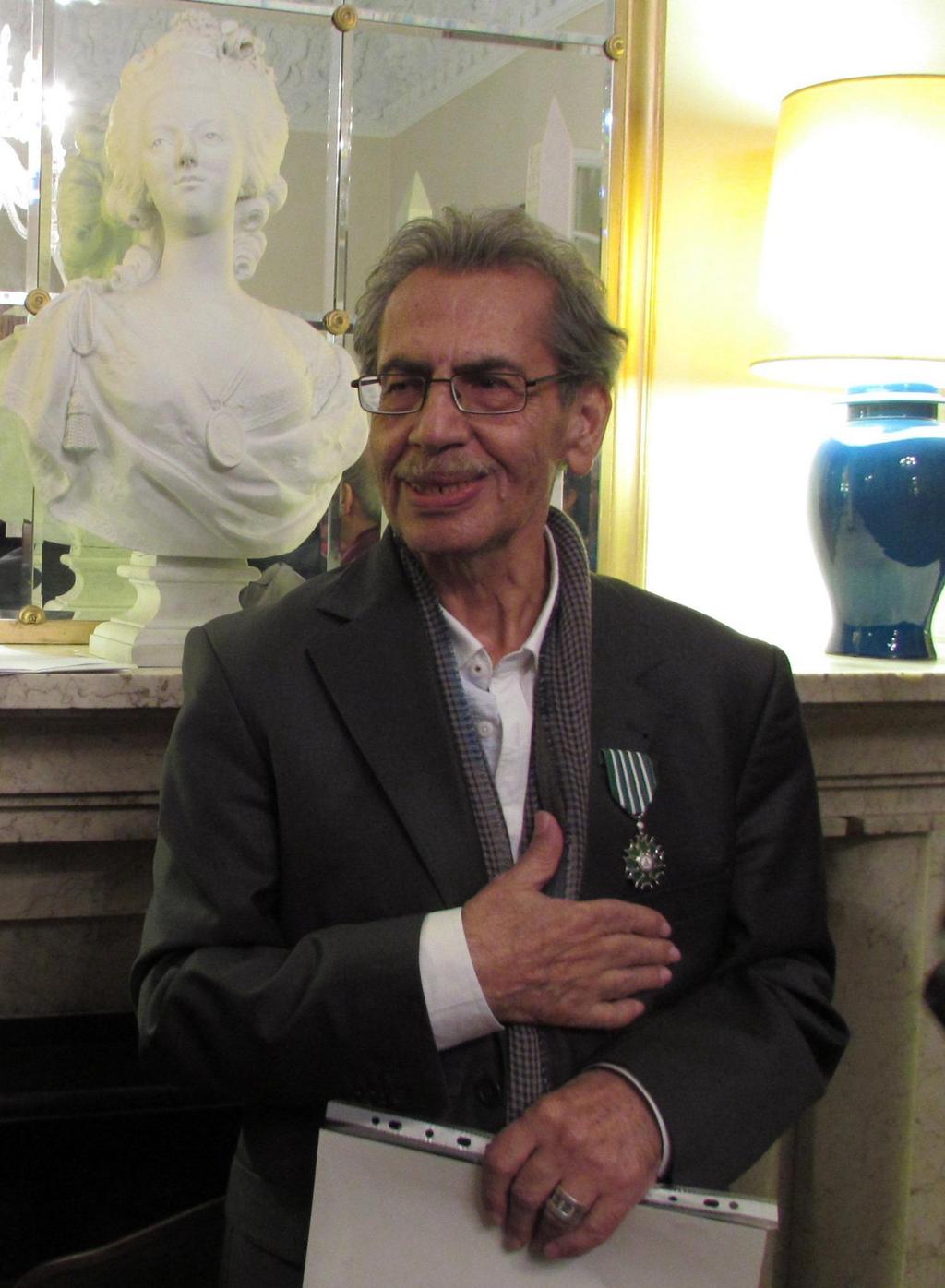
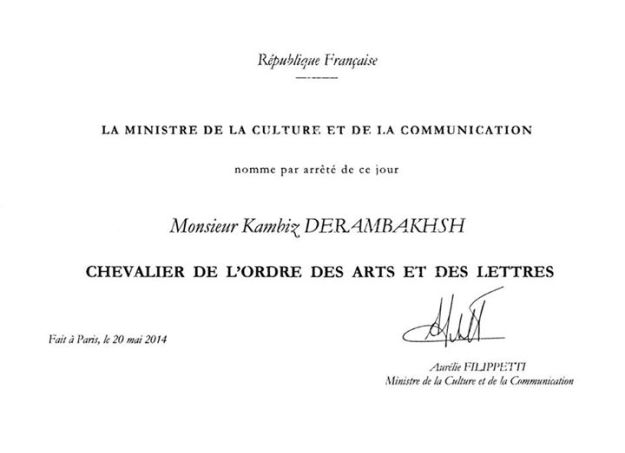
France has decorated three Iranian personalities with the Chevalier of the Legion of Honors over the past six months: Vocalist Mohammadreza Shajarian received the order in June, cartoonist Kambiz Derambakhsh and filmmaker Dariush Mehrjuii are the other honorees.


Awarded Iranian movie Melbourne by Nima Javidi, is to be screened at Mar del Plata International Film Festival in Argentina

Melbourne-Mar-del-Plata-festival

Melbourne chronicles the story of a young couple on their way to the eponymous Australian city to continue their education, but just a few hours before their departure, they become involved in a tragic event.

The movie recently garnered two awards at the 2014 Stockholm International Film Festival in Sweden.

Melbourne also received critical acclaim at the 71st Venice International Film Festival in Italy. The film had its international premiere at the festival.

“Some international critics participated in the festival believe that Melbourne conjures up the mood and tone of the British film director Alfred Hitchcock’s works,” said Javidi.

Mar del Plata International Film Festival is scheduled to take place from Nov 22 to 30, in various categories including documentary, experimental and narrative fiction.

Source: Iran Front Page

Iranian author Mahmud Dowlatabadi receives France’s Chevalier of Legion of Honor

Iranian author Mahmud Dowlatabadi, mostly famous for his novel “Kalidar”, received the Chevalier of the Legion of Honor during a ceremony held in Tehran on Sunday evening. The medal, which is the highest decoration awarded by the French government, was presented to the author by French Ambassador Bruno Foucher during a ceremony at his residence in Tehran.

The ambassador gave a brief speech about the life and works of Dowlatabadi. He also praised his artistic career in theater and storytelling.

Wearing the medal, Dowlatabadi talked about French literature and civilization in his short speech, and pointed to the issues of writing and the pains of writing.

Iranian author Mahmud Dowlatabadi (R) stands beside French Ambassador Bruno Foucher before receiving the Chevalier of the Legion of Honor at the ambassador’s residence in Tehran on November 16, 2014.

A number of scholars and literati including Dariush Shayegan, Kambiz Dermabakhsh, Omid Rohani, Lili Golestan, Javad Mojabi and Hassan Kianian attended the ceremony.

Born in 1940, short-story writer and novelist Dowlatabadi was the most prominent Iranian novelist of the 1980s. Self-educated and forced to work from childhood, he spent part of his younger adult years as a stage actor in Tehran.

“The Colonel”, “Kalidar”, “Desert Strata”, “The Trip”, “The Legend of Baba Sobhan”, “The Cowherd”, “Aqil”, “Man” and “Missing Soluch” are among Dowlatabadi’s credits.

http://www.payvand.com/news/14/nov/1110.html

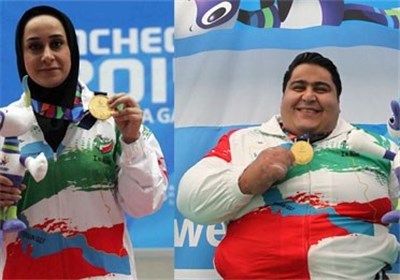
Iranians Rahman and Javanmardi top IPC’s “Athlete of the Month” vote

2014 IPC Athlete of the Month (October 2014) - Javanmardi-Rahman

October 2014 IPC Athlete of the Month (from right to left): Siamand Rahman (1st place) and Sareh Javanmardi (2nd place)

Iranian powerlifter Siamand Rahman has been named the Athlete of the Month for October 2014 after his incredible performance at the Incheon 2014 Asian Para Games in South Korea.

The world’s strongest Paralympian made history at the competition, breaking his own world record three times on his way to gold in the men’s over 107kg category.

Rahman received 63.9 per cent of the public vote to finish ahead of his compatriot, shooter Sareh Javanmardidodmani, who received 34.3 per cent of the vote after breaking two world records on her way to double gold in the P2 (women’s 10m pistol SH1) and P4 (mixed 50m pistol SH1) in Incheon.

Gambian athletics star Demba Jarju came third, after he became the first wheelchair racer to win the Gambian Marathon.

[…]

Sources:
http://www.paralympic.org/siamand-rahman-named-allianz-athlete-month-october-2014
http://theiranproject.com/blog/tag/iranian-female-shooter-sareh-javanmardi/

Iran’s Book and Book Reading Week: Museums in Tehran host events for children to encourage book reading

kids-children-in-tehran-museum

Museums in Tehran host events for children to encourage book reading

The Cultural Heritage and Tourism Research Center is to implement a “Seven Museums, Seven Tales” plan as of Saturday [November 15] to mark the national Book and Book Reading Week.

The plan which is to be carried out in seven museums in the capital aims to promote book reading and introduce [Iran’s] legends and myths as a symbol of oral and intangible heritage.

It also intends to create more attractiveness in museums and revive the art of storytelling.

Creative instructors of storytelling and members of Children’s Book Council will come together in seven museums, namely Iran’s Post Museum, National Museum of Iran, Golestan Palace Museum, Carpet Museum of Iran, Tehran Peace Museum, Moghadam Museum and Bagh-e-Negarestan [Complex] to host Iranian children and their parents as well as other guests between November 15 and 21.

The museums will open their doors to visitors at 11:00 a.m. local time.

Source: Iran Front Page

ABC Australia – Misunderstanding shields us from Iran’s reality

Don’t believe all the stereotypes: the mood inside Iran is hopeful for change and increased positive engagement with the West…

When I told my friends I was travelling to Iran they didn’t believe me.

“That’s the sort of place people go missing and don’t come back,” they said.

“Don’t worry,” I reassured them, “I’m white and Jewish, nobody will be able to miss me, and they won’t be wanting me to stay.”

I was right on the first count, wrong on the second.

Despite a sophisticated English-language tourist infrastructure, there are almost no Western visitors, so Iranians are especially excited to meet Europeans or North Americans. Seemingly insecure, many would ask us whether we were enjoying Iran, responding with scepticism when we said yes.

In a dusty desert town in the centre of the country, a father encouraged his young daughter to ask my Dutch colleague for a photo with him.

“You look just like Louis Tomlinson from One Direction,” she told him excitedly.

People on the street were constantly stopping us, they would ask where we were from, give us drinks, and generously welcome us to their country.

The image of Iran as being full of wild-eyed Arabs chanting ‘death to America’ is wrong on many levels, not least of all because Iranians aren’t actually Arab (and they’re sick of pointing that out).

In the cafes of Tehran the headscarves are skimpy and men and women laugh together over cans of coke, you’re more likely to see iPhones in the streets than AK-47s, and while it’s true that you’d better keep homosexuality behind well-padlocked doors, the prosecution and persecution of gay people isn’t a popular public sport the way it is in a number of other countries.

Don’t get me wrong, Iran is no liberal Mecca, but it’s no worse than many other countries where the West has chosen to use engagement, rather than isolation, to encourage progress.

Don’t Believe the Hype

Tehran itself has a lively and well-educated youth population which bucks at the regime at every turn.

Iranians have access to illegal alcohol, openly mount banned satellite dishes, hold lively house parties, and hack their way around internet restrictions on social media.

Indeed, when we spoke with a group of young Iranians, the only topics off limits were spoilers to the season finale of Game of Thrones.

Even on Israel, the views we encountered were surprisingly moderate. Broaching the subject with one group made them bashful. They thought that as Westerners we would be offended by their ‘extreme’ views.

They supported a two-state solution based on the 1967 border agreement. Imagine their surprise when I told them this was roughly official US policy.

Misunderstanding, it seems, goes both ways.

Western leaders talk tough on Iran to make themselves look strong and Israeli politicians exploit Iran’s nuclear intentions to gain traction internationally.

We have short memories in international affairs, only 35 years ago Iran was ruled by a relatively liberal dictatorship and was a key Western ally, but our distorted perceptions are not entirely our fault. Stereotypes have been encouraged not only by films like Argo, but by authority figures with their own agendas.

Western leaders talk tough on Iran to make themselves look strong and Israeli politicians exploit Iran’s nuclear intentions and poor engagement to gain traction internationally.

Even Iran’s own leaders are prone to spout hatred of the West to pander to their own support bases of hardliners and clerics.

Such statements will gladly be emphasised and taken out of context by those on the other side, and so the cycle continues.

One Iranian told me when he was a kid they were offered the day off school if they would take a bus to Tehran to shout anti-western slogans for international cameras. The kids were enthusiastic because they got the day off school, but when the cameras were off even adults went up to journalists to ask about US culture and tell them how much they wanted to visit New York.

The gap between the rhetoric on Iran and the reality amongst Iranians is perhaps best demonstrated by this month’s inauguration of the country’s new president.

Hassan Rohani was the most liberal of the six candidates permitted to run, and he won just over 50 per cent of the vote.

Rohani is a former nuclear negotiator, has appointed numerous women to high-level government positions, and spoke of the US-Iranian relationship as a ‘wound which must be healed’.

The mood inside Iran is hopeful for change and increased positive engagement with the West, but it would be wrong to say most are optimistic.

A Narrow Path

Iranians have had their hopes crushed before. Every young person we met in Tehran had a friend who was killed in the green movement protests against the legitimacy of Mahmoud Ahmadinejad’s 2009 re-election.

The demonstrations were brutally crushed by the regime, and many of the protestors who weren’t killed have simply vanished, their friends have no idea where they’ve gone.

Iran is a proud country with many sophisticated and well-educated people who remember their liberal past, but it is also a country with a clandestine religious government, not impervious to its own internal power struggles.

With Rohani assuming the presidency, and still holding the goodwill of the people and the religious leadership, now is an opportune moment for the West and for Iran.

The path to a peaceful resolution of tensions is narrow but walkable, and will and restraint is required from both sides.

Remaining cool and rising above provocation isn’t naïve and it doesn’t excuse the often brutal Iranian government, but it does offer the best chance of progress for both the West, and the millions of Iranians who suffer from their regime’s intransigence.

Information about the author:

Ben Winsor is a Law and International Studies graduate currently undertaking a placement with the Presidency of the International Criminal Court in The Hague. He is studying a Masters in Law at the Australian National University. All views expressed are his own and do not reflect those of his employer. View his full profile here.

http://www.abc.net.au/news/2013-09-06/winsor-an-australian-in-iran/4937548

Sistanagila – The Rare Place Where Israelis And Iranians Play Together

by Soraya Sarhaddi Nelson for npr

What do you get when three Israelis, two Iranians and a German walk into a room? A Berlin-based world music ensemble known as Sistanagila, named after an Iranian province — Sistan and Baluchestan — and the popular Jewish folk song "Hava Nagila."

What do you get when three Israelis, two Iranians and a German walk into a room? A Berlin-based world music ensemble known as Sistanagila, named after an Iranian province — Sistan and Baluchestan — and the popular Jewish folk song “Hava Nagila.” (courtesy of Sistanagila)

Like many Iranians, Babak Shafian cringed over Mahmoud Ahmadinejad, his country’s former president, rhetoric about Israel. The 33-year-old computer scientist says the diatribes ignored thousands of years of shared history between Jews and Persians.

“The main thing which annoyed me really is that Ahmadinejad was presented in the Western media as the main voice of Iranian society,” says Shafian, who moved to Germany 14 years ago.

He decided the best antidote would be a musical collaboration with the alleged enemy. The problem, however, is that he didn’t know how to play a musical instrument. So three years ago, Shafian talked to friends and scoured the Internet to find Israelis and Iranians living in Berlin who did.

Yuval Halpern, a 34-year-old lsraeli composer there, recalls getting Shafian’s invitation through couchsurfing.org, a website that connects travelers with locals offering a place to crash.

“At first I thought he’s a terrorist wanting to kidnap me, as most Israelis think when they think of Iran,” Halpern says. “But then I thought I would just meet him and see how it is because I thought the idea was a nice one, and that is how it started.”

Shafian, his German wife, two other Israelis and two Iranians now form the band Sistanagila, which plays what members describe as world music with improvisations and a folksy flair. The name, like the group, is a mix of Israel and Iran, combining the names of an Iranian province and a popular Jewish folk song played at bar mitzvahs, bat mitzvahs and weddings.

Source: NPR

Series: Tehran’s parks and gardens – Javanmardan Garden

Tehran, Iran - Tehran City - Javanmardan Garden 02

Javanmardan Garden – Tehran, Iran

Javanmardan Garden

Javanmardan-e-Iran garden with a total area of 150 hectares is one of the largest gardens located at the northwest area of the capital.

A total area of over 20 hectares is devoted to green space and the complex is powered by solar energy.

There are different special spaces: from a musical fountain with mechanical technologies and laser shows to the house of health and sports or the pond of birds.

The complex has also a 24km walking route, an 8km recreational carriage route and a 8.7km cycling route.

There is a children’s playground, soft games and a Highland Park for children under 14 years old. For youths over 14 years old: a 4600m2 training and professional skate park, a rappel complex , a playground with mechanical games, multifunctional playgrounds, a chess playing site, table tennis and table football playgrounds.

In the botanical garden and all over the garden, the plants and trees have been introduced with special plaques in order to increase the botanical knowledge of the visitors.

The Artists Garden has a traditional tea house and reception pavilion, cultural pavilion and available forestation green spaces.

Sources:
http://www.untoldiran.com/tehran/attractions/park/javanmardan%20park.shtml
http://en.irna.ir/PhotoDetail.aspx?NID=02733085

An exhibition of contemporary Iranian paintings at Tara Gallery in Santa Monica, October 25 – November 22

October 25 – November 22

An exhibition of contemporary Iranian paintings celebrating the splendor of nature.

Opening reception: Saturday, October 25, 6 – 9 PM

About this Exhibition

The multifaceted assemblage includes a medley of celebrated artists currently living in Iran. Tara Gallery is honored for the rare privilege to showcase the prodigious works of Hoonaz Afaghi, Elika Ebrahimi, Pooneh Jafarinejad, Mahvash Joorabchi, Hossein Khoshraftar, Einoddin Sadeghzadeh, and Ahmad Vakili.

Each artist practices a unique and personal interpretation of nature by escaping the polluted urban life in search of the enchanting and unadulterated landscape of Iran.

Contact

1202 Montana Avenue, Suite B
Santa Monica, CA 90403
t: 310.451.2417 | m: 310.489.2417
e: info@taragallery.org

http://taragallery.org/blog/

BBC: The book in every Iranian home

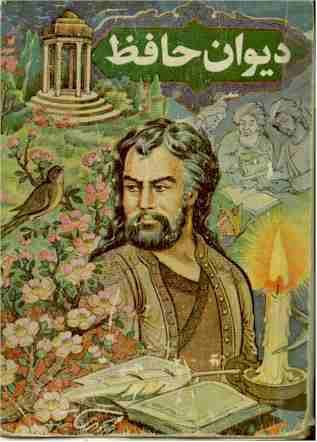
Iranian poet Hafez (1320-1389). He influenced centuries later Thoreau, Goethe, and Ralph Waldo Emerson among others. Emerson referred to him as

Iranian poet Hafez (1320-1389). He influenced centuries later Thoreau, Goethe, and Ralph Waldo Emerson among others. Emerson referred to him as “a poet’s poet”.

The works of the 14th Century poet Hafez can be found in almost every Iranian home – more than 600 years after his death, the writer still offers an insight into his country’s identity.

In Iran they say there are two books in every household – the Koran and Hafez. One is read, the other is not.

To understand this joke you need do no more than join the millions who regularly throng the tomb of Hafez, the 14th Century poet of Shiraz and Iran’s national hero, as I did one recent afternoon. The atmosphere was buzzing, happy and relaxed – Iran at its best.

Day and night the tomb, raised up on a beautifully decorated dais surrounded by its own fragrant rose gardens, water channels and orange trees, is crowded with devotees stroking Hafez’s alabaster sarcophagus, declaiming his verses, relishing his clever plays on words.

Hafez represents all the rich complexities of the Iranian identity. His brilliant use of metaphors in their native Farsi language unites them. […]

Thanks to Hafez, Shiraz is Iran’s most liberal city. […] the lively groups both young and old, men and women mix freely, laughing and chatting together. […]

As the sun disappears from the sky and the illuminations come on round the tomb, the atmosphere becomes ever more festive. People start singing and reciting their favourite poems. Children dangle their feet in the pools, giggling and soaking up their parents’ infectious high spirits.

The scene conceals the paradoxes of Iran but, thanks to the Mullah’s policy of education for all, there are some surprising changes afoot in Iranian society.

More women than men now graduate from university. The birth rate has dropped so dramatically, to one child per family, that the clerics have introduced financial incentives for couples to breed more. Most refuse, saying that it is still too expensive to have more than one child.

While the west remains obsessed with Iran’s nuclear enrichment it is an open secret that the well-connected clerics and businessmen enrich themselves through sanction busting. […]

Rubaiyee 21, by Hafez
Don’t make me fall in love with that face.
Don’t let the drunk the wine seller embrace.
Sufi, you know the pace of this path.
The lovers and drunks don’t disgrace.

Unfortunately for the mullahs the mystic poetry of Hafez, besides lauding the joys of love and wine, also targeted religious hypocrisy.

“Preachers who display their piety in prayer and pulpit,” he wrote 600 years ago, “behave differently when they’re alone. Why do those who demand repentance do so little of it?”

[…]

Read the complete article: BBC | News | The book in every Iranian home by Diana Darke

Iran’s Gilan Province: Rice harvest 2014

Here some beautiful pictures of this year’s rice harvest in the Iranian Province of Gilan. (Click on an image to start the photo gallery):

Source: IRNA | Photos

Iranian women shine in 2014 Karate World Championship

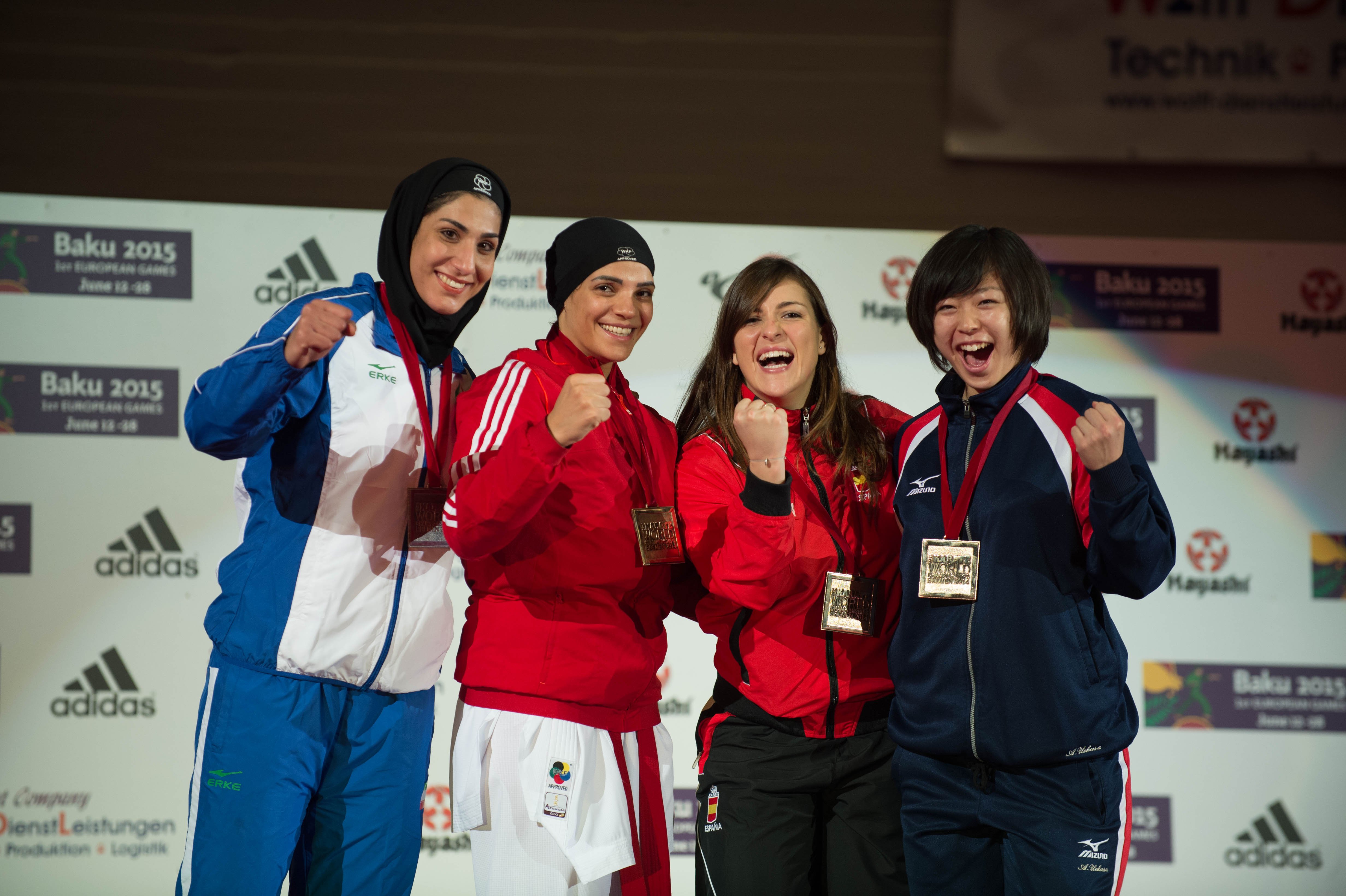
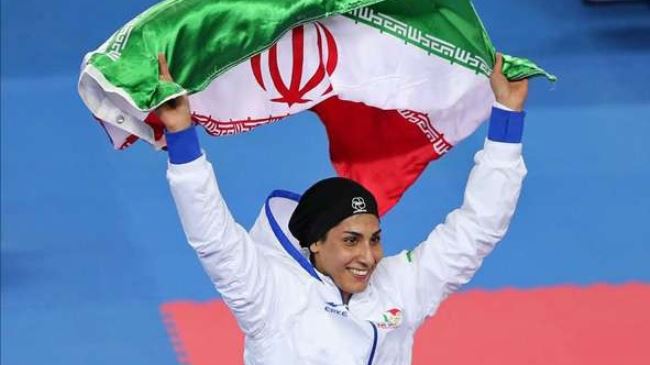
Hamideh Abbasali is the first Iranian women to receive a medal at a Karate World Championship, collecting a silver medal after conceding (2-1) defeat to her Egyptian opponent Shymaa Abouel Yazed in the final competition of the women’s over 68-kilogram weight division.

Abbasali had overpowered Belgian, Spanish, Dutch and Hungarian contestants in her march to the final.

Separately, Mahsa Afsaneh, Elnaz Taghipour and Najmeh Qazizadeh won the third-place women’s kata contest on Saturday and brought home the bronze.

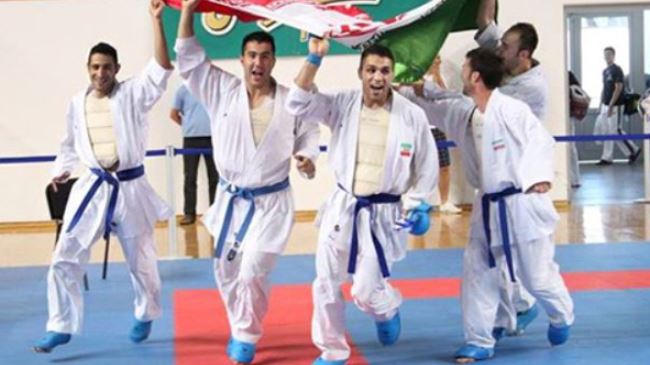
The Iranian men athletes were also very successful. The Iranian men’s kumite team comprised of Saeed Ahmadi, Iman Sanchouli, Saman Heydari, Zabihollah Poursheib, Ebrahim Hasanbeigi, Sajjad Ganjzadeh and Bahman Asgari overcame the host nation 3-2 in the final round of men’s kumite contests at OVB-Arena in the northern German city of Bremen to clinch the gold medal.

They had earlier defeated Dominica (2-1), Japan (3-1), Serbia (3-0) and Belarus (3-0) in its march to the final.

Iran’s Amir Mehdizadeh overcame Vitali Sementsov from Ukraine, and won the bronze medal in the men’s minus 60-kilogram weight category Kumite competition at OVB-Arena in the northern German city of Bremen.

Brazilian athlete Douglas Brose defeated Geoffrey Berens from the Netherlands and won the gold medal in the weight class.

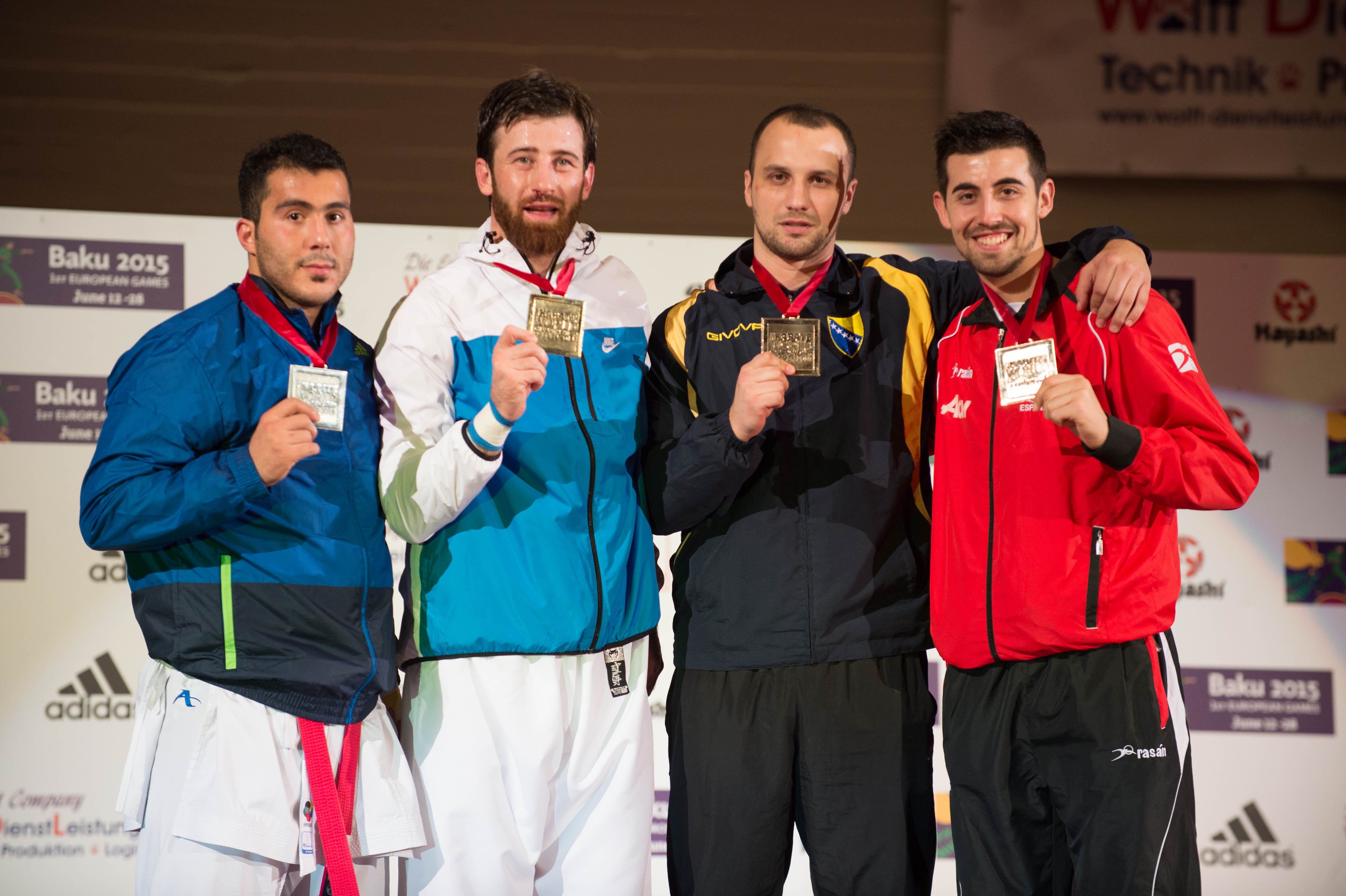
Iranian karate fighter Sajjad Ganjzadeh also lost to Enes Erkan from Turkey (5-4) on Saturday, and snatched a silver medal in the men’s over 84-kilogram weight class.

Ganjzadeh overwhelmed a representative from Bosnia and Herzegovina in the semi-final contest.

The 22nd edition of the World Karate Championships took place in Bremen, Germany from Nov 5 to Nov 9, 2014.

The tournament brought together 887 male and female athletes from 116 nations, including Argentina, Australia, Belgium, Brazil, China, Egypt, Germany, Iran, Italy, Mexico, Russia, Spain, Turkey and the United States.

2014 Karate World Championship - Female Kumite 68kg - Podium - Egypt, Iran (Silver), Spain, Japan

Female Kumite +68kg Podium: (from left to right) Iran (silver), Egypt (gold), Spain and Japan (bronze)

2014 Karate World Championship - Team Female Kata - Podium - Germany, Japan, Italy, Iran (Bronze)

Female Kata Team Podium: (from left to right) Japan (silver), Germany (gold), Italy and Iran (bronze)

2014 Karate World Championship - Female Kumite 68kg - Silver Medal - Hamideh Abbasali, Iran

Hamideh Abbasali celebrating her silver medal

2014 Karate World Championship - Men Kumite Team - Gold Medal - Iran 01

Iran’s men kumite team celebrating their gold medal

2014 Karate World Championship - Team Men Kumite - Podium - Iran (Gold), Germany, Turkey, Japan

Men Kumite Team Podium: (from left to right) Germany (silver), Iran (gold), Japan and Turkey (bronze)

2014 Karate World Championship - Men Kumite -60 Kg 3bronze MAHDI_ZADEH AMIR

Men Kumite -60kg Podium: (from left to right) Netherlands (silver), Brazil (gold), Iran and Russia (bronze)

2014 Karate World Championship - Male Kumite +84 Kg 2sivler GANJZADEH SAJAD

Men Kumite +84kg Podium: (from left to right) Iran (silver), Turkey (gold), Bosnia Herzegovina and Spain (bronze)

Sources:
http://www.presstv.ir/detail/2014/11/09/385365/iran-wins-medals-in-world-karate-games/
http://www.presstv.ir/detail/2014/11/10/385476/iran-mens-kumite-team-crowned-in-world/
http://www.worldkaratefederation.net/news-center-new/karate-bremen-2014-10-new-karate-world-champions/122/

Nellie’s Journey to Iran: from Persian architecture to outstanding hospitality

Posing with friendly Iranians

Photo Highlights of Iran: from Persian Architecture to Outstanding Hospitality
By Nellie Huang

I’ve just completed my Silk Road journey through Central Asia with Oasis Overland. Our trip started in Kyrgyzstan and we traveled through Kazakhstan, Uzbekistan, Turkmenistan, Iran and ended in Turkey. During this overland trip, we spent just under three weeks traversing through Iran, from the eastern corner to the western edge. It was the highlight of our trip and I hope these photos will show you what an amazing country it is.

Mention Iran and many think of burkha-clad women, burning flags and war. But these stereotypes can’t be further from the truth.

For those who are curious and open to new discoveries, Iran is packed full of surprises. It is a relatively safe country to visit and there’s so much to see and do in terms of historical and cultural sights: wander through the thousand-year-old ancient city of Persepolis, get lost in the mud-brick alleys of Yazd, contemplate in the beautiful turquoise-domed mosques that dot Esfahan, meet locals in the gardens surrounding Shiraz and pray with thousands of pilgrims at the country’s holiest city Mashad. The Islamic Republic has an extremely rich cultural heritage and its attractions can definitely rival those of world-famous tourist destinations. Best of all, you won’t find hordes of tourists here. It won’t take you long to question how such a charming country can be portrayed in such a negative light by the media.

Beyond the stereotypes is a country desperate to been seen for what it is, rather than what it is depicted to be. The Iranians are undoubtedly the friendliest people I’ve ever met in the world. Travelers will often find themselves getting invited to stranger’s homes, being treated to endless flow of tea from a shop vendor and getting a free ride from helpful drivers along the way. Locals tend to come up to you, ask where you’re from and genuinely want to get to know you. I’ve always agreed with the saying “it’s the people that makes a place”. It can’t be more true here in Iran where experiences with locals truly live the longest in your memory.

While traveling in Iran, the two topics that most find impossible to escape are religion and politics. These are complex issues that aren’t black or white, but as I discovered, if you’re respectful of their opinions, the Iranians will be more than happy to discuss them with you. It’s also important to note that the government’s views may not be in line with what average Iranians think. Regardless, if you do choose to travel here, a journey to Iran will certainly change your perspective of the country, and perhaps, the world.

Natural Landscapes and Ancient Cities

The abandoned mud brick city of Kharanaq: In the abandoned mud-brick city of Kharanaq, we got lost amidst the alleys and crumbling paths that overlooked this beautiful valley.

The abandoned mud brick city of Kharanaq


The rock cut temples of Naqsh-e-Rostam
: Right at the outskirts of Shiraz, we stumbled upon the spectacular rock tomb of Naqsh-e-Rostam. The ragged cliffs that the tombs are carved into remind me of those in Wadi Rum, Jordan.

The rock cut temples of Naqsh-e-Rostam


Persian Architecture

Amir Chakhmagh: Amir Chakhmagh in is an iconic landmark in Yazd and while it’s now nothing more than a gate (the rest of the building is gone), the unique architecture still makes it quite an impressive sight.

A gate in Yazd


Royal Palace in Shiraz
: The interior of Persian buildings is often just as impressive. This photo shows the interior of the Royal Palace in Shiraz, characterized by arches, spiraled columns and carvings.

Inside a palace in Shiraz


Iranian Way of Life

Colorful spices in the bazaar of Shiraz: Bazaars are an important part of Iranian life. They trace their roots back to the Silk Road days and even until today, Iranians are still known to be excellent traders and businessmen. Spices are of course a common sight in the bazaars.

Colorful spices in the bazaar of Shiraz
Friendly students in Tehran: The Iranians are exceptionally warm and friendly, with many people stopping to strike up a conversation with us seeing that we’re foreigners. I met this bunch of students at the Golestan Palace in Tehran and they were all excited to practice their English with me.

Friendly students in Tehran

More pictures of Nelly’s Journey:
http://www.wildjunket.com/2014/10/22/photo-highlights-iran/

About Nellie Huang: Nellie is a professional travel writer and editor with an eye for adventure and a love for the unknown. Originally from Singapore, she pursued an Engineering degree and spent her days dreaming of travel – the day after graduation, she packed her bags and headed off to experience the world.

She then spent the next few years working as a teacher, translator and project analyst. With sheer will and hard work, she eventually found her way into travel writing and fulfilled her lifetime dream.

Her work has since been published in numerous publications including National Geographic Intelligent Travel, CNN, BBC Travel, Travel+Leisure Asia, Wend, Women Adventure Magazine, Food&Travel, International Lifestyle, TNT Magazine, and Explorer, amongst others. Click to see her portfolio.

She is also a contributing guidebook author of VIVA Travel Guide Guatemala (1st Edition) and writer for World Travel Guides.

Iran’s Gilan Province: Roudkhan Castle

The medieval Rudkhan Castle (Ghale Roodkhan) is located 25km southwest of the city of Fooman in Iran’s Gilan Province in the heart of the forest. Made from brick and stone, the castle covers 50,000 square meters and is 900 meters above sea level. Its architects have benefited from natural mountainous features in the construction of the fort. It is built on two tips of a mount with a total of 65 towers surrounding it, while the walls run 1,500 meters in length. 42 towers still stand intact. It is a military complex which had been constructed during the Seljuk Dynasty by followers of the Ismaili sect. The castle sits at the two peaks of a mountain at elevations of 715meters and 670meters, with an area of 2.6 hectares (6.4 acres). The Rudkhan Castle River originates in the surrounding heights and flows from south to north. It takes around two hours to cross a mountainous winding route with dense forests. To reach this castle people walk a three kilometer distance on foot, then climb around 2,000 steps. The first thing that one notices about the castle is its big entrance gate.

Sources: Wikipedia | Rudkhan Castle, Wikimedia Commons’ media related to Rudkhan Castle, wiseitinerary.blogspot.de, Mehr News Agency | Photos, Press TV

Iran’s Sa’adi and Spain’s Cervantes were honored in Madrid

Sa’adi-Cervantes

Spain hosted a joint literary conference on the life and works of Persian poet Sa’adi and Spanish classic author Miguel de Cervantes.

After a commemorative ceremony in Iran in April to pay tribute to Iranian and Spanish literary giants, they were remembered in Madrid in late October.

The Complutense University of Madrid (UCM) hosted Sa’adi and Cervantes Conference on October 28-29 with Iranian and Spanish academicians attending.

Ali Asghar Mohammadkhani, the manager of Shahre Ketab (City of Book) International and Cultural Affairs, interviewed before the conference started, said, “Shahre Ketab hosted the ceremony to honor Sa’adi and Cervantes on April 21-22 on the occasion of Sa’adi National Day, and we planned a Madrid conference as well to be held in late October in Complutense University of Madrid (UCM). The conference is a concerted effort by Shahre Ketab International and Cultural center, the Center for Sa’adi Studies, Iran’s cultural attaché in Madrid, and UCM, where 11 literary historians and critics will deliver lectures on Sa’adi and Cervantes.”

“Iranian delegation will be in Cervantes’ birthplace in Alcala at the invitation of the University of Alcala, and will have meetings with Spain’s contemporary poets and literary figures. The delegation will also meet Persian literature professors in Madrid and Barcelona Universities,” he concluded.

Source
Iran Front Page: http://iranfrontpage.com/news/cultures/literatures/2014/10/saadi-cervantes-honored-madrid/

Photo Series: Autumn in Iran – Sabzevar, Razavi Khorasan Province

Sabzevar is a city of 200.000 inhabitants in Razavi Khorasan Province in northeastern Iran. It is the commercial center for an agricultural region producing grapes and raisins. There is some small-scale industry, for food processing, cooperware and electric motors. Through the old bazaar of Sabzevar fresh, dried, and preserved fruits and vegetables are exported.

In ancient times it was called Beihagh (Beyhaq). The history of Sabzevar goes back to the 1st millennium BC. Ancient remains include fire-temple ‘Azar Barzin’ which is still visible. Mil-e Khosrow Gerd (meaning “The brick tower of king Khosrau) is the highest brick tower in the city. This ancient brick tower dates back to 6th century and was part of city that no longer exists. This brick tower served as a travel guide for caravans traveling from Nishapur to Rey. Near Sabzevar are also remainings of yakhchals (ice houses or ice pits).

Sources: Wikipedia | Sabzevar, adayinlife.org, Mehr News

Iran’s Sharif University robots help treat cancer children

Researchers in Sharif University of Technology have accelerated the treatment of cancer in children using humanoid social robots.

The research paper submitted to 6th International Conference on Social Robotics University of Technology, Sydney, titled ‘Impact of a Social Humanoid Robot as a Therapy Assistant in Children Cancer Treatment,’ by Sharif University of Technology researchers Minoo Alemi, Ali Meghdari, Ashkan Ghanbarzadeh, Leila Jafari Moghadam, Anooshe Ghanbarzadeh, was awarded the best paper title.

Children suffering from cancer are subjected to higher levels of anorexia, anger, depression, and anxiety during chemotherapeutic treatments. The problem is a real challenge to psychologists in dealing with these children.

[…]

Humanoid robots are the most prevalent social robots which helped researchers including applied linguists, psychologists, and robot experts to plan a six-month research project in two specialized hospitals of Pediatric Center and Mahak.

They found that using humanoid robots contributed significantly in decreased levels of stress, anger and increased appetite in cancerous children.

[…]

Read the complete article:
http://en.mehrnews.com/detail/News/104518 or in
http://www.payvand.com/news/14/nov/1015.html

Tehran hosted 6th Seasonal Flowers and Plants Exhibition

The 6th Seasonal Flower and Plant Exhibition and Autumn Flower Festival took place in the Iranian capital, Tehran.

Domestic exhibitors from across the country have showcased cut flowers, houseplants, outdoor plants and horticultural equipment and related industries. Flower lovers have flocked to the exhibition to revive their spirits after a long day work. Vast arrays of flowers in different colors have turned the expo into a flamboyant painting, catching the eye of every visitor.

According to the organizer of the event, over 200 national flower and plant growers are taking part in the exhibition. Sunflowers, lilies, and lilacs were among the numerous flower species presented in the show. According to the head of municipality parks and green spaces, the exhibition is aimed to make people more familiar with different flowers, and to encourage them to take better care of Mother Nature. Diverse climatic conditions in Iran have turned the country into one the largest producers of flowers in the world. Iran ranks 17th in terms of the area under cultivation of ornamental flowers.

Tehran - 6th Flowers and Plants Exhibition 05 Tehran - 6th Flowers and Plants Exhibition 04 Tehran - 6th Flowers and Plants Exhibition 00 Tehran - 6th Flowers and Plants Exhibition 06 Tehran - 6th Flowers and Plants Exhibition 07 Tehran - 6th Flowers and Plants Exhibition 02

Sources:
PressTV – http://www.presstv.ir/detail/2014/10/24/383464/flower-show-plant/
Iran Front Page – http://iranfrontpage.com/news/society/environment/2014/10/tehran-plays-host-seasonal-flower-show/

Austria honored Iranian film director Abbas Kiarostami with Decoration for Science and Art

Austria awarded Iranian director Abbas Kiarostami the Austrian Decoration for Science and Art. The medal was established in 1960 to honor international figures for their outstanding achievements in the fields of science and arts.

During a ceremony held in Vienna Iranian director Kiarostami, molecular biologist Barbara Hohn and mathematician Bruno Buchberger received the Cross of Honor for Science and Art from Austria’s President, Heinz Fischer. Austrian poet Friederike Mayröcker received a Decoration of Honor for Services to the Republic of Austria.

Abbas Kiarostami was born in 1940 in Tehran and is one of the most important and famous Iranian film directors. The filmmaker was awarded in 1984 with the Golden Leopard in Locarno for “Where is the house of my friend?”. In 1997 he received the Palme d’Or in Cannes for “Taste of Cherry”, and the 1999 Grand Jury Prize in Venice for “The Wind Will Carry Us”. He is also a photographer, poet, painter and has staged operas. He has been decorated with several state medals, including France’s Chevalier of the Legion of Honor.

Sources: Tehran Times, bundespraesident.at (in German)

1001 Libraries to see before you die!

The International Federation of Library Associations (IFLA) Public Libraries Section together with the IFLA Library Buildings and Equipment Section launched in Lyon at the IFLA World Library and Information Congress a project called 1001 libraries to see before you die.

This online initiative aims to bring together best practice examples of public library buildings and spaces from around the world. The libraries can be nominated for different criteria – the library building, the location, the innovative programs or the community engagement.

Currently the list is holding two Iranian libraries: the Astan Quds Razavi Library in Mashhad and the Bazar Library in Tehran.

Mashhad’s Astan Quds Razavi Library has been selected by the Open Education Database (OEDB) among the 20 Libraries that have changed the world in 2012 and three of the collections preserved in the central library are registered in the list of the UNESCO World Cultural Heritage List.

Tehran’s Bazar Library was chosen for its historical building which belonged to a relative of Naseruddin Shah dating back to 150 years.

More information: https://1001libraries.wordpress.com/category/iran/

Iran’s Isfahan Province: Kashan – Boroujerdi House Series

Boroujerdi's House in Kashan, Iran

Boroujerdi’s House in Kashan, Iran

The Boroujerdi House (in Persian: Khaneh-ye Boroujerdi-ha) is a historic house in Kashan, Esfahan Province, Iran that is nowadays open to the public as a museum.

It was built in 1857 for the bride of Haji Mehdi Boroujerdi, a welthy merchant, by architect Ustad Ali Maryam. The bride came from the affluent Tabatabaei family, for whom Ali Maryam had built the Tabatabaei House some years earlier and the condition set for the marriage was the construction of a house as beautiful as the Tabatabaei House.

Considered a true masterpiece of Persian traditional residential architecture, it took eighteen years to build using 25 workers, painters and architects.

Kashan

Wind towers of the Boroujerdi’s House in Kashan, Iran

The House, famous for its atypical shaped wind towers made of stone, brick, sun baked bricks and a composition of clay, straw and mortar, has three entrances and consists of a rectangular beautiful courtyard, delightful plaster and stucco works of fruits and flowers and wall paintings by the royal painter Kamal-ol-Molk and three 40 meter tall wind towers which help to cool the house to unusually cool temperatures.

The entrance to the building is in the form of an octagonal vestibule with multilateral skylights in the ceiling. Near the entrance is a five-door chamber with intricate plasterwork. Following a narrow corridor, a vast rectangular courtyard opens up. The courtyard has a pool and is flanked by trees and flowerbeds. Also in the vicinity of the corridor is a reception area sandwiched in between two rooms. Due to the high amount of sunlight these two rooms receive, they were mostly utilized during the winter months.

In the east and northeast area of the property lie the kitchen, rooms and stairways to the basement. The wind towers allowed for the basements to consistently benefit from a flow of cool air. On the southern side is a large covered hall adorned with many reliefs, artistic carvings and meshed windows which was the main area for various celebrations. It consists of a raised platform on its far side and would normally be reserved for the more important guests.


Source: Historical Iranian sites and people | Boroujerdi House

Iran’s Razavi Khorasan Province: Shamkhal Canyon

Somewhere not far from the border between Iran and Turkmenistan there is a huge and unbelievably beautiful valley called Shamkhal. The name comes from a village near that. It is located in west northern of Quchan. It is about 18 km long; going through many springs and falls within rocky walls which in some parts are 200 meters high.

Source: Irpedia | Photos of Iran | Shamkhal Valley

Kambiz Derambakhsh is Knight of the Order of Arts and Letters

Kambiz Derambakhsh at the French Embassy in Tehran on Sunday, 26th of October 2014

Kambiz Derambakhsh at the French Embassy in Tehran on Sunday, 26th of October 2014

Iranian cartoonist Kambiz Derambakhsh received the Chevalier of the Legion of Honor Medal during a ceremony held at the Embassy of France in Tehran on Sunday evening.

The medal, which is the highest decoration awarded by the French government, was presented to Derambakhsh by French Ambassador Bruno Foucher during a ceremony at his residence in Tehran.

Derambakhsh is the first Iranian visual artist to have received the award, the Persian service of Honaronline, a Persian news website, announced on Monday.

Iranian scientist Mahmoud Hessaby, filmmaker Abbas Kiarostami, stage director Pari Saberi, mythologist Jalal Sattari, poet Mohammad Sepanlu, vocalists Shahram Nazeri and Mohammareza Shajarian, and actress Leila Hatami previously received the honor.

Derambakhsh, 72, has previously held many exhibits across the world and his works are on display in many museums, including the Tehran Museum of Contemporary Art, Istanbul’s Museum of Cartoon and Comic, and the Cartoonmuseum Basel in Switzerland.

More about Kambiz Derambakhsh: Iranian Roots | Kambiz Derambakhsh

Kambiz Derambakhsh - Cartoonist 03

Sources: Tehran Times, twitter.com | @FranceenIran, Facebook | Kambiz Derambakhsh