Tag Archives: Culture

Photos: Sizdah bedar ( Nature day ) in Iran

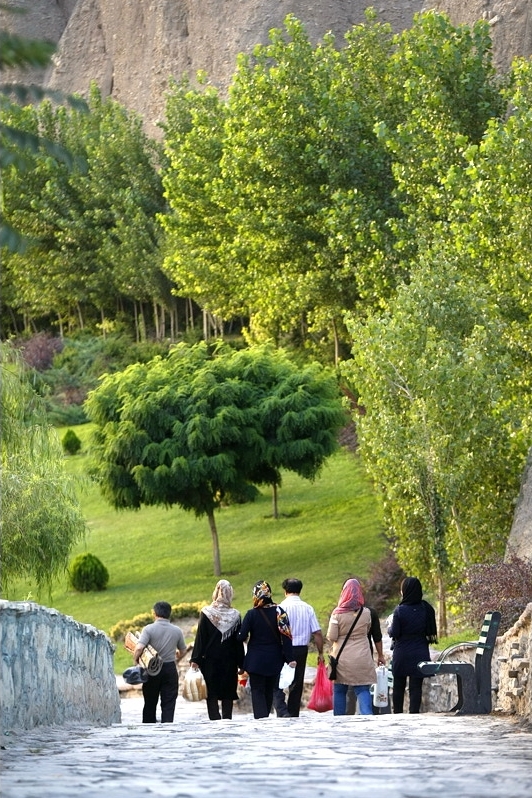
Sizdah Be-dar, literally “thirteenth in outdoors”, is an Iranian festival, and part of the Nowruz celebration rituals, held annually on the thirteenth day of the first month of the Iranian calendar (Farvardin). It is celebrated by leaving the house to spend the day outdoors, picnicking and enjoying nature. Thus this festival is also known as “Nature Day”.

A ritual performed at the end of the picnic is to throw away the sabzeh (greenery on the haft-sin table) part of the traditional table setting for Nowruz in Iran. Doruq-e Sizdah, the Iranian version of the prank-playing April Fools’ Day is also celebrated on this day.

Sizdah Bedar is customary to Iraq, Armenia, Azerbaijan and some parts of Central Asia. In cities with large populations of Iranians, like Los Angeles, it is common to see families celebrating Sizdah Bedar across the city.

Related article: The other Iran | Sizdah Bedar 2015

Photos: Sizdah Bedar 2016 in Iran – Picnicking outdoors on a sunny, rainy and even a snowy day!

Sources: Wikipedia | Sizdah Be-dar, kish.ir 1, kish.ir 2, IRNA 1, IRNA 2, IRNA 3, IRNA 4ISNA 1, ISNA 2, ISNA 3, ISNA 4, ISNA 5ISCA News, Mehr News Agency (MNA) 1, MNA 2, MNA 3, MNA 4, MNA 5, Fars News Agency, Tehran Picture Agency (TPA) 1, TPA 2, TPA 3, TPA 4, TPA 5, TPA 6, Borna News 1, Borna News 2, Borna News 3, Borna News 4, Borna News 5, Borna News 6, Tasnim News Agency (TNA) 1, TNA 2, TNA 3, TNA 4JameJam Online, Young Journalists Club (YJC) 1, YJC 2, Azad News Agency (ANA) 1, ANA 2

Chaharshanbe Suri – Ancient Iranian Fire Festival (Photos)

Chaharshanbe Suri is an ancient ceremony dating back to at least 1700 BCE. Iran’s largest dictionary, Dehkhoda, describes it as: “A festival arranged on the last Tuesday evening of the old year, where you light fires and jump over them, to achieve happiness and good health in the New Year.”

The celebration usually starts in the evening and people leap over the flames, singing “zardi-ye man az toh, sorkhi-ye toh az man”, literal translated as “my yellow is yours, your red is mine”, asking the fire to take their pallor, sickness, and problems and in turn give them redness, warmth, and energy.

Traditionally, it is believed that the living were visited by the spirits of their ancestors on the last day of the year. Many people specially children, wrap themselves in shrouds symbolically reenacting the visits. By the light of the bonfire, they run through the streets banging on pots and pans with spoons (“Gashog-Zani”) to beat out the last unlucky Wednesday of the year, while they knock on doors to ask for treats. Sometimes the treat is a mixture of seven dried nuts and fruits (pistachios, roasted chic peas, almond, hazelnuts, figs, apricots, and raisins) and is called “Ajeel-e Chahar Shanbeh Suri”. The practices are very similar to Halloween, which is a Celtic version of similar festivals celebrated throughout the area in ancient times.

Photos: Chaharshanbe Suri in Iran, 2016

Families customarily enjoy snacks during the evening and a supper at night after the end of the festivities. In Ker­man and Shiraz the main dish is usually polow with pasta soup (“ash reshte“); the longer the pasta strands, the better the chances for a long life for each member of the family.

The ancient Iranians celebrated the last 10 days of the year in their annual feast of all souls, Hamaspathmaedaya (Farvardigan). They believed Foruhars (faravahar), the guardian angels for humans and also the spirits of dead would come back for reunion. These spirits were entertained as honored guests in their old homes, and were bidden a formal ritual farewell at the dawn of the New Year. The ten-day festival also coincided with festivals celebrating the creation of fire and humans. Flames were burnt all night to ensure the returning spirits were protected from the forces of Ahriman. This was called Suri festival. Zoroastrians today still follow this tradition.

The celebration was not held on this night before Islam and might be a combination of different rituals to make them last. Wednesday is likely to have been prompted by an Arab superstition where it represents a bad omen day with unpleasant consequences. This is contrary to Zoroastrian cosmology where all days were sacred and named after a major deity. By celebrating in this manner Iranians were able to preserve the ancient tradition. The festival is celebrated on Tuesday night to make sure all bad spirits are chased away and Wednesday will pass uneventfully.

Today, there is no religious significance attached to it any more and is a purely secular festival for all Iranians (Persians, Azerbaijani people, Armenians, Kurdish people, Assyrians, Bahá’í, Jews, Christian and Zoroastrians). The night will end with more fire works and feasts where family and friends meet and enjoy music and dance.

Chaharshanbe Suri in Tehran, Iran – 2016

Fire Festival in Sweden
In Gothenburg, Stockholm and Malmö, Sweden they celebrate Eldfesten, a Swedish version of the Persian Chaharshanbe Soori. This year, 2016, is the 25th anniversary of the festival in the city of Gothenburg, where it has become one of the most popular public cultural celebrations in the city. Thousands of people, including non-Iranians, attend each year to celebrate the arrival of spring with crackling fires, music, fireworks and fragrant Persian dishes.

Photos: Eldfesten 2016 in Sweden

Sources: Iran Chamber Society, Enciclopædia Iranica, Wikipedia | Chaharshanbe Suri, IRNA 1, IRNA 2, IRNA 3, IRNA 4, IRNA 5, ISNA 1, ISNA 2, Mehr News AgencyFacebook | Eldfesten 2016, Göteborgs-Posten, goteborg.com, Huffington Post Canada

Joint celebration of Chinese and Iranian New Year in Tehran (Photos)

The Chinese Embassy in Tehran and the Iran-China Friendship Association have held a combined celebration marking Chinese New Year as well as Nowruz, Iranian upcoming New Year at Niavaran Cultural Complex.

Chinese cooks and artists offered traditional dishes and handicrafts to the visitors and Iranian artists performed traditional Persian music to celebrate the event. Iran’s Red Dragon International Wushu Association performed lion dance, a tradition in Chinese culture in which performers mimic a lion’s movements in a lion costume. Another part of the celebration was bian lian (literally: face changing), an ancient Chinese dramatic art where performers wear colored masks which they change from one face to another almost instantaneously with the swipe of a fan, a movement of the head, or wave of the hand.

Chinese Lunar New Year is also known as Spring Festival, as the season signifies a new start from the depths of winter, and the corresponding holiday carries the same meaning in Iranian culture. Nowruz, as the Iranian New Year is called in Persian, means “new day” and falls on the first day of the spring equinox every year. It is an ancient ritual dating back 2500 years and is rooted in Zoroastrianism.

There are remarkable similarities in the ways Chinese and Iranians celebrate their spring festivals, according to Alireza Salarian, consul general for Iran in Guangzhou: It is a time for family reunions, people who live away from their hometowns return for a family dinner. Fish is a common holiday dish, as is a version of the saying, “May you get more than you wish for every year.” Like the Chinese, Iranians enjoy a week long holiday, and children wear new clothes as they accompany their parents on visits to relatives.

While Chinese attach scrolls of blessing couplets on gateposts and offer guests nuts and candy in exquisite boxes, Iranians traditionally present an elaborate table setting with seven items starting with the letter “s” in the Persian alphabet.

Sources: China Daily, Mehr News Agency, Tehran Times, Wikipedia | Bian lian

Opera ‘Kalileh and Demneh’ performed by children in Shiraz, Iran (Photos)

The opera of “Kalileh and Demneh”, arranged and conducted by Mohammad-Ali Fallahi, was performed by children younger than 12 years old at the Hafez Hall in Shiraz.

Kalileh and Demneh is a collection of didactic animal fables, with the jackals Kalileh and Demneh as two of the principal characters. Originally from India (between 500BCE and 100BCE), the fables were translated into many languages, undergoing significant changes in both form and content. In Persian literature Kalileh and Demneh has been known in different versions since the 6th century CE. In Sanskrit literature the story cycle is known as Panchatantra, while it was often called Fables of Bidpai in early modern Europe.

Sources: Mehr News Agency, Enciclopædia Iranica | Kalila wa Demna, Honaronline (in Persian)

Tehran calligraphy show promoting Iranian calico art

An exhibition of works by calligraphers Omid Ganjali and Mohsen Soleimani opened at Tehran’ Niavaran Cultural Center on Sunday to promote qalamkari, Iranian calico art that the artists believe is being forgotten.

The artworks were previously showcased at “From Earth to Heaven”, an exhibition that the Salam Art Creations Institute, a Tehran-based private organization developing Iranian arts, held at Cemal Resit Rey Concert Hall in Istanbul in July.

Photos by Mona Hoobehfekr for ISNA

All 30 calligraphy works are huge in size with designs of qalamkari done on their margins. Qalamkari is passing into oblivion in the country, Salam Art Creations Institute Managing Director Rafi Razavi told the Persian service of ISNA. The exhibition was organized to turn the spotlight on Iranian art, he added. “We need to take serious action to support artisans and masters who are still active in this field of time-honored art,” he stated.

The exhibition will run until August 25.

Sources: Tehran Times | Art Desk News, ISNA | Photos

Hamid Saeid: Iranian musician

Since his Internet hit, “Bad Shans” (hard luck), Hamid Saeid has become one of the best-known Iranian musicians with African roots. He’s traveled by motorbike across the province of Hormozgan, which is situated in the South of the country on the Persian Gulf, in order to realize his dream; to organize a concert with the best black musicians in the country. The documentary Dingomaro – Iran’s Black South by Kamran Heidari is a testimony of this trip.

Listen to Hamid Saeid performing Bad Shans (Hard luck):

Source: Autentic | Dingomaro – Iran’s Black South

The Fish & I: Awarded Iranian short film by Babak Habibifar

The Fish and I is an Iranian short film directed, written and acted by Babak Habibifar that recounts the story of a blind man trying to save his fish. The film, screened at the 2015 Clermont-Ferrand Film Festival (Young Audience Program), has won several international honors:

  • Young Jurors Prize; 20min|max Internationales Short Film Festival Ingolstadt, Germany (June, 2015)
  • Special Audience Award; 12th CLAM International Film Festival of Solidarity in Navarcles, Spain (May, 2015)
  • Best Short Film; 6th Skepto International Film Festival in Cagliari, Italy (April, 2015)
  • Honorable Mention; 11th Rengo International Film Festival, Rengo, Chile (February 2015)
  • Special Jury Mention, Young Jury Prize for the Best International Short Film and Mediterranean Diet Award (a cash prize dedicated by a Spanish Institution); 16th International Short Film Festival “City of Soria” in Soria, Spain (November, 2014)
  • Jury Grand Prize and Audience Award; Short Short Story Film Festival in Providence, USA (November, 2014)
  • Most Original Film; Uhvati Film Festival in Novi Sad, Serbia (September, 2014)

About Babak Habibifar
Babak Habibifar is an Iranian writer and director. His short fictions include The Fish and I (2014), After seventeen hours (2013), Somewhere up there (2013) and After fifteen years (also known as Crossword puzzle, 2012). This last film was highlighted by the Jury at the 2013 Strawberry Shorts Film Festival in Cambridge, England. Besides directing, Habibifar has worked as an actor and is also a gifted photographer, having won several photography awards in national competitions.

Sources: Mehr News Agency | News, Art Film Festival | Portfolio | Babak HabibifarGreen Film Festival in Seoul | The Fish and I, NacióDigital.cat | CLAM Festival, Skepto International Film Festival 2015 | Awards and Special Mentions, Rengo International Film Festival, Heraldo.es | Noticias, Press TV | News, Merging Arts Productions | SSS Film Festival, Uhvati Film Festival | Awards, The House of Films | News, 20min|max Film Festival, Odense Film Festival (OFF15), indiehometv.festhome.com (all awards and screenings)

Photos: The 28th International Book Fair kicked off in Tehran!

The event started on Wednesday May 6, in a 120,000 square meter venue at Tehran’s Grand Mosalla, and will continue until May 16, 2015.

Over 2800 publishers from Iran and 65 other countries have presented their latest publications at the fair. 300,000 Iranian books and 160,000 non-Iranian books were presented this year. The foreign publishers substantially offer their materials in English or Arabic however titles in French, German, Chinese, Korean or Japanese are also available.

Millions of visitors inspect the fair every year, including thousands of university students, scholars and families. It is currently the most significant cultural event in Iran as well as one of the most significant events of its kind in Asia and the Middle East. Heads of international book fairs from Oman, this year’s special guest, Paris, Bologna, Moscow, and other places are attending the 28th edition of TIBF.

Hundreds of cultural projects are carried out during the event as sidelines activities, including book review sessions, face-to-face meetings with Iranian authors, lecture sessions, and writing workshops.

Monday May 11, 2015 has been designated as Day of Africa  at the 28th TIBF. To mark the day, African exhibitors will hold an array of cultural programs. As part of the programs, a panel discussion will be staged in the TIBF section of Men of Letters’ House on existing cultural exchanges between Iran and African nations, sponsored by friendship associations established among Iran and a number of African nations, namely Nigeria, Tunisia, Uganda, Senegal, Ivory Coast and Comoros.

The works of illustrators participating at the 52nd Bologna International Children Book Fair will be displayed in an exhibition titled “Tehran-Bologna 2015”. According to IBNA (Iran’s Book News Agency), the illustrations which participated in the latest Bologna Children Book Fair as well as the illustrations by Roger Mellow, the winner of 2014 Hans Christian Anderson Award, will be showcased. Moreover, the works of the Iranian illustrators whose works have participated in the editions of Bologna Fair during the last 10 years are going to be put on public display in this event.

Tehran Metro and the public bus service boosted their cooperation during the 28th TIBF to facilitate the transportation of the visitors. Extra trains are being used and the arrival times of the trains is also reduced to 5 minutes at the weekends. The subway is deploying its maximum manpower particularly at the Beheshti and Mosalla stations, said Mohsen Nayebi, Head of Tehran urban and suburban Railway Operation Company. Public buses, dedicated particularly to transportation of the Book Fair visitors, are plying between the venue and the city’s main squares.

Sources: TIBF on Instagram, TIBF Official Site | News 1, TIBF Official Site | News 2, Tasnim News Agency| Tehran International Book Fair, Press TV | Tehran International Book Fair, irib.ir | Photogalleries, Tehran Municipality | News 1, Tehran Municipality | News 2,Expo Road | Tehran International Book Fair, Mehr News Agency | Photos by H. Razaqnejad , Tasnim News | Photos by M. Hassanzadeh, IRNA | Photos 1IRNA | Photos 2, ISNA | Photos by A. Khosroshahi

The Tehran Graphic Design Week 2015 started!

The Tehran Graphic Design Week 2015 started on April 26 at the Iranian Artists Forum (IAF) as tens of graphic art enthusiasts demonstrated support for the event by gathering outside the venue under the slogan “Graphic Art Needs Promotion”.

“Graphic designs are with us wherever we go. From the moment we wake up, graphic designs are before us telling us what to wear and what is attractive,” said graphics expert Akbar Alemi, a member on the selection committee and the ceremony host.

The head of Iran Graphic Designers Society (IGDS) Ali Rashidi said the extensive world of graphics can offer more than posters and logos and called for Iran to advance in all areas of this pragmatic form of art, Mehr News Agency reported. He took note of “motion graphics and economics of art” as two key areas of IGDS focus this year, and said “this society aims to promote non-still (non-print) graphics.”

French graphic designer Ruedi Baur, who was a guest invitee, said “motion graphics cannot be defined as they are out of our control”. Australian designer Ken Cato opposing the view, stated that motion graphics “even defines throwing up your business card up in the air,” and to prove a point, he did just that.

An introduction to motion graphics and its applications on DVDs was unveiled by Mahdi Mahdian, secretary of the event.

In addition to the two international guest invitees, a number of renowned figures attended the function, including graphic designers Ghobad Shiva, Majid Balouch, Amrollah Farhadi, Mostafa Asadollahi, typography designer Masoud Sepehr, and calligrapher Bahram Kalhornia.

The Tehran Graphic Design Week usually kicks off every year around the World Graphic Design Day which is on April 27. The Tehran Beautification Organization, Contemporary Art (Honar Moaser) Publications and Sepia Co. cooperated with IGDS running the event.

According to Mehdi Mahdian the works exhibited were selected by a committee composed of Akbar Alami, Bahram Azimi, Reza Alavi, Mehrdad Sheikhan and Amir Mohammad Dehetani.

Tehran Graphic Design Week 2015 features various programs such as commemoration of a veteran artist and exhibition of works by two international graphic designers. The Tehran Museum of Contemporary Art displays works by graphic designers Rudie Baur from France and Ken Cato from Australia in separate exhibitions.

Tehran Graphic Design Week 2015 runs for one week in the Iranian Artists’ Forum located on Musavi St., off Taleqani Ave, Tehran.

Program (in Persian): Iranian Graphic Design Society | Graphic Design Week 20015 – Program

Sources: Culture and Heritage National Agency, Tavoos Online, Tehran Times, ISNA | Photos

Iran’s Razavi Khorasan Province: Mashhad’s Spring Flower Festival (Photos)

Each year, the city of Mashhad celebrates spring with a Flower Festival. More than eight million bulbous flowers (e.g. tulips) are being planted in parks and streets and can be enjoyed until mid-May.

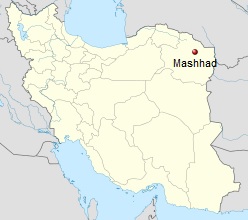
Razavi Khorasan, Iran - Mashhad - MapMashhad (Persian: مشهد‎) with 3.150.000 inhabitants is the second most populous city in Iran and capital of Razavi Khorasan Province. It is located in the northeast of the country, close to the borders of Turkmenistan and Afghanistan. It was a major oasis along the ancient Silk Road connecting with Merv in the East.

Every year, millions of pilgrims visit the Imam Reza shrine. Mashhad is also known as the city of Ferdowsi, the Iranian poet of Shahnameh, which is considered to be the national epic of Iran.

The city is located in the valley of the Kashaf River near Turkmenistan, between the two mountain ranges of Binalood and Hezar-masjed. The city benefits from the proximity of the mountains, having cool winters, pleasant springs, mild summers, and beautiful autumns. It is only about 250km (160 mi) away from Ashgabat, Turkmenistan.

Long a center of secular and religious learning, Mashhad has been a center for the arts and for the sciences. The Ferdowsi University of Mashhad, the Madrassa of Ayatollah Al-Khoei, originally built in the seventeenth century, and the Razavi University of Islamic Sciences, founded in 1984, are located here.

Mashhad is also home to one of the oldest libraries of the Middle-East with a history of over six centuries. The Astan-e Quds Razavi Museum, which is part of the Astan-e Quds Razavi Complex, is home to over 70,000 rare manuscripts from various historical eras. There are some six million historical documents in the foundation’s central library.

Apart from Imam Reza shrine, there are a number of large parks, the tombs of historical celebrities in nearby Tus and Nishapur, the tomb of Nadir Shah, Kooh Sangi park and the Koohestan Park-e-Shadi Complex.

Some points of interest lie outside the city: the tomb of Khajeh Morad, the tomb of Khajeh Rabi’ where there are some inscriptions by the renowned Safavid calligrapher Reza Abbasi and the tomb of Khajeh Abasalt. In Tus, 24km away from Mashhad, is the tomb of Ferdowsi. The summer resorts at Torghabeh, Torogh, Akhlamad, Zoshk and Shandiz are also nearby.

The Shah Public Bath, built during the Safavid era in 1648, is an outstanding example of the architecture of that period. It was recently restored, and is to be turned into a museum.

Other articles about Razavi Khorasan Province: The other Iran | Razavi Khorasan Province

Sources: IRNA | Photos, Wikipedia | Mashhad, Tasnim News Agency | Photos

Photo gallery: Sizdah Be-dar – The Iranian national picnic day

Sizdah Be-Dar (frequently stylized as “13 Bedar”) means in Persian literally 13th in outdoors. It is a festival in the Iranian culture and part of the Nowruz new year celebration rituals, held on the 13th of Farvardin (the 1st month of the Iranian calendar), during which people spend time picnicking outdoors.

Sizdah Bedar is the day Tir (The Blessed day) of the month Farvardin from ancient Persian (Iranian) calendar, which was the first day of agricultural activity in ancient Persia. Be-dar in Persian means going out. Nowadays, Iranians go out to have fun with their families all the day long.

Sizdeh Bedar is celebrated in Iraq, Armenia, Azerbaijan, Central Asia, and elsewhere. An increasing number of participants are taking part in the holiday. In cities like Los Angeles with large populations of Iranians, a growing number of parks are set up by the city to accommodate the large number of people.

Sources:
Wikipedia | Sizdah Be-dar, Mehr News Agency | Photos 1, Mehr News Agency | Photos 2, IRNA | Photos 1, IRNA | Photos 2, IRNA | Photos 3, IRNA | Photos 4

New Year’s dreams – What do Iranians wish for this year that just started?

The start of a new year is associated with dreams and new things we would like to achieve.

Iranians wrote down what they wish of this New Year and were photographed holding their written wishes and an element of the haft sin. Enjoy the photo gallery!

Click on a photo and see the translation of all the wishes:

Learn more about the Iranian New Year (Nowruz), its traditions and food:
The other Iran | Nowruz

Sources: Mehr News Agency

Photo gallery: Nowruz – Iranian New Year Food and Sweets

The main dish for Nowruz is Sabzi Polow Mahi (Sabzi Polow = Rice with fresh herbs, Mahi = Fish). In addition you have Kookoo/Kuku Sabzi (an Iranian Frittata made of fresh herbs and optionally barberries and walnuts). Besides this you have all kinds of sweets, some of them are depicted below:

Sources:

Tumeric and Saffron 1, 2, 3My persian kitchen 1, 2, Persian mama, Iran review, Bottom of the pot

Nowruz – The Iranian New Year

Nowruz (meaning Now=new and ruz=day “The New Day”) is the name of the Iranian New Year. It marks the first day of spring (March equinox) and the beginning of the year in the Persian calendar. It is officially registered on the UNESCO List of the Intangible Cultural Heritage of Humanity.

Nowruz is celebrated by people from diverse ethnic communities and religious backgrounds for thousands of years. It is a secular holiday for most celebrants that is enjoyed by people of several different faiths, but remains a holy day for Zoroastrians. It is also celebrated by the cultural region that came under Iranian influence.

Countries that have Nowruz as a public holiday include the following: Afghanistan, Albania, Azerbaijan, Georgia, Kosovo, Kyrgyzstan, India, Iran, Iraq (Iraqi Kurdistan), Kazakhstan, Mongolia (regional state holiday only), Pakistan, Tajikistan, Turkmenistan and Uzbekistan.

Nowruz traditions
Spring cleaning
, or Khouneh Tekouni (literally means ‘shaking the house’) or ‘complete cleaning of the house’ is commonly performed before Nowruz. Persians and Kurdish and Lure Kurdish, Azerbaijanis, and start preparing for the Nowruz with a major spring-cleaning of their houses, the purchase of new clothes to wear for the new year and the purchase of flowers (in particular the hyacinth and the tulip are popular and conspicuous).

In association with the “rebirth of nature”, extensive spring-cleaning is a national tradition observed by almost every household in Iran. This is also extended to personal attire, and it is customary to buy at least one set of new clothes. On the New Year’s Day, families dress in their new clothes and start the twelve-day celebrations by visiting the elders of their family, then the rest of their family and finally their friends. On the thirteenth day families leave their homes and picnic outdoors, as part of the Sizdah Be-dar ceremony.

During the Nowruz holidays, people are expected to visit one another (mostly limited to families, friends and neighbors) in the form of short house visits, which are usually reciprocated. Typically, on the first day of Nowruz, family members gather around the table, with the Haft Sīn on the table or set next to it, and await the exact moment of the arrival of the spring. At that time gifts are exchanged. Later in the day, the first house visits are paid to the most senior family members. The youth will visit the elders first, and the elders return their visit later. When in previous year, a family member is deceased, the tradition is to visit that family first (among the elders).

The visits naturally have to be relatively short, otherwise one will not be able to visit everybody on their list. A typical visit is around 30 minutes, where you often run into other visiting relatives and friends who happen to be paying a visit to the same house at that time. Because of the house visits, you make sure you have a sufficient supply of pastry, cookies, fresh and dried fruits and special nuts on hand, as you typically serve your visitors with these items with tea or sherbet.

Click a photo and browse to the gallery to see the different elements of the Haft-Sin and their symbolic meaning:

Haft Sīn (haft=seven and sīn=s “The seven ‘S’s”) is the traditional table setting of Nowruz. The Haft Sīn items are:
Sabzeh: wheat, barley or lentil sprouts growing in a dish, symbolizing green environment, happiness and rebirth.
Samanu: a sweet pudding made from germinated wheat, symbolizing affluence.
Senjed: the dried fruit of the oleaster tree, symbolizing firmness and tolerance.
Sīr: garlic, symbolizing health.
Sīb: apples, symbolizing beauty and love.
Somaq: sumac berries, symbolizing patience.
Serkeh: vinegar, symbolizing development and evolution.

Other symbolic items can be:
Sekkeh: coins, representing wealth
– Lit candles, representing enlightenment and sunrise.
– A mirror, symbolizing cleanliness and honesty
– Decorated eggs, sometimes one for each member of the family, symbolizing fertility
– A bowl of water with goldfish, representing life within life, and the sign of Pisces which the sun is leaving. As an essential object of the Nowruz table, the goldfish is also “very ancient and meaningful” and with Zoroastrian connection.
– Rosewater, symbolizing purity and cleanness.
– The national colours, for a patriotic touch
– A holy book (e.g., the Avesta, Qur’an or Kitáb-i-Aqdas) and/or a poetry book (almost always either the Shahnameh or the Divan of Hafiz)

Sources: Wikipedia | Nowruz, Tumeric & Saffron (1), Tumeric & Saffron (2)

Chaharshanbe Suri – An Ancient Iranian Fire Festival to celebrate the last wednesday eve of the year

Chaharshanbe Suri is a fire jumping festival celebrated by Iranic people (Persians, Azerbaijani people, Armenians, Kurdish people, Assyrians, Bahá’í, Jews, Christian and Zoroastrians). The event takes place on the eve of the last Wednesday before Nowruz.

“Red Wednesday”, the words Chahar Shanbeh mean Wednesday and Suri means red, is an ancient Iranian festival dating back to at least 1700 BCE of the early Zoroastrian era. Also called the Festival of Fire, it is a prelude to Nowruz, which marks the arrival of spring. Bonfires are lit to “keep the sun alive” until early morning.

The celebration usually starts in the evening, with people making bonfires in the streets and jumping over them singing “zardi-ye man az toh, sorkhi-ye toh az man”. The literal translation is, my yellow is yours, your red is mine. This is a purification rite; you want the fire to take your pallor, sickness, and problems and in turn give you redness, warmth, and energy. There is Zoroastrian religious significance attached to Chaharshanbeh Suri and it serves as a cultural festival for Iranian and Iranic peoples.

Another tradition of this day is to make special Chaharshanbe Suri Ajil, or mixed nuts and berries. People wear disguises and go door to door knocking on doors as similar to trick-or-treat. Receiving of the Ajeel is customary, as is receiving of a bucket of water.

Sources: Wikipedia | Chaharshanbe Suri, ISNA 1, ISNA 2, ISNA 3, IRNA 1, IRNA 2

Chinese New Year Festival in Tehran, Iran

More than 1,000 people took part in “Happy Chinese New Year in Iran” celebration in Tehran ahead of the date by enjoying Chinese food and martial arts performance.

The event, organized by the Chinese Embassy, was a chance for the participants to learn about Chinese traditions, such as Chinese medicine with a doctor from the University of Tehran showing the practice of acupuncture. The doctor said the Chinese medical clinic set up by the university receives dozens of patients every day as Chinese medicine has been gaining popularity in Iran in recent years.

Red Dragon, directed by Ahmad Rastgou, and co-produced by Iran and China was displayed at the event and a children’s workshop brought together Iranian and Chinese children through Chinese national games and entertainments. A charity shop presented Chinese traditional handicrafts including calligraphy and Chinese miniature along with fireworks entertained the guests.

Performers from a local martial arts club wowed the crowd with their stunning acts and lion dances. A treat to traditional Chinese snacks such as dumplings and noodles also attracted a long queue.

“This is my first time to join Chinese Spring Festival celebration. I think it’s very interesting. Spring Festival is the most important festival in China. I saw lion dances just now. It’s fantastic,” said a student studying Chinese language at university.

The Chinese ambassador, Mr. Pang Sen and the chairman of the Iran-China Friendship Society officially opened the New Year by painting the eyes of the dragon as a symbol of resurrection of the dragon. Mr. Sen accompanied guests in visiting pavilions designed to introduce Chinese culture and traditions.

China’s Ambassador to Tehran expressed gratitude for the guests and dignitaries in the ceremony and congratulated them on Chinese New Year; “Chinese New Year, like that of Iranians, is the spring and renewal of the life on earth, and is one of the greatest traditional festivities, which is widely celebrated across China with magnificent events,” he told the participants.

Wikipedia on the origins of Sino-Iranian relations:
The Parthians were apparently very intent on maintaining good relations with China and also sent their own embassies, starting around 110 BC: “When the Han envoy first visited the kingdom of Anxi (Parthia), the king of Anxi dispatched a party of 20,000 horsemen to meet them on the eastern border of the kingdom… When the Han envoys set out again to return to China, the king of Anxi dispatched envoys of his own to accompany them… The emperor was delighted at this.” (Shiji, 123, trans. Burton Watson).

In this link you can find a video of this year’s Chinese New Year Festival (with Chinese speaking Iranians): CCTV News Content

Here is a video report of last year’s Chinese New Year celebrations in Tehran (in English):

Sources: IRNA | Photos, wikipedia, Mehr News Agency, CCTV News Content


Photo gallery: Bisutun Inscription – Iranian Rosetta Stone from 522BC in a 116 hectar UNESCO World Heritage Site

Bisutun Inscription (Behistun Inscription) is a multi-lingual inscription located on Mount Bisutun in the Kermanshah Province of Iran, near the city of Kermanshah in western Iran.

Authored by Darius the Great sometime between his coronation as king of the Persian Empire in the summer of 522 BC and his death in autumn of 486 BC, the inscription includes three versions of the same text, written in three different cuneiform script languages: Old Persian, Elamite, and Babylonian (a later form of Akkadian). In effect, then, the inscription is to cuneiform what the Rosetta Stone is to Egyptian hieroglyphs: the document most crucial in the decipherment of a previously lost script.

The inscription is approximately 15 metres high by 25 metres wide and 100 metres up a limestone cliff from an ancient road connecting the capitals of Babylonia and Media (Babylon and Ecbatana, respectively). The Old Persian text contains 414 lines in five columns; the Elamite text includes 593 lines in eight columns, and the Babylonian text is in 112 lines.

The monument suffered some damage from Allied soldiers using it for target practice in World War II, during the Anglo-Soviet invasion of Iran.


In 1999, Iranian archeologists began the documentation and assessment of damages to the site incurred during the 20th century. Malieh Mehdiabadi, who was project manager for the effort, described a photogrammetric process by which two-dimensional photos were taken of the inscriptions using two cameras and later transmuted into 3-D images.

In recent years, Iranian archaeologists have been undertaking conservation works. The site became a UNESCO World Heritage Site in 2006. In 2012, the Bisotun Cultural Heritage Center organized an international effort to re-examine the inscription.

The site covers an area of 116 hectares. Archeological evidence indicates that this region became a human shelter 40,000 years ago. There are 18 historical monuments other than the inscription of Darius the Great in the Behistun complex that have been registered in the Iranian national list of historical sites.

Sources: Tasnim News | PhotosWikipedia | Behistun Inscription

Kerman holds biggest Zoroastrian Sadeh Festival

The Zoroastrians marked Sadeh, an ancient feast celebrating the creation of fire, in Kerman. Sadeh has been observed since the days when Zoroastrianism was the dominant religion in the powerful Persian empire.

Every year, on January 30th, thousands of Zoroastrians or even the Muslims from all over Iran as well as other countries gather in Kerman, the city with the greatest Zoroastrian population, to celebrate the religious feast of Jashn-e Sadeh by burning firewood in an open space to signify the coming of spring and to defeat the forces of darkness, frost and cold.

Sadeh celebrates 50 days before Nowrouz, the Persian New Year. Sadeh (meaning ‘hundred’ in Persian) is a mid-winter festival that refers to one hundred days and nights past the end of summer.

Mohammad Ali Golabzadeh, researcher and expert on Kerman, told Mehr News that the ceremony is still celebrated like the ancient times in Kerman, Yazd, and some other Iranian cities.

“Although Sadeh is attributed to Zoroastrians, the ceremony itself has its roots in Kerman’s rituals and even the Muslims participate in it,” he said, adding that for the majority of Iranians Sadeh had no religious significance and everyone gathered to have a good time and celebrate the precious things God has granted humanity.

Source: Payvand News of Iran

A walk through the old pastry shops of downtown Tehran

Tehranis do not take their pastries lightly – literally. Baked goods are sold in boxes of a minimum 500g (1.1lb) going all the way to 2kg (4.4lb). It isn’t strange to see someone walking out carrying several boxes heaped in a precarious pile.

The Iranian palette is no stranger to sweets – from the haji badomi (sugary almond balls) of Yazd to the kolompeh (crisp, date-stuffed cookies) of Kerman. But Tehran has managed to take the European pastry and make its own, a bread pastry that is the perfect complement to afternoon tea.

“Armenians introduced Tehran to the European pastry,” the owner of Lord tells me. His father opened the shop in 1964, he explains, decades after Tehran’s first Armenian pastry store was opened in the bustling, now almost mythical Lalehzar Street. “They packed up and left for the United States after the revolution, but we had thick skin.”

There is no shortage of good pastry shops in downtown. Upscale bakeries have taken over in north Tehran, but this is still the Mecca of shirini (baked sweets). Walking a few minutes south from Lord, on Taleqani Street you will find one of Tehran’s best pastry stores: Shirini Danmarki (Danish Pastry), where the pastries have undergone an Iranian metamorphosis.

The shop offers custard or apricot jam in a buttery crust, apple filled tarts, and Iranian style puff pastry. People come in especially on the half hour (from 8:30 am onward) as the famed noon danmarki – slices of flaky bread stuffed with their own special crème patisserie and sprinkled with sugar – emerges fresh from the oven. […]

For me, an ideal day is roaming downtown’s old districts, then stopping at Danish Pastry for sweets. Then, going for lunch at Soren, an Armenian sandwich store located between Danish and Lord at the intersection of Villa and Warsaw streets: it has been making sumptuous, reasonably priced steak sandwiches sprinkled with diced herbs for generations of downtown dwellers. Then, back to Lord for coffee. Or the whole ritual can be practised in reverse.

West of Lord, on Aban street, in a quaint corner with old houses, stands Hans Bakery. If you didn’t notice the sign on the green door, you’d mistake it for another home. Inside, there are flowers in the yard, and from the kitchen comes the sound of banging pots and pans. The sweet smells of caramel, vanilla and cake lead the way.

The claim to fame of Hans is the delicious sponge cake layered with vanilla cream and strawberries. To get your hands on one, you must arrive before noon, or call to have them save you one. Go earlier and you will find the owners barking rapid Armenian to people over the phone as customers call in to make sure their cake is reserved. The store also sells tarts, an assortment of cookies and cream pastries, but it is their strawberry vanilla cake that makes up for their usually grumpy manners.

To find good natured folks, Orient Cafe, in what was once Roosevelt Avenue (now Moffateh) is the place to go: a brightly lit, spacious Armenian bakery and cafe, where Mr Sevak and his mother manage day-to-day operations. Their coffee is among the best in the city and the chocolate covered orange slices are always tender and full of flavour. Orient also offers delightful perok, a light apricot cake, and nazook, a crisp Armenian pastry baked here with a walnut filling. […]

Orient was established in 1943 by immigrants from Soviet Armenia. Mr Sevak’s family bought the cafe and bakery 15 years ago, following their successful experience with the Anahita Bakery in Sohrevardi Street. His mother oversees the workers in the bakery, and some from the original store were still here until around ten years ago. Bakers serve as the memory of their establishments, learning and perfecting recipes and passing them on.

Many Armenian bakeries also operate as cafes, the most well-known of these being Naderi Cafe, in Jomhoori Street, where generations of writers and artists and students have gathered, and still do. Naderi no longer bakes sweets – but offers raisin cake and roulette (cake roll) brought in. Both always taste stale, but how can you refuse Reza Khan, the jolly waiter, as he insists you’ll enjoy a slice of cake with your coffee?

For the best accompaniment to a cup of coffee, you once walked to Nobel, an Armenian bakery in Mirzayeh Shirazi Street, not far from Lord. Opened in 1963, Nobel baked Tehran’s best cream cookie: layer upon layer of light, airy biscuit covered with crème patisserie and their own distinct cookie powder. Nobel also baked sour cherry and peach pies.

But last summer the owners sold up and moved to the United States.

At least Talaie, another Armenian bakery on Mirzayeh Shirazi Street is still here, next door to the Armenian owned toy and greeting card stores. A small hole-in-the-wall kind of bakery, it sells the best Armenian gata – sweet bread – you can find in Tehran.

Expect long lines at 4 pm when the day’s bread is brought out. Gata is finely layered and in Tehran usually has koritz, a filling of flour, butter and sugar. Nothing goes better with a cup of Turkish coffee than a slice of gata and homemade jam.

Armenians are known not only for their pastries, they opened some of Tehran’s first chocolate shops. In the historic areas of Sadi and Hedayat streets, you will find Mignon bakery and chocolatier. The staff will tell you the shop has been here for 80 years and offer to show you a bound album with pictures of their California stores in Glendale and Pasadena.

The Boghossian family has managed Mignon since 1935, after fleeing to Iran from communist Ukraine where their father was imprisoned – he joined them a few years later. The youngest son, 73-year-old Roben, still runs the Tehran store and can be occasionally found there. My favourite at Mignon is dark chocolate covered marzipan with a hint of orange peel. At Christmas, the store is splendidly decorated and boxes of cakes and chocolates, wrapped in colourful ribbons, are piled everywhere.

Source: The Guardian | Iran Blog

Majid Derakhshani: Iranian composer and tar expert

Iranian-tar-musician-Majid-Derakhshani-HRMajid Derakhshani (born 13/09/1957 in Sangesar, Iran) is an acclaimed Iranian musician and composer.

He was born into a family of artists from the Iranian province Semnan. During his studies of string instruments and composition at the University of Tehran, the legendary Mohammad Reza Lotfi became his teacher.

Subsequent to his emigration to Germany he founded the Nawa Musikzentrum in Cologne; the primary and most active center for Persian classical music outside of Iran. In Iran Majid Derakhshani is deemed to be amongst the best on his instrument – the tar. Hence he carries the venerable title Ostad, denoting him as a master of his instrument. His virtuosity has been celebrated worldwide in festivals, concerts, radio and television productions. He is now considered as the best tar player in the world. He has composed for myriads of international musicians, such as the greatly renowned Iranian singer Mohammad Reza Shajarian (Album Dar Khial).

Here a video of his performance with the wonderful Mah Banoo ensemble:

http://www.youtube.com/watch?v=LXC-XPk8Ets

More information and a list of his CDs: wikipedia | Majid Derakshani

More music-related posts: The other Iran | Music


Series Iranian Art: Handicrafts – The art of turquoise inlaying

Iran is one of the world’s most prolific countries in producing decorative gemstones, and its sky-blue turquoise has always been a magnet for beauty seekers throughout history.

The word turquoise, which dates to the 16th century, is derived from an Old French word for “Turkish”, because the mineral was first brought to Europe through Turkey from the mines in Iran. The Iranians named it “pirouzeh” (meaning victory) and the Aztecs knew it as Teoxihuitl.

It is an opaque stone, which differs in shade from blue, green and blue-green depending on its origin. It is rare and valuable in finer grades and has been prized as a gem and ornamental stone for thousands of years owing to its unique hue. It takes a fine polish and does not lose color with time.

Persian turquoise is extensively found in Iran’s northeastern city of Neyshabur (Nishapur) and dates back to 4,000 BCE. Neyshabur turquoise mines, located 53 kilometers northwest of the city and near the old caravan routes, are believed to be among the world’s oldest known turquoise mines, which supplied the stone to Europe, Western Asia and America.

In Persia, turquoise was the de facto national stone for millennia, extensively used to decorate objects (from turbans to bridles), mosques, palaces and other important buildings. The massive, robin’s egg blue Persian turquoise is used in making jewelry and creating mosaics, inlays or overlays that have adorned numerous monuments over the centuries.

The Persian style and use of turquoise was later brought to India, its influence seen in high purity gold jewellery (together with ruby and diamond) and in such buildings as the Taj Mahal. Archeological excavations have yielded Persian turquoise in ancient graves in Turkistan and throughout the Caucasus dating back to the first to third century BCE.

Iranian artists use turquoise in various forms of art including calligraphy and handicrafts. Inlaid turquoise is one of the most beautiful Iranian artworks. It is made by implanting small pieces of turquoise stone in mosaic fashion on the surface of the dishes, ornaments and decorative objects with copper, brass, silver or bronze bases.

Sources:
wikipedia
Press TV
Photos by Alieh Sa’adatpour for Mehr News Agency

Photo gallery: Exhibition showcasing ancient Iranian artifacts returned from Belgium

Iran’s President Hassan Rouhani has opened an exhibition at the National Museum of Iran showcasing hundreds of ancient Iranian artifacts returned to the country from Belgium after decades of legal battles.

The antique collection was returned to Iran on Thursday Dec. 24. This came after an appeals court in Belgium’s eastern city of Liège ruled in September 2014 that the country’s authorities restitute 349 smuggled artifacts to Iran. The legal process has lasted 33 years.

Praising the efforts made by the Iranian legal team in returning the valuble antiques, Rouhani said the move showed the resolve of the government in “safeguarding the rights of the Iranian nation.” He noted that such cultural exhibitions can help “defuse Iranophobia” in the world.

The stolen artifacts comprising of 221 clay and 128 bronze antiques had been discovered in Khorvin, Savojbolagh County, Alborz Province, 80 kilometers (49 miles) northeast of the Iranian capital and date back to the end of the second millennium and the first millennium BC and are some 3000 years old.

In 1965, a French woman who had acquired an Iranian nationality due to her marriage to an Iranian professor and had been living in Iran for some 18 years, with the help of a Belgian diplomat began to gradually transfer to Belgium the collection.

After the Iranian government was informed of the existence of this antique collection in a Museum in Ghent, Belgium, it filed a lawsuit in the Belgian courts in 1981 and made the claims that these artifacts had been illegally transferred out of the country, belonged to Iran, and as such must be returned home.

Following Iran’s demand in 1981, a Brussels court ordered the seizure of the pieces and their preservation at the Museum of Brussels University, pending a final verdict. The court of first instance ruled out Iran’s claims as the rightful owner in 1998 and again in 2012 the claims were rejected due to pass of time. Iran made an appeal to the Belgian court and finally in September 2014, the court of Appeals established Iran’s ownership of Khorvin’s collection of antique artifacts and ruled that they be returned to Iran.

Iranian officials have filed several other lawsuits in courts in Britain, France, Turkey, and Pakistan for the return of smuggled artifacts over the past years.

Sources:
Press TV
Mehr News Agency
realiran.org
Photos by E. Naredipour for IRNA

Series: Iranian Food – Isfahanian Biryani

In the central Iranian city of Isfahan, Biryani is made with cooked mutton or lamb, which is stewed and minced separately, and then grilled in special small round shallow pans in an oven or over a fire. The meat is generally served with powdered cinnamon in a local bread, usually “nan-e taftoun”, but also occasionally “nan-e sangak”.

You can see some pictures taken during a festival of biryani cooking held in Isfahan:

Source:
Tasnim News
wikipedia

Winners of 9th National Biennial of Persian Painting announced

TEHRAN – Winners of the ninth edition of the National Biennial of Persian Painting were announced during a ceremony at the Iranian Academy of Arts in Tehran on Saturday.


Photo by Sharareh Samei, Honaronline

The participants competed in the five categories of illumination, tash’ir, a form of simple illumination decorated with tiny disordered patterns, gol-o-morgh, a unique style of Persian painting featuring bird and floral motifs in different colors, drawing and Persian painting.

Nasrin Aqamiri won the first prize for her artwork in the category of illumination, the second prize went to Maryam Labani Motlaq and the third was given to Farid Honarvar.

In the tash’ir category, the first prize was given to Sara Aqamiri, the second to Alireza Esmaeilpur and the third to Arezoo Hosseini.

A winner leaves the stage after receiving her award at the closing ceremony of the 9th Iranian National Biennial of Persian Painting in Tehran on January 3, 2015. Organizers and some members of the jury are also seen in the photo. (Source: Honaronline/Sharareh Samei)

Abbas Shahsavari, Bahman Sharifi and Amir Farid were the three winners of the drawing category respectively.

The first prize of gol-o-morgh was given to Mohammadreza Aqamiri, the second to Majid Fattahi and the third prize was shared by Ataollah Shakeri and Rana Sharilu.

Winners of the Persian painting category were Hadi Faqihi, Mostafa Sharafi and Mehdi Mazlumzadeh.

The awards were presented to the winners by Deputy Culture Minister for Artistic Affairs Ali Moradkhani and Director of the Center for Visual Arts of the Ministry of Culture and Islamic Guidance Majid Mollanoruzi.

In addition, a valuable book containing works by the participants as well as works by masters and veterans was unveiled during the ceremony.

Moreover, the young physically-challenged artist Rahim Azimi who paints with his feet was honored at the ceremony.

The exhibit ran from December 8 to 31 at Tehran’s Saba Art and Cultural Institute.

Sources:

http://www.payvand.com/news/15/jan/1024.html

ISNA


Three Iranian children were awarded at the Bulgarian painting competition entitled “Music and Devotional Dances”.

Child paint

Three Iranian children were awarded diplomas of honor at the International Montana Children Painting Competition in Bulgaria.

Paria Pirmandi, 12, Kimia Mahmoudtash, 14, both from West Azarbaijan province and Elaheh Yarahmadi, 7, from Lorestan province were awarded in the competition themed ‘Music and Devotional Dances’.

The Institute for Intellectual Development of Children and Young Adults had forwarded some 331 works to the event.

Source

IRAN FRONTPAGE

Iranian director Bahram Beyzaie to present “Ardaviraf’s Report” at Stanford University

Bahram Beyzaie - Film Director, Screenwriter, Playwright and ResearcherProminent Iranian playwright and director Bahram Beyzaie will stage reading performances of his latest play “Ardaviraf’s Report” at Stanford University on Jan 24 and 25, 2015 at 04:30pm.

The play is Beyzaie’s theatrical rendition of an ancient Zoroastrian text that chronicles the journey of pious Ardaviraf to the other world where he travels through paradise, purgatory and the inferno. Ardaviraf meets many of the mythic and historic figures of Iran on his journey

The play is based on “The Book of Arda Viraf”, a Zoroastrian religious text from the Sassanid era in the Middle Persian language. It is considered an early precursor to Dante’s “Divine Comedy”.

“Ardaviraf’s Report” will be performed at the Cubberley Auditorium of the University in Persian language.

Beyzaie previously performed a shadow play performance of “Jana and Baladoor” at Stanford University in June 2012.

“When We Are All Sleeping” was the last film Beyzaie directed in Iran in 2009. A few years after, he left the country to pursue an educational career at Stanford University as a visiting professor of Persian studies in the United States of America.

Considered as one of the most intellectual auteurs in Iranian cinema, Beyzaie has written and directed several films including “Killing Mad Dogs”, “Travelers”, “Bashu, the Little Stranger”, “The Journey” and “The Downpour”.

Here you can read a more detailed biography of Bahram Beyzaie:
http://theotheriran.com/2014/11/28/bahram-beyzaie-iranian-film-director-playwright-and-researcher

Source:
Tehran Times through Payvand Iran News

Photo Gallery: Saffron Farms in Iran

Four corners of Iran, home to saffron

Northeastern provinces of Iran are known for being saffron producers in Iran while the most expensive spice of the world is planted in four corners of the country, wherever the climate agrees with its requirements. Saffron requires little water and saffron plant blossoms several times a year.

The product is used for both treatment and nutrition. Derived from the dried stigmas of the purple saffron crocus, it takes anything from 70.000 to 250.000 flowers to make one pound of saffron. Moreover, the flowers have to be individually hand-picked in the autumn when fully open. Fortunately, only a little needs to be added to a dish to lend it color and aroma.

Iran now accounts for approximately 90% of the world production of saffron followed by Spain, Egypt, Kashmir, Morocco and Turkey.

Sources:
ISNA
Mehr News Agency
Mehr News Agency Photos

International Conference on Shakespeare Studies held in Tehran, Iran

Prof. Stephen Greenblatt: “I never thought that Shakespeare would become my magic carpet to the land of Persia”

The First International Conference on Shakespeare Studies was held on November 26 to 27, 2014 in Iran.

The conference, organized by the Faculty of Foreign Languages and Literatures from the University of Tehran, explored themes such as ‘Shakespeare and Political Discourse’, ‘Shakespeare under the Iranian Eye’, ‘Shakespeare and Adaptation’, ‘Radical Shakespeare’, ‘Shakespeare and Mysticism’ and ‘Shakespeare and Popular Culture’.

Tehran, Iran - University of Tehran, Conference on Shakespeare Studies 2014 - 00Professor Stephen Greenblatt took part in the conference and delivered a keynote speak focused on Shakespeare and the human condition on November 26. He is one of the world’s most celebrated Shakespearean scholars and best known for Shakespeare biography titled Will in the World: How Shakespeare became Shakespeare, which was on the New York Times Best Seller List for nine weeks. In 2012 he won the Pulitzer Prize for his book, The Swerve: How the World Became Modern.

“I never thought that Shakespeare would become my magic carpet to the land of Persia” said Harvard scholar Prof. Greenblatt when he expressed his enthusiasm for Iran and Persian cultural and historical heritage during the conference.

Prof. Mark Burnett from Queen’s University in Belfast, was another keynote speaker whose discussion focused on cinematic representations of Shakespeare in Iran. He talked about an Iranian adaptation of Shakespeare’s Hamlet entitled Doubt (Tardid), a 2009 Iranian Crystal Simorgh-winning film directed by Varuzh Karim Masihi.

Iranian scholar Hossein Elahi Ghomshei, author and lecturer on literature, art and mysticism, also spoke at the conference.

The event was organized by Dr. Ismail Salami and Dr. Maryam Soltan Beyad, professors at the University of Tehran.

Source: Iran Front Page

Bahram Beyzaie: Iranian film director, playwright and researcher

Bahram BeyzaieBahram Beyzaie was born in Tehran, Iran on Dec 26 1938. He is an Iranian film director, theatre director, screenwriter, playwright, film editor, producer, and researcher.

Beyzaie is part of a generation of filmmakers in the Iranian New Wave, a Persian cinema movement that started in the late 1960s and includes other pioneering directors such as Abbas Kiarostami, Forough Farrokhzad, Sohrab Shahid Sales, and Parviz Kimiavi. The filmmakers share many common techniques including the use of poetic dialog, references to traditional Persian art and culture and allegorical story-telling often dealing with political and philosophical issues.

After beginning Persian literature at Tehran University, Bahram Beyzaie turned to Visual Arts. Here he studied the Book of Kings (Shahname), the Shiite passion plays (Ta’zieh) , the traditional Persian Theatre including the puppet theatre, the pre-Islamic culture and Persian miniature painting. All of this combined with his interest in the far Eastern theatre helped him to develop of a new direction for the Iranian theatre.

Beyzaie’s “Drama in Iran” (Namayesh dar Iran), published in late 1960s is still considered the most important text on the history of Iranian theater. Beyzaie is also the first scholar in Iran to publish books on theater in China and Japan. Some of his plays such as his masterpiece “Marg-e Yazdgerd” (“Death of Yazdgerd”) have been made into films.

In 1964 he published the first of three pieces “Seh Namāyesch-e Arusak” (Three Puppet Plays), where the influence of Pirandello and the Theatre of the Absurd is reflected.

In 1969 he began his film career by directing the short film Amu Sibilou (Uncle Moustache) followed by Safar (The Journey) in 1970. Immediately after, in 1971, he made his first feature film “Ragbar” (“Downpour”) which is regarded by critics to this day as one of the most successful Iranian films ever made. The successful film addresses the late Parviz Fannizadeh as its central character and protagonist. Since then he produced and directed a number of films, including “Bashu, the little Stranger”.

He is known as the most intellectual and conspicuous “author” in Iranian cinema. The main theme of his works is the history and “crisis of identity” which is related to Iranian cultural and mythical symbols and paradigms.

Beyzaie lives and works in Iran, but is spending an academic year at Stanford University as the Bita Daryabari Visiting Professor of Persian Studies.

Selection of works and publications:
– numerous articles on literary and art magazines,
– Theatre in Japan
– Gorob dar Diari Garib (Sunset in a strange Land)
– Chahar Sandoogh (Four Chests)
– Hashtomin Safar-e Sandbad (Sinbad’s Eighth Voyage)
– Ziafat va Miras (1967 – aka Heritage and The Feast)
– Soltan-Mar (1969 – aka The King Snake)
– Dolls
– Story of the hidden Moon
– Seh Namayesh-e Arusak (Three Puppet Plays)
– Marg-e Yazdgerd (1979 – aka Death of Yazdgerd)
– Karname-ye Bandar Bidakhsh (1997 and 1998)
– Banu Aoi (1997 and 1998) (based on The Lady Aoi by Yukio Mishima)
– Shab-e Hezar-o-yekom (2003)
– Afra ya Rooz migozarad (2007 – aka Afra, or the day passes)

Filmography (as a director):
– 1969: Amu Sibilu (short – aka Uncle Moustache)
– 1970: Safar (short – aka The Journey)
– 1971: Ragbār (aka Downpour)
– 1974: Qaribé va Meh (aka The Stranger and the Fog)
– 1976: Kalāq (aka The Crow or The Raven )
– 1979: Charike-ye Tārā (aka Ballad of Tara)
– 1982: Marg-e Yazdgerd (aka Death of Yazdgerd)
– 1986: Bashu, Gharibe-ye Koochak (aka Bashu, the Little Stranger – released 1989)
– 1988: Shayad Vaghti digar (aka Maybe Some Other Time)
– 1992: Mosaferan (aka Travellers)
– 1998: Goft-o-gu ba Bad (short – aka Talking with the Wind)
– 2001: Sagkoshi (aka Killing Mad Dogs)
– 2006: Qāli-ye Sokhangū (The narrative rug)
– 2009: Vaqti hame khābim (When we are all sleeping)

Awards
– 1973: Chicago International Film Festival, Moscow International Film Festival: “The Journey”: Silver Hugo, Silver Award
– 1990: Aubervilliers Film Festival: “Bashu, the little stranger” – Best film
– 2001: 19th International Fajr Film Festival: “Killing Mad Dogs” – Screenplay
– 2004: International Istanbul Film Festival: Award for lifetime achievement

Sources:
Wikipedia (English and German)
Stanford University – Division of Literatures, Cultures and Languages

Iran-USA Simultaneous Art Installation: A Portal Between Tehran and New York City

Shared Studios is launching the first public installation of Amar Bakshi’s Shared Studio project “A Portal BetweenTehran & NYC: Open for Conversation” by conversing through a live audio-visual connection with an individual in Tehran.

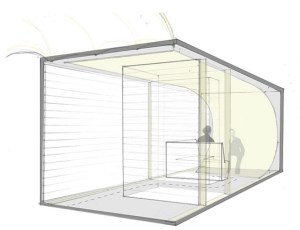
Portals are shipping containers equipped with specialized communications technology. Individuals enter one at a time and converse with a person in the other location as if they were in the same room. Simultaneous text translation is available. This first pairing unites the Lu Magnus Gallery in NYC and the M-40 Studio in Tehran.

OPEN FOR CONVERSATION
DECEMBER 5 – 19, 2014
Special Open Hours: 7:30A – 1:30P, Mon – Sun
LU MAGNUS GALLERY and M-40 STUDIO TEHRAN

Each individual is invited to enter a Portal and converse with whoever happens to be in the Tehran location, or with someone in particular upon advance request. To schedule your visit, please visit SHAREDSTUDIOS.SCHEDULISTA.COM

Powerful new technologies allow us to connect across boundaries as never before; yet we too often use them to cocoon ourselves in our own cultural, political, or ideological communities. Portals puncture hardened stereotypes of the other by facilitating one-on-one encounters. They serve as a catalyst for conversation between communities that would not typically engage with one another due to language barriers, technological limitations and hardened stereotypes of the other meeting people whom they only hear about unidirectionally in the news.

Visit the gallery for special Q&A sessions with the artist and the following New York guests:

Amy Chua and Jed Rubenfeld (Fri Dec 5, 1:00pm-2:00pm)
Yale Law professors and bestselling authors Amy Chua and Jed Rubenfeld. Chua’s books include Battle Hymn of the Tiger Mother and World on Fire. Rubenfeld’s books include The Death Instinct and Freedom and Time.

Jonah Bokaer & James Koroni (Sat Dec 6, 1:30pm-2:30pm)
Jonah & James perform a curated dance live in the New York space, streamed live to Tehran.

Fareed Zakaria (Mon Dec 8, 10:30am-11:30am)
CNN host, Atlantic Monthly writer and bestselling author of The Post-American World and The Future of Freedom

Morgan Spurlock (Wed Dec 10, 10:00am-11:00am)
Documentary filmmaker whose titles include Supersize Me and The Greatest Movie Ever Sold.

Tania Bruguera (Thu Dec 11, 1:30pm-2:30pm)
Tania Bruguera is a Cuban installation and performance artist.

Rob Storr (Fri Dec 12, 9:00am-10:30am)
Robert Storr is the Dean of the Yale School of Art. Formerly, he was Senior Curator at the Museum of Modern Art.

Mohsen Namjoo (Sat Dec 13, 1:30pm-2:30pm)
Mohsen Namjoo is an Iranian artist, songwriter, singer, music scholar and setar (traditional Persian lute) player based in California.

Nicky Nodjoumi (Sun Dec 14 – Dec 15, 11:30pm)
Nicky Nodjoumi’s works are conceived of as theatrical stages, where compositions of figures both serious and ridiculous, in the words of Phong Bui, “house meanings without irony, narratives without stories, humor without morality, above all creating a space that heightens the awareness of old and new history.”

Keller Easterling (Wed Dec 17, 9:00am-10:15am)
Architect, professor and author of books including Extrastatecraft: the Power of Infrastructure Space and Enduring Innocence: Global Architecture and Its Political Masquerades.

Sources: Shared Studios, Lu Magnus Gallery, Spacesmith


Theater Performance: “London, Tehran, Rome, Amsterdam” opened in Tehran, Iran

“London, Tehran, Rome, Amsterdam, Reconsider Your Image Of Me” will play from November 16 to December 12 of 2014, every night (apart from Saturdays), at 21:00 o’clock in the Hafez Hall, Tehran.

This performance, a co-production between the Virgule Performing Arts Company (Iran) and STET The English Theatre (Netherlands) is supported by the Embassy of the Kingdom of the Netherlands. The opening ceremony was held on Sunday, Nov. 16 with the Dutch ambassador to Tehran attending the ceremony.

The performance examines a current topic between Iran and the West, namely what are the images that we have of ‘the Other’ and to what extent fears, fantasies and imaginations are based on truth. By initiating a direct meeting with the Other and listening to each other’s stories, this group aims to create new images, based on the stories of the people who wouldn’t usually make the headlines.

The piece is a multi-media, highly physical, speech performance. It includes the actors’ own stories, dialogue between the actors, video installations with short documentaries about daily life in the countries of origin of the actors and video collages of cultural milestones from these cultures. The physical form of the piece produces a third language.

The project has brought together an international cast to create this piece during a 2 month rehearsal period in Tehran. The company includes Dutch actress Marene van Holk, Italian actress Marta Paganelli, British actress Amy Strange, Iranian actresses Melodie Aramnia and Neda Jebreilli and Iranian actor Meysam Mirzaei, and the piece has been conceived and directed by Arvand Dashtaray.

The production will be performed in the Netherlands in the autumn of 2015.

Sources
Embassy of the Kingdom of the Netherlands in the Islamic Republic of Iran
Mehr News Agency

Iranian Director Amin Rahbar receives the “Climate Clips Award” at the 2014 International Film School Fest Munich

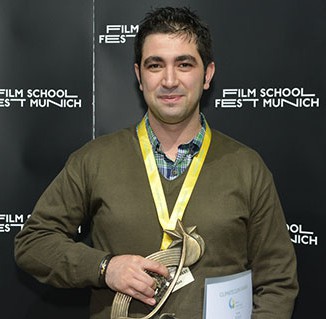
Rahbar, Amin - Iranian Film Director, Azad University of Central Tehran - Scale (Tarazoo)Amin Rahbar’s animation Scale scooped the prestigious Climate Clips Award at the 2014 International Festival of Munich Film Schools, running from November 16-22 in Germany. […]

“Some 42 films from 22 countries took part in this festival, and my production with an environmental theme was selected among the top three and ultimately managed to win the best film award” said Amin Rahbar to Mehr News.

“Scale is 2-minute long and produced with cutout animation technique. In this technique, flat characters and backgrounds are cut from materials such as paper, or if on a computer, with scanned images” explained Rahbar.

Climate-Clips-Jury (Brigitte Bruns, Veronika Nagelschneider and Beatrice Scola): Amin Rahbar’s enchanting animated film SCALE (in Farsi TARAZOO), shows us the dramatic changes industrialization has wrought upon our planet. Our transformation from an agricultural society to today’s skyscraper-studded megacities is brought to life by the sophisticated and original use of an old and relatively simple technique: paper cutouts. In just one and a half minutes, the clip illustrates how drastically our environment has changed, the severe damage that has been done to it and the current consequences such as climate change. The jury congratulates Amin Rahbar on the successful artistic and technical realization of his film.

Winner: Scale | Tarazoo
The story of human life from the beginning to the beginning…
by Amin Rahbar from Azad University of Central Tehran, Iran

Scale has been previously featured and awarded in other international festivals including Hamburg Festival in Germany, con i minuti contati Festival in Italy, and SHNIT Festival in Switzerland. It has also won the Best Film Award at Iran’s Short Film Festival for Children.

The International Festival of Film Schools established in 1981 is now one of the most important festivals for young filmmakers in the world. About 60 films are presented at the festival annually, and each year approximately 100 foreign students and professors have the opportunity to meet, enter into discussions and share their experiences with each other.

Sources: Film School Fest Munich, Mehr News Agency

Haft Negah art exhibition, held in Tehran, closes tomorrow (Nov 28)

The Niavaran Culture Center in Tehran is hosting the 7th annual edition of Iran’s Seven Views (Haft Negah), an art expo coordinated since 2006 by seven major art galleries.

This year, fourteen galleries  take part in the expo. The Aria, Elaheh, Dey, Golestan, Haft Samar, Valli, Mah-e Mehr, The Aran, Etemad, Hanna, Dastaan Basement, Seen, Seyhun, and Tarrahan-e Azad galleries will all participate in this years celebrations taking place from November 14 to 28.

The exhibition will showcase paintings, sculptures, and calligraphy from 350 artists featuring 400 works that respond to this year’s exhibition motto, “Every Iranian Home, One Artwork”.

Some of the well-known artists showcasing their artworks this year include Sohrab Sepehri, Mohammad Ehsaii, Aidin Aghdashlu, Parviz Tanavoli, Iran Darrudi, Farideh Lashaii and Parvaneh Etemadi.

Make sure not to miss this one of a kind artistic event!

Sources: Tara Gallery, Mehr News Agency

Iranian Lili Golestan received France’s Order of Academic Palms

French Order of Academic Palms awarded to Lili Golestan
Source: Tehran Times

Iranian translator Lili Golestan, who is also the curator of Tehran’s Golestan Gallery, received France’s Order of Academic Palms during a ceremony at the Embassy of France in the Iranian capital on Monday November 17, 2014.

French Ambassador Bruno Foucher delivered a short speech before honoring Golestan with the order, which is awarded by the French Minister of Education to those who have rendered eminent service to French education and have contributed actively to the prestige of French culture, Honaronline reported on Tuesday.

Iranian translator and artist Lili Golestan (R) with the French Ambassador Bruno Foucher (photo by Shargh daily)

“In the animated and rich cultural atmosphere of Tehran, in which you can find no day without an event, Golestan Gallery has a special place,” Foucher stated.

He also praised Golestan for the efforts she made to introduce French writers, including Albert Camus, Jean Giraud and Romain Gary, to Persian readers.

“Your achievements show that you are among the very eminent women and France praises such persons. Indeed, such brilliant activities in the promotion of Iranian art and such a will for the introduction of French literature luminaries deserve appreciation,” he added.

Foucher then presented the order to Golestan and she also made a short speech.

“French literature is part of my soul,” she said and added that she has tried to introduce it to Persian readers.

“I have had a small gallery in this mega city for over a quarter of a century. This night’s meeting caused me to take a glance at the past and for the first time to ask myself exactly how many times I have organized exhibitions at this gallery. The result surprised me and I also felt more exhausted: 1040 exhibits. But, due the decoration I received tonight, I feel that it’s time to forget the 1040 exhibitions and also to shelve the forty books that I translated and the 340 articles that I wrote for newspapers and magazines, in order to ease my exhaustion for a while, only for a short while,” she stated.

She translated many books from world literature into Persian. Among the works are Eugene Ionesco’s “Story Number 3″, Maurice Druon’s “Tistou of the Green Thumbs”, Miguel Angel Asturias’ “The Man that Had it All, All, All”, Gabriel Garcia Marquez’ “The Smell of the Guava Tree” and “Chronicle of a Death Foretold”.

Iranian author Mahmud Dowlatabadi was also awarded the Chevalier of the Legion of Honor in Tehran on Sunday evening.

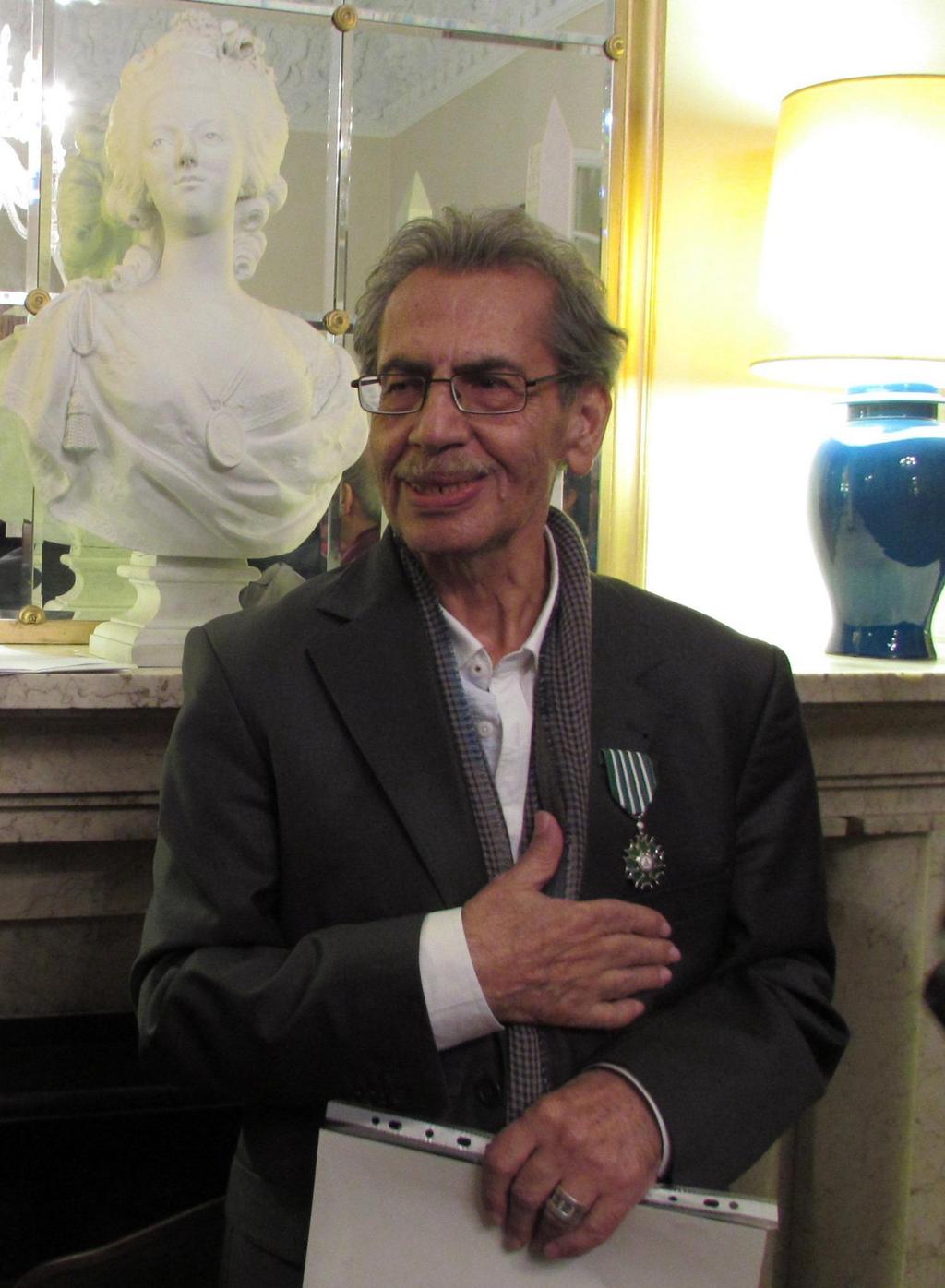
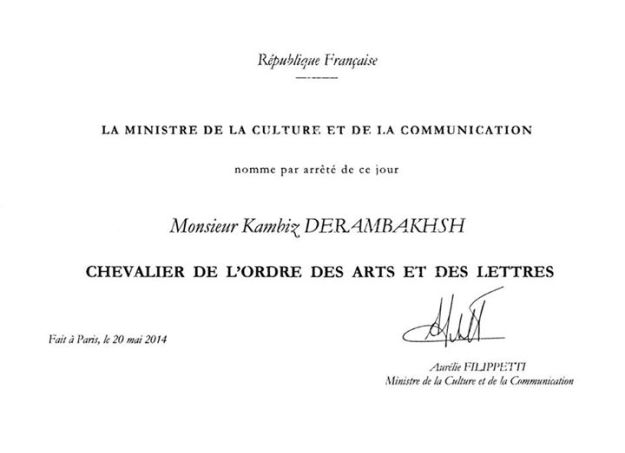
France has decorated three Iranian personalities with the Chevalier of the Legion of Honors over the past six months: Vocalist Mohammadreza Shajarian received the order in June, cartoonist Kambiz Derambakhsh and filmmaker Dariush Mehrjuii are the other honorees.


Iranian author Mahmud Dowlatabadi receives France’s Chevalier of Legion of Honor

Iranian author Mahmud Dowlatabadi, mostly famous for his novel “Kalidar”, received the Chevalier of the Legion of Honor during a ceremony held in Tehran on Sunday evening. The medal, which is the highest decoration awarded by the French government, was presented to the author by French Ambassador Bruno Foucher during a ceremony at his residence in Tehran.

The ambassador gave a brief speech about the life and works of Dowlatabadi. He also praised his artistic career in theater and storytelling.

Wearing the medal, Dowlatabadi talked about French literature and civilization in his short speech, and pointed to the issues of writing and the pains of writing.

Iranian author Mahmud Dowlatabadi (R) stands beside French Ambassador Bruno Foucher before receiving the Chevalier of the Legion of Honor at the ambassador’s residence in Tehran on November 16, 2014.

A number of scholars and literati including Dariush Shayegan, Kambiz Dermabakhsh, Omid Rohani, Lili Golestan, Javad Mojabi and Hassan Kianian attended the ceremony.

Born in 1940, short-story writer and novelist Dowlatabadi was the most prominent Iranian novelist of the 1980s. Self-educated and forced to work from childhood, he spent part of his younger adult years as a stage actor in Tehran.

“The Colonel”, “Kalidar”, “Desert Strata”, “The Trip”, “The Legend of Baba Sobhan”, “The Cowherd”, “Aqil”, “Man” and “Missing Soluch” are among Dowlatabadi’s credits.

http://www.payvand.com/news/14/nov/1110.html

Iran’s Book and Book Reading Week: Museums in Tehran host events for children to encourage book reading

kids-children-in-tehran-museum

Museums in Tehran host events for children to encourage book reading

The Cultural Heritage and Tourism Research Center is to implement a “Seven Museums, Seven Tales” plan as of Saturday [November 15] to mark the national Book and Book Reading Week.

The plan which is to be carried out in seven museums in the capital aims to promote book reading and introduce [Iran’s] legends and myths as a symbol of oral and intangible heritage.

It also intends to create more attractiveness in museums and revive the art of storytelling.

Creative instructors of storytelling and members of Children’s Book Council will come together in seven museums, namely Iran’s Post Museum, National Museum of Iran, Golestan Palace Museum, Carpet Museum of Iran, Tehran Peace Museum, Moghadam Museum and Bagh-e-Negarestan [Complex] to host Iranian children and their parents as well as other guests between November 15 and 21.

The museums will open their doors to visitors at 11:00 a.m. local time.

Source: Iran Front Page

Series: Tehran’s parks and gardens – Javanmardan Garden

Tehran, Iran - Tehran City - Javanmardan Garden 02

Javanmardan Garden – Tehran, Iran

Javanmardan Garden

Javanmardan-e-Iran garden with a total area of 150 hectares is one of the largest gardens located at the northwest area of the capital.

A total area of over 20 hectares is devoted to green space and the complex is powered by solar energy.

There are different special spaces: from a musical fountain with mechanical technologies and laser shows to the house of health and sports or the pond of birds.

The complex has also a 24km walking route, an 8km recreational carriage route and a 8.7km cycling route.

There is a children’s playground, soft games and a Highland Park for children under 14 years old. For youths over 14 years old: a 4600m2 training and professional skate park, a rappel complex , a playground with mechanical games, multifunctional playgrounds, a chess playing site, table tennis and table football playgrounds.

In the botanical garden and all over the garden, the plants and trees have been introduced with special plaques in order to increase the botanical knowledge of the visitors.

The Artists Garden has a traditional tea house and reception pavilion, cultural pavilion and available forestation green spaces.

Sources:
http://www.untoldiran.com/tehran/attractions/park/javanmardan%20park.shtml
http://en.irna.ir/PhotoDetail.aspx?NID=02733085

BBC: The book in every Iranian home

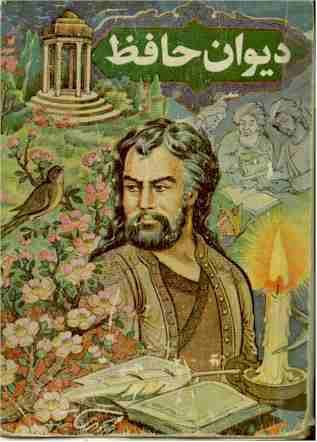
Iranian poet Hafez (1320-1389). He influenced centuries later Thoreau, Goethe, and Ralph Waldo Emerson among others. Emerson referred to him as

Iranian poet Hafez (1320-1389). He influenced centuries later Thoreau, Goethe, and Ralph Waldo Emerson among others. Emerson referred to him as “a poet’s poet”.

The works of the 14th Century poet Hafez can be found in almost every Iranian home – more than 600 years after his death, the writer still offers an insight into his country’s identity.

In Iran they say there are two books in every household – the Koran and Hafez. One is read, the other is not.

To understand this joke you need do no more than join the millions who regularly throng the tomb of Hafez, the 14th Century poet of Shiraz and Iran’s national hero, as I did one recent afternoon. The atmosphere was buzzing, happy and relaxed – Iran at its best.

Day and night the tomb, raised up on a beautifully decorated dais surrounded by its own fragrant rose gardens, water channels and orange trees, is crowded with devotees stroking Hafez’s alabaster sarcophagus, declaiming his verses, relishing his clever plays on words.

Hafez represents all the rich complexities of the Iranian identity. His brilliant use of metaphors in their native Farsi language unites them. […]

Thanks to Hafez, Shiraz is Iran’s most liberal city. […] the lively groups both young and old, men and women mix freely, laughing and chatting together. […]

As the sun disappears from the sky and the illuminations come on round the tomb, the atmosphere becomes ever more festive. People start singing and reciting their favourite poems. Children dangle their feet in the pools, giggling and soaking up their parents’ infectious high spirits.

The scene conceals the paradoxes of Iran but, thanks to the Mullah’s policy of education for all, there are some surprising changes afoot in Iranian society.

More women than men now graduate from university. The birth rate has dropped so dramatically, to one child per family, that the clerics have introduced financial incentives for couples to breed more. Most refuse, saying that it is still too expensive to have more than one child.

While the west remains obsessed with Iran’s nuclear enrichment it is an open secret that the well-connected clerics and businessmen enrich themselves through sanction busting. […]

Rubaiyee 21, by Hafez
Don’t make me fall in love with that face.
Don’t let the drunk the wine seller embrace.
Sufi, you know the pace of this path.
The lovers and drunks don’t disgrace.

Unfortunately for the mullahs the mystic poetry of Hafez, besides lauding the joys of love and wine, also targeted religious hypocrisy.

“Preachers who display their piety in prayer and pulpit,” he wrote 600 years ago, “behave differently when they’re alone. Why do those who demand repentance do so little of it?”

[…]

Read the complete article: BBC | News | The book in every Iranian home by Diana Darke

Nellie’s Journey to Iran: from Persian architecture to outstanding hospitality

Posing with friendly Iranians

Photo Highlights of Iran: from Persian Architecture to Outstanding Hospitality
By Nellie Huang

I’ve just completed my Silk Road journey through Central Asia with Oasis Overland. Our trip started in Kyrgyzstan and we traveled through Kazakhstan, Uzbekistan, Turkmenistan, Iran and ended in Turkey. During this overland trip, we spent just under three weeks traversing through Iran, from the eastern corner to the western edge. It was the highlight of our trip and I hope these photos will show you what an amazing country it is.

Mention Iran and many think of burkha-clad women, burning flags and war. But these stereotypes can’t be further from the truth.

For those who are curious and open to new discoveries, Iran is packed full of surprises. It is a relatively safe country to visit and there’s so much to see and do in terms of historical and cultural sights: wander through the thousand-year-old ancient city of Persepolis, get lost in the mud-brick alleys of Yazd, contemplate in the beautiful turquoise-domed mosques that dot Esfahan, meet locals in the gardens surrounding Shiraz and pray with thousands of pilgrims at the country’s holiest city Mashad. The Islamic Republic has an extremely rich cultural heritage and its attractions can definitely rival those of world-famous tourist destinations. Best of all, you won’t find hordes of tourists here. It won’t take you long to question how such a charming country can be portrayed in such a negative light by the media.

Beyond the stereotypes is a country desperate to been seen for what it is, rather than what it is depicted to be. The Iranians are undoubtedly the friendliest people I’ve ever met in the world. Travelers will often find themselves getting invited to stranger’s homes, being treated to endless flow of tea from a shop vendor and getting a free ride from helpful drivers along the way. Locals tend to come up to you, ask where you’re from and genuinely want to get to know you. I’ve always agreed with the saying “it’s the people that makes a place”. It can’t be more true here in Iran where experiences with locals truly live the longest in your memory.

While traveling in Iran, the two topics that most find impossible to escape are religion and politics. These are complex issues that aren’t black or white, but as I discovered, if you’re respectful of their opinions, the Iranians will be more than happy to discuss them with you. It’s also important to note that the government’s views may not be in line with what average Iranians think. Regardless, if you do choose to travel here, a journey to Iran will certainly change your perspective of the country, and perhaps, the world.

Natural Landscapes and Ancient Cities

The abandoned mud brick city of Kharanaq: In the abandoned mud-brick city of Kharanaq, we got lost amidst the alleys and crumbling paths that overlooked this beautiful valley.

The abandoned mud brick city of Kharanaq


The rock cut temples of Naqsh-e-Rostam
: Right at the outskirts of Shiraz, we stumbled upon the spectacular rock tomb of Naqsh-e-Rostam. The ragged cliffs that the tombs are carved into remind me of those in Wadi Rum, Jordan.

The rock cut temples of Naqsh-e-Rostam


Persian Architecture

Amir Chakhmagh: Amir Chakhmagh in is an iconic landmark in Yazd and while it’s now nothing more than a gate (the rest of the building is gone), the unique architecture still makes it quite an impressive sight.

A gate in Yazd


Royal Palace in Shiraz
: The interior of Persian buildings is often just as impressive. This photo shows the interior of the Royal Palace in Shiraz, characterized by arches, spiraled columns and carvings.

Inside a palace in Shiraz


Iranian Way of Life

Colorful spices in the bazaar of Shiraz: Bazaars are an important part of Iranian life. They trace their roots back to the Silk Road days and even until today, Iranians are still known to be excellent traders and businessmen. Spices are of course a common sight in the bazaars.

Colorful spices in the bazaar of Shiraz
Friendly students in Tehran: The Iranians are exceptionally warm and friendly, with many people stopping to strike up a conversation with us seeing that we’re foreigners. I met this bunch of students at the Golestan Palace in Tehran and they were all excited to practice their English with me.

Friendly students in Tehran

More pictures of Nelly’s Journey:
http://www.wildjunket.com/2014/10/22/photo-highlights-iran/

About Nellie Huang: Nellie is a professional travel writer and editor with an eye for adventure and a love for the unknown. Originally from Singapore, she pursued an Engineering degree and spent her days dreaming of travel – the day after graduation, she packed her bags and headed off to experience the world.

She then spent the next few years working as a teacher, translator and project analyst. With sheer will and hard work, she eventually found her way into travel writing and fulfilled her lifetime dream.

Her work has since been published in numerous publications including National Geographic Intelligent Travel, CNN, BBC Travel, Travel+Leisure Asia, Wend, Women Adventure Magazine, Food&Travel, International Lifestyle, TNT Magazine, and Explorer, amongst others. Click to see her portfolio.

She is also a contributing guidebook author of VIVA Travel Guide Guatemala (1st Edition) and writer for World Travel Guides.

Iran’s Sa’adi and Spain’s Cervantes were honored in Madrid

Sa’adi-Cervantes

Spain hosted a joint literary conference on the life and works of Persian poet Sa’adi and Spanish classic author Miguel de Cervantes.

After a commemorative ceremony in Iran in April to pay tribute to Iranian and Spanish literary giants, they were remembered in Madrid in late October.

The Complutense University of Madrid (UCM) hosted Sa’adi and Cervantes Conference on October 28-29 with Iranian and Spanish academicians attending.

Ali Asghar Mohammadkhani, the manager of Shahre Ketab (City of Book) International and Cultural Affairs, interviewed before the conference started, said, “Shahre Ketab hosted the ceremony to honor Sa’adi and Cervantes on April 21-22 on the occasion of Sa’adi National Day, and we planned a Madrid conference as well to be held in late October in Complutense University of Madrid (UCM). The conference is a concerted effort by Shahre Ketab International and Cultural center, the Center for Sa’adi Studies, Iran’s cultural attaché in Madrid, and UCM, where 11 literary historians and critics will deliver lectures on Sa’adi and Cervantes.”

“Iranian delegation will be in Cervantes’ birthplace in Alcala at the invitation of the University of Alcala, and will have meetings with Spain’s contemporary poets and literary figures. The delegation will also meet Persian literature professors in Madrid and Barcelona Universities,” he concluded.

Source
Iran Front Page: http://iranfrontpage.com/news/cultures/literatures/2014/10/saadi-cervantes-honored-madrid/

Austria honored Iranian film director Abbas Kiarostami with Decoration for Science and Art

Austria awarded Iranian director Abbas Kiarostami the Austrian Decoration for Science and Art. The medal was established in 1960 to honor international figures for their outstanding achievements in the fields of science and arts.

During a ceremony held in Vienna Iranian director Kiarostami, molecular biologist Barbara Hohn and mathematician Bruno Buchberger received the Cross of Honor for Science and Art from Austria’s President, Heinz Fischer. Austrian poet Friederike Mayröcker received a Decoration of Honor for Services to the Republic of Austria.

Abbas Kiarostami was born in 1940 in Tehran and is one of the most important and famous Iranian film directors. The filmmaker was awarded in 1984 with the Golden Leopard in Locarno for “Where is the house of my friend?”. In 1997 he received the Palme d’Or in Cannes for “Taste of Cherry”, and the 1999 Grand Jury Prize in Venice for “The Wind Will Carry Us”. He is also a photographer, poet, painter and has staged operas. He has been decorated with several state medals, including France’s Chevalier of the Legion of Honor.

Sources: Tehran Times, bundespraesident.at (in German)

1001 Libraries to see before you die!

The International Federation of Library Associations (IFLA) Public Libraries Section together with the IFLA Library Buildings and Equipment Section launched in Lyon at the IFLA World Library and Information Congress a project called 1001 libraries to see before you die.

This online initiative aims to bring together best practice examples of public library buildings and spaces from around the world. The libraries can be nominated for different criteria – the library building, the location, the innovative programs or the community engagement.

Currently the list is holding two Iranian libraries: the Astan Quds Razavi Library in Mashhad and the Bazar Library in Tehran.

Mashhad’s Astan Quds Razavi Library has been selected by the Open Education Database (OEDB) among the 20 Libraries that have changed the world in 2012 and three of the collections preserved in the central library are registered in the list of the UNESCO World Cultural Heritage List.

Tehran’s Bazar Library was chosen for its historical building which belonged to a relative of Naseruddin Shah dating back to 150 years.

More information: https://1001libraries.wordpress.com/category/iran/

Kambiz Derambakhsh is Knight of the Order of Arts and Letters

Kambiz Derambakhsh at the French Embassy in Tehran on Sunday, 26th of October 2014

Kambiz Derambakhsh at the French Embassy in Tehran on Sunday, 26th of October 2014

Iranian cartoonist Kambiz Derambakhsh received the Chevalier of the Legion of Honor Medal during a ceremony held at the Embassy of France in Tehran on Sunday evening.

The medal, which is the highest decoration awarded by the French government, was presented to Derambakhsh by French Ambassador Bruno Foucher during a ceremony at his residence in Tehran.

Derambakhsh is the first Iranian visual artist to have received the award, the Persian service of Honaronline, a Persian news website, announced on Monday.

Iranian scientist Mahmoud Hessaby, filmmaker Abbas Kiarostami, stage director Pari Saberi, mythologist Jalal Sattari, poet Mohammad Sepanlu, vocalists Shahram Nazeri and Mohammareza Shajarian, and actress Leila Hatami previously received the honor.

Derambakhsh, 72, has previously held many exhibits across the world and his works are on display in many museums, including the Tehran Museum of Contemporary Art, Istanbul’s Museum of Cartoon and Comic, and the Cartoonmuseum Basel in Switzerland.

More about Kambiz Derambakhsh: Iranian Roots | Kambiz Derambakhsh

Kambiz Derambakhsh - Cartoonist 03

Sources: Tehran Times, twitter.com | @FranceenIran, Facebook | Kambiz Derambakhsh

Mozart Medal holder Shajarian and Shahnaz ensemble to perform in London’s Appolo Hammersmith on October 26.

Mohammad Reza Shajarian

The world-renowned musician ensemble, Shahnaz, started its music tour at the Malmo Arena in Sweden on September 27.

Composer and tar virtuoso Majid Derakhshani, kamancheh virtuoso Saeed Farajpouri and several other musicians are accompanying Shajarian on this tour.

Shajarian is known as Iran’s contemporary traditional music legendary who has invented new string instruments dubbed Bam Sorahi, Saghar and Kereshmeh, designed for traditional Persian music.

The maestro, Shajarian, was honored with UNESCO’s Mozart Medal in 2006 and the 1999 prestigious Golden Picasso Medal.

http://iranfrontpage.com/news/cultures/music/2014/10/shahnaz-music-ensemble-go-stage-germany/

Photos: Christians in Isfahan celebrate the 350th anniversary of the famous Vank cathedral

Art for Humanity WFP Exhibition in Iran

Art for Humanity

The UN World Food Programme (WFP) exhibition features 130 works by 100 prominent Iranian artists in painting and other fields of visual arts.

“This move can serve as a model for the artists in the other countries,” said UN representative, Garry Lewis, during the opening ceremony of the exhibition.

http://iranfrontpage.com/news/cultures/arts/2014/10/art-humanity-wfp-exhibition-opens-tehran/

Speaking at the ceremony, director of the center Abbas Sajjadi hoped to celebrate the end of hunger one day. “In our culture, helping others is a precious value that we have inherited.”

“The project began with 33 artists last year, but we are proud to have 100 artists this year,” she said, adding that the artworks have been priced by the artists themselves.

Gary Lewis also said that many steps need to be taken to eradicate hunger in the world. Sufficient food is being produced in the world, however there is still hunger not only in the poor countries but in the rich and developed ones, he said.

He added all the money raised in this exhibit will provide food for different individuals including Afghan nationals who are being supported by the country of Iran.

He thanked all the Iranian artists who have displayed their heart and compassion in their works.

Hossein Mahjubi, Jalal Shabahangi, Reza Bangiz, Mostafa Asadollahi, Mohammad Farnud and Sorush Sehhat attended the opening ceremony.

Nahid Aryan, Shima Esfandiari, Simin Ekrami, Minu Emami, Bahram Dabiri, Hamed Rashtian, Mohamamd Salahshur, Asal Fallah and Ario Farzi are among the participating artists in the exhibit.

Source: http://www.payvand.com/news/14/oct/1106.html

Iranian children to draw paintings for the disabled

Iranian Children paint for disabled

Iran Paralympics Committee has invited Iranian children to take part in a national drawing contest dubbed “Disability is not Limitation”.

Iran Sports Federation for the Disabled holds the drawing contest “Disability is not Limitation” for children of age 4-12.

The contest is designed to mark Paralympics Week and select works will be awarded on Islamic holiday Eid Ghadeer on October 13.

The paintings should be about the disability and overcoming limitations.

Source: http://iranfrontpage.com/news/cultures/arts/2014/09/iranian-children-draw-paintings-disabled/

Iran hosts retrospective on Christian Iranian composer Loris Tjeknavorian’s music arts

A number of Iran’s leading music artists and cineastes attended the opening gala held on Oct. 9. […] Tjeknavorian was also honored with the lifetime achievement award during the gala.

Tjeknavorian has made nearly 100 recordings and written more than 75 compositions, including symphonies, operas, requiems, chamber music, ballet music, concertos, choral works and an oratorio.

He has conducted international orchestras throughout the world in numerous countries including Austria, the UK, the US, Canada, Hungary, Finland, the former USSR, Armenia, Thailand, Hong Kong, South Africa, and Denmark. […] The literary opera, Rostam and Sohrab and the requiem Departed and the Survived are among his best-known works.

Tjeknavorian has received numerous international awards such as Austria’s Cross of Honor for Science and Art First Class.

More info: http://iranianroots.com/2014/06/07/christian-composer-and-coductor-loris-tjeknavorian-one-of-the-most-celebrated-cultural-figures-in-iran/

Video: Face to Face – Iran music maestro Loris Tjeknavorian talks to PressTV (1 and 2)

https://www.youtube.com/watch?v=rSfCha9DR7k

https://www.youtube.com/watch?v=RCt2x6mYeO8

Source: http://www.payvand.com/news/14/oct/1069.html

World-known Japanese composer Kitaro in Tehran, Iran

iran-kitaro-concert

Distinguished Japanese composer and instrumentalist Kitaro is in Tehran to stage concerts October 15-17.

“My heart is beating hard and I am so excited to see the audience in concerts,” Kitaro said on his arrival.

He also wished to have the opportunity to get acquainted with rich Persian music.

Former instrumentalists of Tehran Symphony Orchestra are to accompany the musician in the concerts.

A winner of a Grammy Award and a Golden Globe Award, Kitaro is regarded as a pioneer of New Age music. Kitaro has received fifteen Grammy Award nominations, winning once in 2000.

Source: http://iranfrontpage.com/news/cultures/music/2014/10/world-known-japanese-composer-kitaro-tehran/

Iran’s Mahak won an international Achievement Award for its exceptional support of children suffering from cancer

Mahak

Iran’s Mahak secured an Achievement Award from the International Project Management Association.

MahakThe IPMA, a non-governmental organization headquartered in Amsterdam, handed out its 2014 Achievement Award to Iran’s Mahak, the Society to Support Children Suffering from Cancer, Khabaronline news website reported.

Mahak was the only finalist in the category of internationally funded humanitarian aid project for its two-year operational and developmental project between March 21, 2012 and March 21, 2014.

At the Award Gala, on September 30 in Rotterdam, the Netherlands, the Iranian charity, which has been active for 23 years and says to have provided care for over 21,000 children suffering from cancer so far, walked away with the award.

Source Iran Front Page: http://iranfrontpage.com/news/society/healthcare/2014/10/mahak-iranian-charity-received-achievement-award-ipma/

Another article about Mahak:
https://theotheriran.com/2013/11/08/iranian-charity-provides-medical-care-to-refugee-children/