Author Archives: socialinform

Photos: Hiking in Iran – Shirbarfy (Snow Lion) near Borujerd

Borujerd is located on the Silakhor Plain, the largest agricultural land in Iran’s Lorestan Province, at approximately 1670 meters above sea level. The Zagros Mountains surround the city from South East to North West. The city of Borujerd is one of the oldest cities in Iran. It owes much of its early development to the Jews that fled to Persia from Mesopotamia.

The people of Borujerd speak mostly the Borujerdi dialect – a distinctive dialect between Lori and Farsi affected by the specific accent common among the Jewish population of Borujerd – Luri, Laki, and the local Judæo-Iranian dialect can be heard as well.

For other posts on nature in Iran click here: Iran’s diverse nature

Photos: The mountains and peaks on the way from Borujerd to Bayranshahr (Chaghalvandy) – along the villages of Zereshgah, Chenarestan, Keyvareh and Buryabaf – are a popular destination for hikers during winter. They are called Shirbarfy (snow lion) and are located at 2995 meters above sea level.

Sources: Wikipedia | Borujerd, Wikipedia | Shirbarfy (in Persian), Mehr News Agency (Photos),

‘Women without Men’ by Iranian artist Parastou Ahadi at Arte Gallery in Tehran

Arte Gallery in Tehran hosted ‘Women without Men’, a solo photography exhibition by Parastou Ahadi.

Parastou Ahadi is an Iranian painter and illustrator born on April 19th,1982. She got a diploma in Mathematics in 2000 and received a B.A. in Graphic Design in 2006. Ahadi lives and works in Tehran, Iran. She is currently pursuing a M.A. in Dramatic Literature at University of Tehran.
More information: parastouahadi.com

Sources: Honar Online, Facebook | Parastou Ahadi

Pooladkaf ski resort in Iran’s Fars Province

The second international ski resort of Iran, Pooladkaf is located in the northwest of Fars Province in the middle of Zagros mountains, 85 km from Shiraz.

Source: MEHR | Photos

Photos: Iranian Christians celebrate New Year in Isfahan

Some Iranian Christians celebrate Christmas on Dec. 25 and New Years’ on Jan. 1, while Iranian Armenians celebrate Christmas at the same time as the Epiphany on Jan. 6.

More content on Iranian Christians on this blog: The other Iran | Christians

Source: http://www.irna.ir/fa/Photo/3022149/

Windcatchers: Ancient and environment friendly Iranian cooling system (Photos)

A  windcatcher or bâdgir (in Persian: bâd “wind” and gir “catcher”) is a traditional Persian architectural element to create natural ventilation in buildings. They have remained present in many countries and can be found in traditional Persian-influenced architecture throughout the Middle East, including in the Arab states of the Persian Gulf (mostly Bahrain and Dubai), Pakistan, and Afghanistan.

Most windcatchers belong to old residential houses, mosques and urban reservoirs, e.g. in Persian architecture they were used as a refrigerating device at traditional water reservoirs (ab anbars) to store water near freezing temperatures in summer. Regardless of its utility, the height and adornments of these windcatchers used to represent the owner’s distinction and social standing.

Recently the windcatcher approach has been adopted in Western architecture, such as in the visitor center at Zion National Park, Utah and at Kensington Oval cricket ground in Barbados.

Below windcatchers in the cities of Yazd and Kashan (Yazd and Isfahan Provinces) by Hamid Najafi for Tasnim News and by Hoda Asghari for Mehr News.

Windcatchers come in various designs: uni-directional, bi-directional, and multi-directional and work pretty much like modern air conditioning system. At the top of the windcatcher are several directional ports – usually four open towards four direction. When the port facing the prevailing wind is opened, air is pushed down the shaft and into the building. At the base of the tower is a pool of water provided by aqueducts called karez (or qanat), over which the air is allowed to pass. As the warm air passes over the surface of the water, the air cools through evaporative cooling. At night, cold air is sucked into the house thereby cooling it naturally.

Windcatchers can also act in reverse. By closing all ports but the one facing away from the incoming wind, air is drawn upwards using a combination of Bernoulli’s Principle and Coanda effect. The negative pressure pulls hot air down into the karez tunnel and is cooled by coming into contact with the cool earth and cold water running through it. At this point, the cooled air is introduced into the building. By facing windcatchers away from the wind, dust and sand blowing in from the desert can also be kept away from buildings.

The evaporative cooling effect is strongest in the driest climates, such as on the Iranian plateau, leading to the ubiquitous use of windcatchers in drier areas such as Yazd, Kerman, Kashan, Sirjan, Nain, and Bam.

Shish-khans (small windcatchers) can still be seen on top of water reservoirs in Qazvin and other northern cities in Iran. These seem to function more as ventilators than as the temperature regulators seen in the central deserts of Iran.

Sources: Tasnim News (Yazd), Mehr News (Kashan), Wikipedia, Historical Iran, Amusing Planet

Iran’s Kermanshah Province: Kambadn

Kambadn was an ancient city, located north of ancient Kermanshah. Nowadays, with the expansion of the city the ruins are located between Taq Bostan and Kermanshah. A city named Kambadn was mentioned in Bisutun (Behistun), the inscriptions authored by Darius the Great, and archeological excavations have located this city near Taq Bostan.

Kermanshah is considered one of the cradles of prehistoric cultures. The area has been occupied by prehistoric people since the Lower Paleolithic period, and continued to later Paleolithic periods till late Pleistocene period; with Neanderthal presence in Middle Paleolithic. The region was also one of the first places in which human settlements were established between 8,000-10,000 years ago.

In May 2009 one of the oldest prehistorian village in the Middle East dating back to 9800 BCE, was discovered in Sahneh, located west of Kermanshah. Remains of later village occupations and early Bronze Age are found in a number of mound sites in the city itself.

In ancient Iranian mythology, the construction of the city is attributed to Tahmuras, the third king of Pishdadian dynasty. It is believed that the Sassanids have constructed Kermanshah and Bahram IV – he was called Kermanshah, meaning king of Kerman – gave his name to the city.

Source: IRNA, Wikipedia | Kambadn (Persian), Wikipedia | Kermanshah, amitisiran.blogfa.com

‘Quantum Soup’ by Iranian artist Mohamadreza Ahmadi Monfared at Mohsen Gallery in Tehran

Mohsen Gallery hosted ‘Quantum Soup’ a solo painting and drawings exhibition by M. Ahmadi Monfared.

“Quantum Soup, is an informal expression for the linking of all matter and energy in the universe, and Demiurge, in Platonic philosophy is not exactly the Creator but a figure who constructs the world especially by using triangles. These two entitle my last two series of paintings and drawings of recent years and in this exhibition.” — Mohamadreza Ahmadi Monfared, Fall 2015

Born in 1983 in Iran, Ahmadi Monfared lives and works as a painter and art teacher in Tehran. After graduating in 2007 with a M.A. in Painting at Tehran University of Art, he has held numerous group and solo exhibitions in Iran. More information: ahmadimonfared.com

Sources: Honar Online, Facebook | M Ahmadi Monfaredsaatchiart.com | M. Ahmadi Monfared

Winners of the 32nd Tehran Short Film Festival (Photos)

The winners were announced during the closing ceremony of Tehran’s 32nd Short Film Festival held at Andisheh Hall.

The jury members of the International Competition Section were Andrzej Bednarek from Poland, Matthias Flügge from Germany, Seigo Tono from Japan, Gipsy Chang from Hong Kong and Alireza Shoja Noori from Iran.

“A Warm Spell” by Toshimichi Saito from Japan received the Grand Prix of the festival. Best Fiction Film was awarded to “It Will Be Alright” by Patrick Vollrath from Austria. “Songbirds’ Shop” by Anatoliy Lavrenishyn from Ukraine won the Best Animation Award. Best Documentary was awarded to “Touch of Freedom” by Sardar Arshad Khan from Poland.

Jessica Dürwald from Germany received the Best Experimental Award for “Eat My Dream”, “Survival” by Masoud Hatami from Iran won the Special Jury Prize, “Electronic Town” by Tony Mullen from Japan was chosen as the Best Film from Asian Countries. Saeed Nejati from Iran received the Best Film from Islamic Countries Award for “Prohibition” and “Angelus Novus” by Aboozar Amini from Netherlands won the Best Anti-Violence Film Award.

Sources: Tavoos Online, Tehran International Short Film Festival, Fars News, ISNA 1, ISNA 2, Tasnim News, Mehr News

Photo series: Winter in Iran – Dizin Ski resort

Dizin is one of the larger Iranian ski resorts in the Alborz mountain range, near Tehran (43 miles north of the capital city) and also near the city of Karaj. It was established in 1969.

The ski season in Dizin lasts longer than in European ski resorts, from December to May, because of the resort’s high altitude. The highest ski lift reaches 3,600 m (11,800 ft), making it one of the 40 highest ski resorts in the world.

The lowest point of the region is 2650m, while its highest point is 3600m, (which equates to 11,811 feet above the sea level). The snow quality at Dizin is fantastic powder and rivals that of many European and Rocky Mountain snow areas.

The Dizin ski complex is the first ski and winter sport resort in Iran which has been officially recognized and granted the title by the International Ski Federation (FIS) for its capability in administrating official and international competitions. At the present, the Dizin ski region is administered by Iran Ski Federation. The FIS Grass Skiing World Cup is also organized in Dizin since 2012.

Sources: Wikipedia | Dizin, Mehr News Agency | Photos 1, Mehr News Agency | Photos 2

More info on: TripAdvisor | Attraction Review | Dizin

Photo series: Christmas in Iran 2015 – Christmas shopping

To learn more about the Christians in Iran, please browse to all posts in the category:
https://theotheriran.com/category/minorities/

Source: IRNA | Photos

‘Haft Negah’: Selection of works by Iranian artists displayed at Niavaran Cultural Center in Tehran (Photos)

The Niavaran Culture Center in Tehran hosted the 8th annual edition of Iran’s Seven Views (Haft Negah), an art expo coordinated since 2006 by seven major art galleries. A selection of paintings, sculptures and calligraphy works by about 400 contemporary Iranian artists were displayed during exhibition.

“Works by the giants of Iranian visual arts including Sohrab Sepehri, Mohammad Ehsai, Sedaqat Jabbari, Yadollah Kaboli, Ebrahim Haqiqi and Farah Osuli will be offered at reasonable prices,” said Lili Golestan, Secretary of Seven Views. According to Golestan, people’s trust in the galleries is one reason behind the success of Seven Views, while the reasonable prices also help.

Related article: The other Iran | Haft Negah art exhibition closes tomorrow (Nov 28th, 2014)

Source: Tehran Times, Honar Online

Photo series: Autumn in Iran – Danesfahan, Qazvin Province

Danesfahan is a city of around 9,000 inhabitants (2006) in Buin Zahra County, Qazvin Province, Iran. It is located west of Sagezabad and south of Esfarvarin. Historically, the city has been affected by earthquakes.

Photo gallery: Charming autumn nature in Danesfahan

Sources: Wikipedia | Danesfahan, Mehr News 1, Mehr News 2

Commemoration of Iranian artist Morteza Momayez with French Graphic Designer Michel Bouvet

In honor of late Iranian graphic designer Morteza Momayez the Iranian Artist’s Forum in Tehran organized a series of events which included a commemoration ceremony, an exhibition of his work and an exhibit and workshop presented by the event’s special guest, French graphic designer Michel Bouvet.

The commemoration ceremony took place in the Ostad Shahnaz Hall at the Iranian House of Artists and it was followed by the opening of an exhibition of Momayez’s work. Michel Bouvet also displayed his work at the Iranian House of Artists and presented a workshop on poster design.

About Morteza Momayez
Morteza Momayez was an Iranian graphic designer, born on August 26, 1935 in Tehran, Iran. He got his bachelor in painting from the School of Fine Arts at University of Tehran in 1965 and his diploma from Ecole National Superier des Art Deco in Paris, France in 1968. He was Editor-in-chief of “Neshan”. Throughout his career, Momayez initiated many cultural institutes, exhibitions and graphic design publications. The renowned pioneer of graphic design in Iran, Momayez received the Art & Culture Award of Excellency from the president of Iran in 2004.

About Michel Bouvet
Michel Bouvet (born 1955 in Tunis) is a French designer and poster artist. He is professor of visual culture at ESAG Penninghen (Paris). Bouvet studied and graduated at École nationale supérieure des Beaux-Arts (ENSB-A). His design influences include Fernand Léger, Raymond Savignac, André François and Roman Cieslewicz. His posters are very often the result of a mixture of techniques (photography, collage, sculpture, painting), which gives them a highly poetic graphic dimension. Bouvet has won many national and international design awards in Poland, Finland, Japan, China and Czech Republic. Since 2002, he designs the corporate identity for the Rencontres d’Arles. He has been the curator of several international graphic design exhibitions.

Sources: Tavoos Online, Wikipedia | Morteza Momayez, Honar Online 1, Honar Online 2, Wikipedia | Michel Bouvet

Photo Series: Autumn in Iran – Gilan Province

Gilan Province lies along the Caspian Sea, bordering the Republic of Azerbaijan in the north, as well as Russia across the Caspian Sea. The climate is humid subtropical with the heaviest rainfall in Iran. Rasht, the capital of the province, is known within Iran as the “City of Rain”.

Large parts of the province are mountainous, green and forested. The coastal plain along the Caspian Sea is similar to that of Mazandaran, mainly used for rice paddies.

In May 1990 large parts of the province were destroyed by a huge earthquake, in which about 45,000 people died. Abbas Kiarostami made his films Life, and Nothing More… and Through the Olive Trees based upon this event.

Enjoy Gilan’s beauty in autumn:

Source: Mehr News Agency, Wikipedia | Gilan Province

Photo gallery: Zereshk (barberry) farms in Iran

Berberis vulgaris, also known as European barberry or simply Barberry, is a deciduous shrub, native to central and southern Europe, northwest Africa and western Asia. It grows up to 4m high with yellow flowers that bloom in late spring. The fruit is an oblong red berry, rich in Vitamin C, that ripens in late summer or autumn. Although it has a sharp flavor, people in many countries eat it as a tart and refreshing fruit. The thorny shrubs make harvesting them difficult, so in most places, they are not widely consumed. They are an important food for many small birds, which disperse the seeds in their droppings.

Iran is the largest producer of zereshk and saffron in the world. Zereshk (or sereshk) is the Persian name for the dried fruit of Berberis, specially that of Berberis integerrima ‘Bidaneh’, which is widely cultivated in Iran. Zereshk and saffron are produced on the same land and the harvest is at the same time. In Iran their main production area lies in South Khorasan, especially around Qaen and Birjand. There is evidence of cultivation of seedless barberry in South Khorasan two hundred years ago.

Zereshk is widely used in cooking, imparting a tart flavor to chicken dishes. It is usually cooked with rice, called zereshk polo, and provides a nice meal with chicken. Zereshk jam, zereshk juice, and zereshk fruit rolls are also produced in Iran.

Photos of zereshk farms in Semirom (Isfahan), Birjand and Zohan (South Khorasan)

Sources: Wikipedia | Berberis vulgaris, Mehr News 1, Mehr News 2, ISNA, IRNA

Photo gallery: Domino competitions in Hamedan, Iran

Different domino tournaments were organized at Hamedan’s Azad University during the last weeks. The competitions for middle and high schoolers took place early November with around one hundred participants in twenty five teams from Hamedan and Lalejin. Twelve teams competed late November during the tournament for university students.

Sources: ISNA 1, ISNA 2, Tasnim News Agency, hamedan.ir, Young Journalists Club

Photo Series: Autumn in Iran – Mazandaran Province

Mazandaran is a Caspian province in the north of Iran. Located on the southern coast of the Caspian Sea, it is bordered clockwise by Russia (across the sea), Golestan, Semnan, Tehran, Alborz, Qazvin, and Gilan provinces. Sari is the largest city and the capital of Mazandaran province.

The diverse nature of the province features plains, prairies, forests and rainforest stretching from the sandy beaches of the Caspian Sea to the rugged and snowcapped Alborz sierra, including Mount Damavand, one of the highest peaks and volcanos in Asia.

Sources: ISNA 1, ISNA 2, Wikipedia | Mazandaran Province

Mixed exhibition of Iranian and Western art at the Tehran Museum of Contemporary Art (Photos)

The exhibition, entitled ‘Towards the Ineffable: Farideh Lashai’, presents a collection of 130 works including paintings, glassworks, drawings and video arts. It will be on display through February 26, 2016 at Tehran Museum of Contemporary Art.

Italian Germano Celant, Artistic Director of the Prada Foundation in Milan, co-curated the exhibition with the Iranian curator, architect, and filmmaker Faryar Javaherian. It marks the first time a non-Iranian curator of such stature has curated an exhibit at the museum since the revolution.

Javaherian and Celant have created an anthology of works by the Iranian modernist Farideh Lashai (1944-2013), who became one of Iran’s leading artists of the era. The Western works are being presented as context for Lashai’s retrospective. The intercultural exchange was achieved by hanging works by Western artists on gray walls, often across the room from Lashai’s works, which are hung on white walls.

Forty two works by Jackson Pollock, Alberto Giacometti, Mark Rothko, Andy Warhol, Roy Lichtenstein, Francis Bacon, Cy Twombly, Claude Monet, Willem de Kooning, René Magritte, and many others will surround Lashai’s art. Iranian artists are also represented, as works by Manoucher Yektai, Sohrab Sepehri, and Nasser Assar are included.

“I want to force the audience to see the context,” Celant said. “There’s a self-portrait by Farideh, and there’s a self-portrait by Giacometti. We’re trying to say, O.K., the identity of the Iranian art is related to another identity in the world. That’s a dialogue that needs to be established, and that’s my function as a non-Iranian curator.”

In addition, Catherine de Zegher, director of the Museum of Fine Arts Gent in Belgium, and Venetia Porter, the Assistant Keeper in the Department of the Middle East at the British Museum participated at a one-day seminar held at the museum. Art critics and historians Media Farzin, Marjan Tajeddini and the curators also discussed and reviewed the exhibition at the seminar.

In October, the museum signed a tentative agreement with the German government to send 60 artworks from Tehran – 30 Western and 30 Iranian – to Berlin for a three-month show next fall, which would mark the museum’s first exhibition overseas.

About Farideh Lashai
https://upload.wikimedia.org/wikipedia/en/a/a7/Farideh_Lashai.jpgBorn 1944 in Rasht, Farideh Lashai was among the most successful Iranian artists, writers and translators, best known for her abstract paintings. She studied art at the Academy of Decorative Arts in Vienna, Austria, and held over 100 solo and group exhibitions in Iran and many other countries, such as Italy, Germany, the US, Switzerland, Britain and France. After a long battle with cancer she passed away in the Iranian capital, Tehran, in 2013. She was 68 years old.

Lashai particularly won fame for her lyrical abstract paintings and multimedia installations that combined video projections and canvas works. Her works were mostly inspired by her personal experiences and modern Iranian art forms.

Sources: Tehran Times, Vanity Fair, IRNA, Tavoos Online, Honar Online 1, Honar Online 2, Honar Online 3, ISNA, The Telegraph

World Cup 2018 Qualifications: Sunni, Christian, Shiite players score goals for Iran in one game

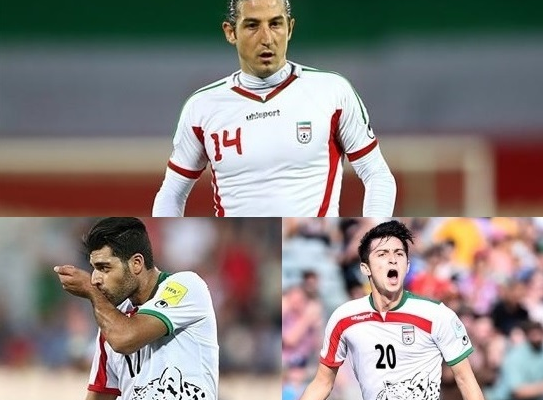
Three Iranian players with three different religions scored goals in the same international match, that Iran won with 3:0.

Iran Christian Sunni and Shia players

It was during the AFC World Cup 2018 Qualification game against India.

Iranian national team’ goals in the match, held in Indian city of Bangalore, were scored by three different players:

Sardar Azmoun, who scored the first goal for Iran, is born in Gonbad-e Kavus in north-eastern Iran into a Sunni family. He is an Iranian Turkmen, and speaks fluently both languages: Turkmen and Persian.

Iran’s second goal was scored by Andranik Teymourian, an Iranian Armenian. Teymourian has become the first Christian to lead Iran’s national football team as its permanent captain.
Some very interesting article on Andranik Teymourian: https://theotheriran.com/tag/andranik-teymourian/

Mehdi Taremi, who is Shiite like many other Iranians, scored last goal in a match that ended with the hosts suffering a 3-0 defeat against Iran in the 2018 FIFA World Cup Qualifier match at Kanteerava Stadium.

Other interesting articles and photo series regarding Iran’s minorities: https://theotheriran.com/tag/minorities/

Sources: RealIran.com, wikipedia | Sardar Azmoun

Photo Series: Autumn in Iran – Asalem to Khalkhal road

Khalkhal is the capital of Khalkhal County, in Ardabil Province, Iran. Its population is 38.521 (2006). Asalem is a city in Talesh County, Gilan Province, Iran. Its population is 3.347 (2006).

The road from Asalem to Khalkhal is known for its beautiful landscapes.

Sources: Wikipedia | Asalem, Wikipedia | Khalkhal, Tasnim News Agency, Mehr News, JameJam

Photo series: Autumn in Iran – Snow in Tabriz

Tabriz, located at an elevation of 1,350 meters above sea level, is the capital of East Azerbaijan Province and the most populated city North-Western Iran. With cold winters and temperate summers, the city is considered a summer resort.

Photo gallery: Tabriz covered in early autumn snow

Related content: The other Iran | Tabriz, The other Iran | East Azerbaijan Province

Sources: JameJam Online, Tasnim News Agency, Mehr News 1, Mehr News 2, Wikipedia | Tabriz

Iran wins gold at 2015 Youth & Cadets Chess World Championship

Almost 1,600 chess players from 92 countries took part at the FIDE World Youth & Cadets Championship 2015 in Greece. India dominated the event, winning 11 medals, among them 5 gold. Iran and Bulgaria complete the top three with one gold and one bronze medal each. Azerbaijan, Germany, Greece, Uzbekistan and Vietnam have one gold medal each. Russia and USA took 4 medals each, but none of them was gold.

Iranian chess player Mosadeghpour Masoud cruised to the victory with 9.5 points from 11 games in the Open U18 leaving the nearest followers a full point behind. He has achieved the IM title norm after the completion of the event, showing that the rise of Iranian chess is real, notably in the males now, since the women had already made their mark more than once. After Iranian Pouya Idani’s surprise win in the 2013 WCCY Open U18, Masoud is now the nation’s second gold just two years later. (Final ranking of the Iranian players below).

Photo gallery: Iranians at WYCC 2015

Iranian players: Final ranking at WYCC 2015 after 11 rounds
1st Mosadeghpour Masoud (IM) – Open U18 – (Rank 1 out of 116 participants)
3rd Gholami Aryan (FM) – Open U14 – (Rank 3 out of 150 participants)
6th Asadi Motahare (WFM) – Girls U12 – (Rank 6 out of 120 participants)
6th Firouzja Alireza – Open U12 – (Rank 6 out of 150 participants)
8th Lorparizangeneh Shahin (IM) – Open U16 – (Rank 8 out of 150 participants)
9th Derakhshani Dorsa (WIM) – Girls U18 – (Rank 9 out of 80 participants)
11th Alinasab Mobina (WFM) – Girls U16 – (Rank 11 out of 95 participants)
12th Maghsoodloo Parham – Open U16 – (Rank 12 out of 150 participants)
12th Tabatabaei M.Amin (IM) – Open U14 – (Rank 12 out of 150 participants)
13th Khodashenas Mersad – Open U18 – (Rank 13 out of 116 participants)
18th Gholami Orimi Anahita (WIM) – Girls U18 – (Rank 18 out of 80 participants)
21st Baradaran Tamadon Arian – Open U10 – (Rank 21 out of 150 participants)
22nd Mahdian Anousha – Girls U12 – (Rank 22 out of 120 participants)
25th Daneshvar Bardiya – Open U10 – (Rank 25 out of 150 participants)
29th Kalantari Sedigheh (WFM) – Girls U14 – (Rank 29 out of 125 participants)
42nd Tahbaz Arash – Open U16 – (Rank 42 out of 150 participants)
59th Mahjoob Zardast Artemis – Girls U8 – (Rank 59 out of 87 participants)
63rd Hashemi Seyede Fatemeh – Girls U14 – (Rank 63 out of 125 participants)

Sources: FIDE WYCC 2015, chess-results.com, chessbase.com, IRNA

Photo gallery: Ski season started at Tochal Ski Resort in Tehran, Iran

Tochal ski resort officially started this year’s autumn-winter season.

Tochal Complex, located on the northernmost part of Tehran, has been open to the public since 1978. The gondola lift, used for accessing ski resorts and other recreational centres on the mountain, has a length of 7500m. It starts at the Velenjak valley at an altitude of 1900m and ends at Station 7, at an altitude of 3740m, near the main ridge of Mount Tochal. The main ski slopes are located in Station 7 and due to its height they are covered with snow for more than 8 months of the year.

Tochal Mountain offers an unexpected array of outdoors activities –from hiking to skiing and is seen as one of the perfect places to escape the commotion of the city that lies below it; Tehran. There are various mountaineering routes across the rugged landscape, which cater to different levels of ability (and enthusiasm).

Sources: IRNA, ISNA, BORNA, Mehr News, Fars News, Young Journalists Club, Tehran Times (PDF), Wikipedia | Tochal Complex

Iranian winners at ‘Graines d’artistes du monde entier 2015: Face or Mask’, a children and young adults competition in France

Eighteen Iranian children have received awards or honorable mentions for their art work submitted to the international visual art competition held by the Centre pour L’UNESCO Louis Francois based in Troyes, France.

Every year the organization launches an international visual arts competition for children and young adults. This year, the Centre pour L’UNESCO Louis Francois received 5000 submissions from 53 countries.

Bahar Raznahan (1st place), Hediyeh Hasri (7th place), Sara Esmaeilinia (8th place) in the 10-13 age group and Pantea Nemati (12th place) in the 14-17 age group received awards.

Shakiba Bourki, Pouyan Pireh, Nazafarin Akia, Mardin Fathi, Sajjad Mohseni, Rastin Tajik, Parham and Pouya Javidan, Samin Abbasi, Zahra Hemmati, Amir Abbas Parast, Aynaz Shadmanesh, Soheil Kargar, Kiarash Samimi, Fatemeh Abiri and Mohammad-Mehdi Khoshhal received honorable mentions. The drawings were collected and submitted by the Iranian Center for the Intellectual Development of Children and Young Adults.

Sources: Facebook | Centre pour l’UNESCO Louis François, Tavoos Online

Asia Pacific Screen Awards (APSA) honors Iranian actress Fatemeh Motamed-Arya

The 2015 edition of Asia Pacific Screen Awards (APSA) has awarded Iranian actress Fatemeh Motamed-Arya during a ceremony held in Brisbane, Australia. She received the event’s Special Mention for the Best Performance by an Actress for her portrayal of a nurse in ‘Avalanche,’ directed by Iranian filmmaker Morteza Farshbaf.

Kirin Kiki won the award for Best Performance by an Actress for her role in “An” from Japan while the award for Best Performance by an Actor went to Jung Jaeyoung for his role in “Right Now, Wrong Then” from South Korea.

Apichatpong Weerasethakul from Thailand received the best film award for “Cemetery of Splendor” and Alexey German Jr. from Russia won the best director award for “Under Electric Clouds”. The award for best cinematographer went to Mark Lee Ping-bing from Taiwan for his collaboration in director Hou Hsiaohsien’s “The Assassin”.

The 2015 APSA International Jury was presided by South Korean filmmaker Kim Dong-Ho. He was joined by Mostofa Sarwar Farooki (Bangladesh), Zhang Xianmin (China), U-Wei Bin HajiSaari (Malaysia), Alexei Popogrebsky (Russia) and Negar Javaherian (Iran). Javaherian won the UNESCO Award at the APSA in 2013 for her performance in Maziar Miri’s “Painting Pool”.

Established in 2007, APSA is an international cultural initiative to honor and promote the films, actors, directors, and cultures of the Asia-Pacific region, under the auspices of UNESCO and FIAPF – International Federation of Film Producers Associations.

About Fatemeh Motamed-Arya
Born in 1961, Fatemeh Motamed-Aria is one of the most significant Iranian actresses, who has won numerous national and international awards, including the Best Actress Prize of the 2011 Montreal Film Festival in Canada and the Prix de Henri-Langlois award of the 2012 Vincennes International Festival in France. ‘Once Forever’ (1993), ‘Blue-Veiled’ (1995), ‘Gilaneh’ (2004) and ‘Here Without Me’ (2011) are among the films she has performed in so far.

Sources: Tehran Times, Payvandasiapacificscreenacademy.com, Instagram | apscreenawards, taghato.net

Photo Series: Autumn in Iran – A rainy day in Tehran

Iran’s capital, Tehran, with a population of around 9 million in the city and 16 million in the wider metropolitan area, is the largest city and urban area of Iran. The semi-arid climate of the city is largely defined by its geographic location, with the towering Alborz Mountains to its north and the central desert to the south. The weather is mild in spring and autumn, hot and dry in summer, and cold in winter. Because the city is large with significant differences in elevation among various districts, the weather is often cooler in the hilly north than in the flat southern part of Tehran.

Photo gallery: A rainy autumn day in Tehran’s Mellat Park

Source: ISNA, Fars News, IRNA, Tasnim News, Wikipedia | Tehran

Iranian artist Pariyoush Ganji honored with Japan’s Order of the Rising Sun

Iranian artist Pariyoush Ganji has been honored with the Order of the Rising Sun by the Japanese government. She received the “3rd Class, Gold Rays with Neck Ribbon Order of the Rising Sun” at the Embassy of Japan in Tehran.

The 70-year old artist was commissioned by the Japan Foundation to conduct research in the city of Kyoto on Sassanid-era designs, which had been transferred via the Silk Road and appeared on the kimono, the traditional Japanese female costume, and the belt obi.

In addition, Ganji, who has been teaching in Iranian art universities, has long promoted the Japanese art of sumie (Japanese black ink painting) and shoi (traditional Japanese architecture) in her classes. She has had a big share in introducing and promoting Japanese art in Iran and has also helped elevate the artistic exchanges between Iran and Japan.

The Japanese government honored 89 foreign nationals on November 3rd, 2015. Iranian film director Abbas Kiarostami also received the Order of the Rising Sun in 2013.

The Order of the Rising Sun was established by Emperor Meiji of Japan in 1875 and was awarded in nine classes until 2003. The badge features rays of sunlight from the rising sun. The design of the Rising Sun symbolizes energy as powerful as the rising sun in parallel with the “rising sun” concept of Japan (“Land of the Rising Sun”).

The order is awarded to those who have made distinguished achievements in international relations, promotion of Japanese culture, advancements in their field, development in welfare or preservation of the environment.

Sources: Tavoos Online, Embassy of Japan in Iran, Honar Online I, Honar Online II, Wikipedia | Order of the Rising Sun

‘Curriculum Mortis’ by Iranian artist Barbad Golshiri in Tehran

Aaran Gallery hosted one of Barbad Golshiri’s versions of ‘Curriculum Mortis’, that portrays concepts related to death and graveyards.

“I am a taphographer [1], I make grave markers, for the past fifteen years I take pictures of graves and burials and I make frottages on epitaphs of those eliminated only to distribute them. I have also made cenotaphs [2]. Memorials too, for the dead and the living. All these frame Curriculum Mortis. It is true to say that Curriculum Mortis  is not a series. I cannot make series.” […]
– Barbad Golshiri on the catalogue of the exhibition

About Barbad Golshiri
Barbad Golshiri is an Iranian contemporary artist, born in 1982 in Tehran, Iran. His father was Houshang Golshiri, a famous Iranian writer. He studied painting at The School of Art and Architecture, Azad University, Tehran. He has worked both as a media artist and a critic. He works with video, digital media, installation, photography, the internet, graphic novels and Lettrism. He won the third prize of the 6th Tehran Contemporary Painting Biennial, Tehran Museum of Contemporary Art. (More information: Wikipedia | Barbad Golshiri)

To read the review of the New York Times (Sep 19th, 2013) of one of Barbad Golshiri’s versions of ‘Curriculum Mortis’ click here.

Comments
[1] Tapographer: A tapographer is a copier of tombstones.
[2] Cenotaph: A cenotaph is an “empty tomb” or a monument erected in honour of a person or group of people whose remains are elsewhere. It can also be the initial tomb for a person who has since been reinterred elsewhere.

Sources: Honar Online, Instagram @aarangallerytehran, tandismag.com, Tehran Times, Aaran Gallery, Wikipedia | Barbad Golshiri, Proceedings of the New Jersey Historical Society, Wikipedia | Cenotaph

Photo Series: Autumn in Iran – Snowfall in Masal, Gilan

Masal, a county in the western part of Gilan Province, encompases the upper valley of the Shanderman River and the whole catchment basin of the Masal River (also called Ḵālekāi) until its arrival into the plain. The local population, 48,000 inhabitants in 2006, speaks Talysh, Gilaki and Persian. Masal and Bazar Jomeh are the only cities in the county.

The main agricultural production is rice, cultivated in the lower valleys and the edge of the plain, in small holdings. Of the three usual complementary resources of the plain (namely sericulture, tobacco, and tea), sericulture is the only one to have had a significant but highly variable role. The impact on this area of the crisis of silk production in the late 2000’s is uncertain. The other main activity and source of income is stock-breeding.

Unlike the valleys adjacent to the north or to the south, this area has no temporary bazaars on summer pastures because of the strong attraction and relative proximity of the Friday bazaar in Shanderman and Saturday bazaar in Masal. In both cases, this commercial activity has launched an urbanization process by gradually gathering services and resident population around the commercial core.

Sources: JameJamOnline, Instagram, Wikipedia | Masal County, Enciclopædia Iranica | Masal

Iran wins bronze at the Beach Soccer Intercontinental Cup

Russia won the final of the Beach Soccer International Cup after defeating Tahiti 5-2. Iran’s victory over Egypt brought Iran the tournament’s third place. Tahiti had a very succesful run, reaching the final after qualifying for the first time to the knock-out stage of the Beach Soccer Intercontinental Cup.

The 2(3)-2(2) penalties win for Iran over Egypt was a thrilling match. The tension was palpable as the third period began with a 1-1 score and no clear advantage for either team, until an early goal from M. Abdelnabi gave Egypt the lead. All that changed when Iran tyed the game at 2 with one minute left and after a scoreless three-minute extra-time period, the teams headed into a penalty shoot-out.

Eight teams participated at this fifth edition of the Samsung Beach Soccer Intercontinental Cup, which took place at Jumeirah Beach in Dubai, United Arab Emirates from November 3rd to 7th. The invitation-only tournament has been held annually starting in 2011. The competition is similar to the FIFA Confederations Cup.

IRAN-EGYPT – Match stats
Goals: 1-0: M. Samir, min. 7 (2); 1-1: A. Akbari, min. 5 (2); 2-1: M. Abdelnabi, min. 10 (3); 2-2: F. Boulokbashi, min. 1 (3).
Penalties: A. Naderi: Make; M. Samir: Make; M. Morshedi: Make; A. Aboserie: Make; A. Akbari; Make; Hassane: Miss.

Sources: Mehr News Agency, The National, beachsoccer.com, Wikipedia | Beach Soccer Intercontinental Cup, Twitter @BeachSoccer_WW, Twitter @DubaiSC

‘Distant memories’ by Iranian artist Tara Behbahani in Tehran (Photos)

Golestan Gallery hosted ‘Distant memories’, a painting exhibition by Tara Behbahani.

Tara Behbahani (born 1983) has been learning tricks and techniques of sculpturing with her mother, and painting with her father, who himself is one of the most famous contemporary artists, Taha Behbahani, since early childhood. She has been studied Art and Mathematics along side each other and after completing her university studies in Mathematics she started to research the relationship between art and geometry in Eastern Art.

She has participated in several exhibitions in Iran and abroad and has written about Islamic and Eastern Art in various magazines. For the past 12 years she has been teaching painting to youth and children.

Sources: tarabehbahani.com, mopcap.com, Honar Online, Instagram @tarabehbahani, Golestan Gallery

Iranians gather in front of the French embassy in Tehran to show their sympathy for victims of Paris attacks (Photos)

Iranian People placed flowers and candles outside the ‪French‬ embassy in ‪‎Tehran‬ to pay tribute to the victims of the deadly attacks in ‪Paris‬ November 13. The ISIS terrorist group claimed responsibility for the attacks.

Related article: Iran’s reaction to 9/11 as covered by global media

Sources: realiran.org, imgur.com

Iran’s women win silver medal at the Asian Canoe Polo Championships in Hong Kong (Photos)

The 16th Asian Canoe Polo Championships have been held in October 2015 in Hong Kong, with over 200 players in four categories (Men, U21 Men, Women, U21 Women) from eleven participating countries (Brunei, China, Indonesia, Iran, Japan, Macau, Malaysia, Singapore, Thailand, Chinese Taipei and Hong Kong).

Iran, Singapore, Chinese Taipei and Japan dominated the finals of the Championships. Each of them respectively won a championship in the end. Iran won a total of four medals (one gold, two silver and one bronze) and the top scorer titles in the U21 men and women categories.

Singapore’s women canoe polo team defeated five-time defending champions Iran 3-1 in the final, winning the title for the first time. Singapore had fallen to Iran at the final hurdle thrice (2005, 2009 and 2013). Iran’s U21 women team cut Singapore’s title hopes winning the final 5-1. Iran men won bronze after future champion Japan defeated them 7-6 in the semifinals. The U21 team lost 2-6 to Chinese Taipei in the final to settle for a silver medal.

Photos of the Iranian team during the championship in Hong Kong

The Asian Canoeing Championships are subdivided into three tournaments: canoe sprint, canoe slalom and canoe polo. Canoe polo is a combination of canoeing and water polo. The canoes that are used are lighter and shorter than a conventional one, for easier manoeuvrability. Two teams of five players attempt to score using a water polo ball in an area slightly smaller than an Olympic-sized pool. The game can be played in a swimming pool or a lake. The 20-minute game is divided into two halves, with a three-minute interval. The players score by sending the ball into a goal, which is suspended 2m above the water’s surface. Besides using the paddles, players can also use their hands to pass the ball, similar to the practice in water polo. Each player has to wear protective gear such as helmet, vest and face guard.

Sources: Wikipedia | Asian Canoeing Championships, The Straits Times, Asian Canoe Confederation, Iran Daily, Fars News, Sportsoho

Photo Series: Autumn in Iran – Along the Zayanderud, Chahar Mahal and Bakhtiari

Zayanderud (literally ‘river that gives life’) is the largest river in the central plateau of Iran. It starts in the Zagros mountain range in western Iran and runs 400km to the east before ending in the Gavkhouni Swamp, a seasonal salt lake, southeast of Isfahan city, in the central part of the country.

The Zayanderud Dam had its floodgates opened on Friday to supply the water required for farmers’ autumnal crop growing. The increase in discharge of the Zayanderud is making the landscape along the river even more enjoyable (see photos below).

Photos: The Zayanderud flowing through Chaharmahal and Bakhtiari on its way to the city of Isfahan

Sources: Tasnim News Agency, PressTV

Iran’s South Khorasan Province: Kolah Farangi, Birjand

The Kolah Farangi Citadel is located in Birjand in South Khorasan Province. It was built during the late Zand and early Qajar era between the years 1848 and 1895. The structure is a unique landmark of Birjand and was constructed by Amir Hassan Khan Sheybani. It consists of the garden, the stable, the bathhouse, the offices, and the reception hall.


The building has a hexagonal base, a white conical top and is six stories high. The main entrance is preceded by a roofed area containing some eye-catching arcs. The interior of the ground floor has a number of different rooms which are connected by hallways. In its center there is a room containing a pool which can be accessed from many different entrances. It is situated approximately a meter lower than the rest of the floor and is octagonal in shape. The pool helps keep optimum ventilation throughout the building.

The Kolah Farangi Citadel is registered as national cultural heritage site number 1880. Today it is used as Southern Khorasan’s governorship offices and storage space.

Sources: Dream of Iran, Historical Iran

Iran wins sixteen medals at the Asian Canoe Sprint Championships in Palembang, Indonesia

The 16th Asian Canoeing Championships, hosted in Palembang, Indonesia from November 4th to November 8th,  were attended by 500 athletes from 21 countries: Cambodia, China, Chinese Taipei, Hong Kong, India, Indonesia, Iran, Iraq, Japan, Kazakhstan, Kyrgyzstan, North Korea, South Korea, Macau, Malaysia, Philippines, Singapore, Tajikistan, Thailand, Uzbekistan, Vietnam. Unfortunately athletes from Nepal and Pakistan were not able to attend the event due to a delay in their visas.

Iran had a very succesfull run winning a total of sixteen medals (five gold, five silver and six bronze). Kazakhstan dominated the tournament, grabbing the most medals.

Results – Senior
Women C1 200m Fatemeh Karamjani (Gold)
Women C1 500m Fatemeh Karamjani (Silver)

Men K4 1000m Ali Aghamirzaei / Babak Darban / Farzin Asadi / Amin Boudaghi (Gold)
Men C1 200m Adel Mojallalimoghadam (Bronze)
Men K1 1000m Farzin Asadi (Bronze)
Men K2 200m Ali Ojaghu / Seyedkia Eskandanihahosseini (Bronze)
Men K2 1000m Ali Aghamirzaei / Amin Boudaghi (Bronze)

Photos: Iranian canoe athletes at national and international canoeing competitions

Results – Junior
Women K1 200m Mina Abdolahi (Gold)
Women K2 500m Ebrahimi / Tahmasabi (Gold)
Women C1 200m Atena Raofi (Bronze)
Women K1 500m Mina Abdolahi (Bronze)

Men C1 1000m Nabi Rezayi (Gold)
Men K1 1000m Alireza Farmande (Silver)
Men K2 1000m Masoud/Sharifi (Silver)

Dragon boat races
Women 200m (Silver)
Women 500m (Silver)

Sources: Wikipedia | 2015 Asian Canoe Sprint Championships, palembantribunnews.com, antarasumsel.com I, antarasumsel.com IIantarasumsel.com III, The Straits Times, Mehr News 1, womencanintl.com, Mehr News 2

Iran wins silver at the 2015 Futsal Grand Prix in Brazil

Brazil defeated Iran 4 to 3 to win the final game of the 2015 Futsal Grand Prix in Uberaba, Brazil.

Iran advanced to the finals after defeating Paraguay 2:0 and after achieving 9 of 9 possible points in Pool B by winning 7:3 against Uruguay, 4:1 against Colombia and 7:0 against Angola.

The host nation is the most successful team in the history of the tournament with nine titles while Spain has won the competition once in 2010. Iran has finished in second place three times and in third place two times out of ten editions.

The Grand Prix de Futsal, first held in 2005, is an international futsal competition of the same kind of the FIFA Futsal World Championship but with invited nations and held annually in Brazil.

Sources: Facebook | CBFS, Mehr News, Wikipedia | 2015 Grand Prix de Futsal

Photo Series: Autumn in Iran – Snowfall in Talesh, Gilan

Talesh is a 200,000 inhabitants county in Gilan Province, Iran. Its capital, Hashtpar (also called Talesh), is situated 140 km north-west of Rasht, on the south-west coast of the Caspian Sea. The region, a mountainous area, outstands with its virgin ant intact nature.

Photos of the first snowfall in Talesh:

The Talysh are one of the oldest inhabitants of the western littoral Caspian Sea and are amongst the native inhabitants of today Iran and neighboring Azerbaijan.

Generally speaking, the land of Talesh has been divided in three regions: Gaskarat, Foumanat and Azerbaijan Taloshian. In Gaskarat, the majority of people speak Taleshi and/or Azeri, Farsi. In Foumanat, most speak Taleshi. Lastly, Talysh from neighboring Azerbaijan are often bilingual and trillingual, consisting of Taleshi, Azeri and Russian speakers. Taleshian people at present are mostly Sunni and Shia Muslims.

Sources: ISNA, Wikipedia | Talesh County

‘Emigrants’ by Iranian artist Shirin Ettehadieh in Tehran (Photos)

Shirin Gallery hosted ‘Emigrants that carry away their memories’, a painting exhibition by Shirin Ettehadieh.

Autumn is the season of reminiscence, this time my paintings are the memory of flowers and the emigrants that carry away the memory of their homeland.
– Shirin Ettehadieh, Autumn 2015

Shirin Ettehadieh studied at École du Louvre in Paris. She has held exhibitions in France, Greece, the Netherlands and Switzerland, as well as numerous solo and group exhibitions in Iran.

Shirin Ettehadieh on Facebook, website

Sources: 360cities.net, Honar Online, Instagram @shiringallerytehran

Iran won 13 medals (4 gold, 7 silver and 2 bronze) at 2015 IPC Athletics World Championships

A total of 19 athletes represented Iran at the 2015 IPC Athletics World Championships, winning 4 gold, 7 silver and 2 bronze medals, as well as 10 Paralympic quotas.

Iran’s Mohammad Khalvandi (javelin F57), Mohsen Hosseinipanah (shot put F35), Siamak Saleh Farajzadeh (shot put F34) and Saman Pakbaz (discus F12) claimed four gold medals.

Sajad Mohammadian (shot put F42), Ali Mohammadyari (discus throw F56), Saman Pakbaz (shot put F12), Seyed Erfan Hosseini (javelin F13), Mohsen Kaedi (shot put F34), Peyman Nasiri Bazanjani (1,500 m T20) and Ali Olfatnia (long jump T37) won seven silver medals.

Mohsen Kaedi (javelin F34) and Abdolrasol Mirshekari (javelin F46) have also claimed two bronze medals.

On the final day of competition, 20-year-old Saman Pakbaz won gold (46.20m) in the F12 men’s discus throw category. Silver went to Kim Lopez Gonzalez (44.93m) from Spain and bronze to Poland’s Marek Wietecki (44.76m). The medalists, however, will not be playing in the Rio 2016 Paralympics despite their medal wins, as men’s discus throw F12 class is not included in the games.

Since discus throw will not be a part of 2016 Summer Paralympics in Rio de Janeiro, gold and silver will not secure a quota; however, Saman Pakbaz had earlier received a ticket by snatching a silver medal in the shot put.

The 2015 IPC Athletics World Championships opened in Doha, Qatar, on October 21, and concluded on October 31. The tournament brought together around 1,300 athletes from 90 countries.

Sources: Press TV, Mehr News Agency, Tasnim News Agency, paralympic.org, Zimbio (Photos)

Street Art in Iran: Mehdi Ghadyanloo (Photos & Video)

Iranian Mehdi Ghadyanloo’s canvas is the skyline. His illusions create windows to other — more magical — worlds. Seeking to combine minimalist architectural spaces with surreal scenes from another universe, he has painted over 100 murals across the Iranian capital, giving unsuspecting drivers good reason to do a double take, as the fantasy blends in with the real.

Like exaggerated dream sequences, his images portray gravity-defying figures and portholes to other dimensions, all from altered perspectives that meld sky and structure.

About Mehdi Ghadyanloo
Mehdi Ghadyanloo is an Iranian painter, born 1980 in Karaj, Iran. He moved to the capital to study at Tehran University’s College of Fine Arts. He graduated with a BA in 2005 and subsequently earned a MA in film studies from Tehran’s Teachers College (Tarbiyat-e Modarres).

Known primarily for his gigantic trempe l’oeil [1] style murals in central Tehran, Ghadyanloo also creates small scale paintings, with surreal and minimalistic themes. Through his works, Ghadyanloo opens a window into the mood of life in Iran today. At the same time, he provides an autobiographical perspective, portraying the landscapes of his youth, his memories of Iran-Iraq war (1980-1988), and his life experience in the Islamic Republic.

In 2015 he visited London for an exhibition of his “indoor” paintings, and painted murals there also, including one in Shoreditch.

A report from CNN about Mehdi Ghadyanloo:

Related articles:
1. The Guardian | Tehran’s answer to Banksy: Mehdi Ghadyanloo hits Britain,
2. Howard Griffin Gallery | Artists | Mehdi Ghadyanloo
3. Urban Outfitters Blog | Artist of the week: Mehdi Ghadyanloo
4. Facelifting Tehran | One Wall at a Time: Interview with Mehdi Ghadyanloo

Comments
[1] trompe-l’oeil: Art technique that uses realistic imagery to create the optical illusion that the depicted objects exist in three dimensions.

Mehdi Ghadyanloo on Facebook, Bēhance, Instagram and Twitter

Sources: CNN, Huffington Post, Howard Griffin Prints, Wikipedia | Mehdi Ghadyanloo, The Guardian, Facebook | Blue Sky Painters, Bēhance, fubiz.net, yourmiddleeast.com, Wikipedia | Trompe-l’oeil

International sculpture symposium in Tehran, Iran (Photos)

The 7th International Sculpture Symposium of Tehran 2015, from September 23rd to October 16th, included a stone workshop, an iron workshop and an exhibition section and was subdivided into a main and a student competition category.

The jury of the symposium, with two Iranian and a foreign member, had selected works by 14 foreign artists from Russia, Belarus, Albania, Portugal, Italy, Serbia, Taiwan, South Korea, Germany, Peru, Bulgaria, Greece and Romania to participate in the event.

Sculptors from South Korea, Taiwan and Peru took home the first prizes. Su-Dong Cho from South Korea and Wu Ming-Sheng from Taiwan shared the first prize in the stone category. The second prize in the stone category was also shared by Mehdi Seifi from Iran and Stefano Grattarola from Italy. In the steel category Peruvian sculptor Pool Guillen won the top prize and Amir Vafai from Iran won the second prize.

Sculptors, experts and artists gathered at Tehran’s Milad Tower to examine the art of sculpting in four panels. During the first part of the conference the artists, including Saeed Rafiee-Fard, Javad Hassanjani and Kianoosh Motaqedi, presented papers. The second part analyzed the works presented at the symposium.

To see pictures of the artists click here: IRNA | Artists at the 7th Sculpture Symposium

To see pictures of the award ceremony click here:
1. Mehr News Agency (photos)
2. Honar Online (photos)

Sources: Iran DailyBorna News, IRNA, Tasnim News 1, Tasnim News 2, Mehr News Agency (MNA) 1, MNA 2, MNA 3Honar Online, Tehran Press Agency (TPA) 1TPA 2, Tavoos Online,

Iran via Documentaries: Docunight is hosting Iran documentaries for audiences in the US and Canada

On the last Wednesday of every month, Docunight screens a documentary about, around, or made in Iran or by Iranians in various cities throughout the US and Canada. ‘The Glass House’ by Hamid Rahmanian (2008, 92min) will be  on October 28th.

Docunight is a monthly program, focused on screening Iran-related documentaries that began in San Francisco and has grown to screen films in other cities including New York, Los Angeles, Washington, San Diego, Minneapolis, Washington, Vancouver and Toronto.

Organized by efforts of Ahmad Kiarostami in collaboration with NIAC in the US and ECUPC in Vancouver, the program aims to create an opportunity for cultural exchange and to provide proper grounds for foreign audiences to better understand the Iranian society.

For information on upcoming screenings please visit:
www.docunight.com or Facebook | Docunight

These are the documentaries that have been shown so far:
– Trucker and the Fox (2014, 78min, Dir: Arash Lahooti)
– Abbas Kiarostami: A Report (2013, 82min, Dir: Bahman Maghsoudlou)
– Iranien (Iranian) (2014, 105min, Dir: Mehran Tamadon)
– Going Up the Stairs (2011, 52min, Dir: Rokhsareh Ghaemmaghami)
Behjat Sadr (2006, 46min, Produced by Marjaneh Moghimi, Dir: Mitra Farahani)
Monir (2014, 54min, Produced by: Leyla Fakhr, Dir: Bahman Kiarostami)
– Caged (2013, 52min, Dir: Tala Hadavi)
Street Sultans (2011, 38min, Dir: Paliz Khoshdel, Zeinab Tabrizy)
– Before The Revolution (2013, 60min, Dir: Dan Shadur & Barak Heymann)
– Molf-e Gand (2009, 53min, Dir: Mahmoud Rahmani)
– I Saw Shoush (2002, 8min, Dir: Bahman Kiarostami)
Infidels (2004, 40min, Dir: Bahman Kiarostami)
Pilgrimage (2005, 52min, Marjaneh Moghimi for Butimar Production, Dir: Bahman Kiarostami)
The Bathhouse That Wanted To Keep On Being A Bathhouse (2010, 52min, Dir: Mehdi Shabani)
Park Mark (2010, 42min, Dir: Baktash Abtin)
“Mory” Wants A Wife (2009, 42min, Dir: Baktash Abtin)
Be Like Others (2008, 74min, Dir: Tanaz Eshaghian)
The Law In These Parts (2011, 90min, Dir: Ra’anan Alexandrowicz)
My Name Is Negahdar Jamali And I Make Westerns (2012, 65min, Directed by Kamran Heidari)
Lady of the Roses (2008, 52min, by Mojtaba Mirtahmasb)
Back Vocal (2004, 40min, by Mojtaba Mirtahmasb)
Kahrizak, Four Views (2012, 86min, Dir: Rakhshan Bani Etemad, Mohsen Amiryoussefi, Bahman Kiarostami, Pirooz Kalantari)
Bassidji (2009, 114mins, Directed by Mehran Tamadon)
Red Lines and Deadlines: Life behind the scenes of the Iranian newspaper Shargh (2004, 5-53min, Filmed, produced and directed by Taghi Amirani)
Statues of Tehran (2008, 60min, Dir: Bahman Kiarostami)

Sources: docunight.com, Tavoos Online

Bloomberg and IBT: Business women in Iran – Ready for take off!

Excerpts of “Women in Iran Are Ready to Show They Mean Business” from Bloomberg.com:

Women in Iran are ready to make career gains in a way few of their peers can in the Gulf Arab world.

Thirteen years after Mona Hajialiasghar started out as an asset manager in Tehran, she’s chief operating officer of Kardan Investment Bank, which oversees about $300 million invested in Iran. As her country edges toward an historic agreement that promises to plug it back into the global economy, she already sees more women joining her.

“The presence of women in Iran in the workplace and in higher education is much more serious now compared to when I first started,” said Hajialiasghar, 35, who has a master’s degree in business management. “With younger women entering the market, firstly their numbers are much higher, but also their confidence is much higher.” […]
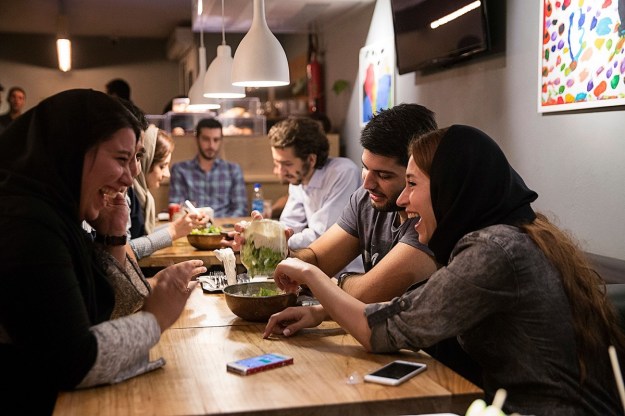
Young couples enjoy a meal in a western style restaurant in Tehran. Photographer: Simon Dawson/Bloomberg

Young couples enjoy a meal in a western style restaurant in Tehran. Photographer: Simon Dawson/Bloomberg

Kardan’s chief executive officer, Majid Zamani, said that across Iran’s nine investment banks, the presence of women is high compared with other industries and in some cases it even outnumbers men like himself. “I’d say this is definitely the case in the capital markets in Iran,” Zamani said. “We’re looking for dedicated, committed people and contrary to what’s sometimes the public perception, women tend to be the strongest candidates in this regard.” […]

While women have been legally obliged to cover their hair and adapt Islamic rules of modesty in clothing since the revolution in 1979, they have never faced limitations when it comes to driving, voting and access to education. They also occupy some top political jobs – three of President Hassan Rouhani’s vice presidents are women.
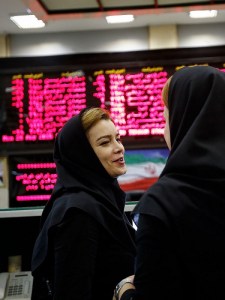
Bloomberg - 2015.10.01 - Women in Iran Are Ready to Show They Mean Business 2

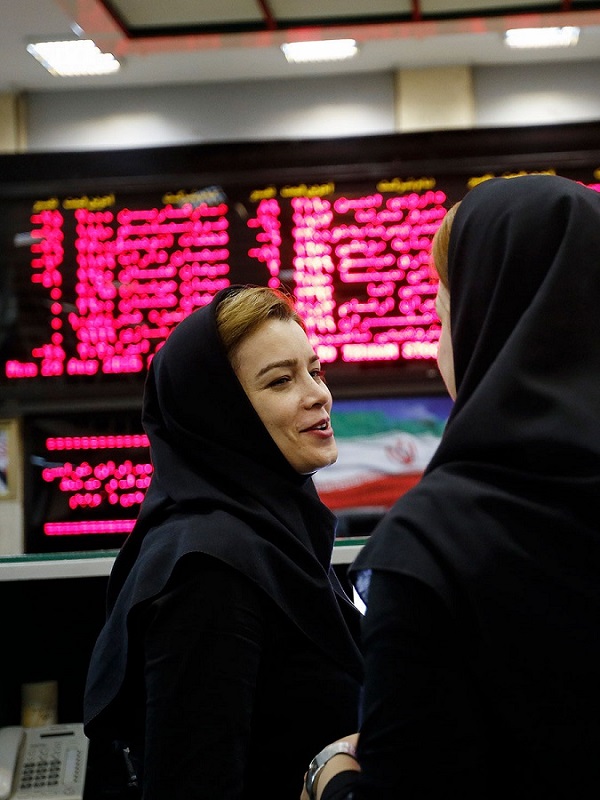
Employees work at the Tehran Stock Exchange in Tehran.
Photo by: Simon Dawson/Bloomberg

The nuclear deal “means economic empowerment for women in Iran,” said Suzanne DiMaggio, director of the Iran Initiative at New America Foundation in New York, a not-for-profit research organization. “Already today there are more women than men studying at Iranian universities, and they also work for a living and can own businesses and vote, so once sanctions are lifted and Iran reintegrates into the global economy, that should help women.”

Government figures show 72 percent of working women in Iran are employed by private enterprises. That’s the area of the economy that’s set to burgeon after sanctions stifled business, according to Shahindokht Molaverdi, one of the country’s three female vice presidents.

While Iranian law protects equal pay in government jobs and there’s maternity leave of as long as 12 months in some departments, women in Iran face much of the same problems as they do in the western world. There are disproportionately fewer of them in the executive suite after making up more than half of university places. They also suffer from a higher rate of unemployment, which at 19 percent is more than twice the figure for men, according to Iran’s National Statistics Organization. […]

Fatemeh Moghimi started her trucking business in Tehran 26 years ago after finishing a degree at City University in London. She’s the first woman to be elected to the board of directors of the Tehran Chamber of Commerce and Industry and she employs several women as drivers.

“I was worried, because I wanted to start my business,” Moghimi, 57, said in an interview at her office at the Tehran Chamber of Commerce and Industry, where she spends her Saturday mornings mentoring dozens of mostly female entrepreneurs. “It took two years. I came across a lot of cultural barriers, with the mindset of people, rather than legal barriers.”

Excerpts of “Trendy Tehran – Meet the female entrepreneurs breaking boundaries in Iran” from the International Business Times:

Mahsa Rezazadeh started her café in Tehran seven years ago and now brings in a better wage than her husband, a lawyer. She attributes her success amid a sanctions-shattered Iranian economy to hard work and the fact that however bad things get in Iran, Iranians cannot resist the smell of a home-cooked meal and freshly brewed coffee. “People may cut other expenses but they don’t compromise their stomach,” Rezazadeh, a mother of two, tells IBTimes UK from her café Little House in central Tehran. […]

Like many Iranian entrepreneurs, Rezazadeh is hoping that the lifting of sanctions following the nuclear deal between Iran and the US will trickle down, so that those who frequent her café will have more money to spend on food and coffee. “If sanctions are lifted and my customers can pay more money and I will able to do more,” she said. […]
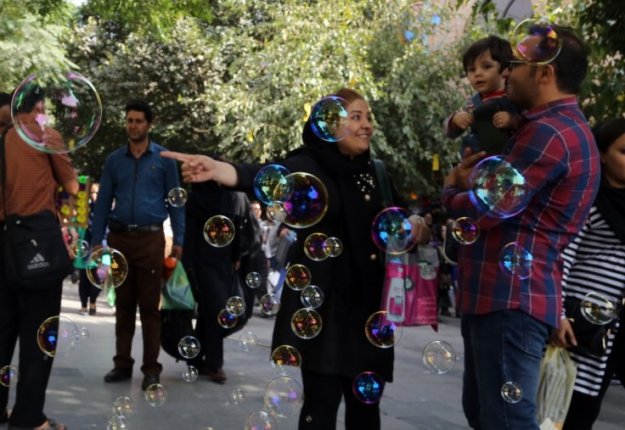
International Business Times - 2015.10.05 - Trendy Tehran Meet the female entrepreneurs breaking boundaries in Iran

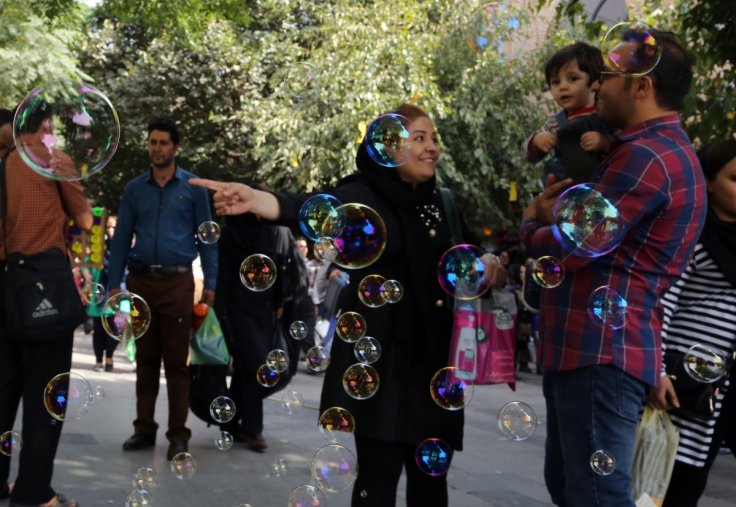
An Iranian family look at bubbles as they shop at the main bazaar in Tehran. Photo credit: Atta Kenare/AFP/Getty

Mona Mahpeyma, 25, is a graphic design graduate and aspiring fashion designer, who owns her own outlet in Tehran. […] “At first some thought that I as a woman could not make it but […] restrictions could not stop me. In business the restrictions for women are less than other areas like politics and sports,” she said. “The main restriction in doing business is financial, which is equal for men and women.”

The sanctions had been particularly problematic for Mahpeyma as they made the raw materials she needs far more expensive. She is hoping that Iran’s textile industry can now grow meaning her costs will go down. “At the time of the international sanctions imposed on us, the market for clothing and fashion was not money making. Now, if I decide to expand my business internationally without any sanctions I will have the opportunity to present myself as an Iranian designer internationally. Now I hope for a better change for women like me who have their own startups.”

Other interesting posts on Iranian women: https://theotheriran.com/tag/women/

Glassware and Ceramics Museum of Iran in Tehran (Photos)

The Glassware and Ceramics Museum of Iran is situated in a garden with a span of 7000 square meters. The building was constructed as a private residence about 90 years ago upon orders of Ahmad Qavam (Qavam-ol-Saltaneh). It later housed the Egyptian embassy and was converted into a museum in 1976 by three groups of Iranian, Austrian and French architects.

The museum’s main building, a two-storey octagonal construction with suspended pillars and a basement, occupies an area of 1040 square meters. Its architectural style is a combination of the traditional Iranian style and the European architecture of the 19th century.

The collection of glass and clay works that are on display at the museum is among the rare collections in Iran, mainly from Neishabur, Kashan, Rey and Gorgan. It comprises clay pots dating back from the 4th millennium BCE up to the present time as well as glass works from 1st millennium BCE up to the contemporary era. European glass works belonging to the 18th and 19th centuries are also parts of the collection.

Sources: Tehran Press Agency, Glassware and Ceramics Museum of Iran, Iran Chamber Society, Lonely Planet

Winners of the International Theater Festival for Children and Youth 2015 in Hamedan, Iran (Photos)

The winners of the 22nd International Theater Festival for Children and Youth were introduced during the closing ceremony held on Tuesday, October 6th, in Hamedan.

Veteran Iranian director, Marzieh Boroumand, was honored for her lifetime achievements. Boroumand is most famous for her hits “Grandmother’s Home” and “School of Mice”, two popular puppet series from the 1980s.

About fifty theater troupes from nine different countries attended early October to the 22nd International Theater Festival for Children and Youth.

Related article: International Theater Festival for Children and Youth in Hamedan, Iran (Photos)

Sources: Tavoos Online, Mehr News Agency, ISNA, IRNA

Beautiful landscapes on the road from Pounel to Khalkhal (Photos)

Pounel (Poonel or Punel) is a village of 2,300 inhabitants in Rezvanshahr County, Gilan Province, Iran. Khalkhal lies in the eastern part of the historical Azerbaijan plateau and with a population of 38,521 (2006), is the capital of Khalkhal County, in Ardabil Province.

The main ethnic groups living in Khalkhal are Azeris (95%), followed by Talishs and Tats (3%), Kurds (1%) and Persians (1%).

The road from Pounel to Khalkhal has wonderful sights that can be enjoyed by car. If you like hiking, you can visit Ardeh, a village thirty kilometers from Pounel, with beautiful hiking trails.

Sources: IRNA, Instagram, Panoramio | Alireza Jahaveri, Panoramio | Ali Memari, Panoramio | Peyman Azimi, Wikipedia | PunelWkipedia | Khalkhal, Iran Travel Information Forum

International Theater Festival for Children and Youth in Hamedan, Iran (Photos)

Hamedan hosted early October the 22nd edition of the International Theater Festival for Children and Youth. About fifty theater troupes from nine countries, among others Italy, Germany, Finland, Russia and England, attended the festival and competed in different sections (children, youth and international). Besides their performances the troupes also arranged several workshops.

Sources: Tavoos Online, IRNA, ISNA, Mehr News 1, Mehr News 2, Mehr News 3, Honar Online

Opera ‘Kalileh and Demneh’ performed by children in Shiraz, Iran (Photos)

The opera of “Kalileh and Demneh”, arranged and conducted by Mohammad-Ali Fallahi, was performed by children younger than 12 years old at the Hafez Hall in Shiraz.

Kalileh and Demneh is a collection of didactic animal fables, with the jackals Kalileh and Demneh as two of the principal characters. Originally from India (between 500BCE and 100BCE), the fables were translated into many languages, undergoing significant changes in both form and content. In Persian literature Kalileh and Demneh has been known in different versions since the 6th century CE. In Sanskrit literature the story cycle is known as Panchatantra, while it was often called Fables of Bidpai in early modern Europe.

Sources: Mehr News Agency, Enciclopædia Iranica | Kalila wa Demna, Honaronline (in Persian)

‘Gate of Words’ by German artist Philipp Geist is lighting up the Azadi Tower in Tehran, Iran (Photos)

A performance consisting of projections of light titled ‘Gate of Words’ by German artist Philipp Geist is taking place at Tehran’s landmark Azadi Tower until October 5th.

The installation artistically visualizes the topics of freedom, peace, space and time in different languages. During the performance Azadi Tower is to become a three-dimensional light sculpture that can be crossed by visitors.

‘I tried to illustrate words one by one to make the reader pay more attention to them. Sometimes, words are legible and sometimes not. Using this method, I make great attempts to make each and every reader have his/her own interpretation of the subject,’ said the German artist.

Facts about Azadi Tower
– It is one of the most familiar landmarks of Tehran.
– The builduing includes a cultural centre with a library, a museum and several art galleries.
– The entrance of the tower is directly underneath the main vault and leads into the Azadi Museum on the basement floor.
– The main display is occupied by a copy of the Cyrus Cylinder (the original is in the British Museum).
– The monument acts as a grandiose gateway to the Iranian capital, and is surrounded by a large plaza (approx. 50,000 m²).
– Built in 1971 in commemoration of the 2,500th anniversary of the Persian Empire, this “Gateway into Iran” was named the Shahyad Tower, meaning “Kings’ Memorial”, but was dubbed Azadi (Freedom) after 1979. It is 50 meters (164 ft) tall and completely clad in cut marble.

Sources: Mehr News Agency, ISNA, IRNA, Borna News, Instagram @videogeist, Tavoos Online, Wikipedia | Azadi Tower