Tag Archives: Iran

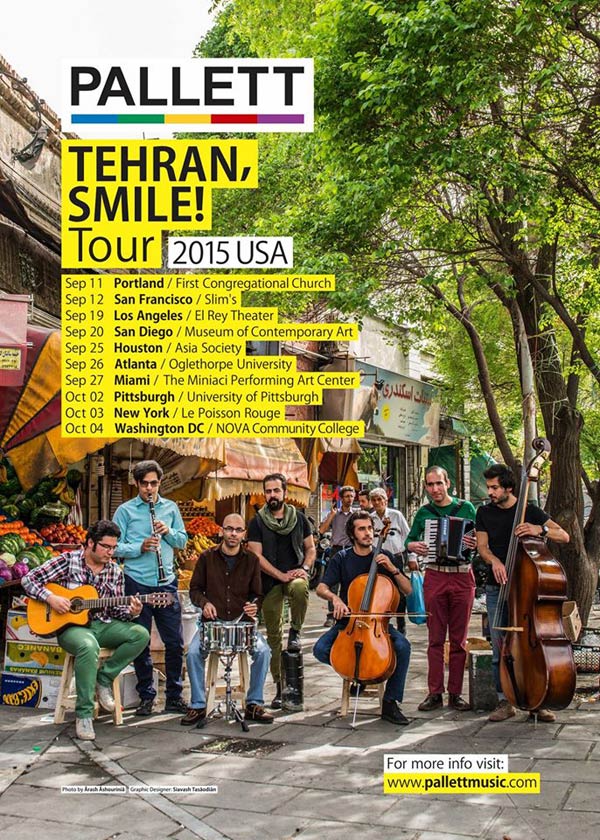
Iran’s Pallet band launches concert tour in US

Iran’s Pallet music band has launched its new international concert tour with a successful performance in the US city of Portland. The group went on stage in Portland, Oregon on September 11. The tour will continue with concerts in 11 other US cities and wrap up in Washington D.C on October 4.

Iran's Pallett-music-band-US-tourAccording to bandleader and clarinetist Rouzbeh Esfandarmaz, Pallet will perform pieces from its two albums ‘Mr. Violet’ and ‘Tehran, Smile.’

Vocalist Omid Nemati, cellist Mahyar Tahmasebi, guitarist Kaveh Salehi and double-bass player Dariush Azar accompany Esfandarmaz during the tour.

The fusion band Pallet has held many concerts in Iran and other countries such as France, Germany, Sweden, Italy and the Netherlands.

More songs from Pallet: http://www.last.fm/music/Pallet+Band

Source: Payvand | News, Youtube.com

Iran’s Hamedan Province: ‘Ganjnameh’ – an ancient cuneiform inscription of the Achaemenid Empire (Photos)

Ganj Nameh, literally translated as “treasure epistle”, is an ancient inscription, 5 kilometers southwest of Hamedan, near a natural waterfall, into a rockface on the side of Alvand Mountain, in Hamedan Province, Iran

The inscriptions were carved in granite in two sections. The one on the left was ordered by Darius the Great (521-485 BC) and the one on the right by Xerxes the Great (485-65 BC). Both sections were carved in three ancient languages: Old Persian, Neo-Babylonian and Neo-Elamite. The incscriptions start with praise of the Zoroastrian God (Ahura Mazda) and describe the lineage and deeds of the mentioned kings.

Ganjnameh sits along the ancient Imperial Road, that connected the Achaemenid capital Ecbatana to Babylonia. It was a safe and frequently traveled road and had much visibility during the Achaemeniad period. The inscriptions were studied in detail by the French painter and archaeologist Eugene Flandin during the 19th century. Subsequently Sir Henry Rawlinson, a British explorer, used the inscriptions to decipher the cuneiform characters of the era.

The translation of the text on the right plate, attributed to Xerxes, is: “The Great God Ahuramazda, greatest of all the gods, who created the earth and the sky and the people; who made Xerxes king, and outstanding king as outstanding ruler among innumerable rulers; I the great king Xerxes, king of kings, king of lands with numerous inhabitants, king of this vast kingdom with far-away territories, son of the Achaemenid monarch Darius.”

Later generations who could not read the Cuneiform alphabets of the ancient Persian assumed that they contained the guide to an uncovered treasure; hence they called it Ganjnameh which literally means “treasure book”, but it has also been called Jangnameh, literally “war book”, possibly due to the wrong assumption that the inscriptions described ancient wars of the Achaemenid era.

Two modern contemporary carved tablets have been placed in the site’s parking lot with Persian explanation and its English translation.

Unfortunately, this archeological site is in danger due to the construction of restaurants and entertainment centers in the vicinity of Ganjnameh that have changed the historic atmosphere and endangered the cultural and natural landscape of the area. Adding to these existing problems is the construction of a cable car nearby.

Sources: Historical Iran | Ganjnameh, Wikicommons | Ganj Nameh inscriptions, Mehr News Agency | Photostishineh.com | Ganjnameh, Panoramio | M. Eskandari, Panoramio | Alexandru Velcea, Panoramio | Mauro – Iran 2013, Panoramio | Ehsan Khanjani, Cultural Heritage News Agency (in Persian)

Iran’s exceptional reaction to 9/11 attacks: candlelit vigils for the victims and 60k soccer fans respected a minute’s silence

“Iran’s sympathetic response to the American tragedy has been exceptional for a country under US economic siege for two decades. Only hours after the Sept. 11 attack, President Muhammad Khatami condemned it, as did Supreme Leader Ayatollah Ali Khamenei. Other officials have sent sympathetic messages, including one from the mayor of Tehran to the mayor of New York – the first public official contact between Iran and the US since the 1979 Iranian revolution. […]

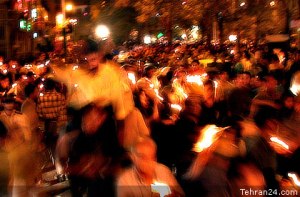
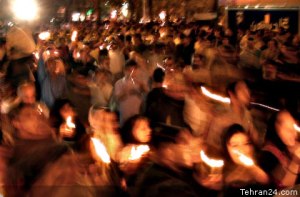
More important, 60,000 spectators observed a minute of silence during a soccer match in Iran’s Azadi Stadium, and hundreds of young Iranians held a candle-lit vigil in Tehran.”
Source: The Christian Science Monitor | US and Iran must work together against Taliban by R. K. Ramazani – September 24, 2001

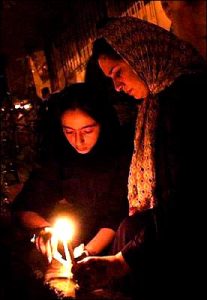
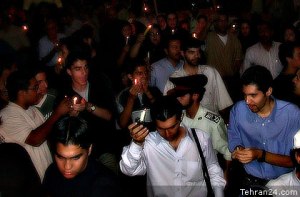
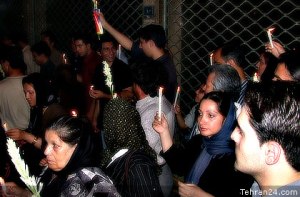
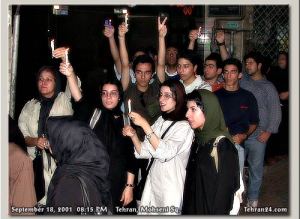
“Iranian women light candles in Tehran’s Mohseni Square in memory of the victims of the terror attacks on the World Trade Center in New York and the Pentagon in Washington DC. [see first picture above] […]

Even the most hardline Islamic clerics, who despise the United States, have been shocked into silence by the attacks. President Mohammad Khatami set the tone for Iran’s reaction with a statement that in Persian rang with deep compassion: ‘On behalf of the Iranian people and the Islamic Republic, I denounce the terrorist measures, which led to the killing of defenseless people, and I express my deep sorrow and sympathy with the American people.’ […]

Iran’s supreme leader Ayatollah Ali Khamenei condemned the attacks which have been blamed on Saudi-born Osama bin Laden. […]

‘Why should Americans deserve this? That’s a sick thought. They are just ordinary people like us,’ said Massoud Moshiri, as he bought cigarettes at a juice stand.” […]
Source: Times.com | Photoessay | Iran mourns America’s dead – September 18, 2001

On Tuesday, Ayatollah Khamenei, in his first public remarks on last week’s attacks, markedly failed to brand the United States an enemy. ‘Islam condemns the massacre of defenseless people, whether Muslim or Christian or others, anywhere and by any means,’ he said, adding pointedly: ‘And so Iran condemns any attack on Afghanistan that may lead to another human tragedy.’ […]

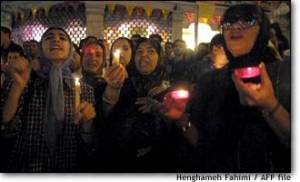
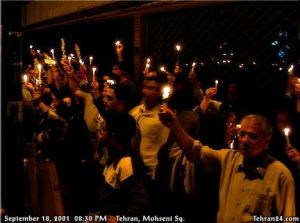
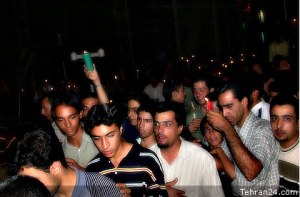
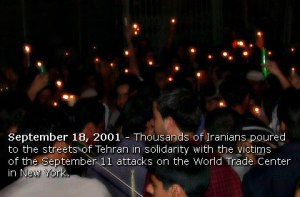
On Tuesday, more than than 3,000 mostly young people held a candlelight vigil in Tehran for the victims of the terror attacks, closely watched by security forces.

One reformist member of Parliament, Ahmad Borghani, even went to the United States interest section at the Swiss Embassy on Tuesday with a wreath of white flowers to sign the memorial book in sympathy with the family’s of the victims. ‘This tragedy has brought the two countries closer,’ he said. ‘But the United States must not expect Iran to cooperate in a military attack — considering our past relations.’
Source: The New York Times | World | A NATION CHALLENGED: TEHRAN; Iran Softens Tone Against the United States by Nazila Fathi – September 21, 2001

“IRAN — President Mohammad Khatami condemned ‘terrorist’ attacks on the United States”
Source: The New York Times | US | Reaction from around the world – September 12, 2001

“Leaders of Middle Eastern nations, including U.S. foes Libya and Iran, have condemned the terror attacks on the U.S. […] Mohammad Khatami, the Iranian president, said he felt ‘deep regret and sympathy with the victims.’ ”
Source: CNN.com | World | Attacks draw mixed response in Mideast – September 12, 2001

“Iranian President Mohammad Khatami, a moderate who is struggling for power against the country’s hard-line Islamic leaders, expressed ‘deep regret and sympathy with the victims’ and said ‘it is an international duty to try to undermine terrorism.’ ”
Source: FoxNews.com – September 12, 2001

“And in Iran, Tehran’s main football stadium observed an unprecedented minute’s silence in sympathy with the victims. Iran’s Ayatollah Imami Kashani spoke of a catastrophic act of terrorism which could only be condemned by all Muslims, adding the whole world should mobilise against terrorism.”
Source: BBC News | World | Americas | Islamic world deplores US losses – September 14, 2001

“Even in Tehran, where anti-American chants are all too common, thousands of people attending a World Cup qualifying match between Bahrain and Iran observed a moment of silence.”
Source: The New York Times | US | AFTER THE ATTACKS: THE VIGILS; Surrounded by Grief, People Around the World Pause and Turn to Prayer by Dan Barry – September 15, 2001

“In Iran, antipathy toward the United States was set aside as 60,000 spectators and players observed a minute of silence at the Tehran soccer stadium before a World Cup qualifying match.”
Source: Spartanburg Herald-Journal | REACTION ABROAD | World grieves along with America by Audrey Woods from Associated Press – September 15, 2001

“Iran’s Supreme Leader, Ayatollah Ali Khamenei, has strongly condemned the suicide terrorist attacks in New York and Washington. ‘Mass killings of human beings are catastrophic acts which are condemned’ he said ‘wherever they may happen and whoever the perpetrators and the victims may be’. ”
Source: BBC News | World | Middle East | Iran condemns attacks on US – September 17, 2001

“Last week, Ayatollah Ali Khamenei of Iran, one of the most conservative and anti-American Muslim clerical leaders, called the fight against terrorism a ‘holy war.’ He joins a host of learned Muslims who have loudly condemned terrorism as forbidden in Islamic law in the wake of the attacks on Sept. 11.”
Source: The New York Times | Opinion | Islam and the opposition to terrorism by Roy Mottahedeh – September 30, 2001

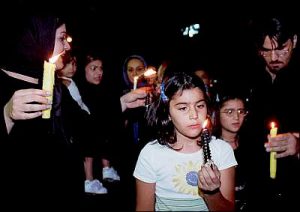
“After news of the Sept. 11 terrorist attacks spread to Tehran, hundreds of Iranians, students, merchants and housewives joined in a candlelight vigil in a downtown square. Many were crying. Three weeks later, I am still approached by ordinary Iranians, in restaurants, Internet cafes and on the street, telling me how sorry they are, and how worried they are about the ‘American war’ that is about to begin, just next door.”
Source: NBC News | Inside Iran, a nation conflicted by Jim Maceda – October 7, 2001

“On the evening of September 11, 2001, about two hundred young people gathered in Madar Square, on the north side of Tehran, in a spontaneous candlelight vigil to express sympathy and support for the United States. A second vigil, the next night, was attacked by the basij, a volunteer force of religious vigilantes, and then dispersed by the police. […]

The statement that Mohammad Khatami, Iran’s popularly elected President, made was extraordinary — extraordinary to American ears, at least. ‘My deep sympathy goes out to the American nation, particularly those who have suffered from the attacks and also the families of the victims,’ he said. ‘Terrorism is doomed, and the international community should stem it and take effective measures in a bid to eradicate it.’ ”
Source: The New Yorker | Letter from Tehran | Shadow Land by Joe Klein – February 18, 2002

“Iranian Students are calling for pro-american demonstrations, marking 9/11
A Public Call For Rememberance of the 9/11 Tragedy […]
Now, with the first anniversary of 9/11 tragedy upon us, as SMCCDI expresses its sympathy to the families of the victims and survivors of that ungodly event, and the honorable nation of America; it invites all free spirited Iranians to honor the memory of the victims of that day by gathering and lighting a candle in front of the main entrance of the Tehran university and major public squares in Tehran, and the main squares in other cities and townships, from 6:00 PM till 9:00 PM, on Wednesday 11 September.”
Source: daneshjoo.org | Post 1873 by SMCCDI Political Committee – September 10, 2002

“Finally, I’ve found a pro-American country. Everywhere I’ve gone in Iran, with one exception, people have been exceptionally friendly and fulsome in their praise for the United States […]. Iran is also the only Muslim country I know where citizens responded to the 9/11 attacks with a spontaneous candlelight vigil as a show of sympathy. ”
Source: The New York Times | Opinion | OP-ED Columnist: Those Friendly Iranians by Nicholas D. Kristof – May 5, 2004

“Ordinary Iranians have long had a softer stance toward the West than their leaders; after the Sept. 11 attacks, Iranians held a spontaneous candlelight vigil in Tehran.”
Source: Chicago Tribune | News | Contenders for Iranian presidency talk up U.S. by Evans Osnos – June 12, 2005

“In Iran, vast crowds turned out on the streets and held candlelit vigils for the victims. Sixty-thousand spectators respected a minute’s silence at Tehran’s football stadium.”
Source: BBC News | Middle East | Iran-US: Gulf of misunderstanding by Gordon Corera – September 25, 2006

“Mourners held a spontaneous candlelight vigil as thousands of people took to the streets of north Tehran chanting, ‘Death to terrorists.’ Iranian soccer fans observed a minute of silence before a match with Bahrain. Even Supreme Leader Ayatollah Ali Khamenei condemned the attacks: ‘Mass killing is wrong, whether it’s in Hiroshima, Bosnia, New York, or Washington.’ During Friday prayers at Qom, Ayatollah Ibrahim Amini said that the Iranian people grieved with the relatives of those killed, and the traditional slogan ‘Death to America’ was absent from the crowds’ mantras.
Source: Command Posts | Focus on: 9/11, Iran | After 9/11: The United States and Iran by David Crist – September 11, 2012

“Iranians mourn 9/11 victims”
Sources: shabhaft.blogfa.com | Post 134 and LiveLeak.com | Forgotten fact: night of 9/11, Iran – Spontaneous candlelight vigil to express sympathy and support for the American people

Other must read Iran-USA news: The other Iran | Tag | USA

” 2001/09/11, thousands and thousands Iranians went instantly in the streets with candles in homage to the victims ”
http://news.blogs.cnn.com/category/terrorism/september-11/” iranians mourn 9/11 victims ”
http://shabhaft.blogfa.com/post-134.aspx” Iranian Students are calling for pro-american demonstrations, marking 9/11 ”
http://daneshjoo.org/article/publish/printer_1873.shtml
Read more at http://www.liveleak.com/view?i=44b_1359356589&comments=1#DDqQZ5dOfJ70MPYf.99
” 2001/09/11, thousands and thousands Iranians went instantly in the streets with candles in homage to the victims ”
http://news.blogs.cnn.com/category/terrorism/september-11/” iranians mourn 9/11 victims ”
http://shabhaft.blogfa.com/post-134.aspx” Iranian Students are calling for pro-american demonstrations, marking 9/11 ”
http://daneshjoo.org/article/publish/printer_1873.shtml
Read more at http://www.liveleak.com/view?i=44b_1359356589&comments=1#DDqQZ5dOfJ70MPYf.99In Iran, vast crowds turned out on the streets and held candlelit vigils for the victims. Sixty-thousand spectators respected a minute’s silence at Tehran’s football stadium. http://news.bbc.co.uk/2/hi/middle_east/5377914.stm
Holy muron was celebrated at St. Sarkis Cathedral in Tehran, Iran

In the Armenian Church the Holy Muron is prepared and blessed every seven years. It is composed of olive oil and forty-eight aromas and flowers. The remaining portion of the previous blessed holy oil is poured into the newly prepared oil during the blessing ceremony and passes the blessing from generation to generation. It is said that this very procedure has been followed for nearly 1700 years.

The Catholicos of all Armenians in Etchmiadzin combines a new mixture of holy muron in the cauldron every seven years using a portion of the holy muron from the previous blend. This is distributed to all of the Armenian churches throughout the world. Here are some photos of this years ceremony in Tehran’s St. Sarkis Cathedral:

More post about Iranian Christians: Click here

More information about the ceremony can be found here: Wikipedia

Sources: theorthodoxchurch.info, ISNA | Photos

Iran’s basketball team crowned champion in 2015 William Jones Cup in Taiwan

The Iranian national men’s basketball team has finished first at the 2015 William Jones Cup in Taiwan, after pulling off an emphatic victory over Russian squad Spartak Primorye.

On Saturday, the Iranian sportsmen registered a 78-54 win against the Vladivostok-based side in a match staged at the Xinzhuang Gymnasium in New Taipei City.

In the history of the William Jones Cup, Iran is the second most successful nation behind the United States.

Former NBA player Hamed Haddadi was selected as Most Valuable Player of the tournament.
Haddadi, his Iranian team mate Mehdi Kamrani were also named as part of the “Mythical Five” of the tournament.

About William Jones Cup:

The R. William Jones Cup (also known as the Jones Cup) is an international basketball tournament held annually since 1977 in Taipei, Taiwan. It was named in honor of basketball promoter Renato William Jones, who was one of the founders of the International Basketball Federation (FIBA). Like the Olympics and the FIBA Basketball World Cup, it has both men’s and women’s versions. The men’s version is currently being dominated by American teams since the tournament’s inaugural staging.

Sources: Payvand | News, wikipedia | William Jones Cup, MEHR | Photos, Bleacherreport

Zohreh Abdollah-Khani: Iranian ice climber (Photos)

Abdollah Khani, Zohreh - Iranian ice climber - First Iranian female to win an international ice climbing medal 0Zohreh Abdollah Khani, born on September 30th, 1984 in Karaj, Iran. She is currently Iran’s ice climbing champion and Asia’s bronze medal holder. She became the first female ice climber to win a medal for Iran at an international venue, when she finished third in Women Speed at the 2014 UIAA Ice Climbing Asian Championship in Cheongsong, South Korea.

The photo gallery was taken during Abdollah Khani’s training by reporters of Borna News.

Below a video of Zohreh Abdollah Khani

Other posts about great Iranian women: click here

Sources: Borna News | Photos, everest51.blogspot.de, Ice Climbing World Cup | Women Speed Asia 2014, ISNA-Alborz | News

4th Persian Film Festival in Sydney, Australia, from September 3rd to 6th, 2015

The 4th Persian Film Festival is on from September 3rd to 6th at Palace Norton Street Cinemas, showcasing the best of Iranian cinema and the Persian speaking world. Over four days the festival offers its viewers a great line-up of 22 films including features, documentaries, short films and animations, and Q&A sessions with filmmakers from Iran, USA and Australia.

The festival is hosting a free screening of a number of award winning short films and animations from across Iran and from Iranian filmmakers in Australia, including the screening of Oscar nominated Simorgh by Meghdad Asadi, and current official selection at MIFF 2015 The Phoenix by Nora Nasiri, as well as, Sydney based filmmaker’s How Can Be Both by Saeed Sourati.

The displayed Movies and their directors are:

The President by Mohsen Makhmalbaf
A Few Cubic Meters of Love by Jamshid Mahmoudi
Block 9 Exit 2 by Alireza Amini
The Ride (Darbast) by Ali Khameparast Fard
I Want To Be A King by Mehdi Ganji
Impression-xps160 by Tiyam Yabandeh

Other films are:

This slideshow requires JavaScript.

Ranging in subject matter and style, the films offer short glimpses into contemporary and important social and cultural issues.

Opening Film: The President by Mohsen Makhmalbaf

Opening Film: The President by Mohsen Makhmalbaf

Other posts about Iranian cinema and its stars: click here

Sources: Persian Film Festival, Persian Film Festival | Free sessions, Persian Film Festival | Directors, Persian Film Festival | Movies

Video: Spotlight on Iran’s film industry – BBC News

More posts about Iranian Cinema: click here

Iran’s youth and junior national climbing team training in Hamedan (Photos)

Twenty seven athletes from Iran’s youth and junior national climbing team participated end of July at a four-day training camp in Hamedan to improve their speed, leed and bouldering skills.

Sources: Iran Mountaneering and Sport Climbing Federation | News, Borna News | Photos, IRNA | Photos

Iran wins 3rd place in FIVB U19 Volleyball World Championship 2015 in Argentina

An incredible tournament-high production of 40 points from Iranian star Rasoul Aghchehli ejected the Asians to a remarkable bronze medal as they won over previous champions Russia 3-1 (25-17, 26-28, 25-16, 25-23).

Iranian captain worked at their maximum and he completed 36 spikes and 4 blocks, to break all previous records. Rasoul was escorted by Mirbabak Mousavigargari and Aliasghar Mojarad, with 13 and 12 points respectively. On top of that, Rasoul won a terrific battle of opposites over powerful Russian Dmitry Yakovlev, who led his side with 26 tallies. Yakovlev had in middle-blocker Aleksandr Melnikov his best supporter with 13 points, but it wasn’t enough to stop the Iranian machinery.


Iran finished second behind Poland on the group stage, winning against Germany on the round of 16 and although they were only a few inches away from elimination, Iran resurged from ashes and achieved a spectacular return to rule out Italy 3:2 (17:25, 22:25, 25:20, 25:20, 15:11) and move to semifinals, where they lost against champion Poland 3:1.

Iran improved his previous run with the step onto the podium, as they were left out on the very verge of it on Mexico 2013, finishing fourth. Russia fell out of the top, as the gold medal will now change hands.

Iran U19 national volleyball team
Iran’s youth team have won seven gold medals and a silver medal – the best record in this age group in the Asian region. Last year, the team earned the qualification ticket to the FIVB Volleyball Boys’ U19 World Championship in Argentina after an unbeaten run in the continental championship. The result is the product of a long-term project of Iran to serve as a farm of talents for the senior men’s team. In the World Championship, Iranian youth have been a consistent force in the final, finishing with a gold medal in 2007, two silver medals in 2001 and 2009, a bronze medal in 2003, and a fourth place finish in the last edition.

Source: 2015 U19 FIVB Men Volleyball Championship | News, FIVB | Press releases, 2015 U19 FIVB Men Volleyball Championship | Iran

Morteza Jafari: First Iranian gold medal at the FIS Grass Skiing World Cup competition held in Dizin, Iran (Photos)

Iranian skier Seyyed Morteza Jafari made history at the Grass Skiing World Cup in Dizin, collecting the Iran’s first gold medal in the sport. After winning a silver medal in Super G, he finished in the first place in the giant slalom competitions with a time of 51:09 seconds, followed by Italian Eduardo Frau with 51:78 and Austrian Michael Stocker with 51:98. Slovakian Barbara Mikova won gold medals in Ladies’ Giant Slalom and Ladies’ Super G.

The tournament, that brought together skiers from Austria, the Czech Republic, Italy, Slovakia, Switzerland and Iran, was organized in Dizin. It is the third time, that this ski resort located in the Alborz mountain range and near the capital Tehran, hosts a Grass Skiing World Cup event.

The World Cup season 2015 got underway on July with giant slalom and slalom competitions in Predklasteri (Czech Republic) before moving to Ravascletto (Italy) for slalom events on 17th and 18th July. The tour stopped in Dizin (Iran) on 6th and 7th August, and Marbachegg (Switzerland) on 15th and 16th August, both for giant slalom and super-G events. The World Cup Finals will be held from 21st-23rd September in Kaprun (Austria).

The two major highlights of the season will be the Junior World Championships in Stitna (Czech Republic) from 28th July-2nd August and the World Championships in Tambre (Italy) from 1st-6th September.

Full Dizin Grass Skiing WC results: International Ski Federation (FIS) | Event results

Sources: FIS | News, Tehran Times | News, Team Iran | Skiing News, Press TV | News, Tasnim News | Photos (01-06), ISNA | Photos (07-19), IRNA | Photos (20-46), Fars News Agency | Photos (47-58), BORNA News | Photos (59-76)

Tehran calligraphy show promoting Iranian calico art

An exhibition of works by calligraphers Omid Ganjali and Mohsen Soleimani opened at Tehran’ Niavaran Cultural Center on Sunday to promote qalamkari, Iranian calico art that the artists believe is being forgotten.

The artworks were previously showcased at “From Earth to Heaven”, an exhibition that the Salam Art Creations Institute, a Tehran-based private organization developing Iranian arts, held at Cemal Resit Rey Concert Hall in Istanbul in July.

Photos by Mona Hoobehfekr for ISNA

All 30 calligraphy works are huge in size with designs of qalamkari done on their margins. Qalamkari is passing into oblivion in the country, Salam Art Creations Institute Managing Director Rafi Razavi told the Persian service of ISNA. The exhibition was organized to turn the spotlight on Iranian art, he added. “We need to take serious action to support artisans and masters who are still active in this field of time-honored art,” he stated.

The exhibition will run until August 25.

Sources: Tehran Times | Art Desk News, ISNA | Photos

Iranian ‘Mehr Theatre Group’ is in Europe performing its new play ‘Hearing’

The Mehr Theatre Group, an Iranian troupe led by director/writer Amir-Reza Kuhestani, will be performing the play Hearing in Switzerland, the Netherlands, Germany and France. The show centers on events happening in a girls’ dormitory.

Hearing premiered at Tehran’s City Theater in July before going on stage in Zurich, Switzerland at the Zürcher Theater Spektakel. They are attending the Noorderzon Festival in Groningen, the Netherlands with performances on August 25th and August 26th.

The troupe will next return to Geneva, Switzerland to perform Hearing on August 29th and August 31st at the La Bâtie, a festival of theater performances and film screenings. In September they will be heading to Frankfurt, Germany and Marseille, France. Full schedule: Mehr Theatre Group | Tour dates

About Hearing (Synopsis)
The girls’ dormitory was always like an unattainable castle. […] After the entrance door, a female world begun in which the entree of any man was prohibited. […] Now, presume that in a situation like this, one day, a girl reported that she had heard a man in one of the rooms. This would be the starting point of the performance.
More about the show: Mehr Theatre Group | Hearing

About Mehr Theatre Group
Mehr Theatre Group was created in 1996. The aim was to create a new type of theater — far from the traditional Iranian theater — based on new stage direction and a new acting style influenced by film. At first, Amir Reza Koohestani joined the Mehr Theatre Group to participate in their acting workshop, but after 6 months of the workshop they decided to produce theater productions based on their training. Since Amir was the only one with writing background he dedicated his time to write for the theater. […] The Mehr Theatre Group is today one of the most well known Iranian theater companies in Iran and has gained international acclaim with successful performances across the world. More about the troupe: Mehr Theatre Group

Below, a trailer of Timeloss, their last work before Hearing, also presented at the Under The Radar Film Festival in New York, USA. Other trailers: Mehr Theatre Group | Videos

About Amir Reza Koohestani
Amir Reza Koohestani is one of Iran’s most successful and prolific playwright-directors. With his third play, Dance on Glasses (2001), in tour for four years, Amir Reza Koohestani gained international notoriety and found the support of several European theatrical artistic directors and festivals. In February 2012, the movie Modest Reception, which script was co-written by Koohestani and Mani Haghighi – actor and film director – wins the Netpac Award at the Berlin International Film Festival 2012. He is the first director to win two consecutive awards for the “Best theatre production of the year” in Iran (Ivanov, 2011 and The Fourth Wall, 2012). More about him: Mehr Theatre Group | Amir Reza Koohestani

Related articles: The other Iran | Theater

Sources: Tehran Times | Art Desk, Mehr Theatre Group

Iran’s women inline speed skating competition (Photos)

135 Iranian athletes, divided in juniors and seniors, participated during the first stage of women’s inline speed skating competition. The best athletes in the different disciplines were invited to Iran’s national team camp in Mazandaran and Borujen in August.

Other posts about Iranian women: The other Iran | women

Sources: IRNA | Photos, Iran Skating Federation | News, Iran Skating Federation | Photos, BORNA News Agency | Photos

Iran’s Isfahan Province: Kashan – Fin Garden Series (2nd photo gallery)

Fin Garden, located in Kashan, Iran, is a historical Persian garden completed in 1590. It is the oldest existing garden in Iran. Unesco declared the garden a World Heritage Site in 2012.

Related post about Bagh-e Fin (Fin Garden) with more information and photos:
The other Iran | Kashan – Fin Garden Series

Sources: Wikipedia | Fin Garden, Mehr News Agency | Photos

Show Jumping Competitions Held in Isfahan, Iran (Photos)

Isfahan hosted the 3rd Naqsh-e-Jahan Cup, a show jumping competition. For three days more than 200 riders from Isfahan, Tehran, Fars, Qom, Tabriz, Zanjan and Kerman competed in different classes and categories (children, teen, youth and adults).

Show Jumping, also known as “stadium jumping”, “open jumping”, or simply “jumping”, is a part of a group of English riding equestrian events that also includes dressage, eventing, hunters, and equitation. Jumping classes are commonly seen at horse shows throughout the world, including the Olympics. International competitions are governed by the rules of the International Federation for Equestrian Sports (FEI).

Sources: Wikipedia | Show jumping, Tasnim News | Photos, IRNA | Photos, Equestrian Federation of Iran | Naqsh-e-Jahan Cup results (in Persian)

China Philarmonic Orchestra performed together with the Tehran Symphony Orchestra in Iran (Photos)

Iranian-Austrian conductor Alexander Rahbari conducted the Teheran Symphony Orchestra as it played Scheherazade by Rimski-Korsakov and Yu Long conducted the China Philharmonic playing the New World Symphony by Dvorak.

In preparation for the joint concert, Rahbari was in Beijing rehearsing with the China Philharmonic. “It’s a very nice orchestra,” he says. “I hadn’t been to Beijing before, but I am familiar with Chinese musicians and the way Chinese think. Over the past 40 years I’ve conducted a lot of orchestras with Chinese musicians.

“It took us just an hour and 40 minutes to finish rehearsals on the first day. This is a well disciplined orchestra. Good orchestras have similar qualities. When they get down to work, they’re not Chinese or Iranian or German; they’re all musicians.

Rahbari’s positive feelings about the orchestra seem to have been reciprocal. Zhao Yunpeng, the first cello, says: “He’s charismatic and he’s got very sharp ear. He seems to be able to pinpoint problems very quickly. […] We knew little about him before but the rehearsals have been terrific.”

The China Philharmonic Orchestra’s two-night appearance in Teheran is the fourth stop on a 14-day tour taking in five countries (Kyrgyzstan, Tajikistan, Kazakhstan, Iran and  Greece) on the Silk Road.

About Alexander Rahbari and the Tehran Symphony Orchestra
Rahbari first conducted the Teheran Symphony Orchestra about 40 years ago, before the Islamic revolution, when the orchestra was in its heyday and hosted the likes of the violinist Yehudi Menuhin and the choreographer Maurice Bejart.

Rahbari left Iran in 1976 and did not return for another 30 years. In 2005 he was invited to rebuild the Teheran Symphony Orchestra but turned down the offer on political grounds. But eight years later, when Hassan Rouhani was elected Iran’s president, he promised to revive the 80-year-old orchestra and invited Rahbari back.

Sources: China Daily | Musical diplomacy’s perfect harmony, Honar Online | Photos 1, Mehr News Agency | Photos 1, Mehr News Agency | Photos 2, Honar Online | Photos 2, ISNA | Photos

Iran’s Kerman Province: Fath-Abad Garden (Photos)

Fath-Abad Garden is located next to the village of Ekhteyarabad, 25km from the city of Kerman. It dates back to the Qajar era. The garden has been recently renovated after having its last restoration in 1972.

Shazdeh Garden, a historical  Persian Garden near Mahan, also in Kerman Province, has been modeled on Fathabad Garden.

Related articles: The other Iran | Shazdeh Garden

Sources: IRNA | Photos, Wikipedia | Fath-Abad Garden (in Persian), Tasnim | Photos , ISNA | Photos

Iran’s Radkan (East) Tower a sophisticated instrument for studying the stars built in AD 1261

Radkan (East) Tower or Mil-i Sharq Radkan lies near Radkan Village, 25km away of Chenaran in Razavi Khorasan Province, Iran. According to Iranian archaeo-astronomer Manoochehr Arian, it was actually a highly sophisticated instrument for studying the stars built in AD 1261 by astronomers led by Nasruddin Tusi (Nasir Al-Tusi; 1201–74).

The round, conical-topped brick tower was designed so that the sun shines directly through its doors and niches on solstice and equinox days. It was possibly with data collected here and at his more famous observatory at Maraqeh that Tusi managed to calculate the earth’s diameter and explain discrepancies between Aristotle’s and Ptolemy’s theories of planetary movement.

Based on epigraphic remnants, German archaeologist and Iranologist Ernst Herzfeld, has argued that the tomb tower belongs to Amir Arghun Khan, a residence of Radkan who died in 1274. The tomb is cylindrical, with an octagonal burial chamber crowned by a conical dome. It is entered from two axial entrances facing southeast and northwest.

The thirty-six engaged columns enveloping its exterior between the base and the dome give the tomb a wavy outline. A spiraling stair encased within the monument’s walls gives access to the inner dome, of which only the base remains. The double dome construction of the roof has a long history in the tomb towers built in Iran during the Seljuk period (roughly 1050-1150) and before. Gunbad-i Qabus in Gorgan is the first example of a monumental tomb structure that employs a double dome construction with an outer conical roof covering an inner hemispherical one.

Sources: Lonely Planet | Radkan, Iran, ArchNet | Mil-i Sharq Radkan, Mehr News Agency, Facebook.com | Ariana Ahangary, citypedia.ir, The best travelled | Witold Repetowicz

Taha Zaker: Iranian artist wins Graphis gold award

“Contemporary Musicians”, the poster series by Iranian graphic designer Taha Zaker received the gold award of the Graphis Poster Annual 2016. The collection including seven posters by Zaker has been produced in Tehran Studio, and the winners were announced by the jury late July.

Graphis is a Zurich-based international journal of visual communication, the first edition of which was published in 1944. Graphis is committed to presenting and promoting the work of exceptional talent in graphic design, advertising, photography and art/illustration.

About Taha Zaker
Born in 1987, Zaker is a graduate of graphic design. He is the art director and graphic designer at Tehran Studio. He has also produced several documentaries and experimental films. He has also designed the poster of the 33rd Fajr International Film Festival and several other movies such aa “I Am Not Angry”, “Rainy Day”, and “Parviz”.

Sources: Tehran Times, Mehr News, Graphis.com

Iran’s Isfahan Province: The underground city of Nushabad (Photos)

The underground city of Ouyi (Noushabad) in northern Kashan, Isfahan Province, is considered one of the masterpieces of ancient architecture. The complex spreads across thousands of square meters and consists of many labyrinth-like architectural structures, corridors, rooms and wells. Natural air conditioning and water supply of the city are among its ancient engineering wonders. The ventilation system used in the underground city through devising canals made it possible for the refugees to breathe even at a depth of 20 meters below the ground.

A large number of historic evidence including earthenware vessels and stone instruments ranging in date to Sassanid (224-651 AD), Ilkhanid (1256-1336), and Safavid (1501-1736 AD) dynastic periods have been retrieved from the underground city. After three seasons of performing archeological studies, tourists can once again visit the city from entrances adjacent to two old water reservoirs.

In the past this region was quite insecure and by forming an underground chain of passages beneath the entire city, the inhabitants would shelter there in the time of being attacked. Through these passages they could reach any spot of the city without being seen.

The depth of this underground city varies from 4 to 18 meters. Entrances to the city were from population concentration points such as water reservoirs, markets, fortresses and also some individual houses. People could live in the underground passages and room for several days without the need of going outside.

There are three levels in this underground city and these levels were cleverly planned in a way that going to the different levels required moving from down to up. This made it easier for the people sheltering in the underground city to prevent enemies from getting to the upper levels.

Another interesting feature of their architecture was the curvy passages that made it possible for the inhabitants to ambush enemies. Furthermore there were several other tricks that were used to resist against the enemies, for instance digging deep holes in the middle of the rooms and covering it with rotating stones that would fall down if anyone stepped on them.

Other great photo series and stories on Iran: The other Iran | Photos

About Nushabad
Nushabad (Persian: نوش آباد‎, also Romanized Noshabad) is a city in the Central District of Aran va Bidgol County, Isfahan Province, Iran about 5 kilometers north of Kashan. At the 2006 census, its population was 10,476, in 2,859 families. As Nushabad city is located in the region of central desert of Iran, its weather is quite harsh. During the day Nushabad has a very hot temperature and during the nights it gets pretty cold.

Sources: Wikipedia | Nushabad, Hamshahri Online (Photos), Fars News | Photos, Historical Iran

Badab-e Surt Spring, Iran – naturally formed staircase built over thousands of years

Badab-e Surt’s springs are two distinct mineral springs with different natural characteristics, located at 1,840 metres (6,040 ft) above sea level in Mazandaran Province in northern Iran

Over the course of thousands of years the water from these two springs emanating from the mountain range have combined and resulted in a number of orange-, red- and yellow-colored pools shaped as a naturally formed staircase.

Other interesting photos of Iran: The other Iran | Photos

Sources: Wikipedia | Badab-e Surt, Bing (pictures)

Iranian high school students win first place in the 9th International Olympiad on Astronomy and Astrophysics (IOAA)

Iranian high school students are in this year’s 9th International Olympiad on Astronomy and Astrophysics (IOAA) on top of the medal table with three gold, four silver and three bronze medals.

This year’s competition was held from July 26 to August 4 in the Indonesian city of Semarang with the participation of 41 countries. The IOAA is an annual international astronomy competition for high school students and was first held in Thailand in 2007

Arman Vasigh Zadeh Ansari, Fatemeh Zargar Bashi and Ali Zare won the gold medals, Saeed Hojjati Nejad, Saeed Morteza Sadat, Mohammad Hadi Sotoudeh and Ali-Reza Arjmand Shakouri won the silver medals and Ali Chegini, Parsa Nourozi and Seyed Ali Hadian Emrai won the bronze medals.

Special awards were also given to Fatemeh Zargar Bashi (Most Creative Solution) and to Ali Zare (Best Theory).

Related posts (other international successes): The other Iran | Education

Sources: Payvand News of Iran, IOAA 2015 Newsletter Vol.08 | Student rankings (p6), Special Awards and Honorable Mentions (p7), Medal distribution (p8) – (PDF), Facebook | IOAA 2015, IOAA 2015 | Photos


German broadcaster, DW’s Dan Hischfeld, shares his experience in Tehran, Iran

The taxi ride from the airport to the center takes about an hour. The first thing you notice is that something is missing. Even the rush-hour traffic lacks the chaos that we know from Arab countries and from mega-cities such as Bangkok or Mumbai. No weaving cars or pedestrians risking their lives to get to the other side of the street. Everything seems somehow European. […]

Friendly and helpful
Most of the population is under 30. They are not afraid of contact with strangers and welcomed me, the visitor from the West, with an openness and friendliness that would surprise even a well-traveled globetrotter. Strangers on the street invited me for tea. Someone offered me his mobile phone – me, a foreigner who had obviously got lost – so I could call my hotel. He even rang an acquaintance that spoke a smattering of English and might have been able to help me.

Tehran is a modern metropolis where I quickly felt at home. […] But I soon noticed I was in an Islamic country too. The subway carriages are divided by glass doors into male and female compartments – and of course I got in the wrong side! No problem, I just switched to the men’s section. But another passenger told me that hardly anyone paid attention to the segregation of the sexes in the metro anyway and that nobody got upset when someone sat in the “wrong” place. In fact, it’s a sort of protest.

Tradition and progress

There’s also a measure of public protest as far as Islamic dress code is concerned. In public, women in Iran have to wear the “hijab,” a kind of headscarf, or the black “chador,” which covers the entire body – only the face is left exposed. But I saw only a few women all dressed in black. And even the headscarf, which is supposed to cover the entire hair, tends to be worn in the capital as a scarf. If the religious police show up, then they say the wind has just blown it down.

Young women in particular love to wear pink jeans and modern-cut clothing. Tehran is undoubtedly a modern metropolis. And, although it seems quite normal to me as a European to see women sitting behind the wheel of their cars, compared to other Islamic countries, it’s quite progressive. In Saudi Arabia, a woman driving without special permission can be punished by caning.

Propaganda and censorship
Strolling through the city, I was enchanted by the beautiful ornate houses and palaces from the time of ancient Persia. Here I got an idea of how magnificent this country once was. But the people impressed me most. They have a huge interest in world events. Although anti-American propaganda is on walls and billboards everywhere, most people in Tehran think differently and talk openly in the restaurant in the evenings. Thanks to satellite TV (which is actually prohibited, but somehow everyone has it anyway) and the Internet (whose government firewall censorship can be circumvented in just a few clicks), many Iranians now have their own opinions on world events, corruption and politics.

Tourism as an opportunity
This country, where I encountered forests, deserts, beaches and high mountains, is just waiting to be discovered. In Tehran, for example, I took a cable car to more than 4,000 meters above sea level and experienced what climbers call “altitude sickness.” In any case, a week was far too short. For this country, you have to take your time. Or maybe just come back.

Source: DW | A trip to Tehran (Photos in the article)

Duluth orchestra and Iranian composer make music history

For perhaps the first time since the Iranian revolution in 1979, an Iranian composer living in Iran collaborated with an American orchestra. It was the world premiere of “Kalileh,” a classic Persian fable set to music by composer Hooshyar Khayam, performed on July by the Lake Superior Chamber Orchestra (LSCO), in Duluth, Minnesota.

The story of how a small orchestra in Duluth commissioned an original piece from a young Iranian composer begins last year, when conductor and artistic director Warren Friesen needed six more minutes of music for a concert. “So I literally went into YouTube, and I put in ‘piano and strings’ and let’s see what comes up,” he recalled. Thousands of pieces did and Friesen listened to snippets of dozens of them.

“I came across a piece called ‘Stained Glass’ by a composer I’d never heard of, with this funny name of Hooshyar Khayam. […] At this point I didn’t even know that Hooshyar was living in Tehran. All I knew was that I liked his music.” The LSCO performed the piece last July in Duluth, and an unlikely friendship was born between the 62-year-old Friesen and 36-year-old Khayam.

“I was very much moved by the extreme power of the musicians in the American orchestra, who could in fact play the Persian rhythms with that accuracy and that perfection,” Khayam said. So after that performance, Khayam agreed to create an original piece for shadow puppets and chamber orchestra based on an ancient Indian/Persian fable of the composer’s choice to play this year. Ultimately, Khayam added a youth chorus into the mix.

The result is “Kalileh,” based on an ancient Persian fable of the same name, which tells the story of a jackal, a trickster character, who seeks to become more powerful by becoming more beautiful. “The opening chorus, which I love, says ‘Come, Come Wanderer, lover of leaving, even if you have broken your vow a thousand times, come, come.’ It’s such a beautiful invitation,” Friesen said. The lyrics, explained Friesen, are verses of poetry written by famous 13th-century Persian poets Saadi and Rumi.

Khayam said the work “for me was more than a professional commission. I personally believe that ‘Kalileh’ shows something deeper of this relation of me as an Iranian with this wonderful orchestra in America. […] I’m always searching for sort of a higher meaning than only notes to listen to. […] The most important ingredient of this collaboration is that fact that it’s happening between two countries who have had years of misunderstanding and years of conflict.”

Khayam has collaborated with Friesen and others through Skype over the past year and visited Duluth for the performances.

All USA-Iran related posts on this blog: The other Iran | USA

About Hooshyar Khayam
Hooshyar Khayam (b. 1978) is an Iranian musician. He is active as a composer, pianist, and conductor. His works are in contemporary classical, contemporary jazz, Persian/world music; and in music for film, animation, dance, and theater.

He is the finalist of the Queen Elisabeth International Composition Competition for his piano concerto Before the Dream is Over (2013), first prize award winner of Franz Schubert and Modern Music International Composition Competition for his trio I Waited for You in Rain (2011), finalist of the Mauricio Kagel International Composition Competition (2013); Winner of Culture and Music Critic’s Prize: Tehran’s best album of the year for Tatari (2007); and 4-star winner Top of the World Albums by Songlines (75th issue) for his album All of You (with Amir Eslami, 2011) as distinctive music of Middle East.

Khayam has BM in Persian Music, University of Art, Tehran; AD in Piano Performance, Trinity College, London; MM and DMA in Composition, College-Conservatory of Music, Cincinnati. He lives and works in Tehran as an independent artist.

About Warren Friesen
Warren Friesen on Facebook

Further read: Duluth News Tribune | Duluth’s Lake Superior Chamber Orchestra set to bridge cultures with new work

Sources: Minnesota Public Radio News, Hooshyar Khayam | Biography, Duluth Reader | A musical blowout at the end of July 2015

London Iranian Film Festival – Saturday August 1st, 2015 – 3 Movies 1 Ticket

London Iranian Film Festival is the only annual festival to present Iranian cinema in the UK.  The festival aims to introduce the international community to the best of Iranian cinema.

Screenings: 3 Movies, 1 Ticket (Melbourne, I’m Not Angry, 360 Degrees)
Date:
Saturday 1st August
Time: 14:00- 21:00
Venue: Greenwood Theatre, King’s Venues, London, 55 Weston Street, London

Tickets are £18 if purchased in advance or £25 on the door (for all three screenings) and can be purchased at: http://www.ukiff.org.uk/

More info about Iranian cinema and successful movies: The other Iran | Cinema

Iran’s East Azerbaijan Province: Beautiful nature of Arasbaran (Photos)

Arasbaran is a large mountainous area stretching from the Qusha Dagh massif, south of Ahar, to the Aras River in East Azerbaijan Province of Iran. The region enjoys great history as well as magnificent nature and landscapes; peaks as high as 2,200 meters, alpine meadows, rangelands, forests, rivers and springs. Since 1976, UNESCO has registered 72,460 hectares of this region as biosphere reserve.

Related article with more information about Arasbaran:
The other Iran | Photo Series: Spring in Iran – Arasbaran, East Azerbaijan Province

Sources: Tasnim News Agency | Photos, Mehr News Agency (Photos)

Iran’s Tehran Province: Tangeh Savashi (Photos)

Tangeh Savashi (or Tangeh Vashi) is a gorge and narrow mountain pass in the Alborz range. Located 15 kilometers west of Firouzkouh, the narrow gorge was created by a perennial stream which comes down from a series of waterfalls upstream.

Slightly lower, in a hilly area, the stream provided a patch of lush grazing land within the mountains. Until the 20th century the area was a royal hunting reserve, populated by various wildlife. Fath Ali Shah (1772 – 1834), Qajar Shah of Persia, maintained a hunting lodge there and to commemorate his hunts he ordered the carving of a relief in the mid way point of the pass. There are ruins of a Qajar guard tower at the top of one of entrances to the gorge.

Today, the relief is a popular tourist attraction and the location is also highly popular among trekking and hiking fans.

Sources: Wikipedia | Tangeh Savashi, Wiki Commons | Tangeh Savashi, Mehr News | Photos

Iran’s Mazandaran Province: A glimpse at its beautiful and diverse nature (Photos)

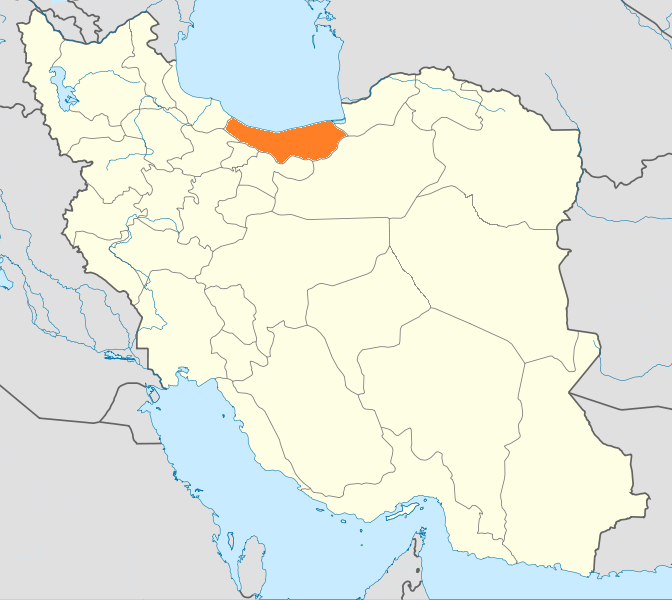
Mazandaran Province is located in the north of Iran, on the southern coast of the Caspian Sea, with Sari as its provincial capital.

The diverse nature of the province features plains, prairies, forests and rainforest stretching from the sandy beaches of the Caspian Sea to the rugged and snowcapped Alborz mountain range, including Mount Damavand, one of the highest peaks and volcanos in Asia. The Alborz Mountain Range surrounds the coastal strip and plains of the Caspian Sea like a huge barrier.

The province enjoys a moderate, subtropical climate with an average temperature of 25 °C in summer and about 8 °C in winter. Although snow may fall heavily in the mountains in winter, it rarely falls at sea level.

Mazandaran, Iran - MapThis region has a variety of climates, including the mild and humid climate of Caspian shoreline and the moderate and cold climate of mountainous regions. In the 1,500- to 3,000-meter altitudes, snow covers parts of the province even up to the middle of the warm season. In fact, snow can be observed in this region even in the warmest months of the year, which lends a touch of beauty to this region.

Human habitation in the area dates back at least 75,000 years. Recent excavations in Goher Tippe provide proof that the region has been urbanized for more than 5,000 years, and the area is considered one of the most important historical sites of Iran. Mazandaran was a part of the ancient Persian province of Hyrcania.

The population is overwhelmingly Mazandarani, with a minority of Azerbaijanis, Georgians, Armenians, Circassians, Turkmen and others. Mazandaran is a center for Iranian culture and has produced a number of famous poets. The people are largely secular, and consequently women have had greater social freedom and independence than their Persian cousins. The cuisine of the province is very rich in seafood due to its location by the Caspian Sea, and rice is present in virtually every meal. Indeed, the rest of Iran was introduced to rice through Gilan and Mazandaran.

Sources: Wikipedia | MazandaranMehr News | Photos 1Mehr | Photos 2, WikiCommons | Mazandaran, Fars News | Photos, Tasnim News | Photos, Iran Chamber Society | Mazandaran

Iran puts on remarkable show at RoboCup 2015 in China

The 19th RoboCup Tournament took place from July 19th to July 23rd, 2015 in Hefei City, East China with more than 2000 participants from 47 countries. The Iranian teams achieved three first places, three second places and two third places along with top spots at technical challenges and other awards.

Many Iranian High Schools participated at the event. At the 2D Simulation RoboCup Soccer Competition, Phonix from Atomic Energy High School was awarded Best New Team, finishing 10th. At the same competition HERMES from Allameh Helli Highschool was 5th and Genius2015 from Ghazal High School, Shiraz was 11th.

Detailed results for top Iranian teams

1) RoboCup Rescue Competition
Rescue Simulation: 1st S.O.S (Amirkabir University of Technology, Iran), 2nd MRL (Mechatronic Research Lab, Islamic Azad University of Qazvin, Iran), 3rd SEU_Jolly (China)

Rescue Robot: 1st MRL (Iran), 2nd iRAP_Junior (Thailand), 3rd YRA (Islamic Azad University of Yazd, Iran) // Innovative User Interface Award: Hector Darmstadt (Germany) and MRL (Iran).

2) RoboCup Soccer Competition
Humanoid League – Adult Size: 1st THORwIn (USA), 2nd Baset Adult-Size (Baset Pazhuh Tehran Cooperation, Iran), 3rd HuroEvolution AD (Taiwan) // Technical challenges: 1st Baset Adult-Size (Iran), 2nd HuroEvolution AD (Taiwan) and CIT Brains Adult (Japan), 3rd THORwIn (USA)

Humanoid League – Teen Size: 1st Team Parand (Parand Islamic Azad University, Tehran, Iran), 2nd HuroEvolution TN (Taiwan), 3rd AUT-UofM (Amirkabir University of Technology – University of Manitoba, Iran – Canada) // Technical challenges: 1st HuroEvolution TN (Taiwan), 2nd place shared between WF Wolves & Taura Bots Teen (Germany & Brazil) and AUT-UofM (Iran & Canada)

Small Size: 1st CMDragons, Carnegie Mellon University (USA), 2nd MRL, Qazvin Islamic Azad University (Iran), 3rd ZJUNlict, Zhejiang University (China) // Technical challenges: 1st ER-Force (Germany), 2nd ZJUNlict (China), 3rd MRL (Iran)

Middle Size: 1st Water (China), 2nd TechUnited Eindhoven (Netherlands), 3rd ARES (China) // Technical challenges: 1st MRL (Iran), 2nd NuBot (China), 3rd Tech United Eindhoven (Netherlands)

2D Simulation: 1st WrightEagle, University of Science and Technology of China (China), 2nd HELIOS2015, Fukuoka University, Osaka Prefecture University, (Japan), 3rd Gliders2015, University of Sydney and CSIRO (Australia) // Best New Team: Phonix (Atomic Energy High School, Iran).

About RoboCup
RoboCup is an annual international robotics competition aiming to promote robotics and artificial intelligence research, by offering a publicly appealing, but formidable challenge. The name RoboCup is a contraction of the competition’s full name, “Robot Soccer World Cup”, but there are many other stages of the competition such as “RoboCupRescue”, “RoboCup@Home” and “RoboCupJunior”. The official goal of the project is “By the middle of the 21st century, a team of fully autonomous humanoid robot soccer players shall win a soccer game, complying with the official rules of FIFA, against the winner of the most recent World Cup.”

Other related articles: The other Iran | RoboCup

Sources: RoboCup 2015 | Results, Mehr News Agency | News 1, Wikipedia | RoboCup, Mehr News Agency | Photos, RoboCup Humanoid League, Mehr News Agency | News 2

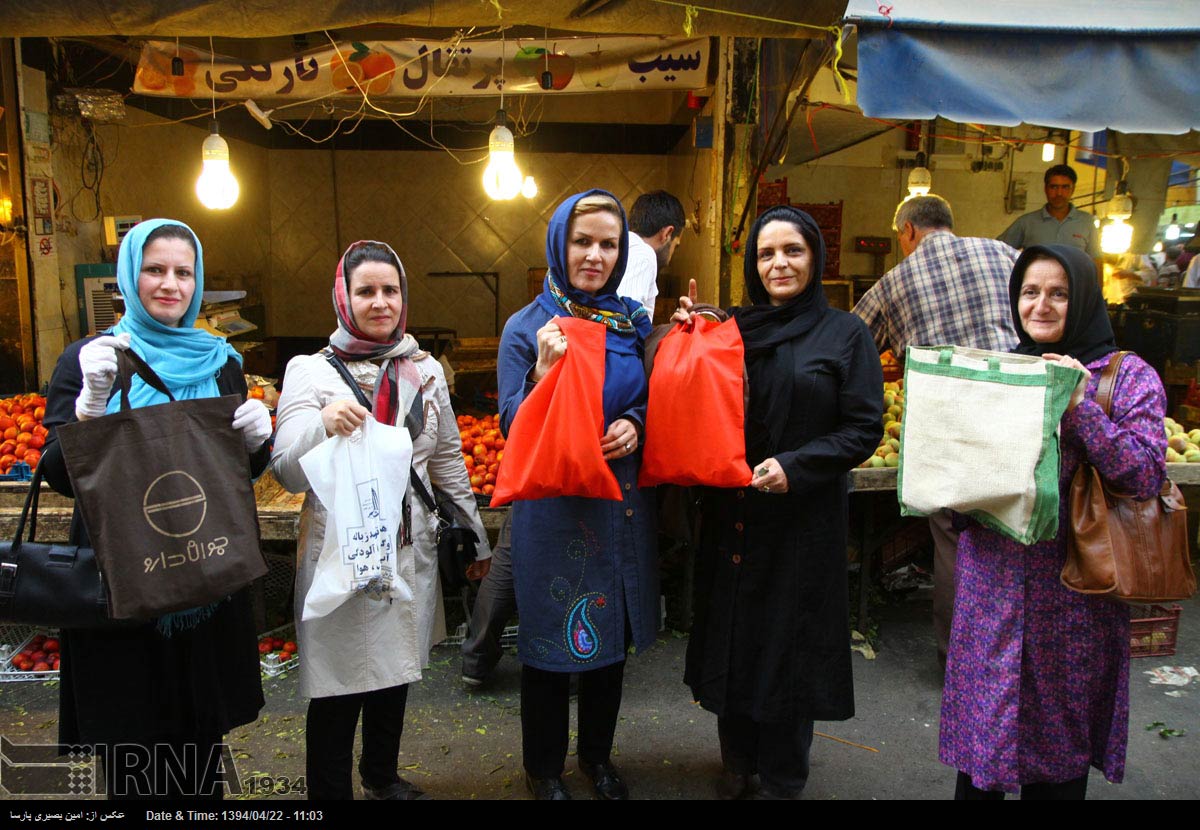
Plastic-Bag Free Day in Iran: Campaign promotes stopping use of plastic bags

On July 12, which is Plastic-Bag Free Day in Iran, several organizations once again geared up to raise public awareness about the environmental problems posed by plastic bags. For a week, Tehran and several other provinces implemented a program of using biodegradable bags in stores and markets bearing the logo “less plastic, cleaner earth, better health”.

Plastic-Bag Free Day was launched in Iran following a proposal by the Fruit and Vegetable Markets in 2012, which immediately found the support of Tehran City Development offices and the Department of the Environment. The markets have since completely stopped using plastic bags. All plastic bags have been replaced with paper and cloth bags in 15 fruit and vegetable markets across the capital, eliminating the use of 400 million plastic bags.

Plastic-Bag-Free-Day-in-Hamadan-Iran-1

Statistics indicate that 177,000 tons of plastic bags are produced each year in Iran. Across the world, 3.5 million tons of waste is produced each day, and Iran’s contribution to that is now pegged at 40,000 tons a day.

The international Plastic-Bag Free Day is observed on July 3.

Source: Payvand | News

Iran’s Fars Province: Tarom Waterfall near Neyriz

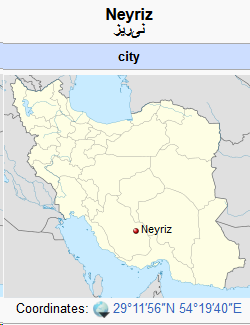
Tarom waterfall is located in the Fars province five kilometers south of the city of Neyriz. Tarom waterfall is about 115 meters high, and thus is the highest waterfall in the Middle East.

Iran, Neyriz mapNeyriz (also Romanized as Neyrīz and Nīrīz) is the capital city of Neyriz County, Fars Province, Iran. It has a population of 45,000 inhabitants (2006).


Sources: ISNA | Photos, Wikipedia | Neyriz, Tishnieh.com (Farsi)

Munchies Guide To Tehran, Iran: Beluga Caviar is Black Gold

Iran’s South Khorasan Province: Akbarieh Garden and Mansion, Birjand (Photos)

Akbariyeh Garden is Located in Birjand, North-east of Iran and is one of the most beautiful Persian gardens. This historical garden lying in the mountainous bed, consists of two mansions.

Construction of the older building in the easternmost of the garden dates back to the late Zandiyeh and early Qajar era. But the central building, on the western front, is almost as the core counts of the garden. It is beautifully decorated and was used for ceremonies.


The mansions display inlaid decorations, netted and sash windows with colored glasses, and geometrical plaster designs. The Russian-Iranian design displays tall trees, pavilion, and extremely beautiful sash decorating with mirrors and tile.

The Akbariyeh Garden’s mulberry trees, pomegranates and flowers are making beautiful sights.
Although the garden is situated in remote parts of the country, it is one of the Persian gardens that worth visiting in a trip to Iran.

Today, the mansion is used as a library, museums of archaeology, anthropology and wildlife and a traditional Persian tea house.

Akbariyeh Garden is among the 9 Iranian Gardens which are collectively registered as one of the Iran’s 17 registered World Heritage Sites under the name of the Persian Garden.

Akbariyeh Garden is also known as the Akbarieh Garden and Edifice, or Akbarieh Garden and Complex. In Persian it reads as “باغ اکبریه” (from right to left) and pronounced as “baqe akbariyeh”.

Related posts: The other Iran | Birjand

Sources: Otraq.com, Dream of Iran

Munchies Guide To Tehran, Iran: Persian Meatballs, Traditional Teahouses, and the Perfect Kebab

Behnaz Shafiei: Iranian professional road racer

In the dusty hills of Hashtgerd, some 40 miles west of Tehran, a rider on a souped-up bike comes roaring along a rough-and-ready race track, braving steep jumps and dangerous turns. With a bright orange and black biker suit and helmet, the motorcyclist looks just like any other, until the helmet comes off. The rider is a woman.

“When people find that out, they stop and say damet-garm [Persian for ‘right on’],” Behnaz Shafiei told the Guardian. She feels welcome in an otherwise all-male motorcycling club, where she practises three times a week: “They offer help when I tow my bike with the car or when I run into a technical problem.”

The 26-year-old is among the first group of female motorcyclists in Iran to have recently obtained official permission to practise on off-road circuits, and the one and only Iranian female rider to have done professional road racing.

Women in Iran are still banned from riding a motorbike in public, and are not issued licences, although they are allowed to take part in other sports, from martial arts to car rallies. But things are beginning to change. Shafiei’s story has attracted a great deal of interest at home. A leading national newspaper recently photographed her at play and state-run television has broadcast an interview with her. Shafiei is hopeful that soon she will also be allowed to compete.

Men and women alike rub their eyes in disbelief when they see her on a motorbike, Shafiei said, but she added that reactions were always positive. “I’ve never seen a bad reaction to what I do. People here are fascinated when they see a woman doing such a physically demanding sport,” she said. “Everyone has something affirmative to say. Women wave hands and say well done, you are brave. There are people who can’t believe a woman can ride a motorbike but they’re generally thrilled and feel very proud.”

Shafiei, who was born and raised in Karaj, near Tehran, found her passion for motorcycling at the age of 15 while on holiday with her family in Zanjan province. “There was this young woman in a village there who rode a 125cc urban motorbike to travel between houses, like one used by the postman,” she recalled. “I like that a lot and told myself that I want to ride a motorbike too and in fact I learned how to ride a motorcycle for the first time during my stay there.”

With support from her family, especially her mother, Shafiei dabbled in motorcycling for a few years before pursuing the sport professionally. “I used to borrow my brother’s bike and ride in the city stealthily. It was such fun,” she said.

She saved money from her work as an accountant and bought her first bike, an Apache 180cc, four years ago. A couple of years later she went to a track race in northern Karaj to have a look. Male riders there, she said, encouraged her to come along regularly and offered to teach her what they knew.

These days, Shafiei has changed her bike to a 2012 Suzuki 250cc, focusing all her attention on motocross, but a ban on women riding in official race tracks means she can only practise in rudimentary clubs such as the one in Hashtgerd, where medical facilities are not available.

“We don’t have a single ambulance in the track. It’s an expensive sport and we have no sponsors. If someone has an injury, it might get even worse by the time the rider is taken to the hospital,” she said. […] “I want to be part of my own country’s team, I don’t want to go abroad. I want to bring pride to Iran and show that Iranian women can do this sport too.” She added: “Outside, Iran is depicted differently. We want to change that view. People ask if women are allowed to drive in Iran. Of course they are.”

Shafiei says she looks up to Laleh Seddigh, Iran’s most famous female car race driver, nicknamed “little Schumacher”, whose struggle to become the country’s first woman champion was the subject of a BBC documentary. “Laleh Seddigh is my idol, I hope that one day we will be allowed to race like her,” Shafiei said.

Iran’s president, Hassan Rouhani, has called for gender equality since taking power and hopes are high, although he has yet to deliver on his promises. In 2013, he tweeted in support of Shirin Gerami, the first Iranian female triathlete to take part in a world championship.

Fariba Javanmardi, the deputy head of Iran’s motorcycle and automobile federation, speaking to the country’s SNN student news agency this month, said: “Culture has not been promoted in this field and many are opposed to women riding on motorbikes. At the moment, you can’t imagine a women riding on a motorbike in the streets. But we hope that the issue of their licences would be resolved. We are working on it.”

Shafiei was confident Javanmardi and her colleagues were doing all they could to help. She said: “The restrictions in Iran are problematic for us. My wish is that this sport becomes free for women.”

Related article:  Noora Naraghi- Iran’s female Motocross champion

Sources: The Guardian, Dailydot, Jamejamonline, Instagram | Behnaz Shafiei

Munchies Guide To Tehran, Iran: The Grand Bazaar

Sara Khadem: Iran’s top ranked chess Woman Grand Master and Under-12 world champion

Sara Sadat Khadem-al-sharieh (born March 10, 1997) is an Iranian chess Woman Grand Master. As of July 2015, she is ranked world no. 4 girl player and no. 66 junior player. She won the Under-12 World Youth Chess Championship (Girls) in 2009. She played at the 40th Chess Olympiad in 2012. Her current ELO rating is 2412.

FIDE Titles
International Master (IM), 2015
Woman Grand Master (WGM), 2013
Woman International Master (WIM), 2011
Woman FIDE Master (WFM), 2008

Quick interview at the Olympiad in Tromsø 2014:

Sources: wikipedia | Sara Khadem, FIDE top women chess players of Iran

Iran’s Golestan Province: Ghale Maran near Ramian (Photos)

Ghale Maran is a peak of high altitude in Ramian County, Golestan Province. It is said that there was ancient castle located top of this mountain, south of Ramian, a 12,000 inhabitants city (2006), in Golestan Province, in northern Iran.

Iran’s South Khorasan Province: Birjand Citadel 2 (Photos)

The citadel protected people from the aggression of enemies during the Safavid and Qajar eras. Made of brick and clay walls, it is the oldest structure in the city and dates back to Safavids. The castle offers a beautiful view of the city, specially the old town.

Birjand, located on the eastern side of Iran’s central desert, is the capital of Southern Khorasan province in Eastern Iran. The weather is harsh and dry, however, Birjand had the first water system in Iran, even before that of Tehran and other big cities.

Due the climate and being protected by mountain range and desert, Birjand’s culture and language have remained almost unaffected by time. The Birjandi dialect of Persian is considered one of the oldest spoken accent of the language in Iran.

It is said that the Shokatiyeh School in Birjand together with Darolfonoon in Tehran were the first modern public schools of higher education in Iran in the mid-19th century. Nicknamed as City of Pines and City of Culture, Birjand has amassed an abundance of institutions of higher education and become an important location for research and development.

Related article: The other Iran | Iran’s South Khorasan Province: Birjand Citadel (Photos)

Sources: IRNA | Photos, Dream of Iran | All About Birjand: The Capital of Saffron Province

Iran’s chess grandmaster Ehsan Ghaem-Maghami attained top 4 spot at DC International 2015

Iranian GM Ghaem-Maghami (2562) shared the first place with British GM Luke McShane (2685), Indian GM Magesh Panchanathan (2541) and Bulgarian IM Andrey Gorovets (2514).

In the last round of the blitz section of the competitions held in Washington DC, US in 9 round Swiss, the 32-year-old Iranian national came first with the overall score of 7 out of 9. 123 chess players from 39 countries participated at this event which took place from June 25 to 30. The Iranian grandmaster secured 16 units to his international rating.

About Ehsan Ghaem-Maghami
Ghaem Maghami, born January 11th, 1982, is the first international grandmaster in Iranian chess history (2000), and the best Iranian chess player with regards to his ranking and rating since the age of 14, having won twelve Iranian Chess Championships (the last one in 2015).

In 2009, he won a 20-game combined match (four classical, four rapid and twelve blitz games) against Anatoly Karpov, played with a special rule: play to mate or dead draw. On the 8th and 9th of February 2011, he claimed the Guinness record for simultaneous chess games. After 25 hours, the final results were 580 wins, 16 draws and 8 losses for a total score of 588 out of 604 or 97.35 percent. Ten more boards were added which he won but which were not counted for the record.

He is a bachelor of law and now doing a masters in law and sports management at the University of Tehran. On the July 2015 FIDE list, he holds an Elo rating of 2570 (best Elo rating: 2633, April 2005). Ghaem-Maghami is married to Iranian WIM Shayetesh Ghader Pour (Elo rating: 2198 in July 2015. Best Elo rating: 2252, November 2011).

Sources: Mehr News Agency, Chess Events | DC Int’l 2015 StandingsBZ Basellandschaftliche Zeitung | Sport (in German), FIDE | Ratings, chessgames.com | Ehsan Ghaem Maghami, FIDE | World record by Ghaem-Maghami

Iran’s Chaharmahal and Bakhtiari Province: Beautiful Koohrang (Photos)

Kuhrang (Koohrang) County lies in Chaharmahal and Bakhtiari Province in central Iran. The capital of the county is Chelgard. Rural areas in Koohrang have a temperate climate with beautiful landscapes.

During Spring, from early April to early May, grow fritillaria imperialis, called often “inverted tulip” in Iran. Its main habitat is Zagros Mountains and the greatest flowers are found in Kuhrang.

The Lion Tombstones (shir-e sangi or bardshir) are a type of tombstone in the form of a lion, found mostly on the graves of Lor and Qashqai (Ghashghai) nomads in the west, southwest, and parts of southern Persia. The major concentration of these statues in today’s Iran are in the province of Khuzestan.

These lions statues stare out from isolated Bakhtiari graveyards in many valleys and across the Zagros Mountains, along the migration routes of the tribes. They mark the graves of unknown chiefs and warriors who died in local battles and can be found individually and in clusters.

Sources: Tasnim News | Photos, IRNA | Photos 1, IRNA | Photos 2, Wikipedia | Kuhrang County, Enciclopædia Iranica | Lion Tombstones, Mehr News | Iran home to inverted tulips

Iran’s Golestan Province: Turkmen Sahra (Photos)

Turkmen Sahra (meaning Plain of Turkmen) is a region located mainly in Golestan Province, reaching to the Provnice of Razavi Khorasan and North Khorasan. It is situated in the northeast of Iran, near the Caspian Sea, bordering Turkmenistan. The majority of the inhabitants of the Turkmen Sahra are ethnic Turkmen. The biggest city is Gorgan which is dominated by Persian inhabitants, though in recent years there has been immigration of Turkmen and Zabuli from southern Iran. Other cities of Turkmensahra are Gonbad (called Kummet in Turkmen), Aqqala (Ak Qala), Kalaleh (Kelala), Gomishan (Kumushdepe), meaning the “silvery hill” in Turkmen, and Bandar Torkaman (Bender Turkmen), generally just called Bandar.

Sources: Tasnim News | Photos, Wikipedia |  Turkmen Sahra, Wikipedia | Iranian Turkmen

Italian festival ‘Il Cinema Ritrovato’ screening movies from Iranian New Wave cinema

Il Cinema Ritrovato, an Italian festival dedicated to screening newly restored classics running in Bologna until July 4, is showing four Iranian films from the Iranian New Wave cinema. The program is curated by Ehsan Khoshbakht in collaboration with the National Film Archive of Iran.

The black comedy “Night of the Hunchback” (1965) directed by Farrokh Ghaffari, set over the course of one night against a backdrop of uptown Tehran partying to Ray Charles, focuses on the efforts of a group of stage actors, the father of a bride, and a hairdresser and his assistant (played by Ghaffari himself) to rid themselves of an unwelcome corpse.

The satirical documentary “The Night It Rained or The Epic of the Gorgan Village Boy” (1967) directed by Kamran Shirdel, offers a crash course in 1960s Iran. A newspaper story of a heroic village boy who prevented a train disaster appears and spreads quickly. The incident, reported on and challenged by local officials and journalists, is soon doubted and leads ultimately to confusion, with nobody knowing exactly who has saved whom.

“The Cow” (1969) by Dariush Mehrjuii, which is considered as the milestone of Iranian new wave cinema, tells the story of a poor villager whose only source of joy and livelihood is his cow, which provides milk for the village. One night the cow is mysteriously killed and that’s when the madness, or rather transformation, begins.

“A Simple Event” (1973) by Sohrab Shahid Saless depicts a few days in the life of a young boy living by the Caspian Sea. At school he falls behind his classmates and is almost expelled. He helps his father to fish illegally, and at home watches as his mother’s health deteriorates.

About Iranian New Wave
Iranian New Wave cinema came about as a reaction to the popular cinema of the time which did not reflect the lives of regular Iranians. It began in 1969 and then ended with the beginning of the Iranian revolution in 1979. The films produced were original, artistic and political. The House Is Black by Forough Farrokhzad (1963) is considered to be a precursor to the New Wave cinema. Other films such as Farrokh Ghaffari’s “The Night Of The Hunchback” (1964), Abrahim Golestan’s, “Mud-Brick And Mirror” (1965), and Ferydoon Rahnema’s “Siavush in Persepolis” are all considered to be precursors as well. The first film considered to be part of this movement is Darius Mehrjui’s “The Cow” (1969). Other films considered to be part of this movement are Naser Taqvai’s “Peace in the Presence of Others” (1969/1972), which was banned and then heavily censored upon its release, and Sohrab Shahid Saless’ “A Simple Event” (1973) and “Still Life” (1974).

Sources: Tehran Times | News, Il Cinema Ritrovato, Wikipedia | Iranian New Wave

Works by Iranian artist Pariyoush Ganji on display in Tehran

The current exhibition ‘A decade of paintings” is a selection of works from Pariyoush Ganji’s Red, Night and Day Windows, Roses and Water series.

Over the past ten years Ganji has worked on several collections ‘Day, Night Windows’ (2012), ‘Day, Night Windows’ (2010), ‘Roses’ (2006), ‘Windows Red’ (2003), ‘Sumi-e, Ink Paintings’ (2000-2012) and ‘Windows, Memories of Childhood’ (1997-2007).

The exhibition will run until July 23rd at Aryana Gallery (No.9, Fayazi St.,(Fereshte St.), Tehran).

About Pariyoush Ganji
Pariyoush Ganji (1945 in Tabriz, Iran) studied painting from 1968 to 1975 in London (St. Martin School of Art, Sir John Cass Art School, Chelsea School) and Paris (École de Beaux Arts). Her research include ‘The History of Persian Textile’ (Italy, 2007), ‘The Influence of Sassanid Patterns on Kimono and Obi Patterns through the Silk Road’ (Kyoto, Japan, 1996) and ‘Saffavid tiles in Isfahan’ (London, England, 1974). She held exhibitions at Luci Makintosh Gallery (Switzerland, 2012), Bank Art Museum (Japan, 2006), Museum of Art and Science (USA, 2003) and National Museum of Tashkent (Uzbekistan, 1999).
A more detailed biography: Pariyoush Ganji | About or Caroun.com | Pariyoush Ganji.

Sources: Iran Daily | News, Art 360° | Ariana Gallery, Honaronline.ir | Featured

Rice fields in Iran (Photos)

Iran is a vast country, covering 1,648,000 km2 (164.8 million ha). Its topography is dominated by two mountain ranges – Alborz and Zagros – while two great deserts extend over much of the central region, leaving about 20 million ha for crop production. On account of the highly diverse climatic and soil conditions, only 12.5 million ha are cultivated annually with a wide range of food crops. Wheat, rice and barley are the most important cereals cultivated.

Rice is the staple food in Iran, with the quality of cooked rice outweighing all other considerations for Iranian consumers. The total area under rice is more than 600 thousand ha and rice is now grown in varying degrees in nearly all provinces of Iran. However, more than 80 percent of rice area is distributed in the two northern provinces of Mazandaran and Gilan.

Iran’s rice production in 2011 was 2.4 million tons, which increased from a total of 2.3 million tons in the previous year. Iran has 3,800 rice milling units (2009). Iran has imported about 1.4 million tons of rice from UAE, Pakistan and Uruguay worth $800 million in 2009. Iran’s rice imports drop by 40% in 2010. The average per capita consumption of rice in Iran is 45.5 kg, which makes Iranians the 13th biggest rice consumers.

The photos were taken in different Iranian provinces: Qazvin, Gilan, Kurdistan, North Khorasan, Fars and Kohgiluyeh and Boyer-Ahmad.

Sources: Food and Agriculture Organization of the United Nations (FAO) | The rice situation in Iran by N. Shobha Rani, Wikipedia | Agriculture in Iran, Encyclopaedia Iranica | Berenj “rice”, Mehr News Agency | Photos, MNA | Photos, Tasnim News Agency | Photos 1, Tasnim | Photos 2, Tasnim | Photos 3, Tasnim | Photos 4, IRNA | Photos, ISNA | Photos 1, ISNA | Photos 2

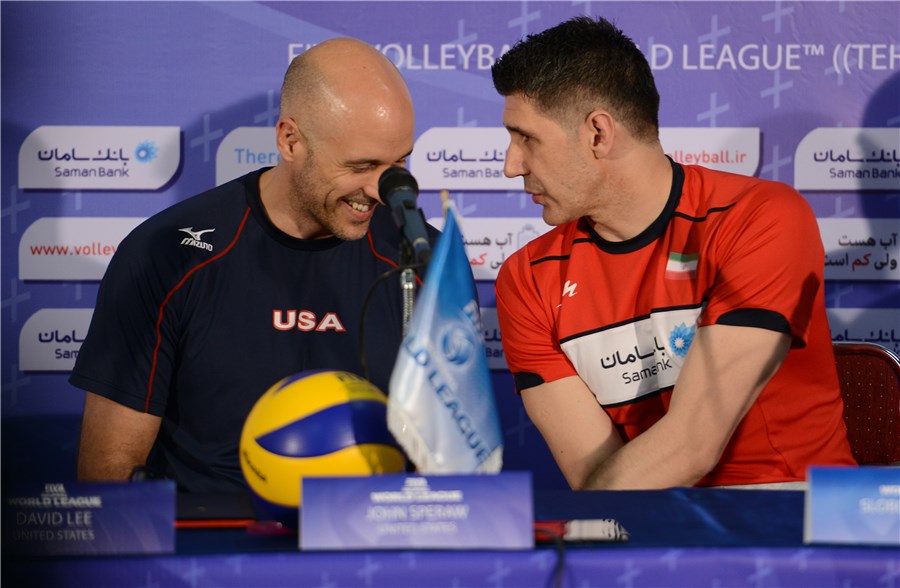
John Speraw, U.S. men’s national volleyball team head coach: “Iranians are wonderful people”

“My first impression was that everyone here has been incredibly hospitable. Everyone has been very nice. They have gone out of their way to make sure that we had really nice experience here. I think we have enjoyed it tremendously.”

“We had the opportunity to get out into the city one day. We went to the [Milad Tower] and learning a little more about Tehran, and I think that is good for us. We went to a nice lunch on the [Darakeh] hills. I think we wanted to do those things because I think we are all aware that the portrait of the relationship between Iran and the United States is inaccurate in the media. Probably on both sides, my guess.”

“What I know and have known from spending time with Iran and the United States both last year and this year is that the relationship between the people is not reflective of the relationship between our governments and that the Iranian people are wonderful people and have treated us kindly.”

“I think we have shown the same because America is a wonderful country with wonderful people too. Yes, it a great place, so the message we would bring back is this: it was a great trip and we look forward to coming here again. And I think we have much better understanding of what the environment is both inside the arena and outside.”

Iran coach Slobodan Kovac added: “I want to say something about this. We want to return this hospitality (Mr. Speraw said about); last year we stayed in the USA for more than fifteen days. Everything was perfect. They gave us the maximum things to prepare for world championship.”

Read all posts on this blog related to USA-Iran here: https://theotheriran.com/category/usa/

IRAN - USA -- USA & Iran national coaches at the press conference before the match

Speraw and Kovac in press conference before the match on June 19 (Photo credit: FIVB)

About John Speraw and Slobodan Kovač
John Speraw is an American volleyball coach. He is the head coach of the United States men’s volleyball team and UCLA. He was the former coach of UC Irvine volleyball program where he led the team to three national titles in six years. Speraw graduated from UCLA in 1995 with a B.S. degree in micro-biology and molecular genetics.

Slobodan Kovač is a Serbian former volleyball player and current coach. He is coaching Iran men’s national volleyball team until the 2016 Olympic Games in Rio de Janeiro. Previously competing for Yugoslavia, he won a bronze medal at the 1996 Olympics in Atlanta and won his first gold medal with the Yugoslav team at Sydney at the 2000 Summer Olympics.

Source: FIVB | World League 2015 | News, Wikipedia | John Speraw, Wikipedia | Slobodan Kovač, TPA | US national volleyball team visited Milad Tower, Tasnim News | Photos

Iran’s Kerman Province: Rageh Canyon (Photos)

The Rageh canyon is one of the unique and beautiful natural places, in the desert of Rafsanjan County. It was created by the floods and soil erosion of the Givdary River over twenty thousand years. This 20km long, 70m deep and 180m wide valley, with sharp conical peaks, blades and strip wise walls, has interesting and various spatial shapes, narrow and wide passages alongside the river and valley walls.

The nearest city to Rageh Canyon is Rafsanjan, the capital of Rafsanjan County. It is Iran’s center of pistachio cultivation and also a major center of carpet production even though the rugs are sold as Kermani rugs rather than Rafsanjani ones. Another large employer is the nearby Sarcheshmeh copper mines.

Sources: Wikipedia | Rafsanjan (in English), other sources in Persian: ISNA | Photos, Mehr News Agency | Photos, Mehr News Agency | News, rageh.ir.

Iran’s Khuzestan Province: Ahvaz – About bridges and a rainbow colored waterfall (Photos)

Ahvaz is a city in the south of Iran with a population of 1,400,000 (2006). Ahvaz is built on the banks of the Karun River and is situated in the middle of Khuzestan Province. The city has an average elevation of 20 meters above sea level.

The Karun is Iran’s most effluent and only navigable river. It is 720 km long. It rises in the Zard Kuh mountains of the Bakhtiari district in the Zagros Range, receiving many tributaries, such as the Dez and the Kuhrang, before passing through the capital of the Khuzestan Province of Iran, the city of Ahvaz.

The river divides the city in two; east and west and with its many bridges connecting both sides of the city over the Karun, Ahvaz is called “The city of Bridges”:
1st) Black Bridge or Railway Bridge (Pol-e Siah): Built in 1919. It is 1050m long and 6.00m wide.
2nd) White Bridge (Pol-e Sefid): Built in 1936, it was the first suspended bridge of Iran.
3rd) Third Bridge: Finished in 1970, it is 496m long and 14.50m wide.
4th) Fourth Bridge or Salman Farsi Bridge: Built in 1975. It is 576m long and 16,70m wide.
5th) Fifth Bridge: It was inaugurated in 1996. It is 480m long and 30,70m wide.
6th) Sixth Bridge or Steel Bridge (Sana-ye Foolad): The bridge was completed in 2007. Its lenght is 740m and its width 30.40.
7th) Seventh Bridge: Finished in 1998. There is an artificial waterfall on this bridge to enjoy on weekends and special days.
8th) Eighth Bridge or Cable Bridge: Inaugurated in 2012 as the biggest cable bridge in the Middle East, it is 1,014m long and 22m wide.

Alongside the seventh bridge, on weekends and special days, there is a beautiful artificial waterfall. It combines water eruption and light games on both sides of the bridge. The waterfall is from one side 150m long, from the other side 200m and has a a height of 35 meters.

Sources: ISNA | Khuzestan | Photos, ISNA | Photos, Mehr News Agency | Photos 1, Mehr News Agency | Photos 2seeiran.ir, asriran.com | News, ISNA | Khuzestan | News, Wikipedia | Ahvaz, Ahvaz Municipality | Tourismus | Bridges, Wikipedia | Karun, untoldiran.com | Karun Rainbow Waterfall, Payvand News of Iran, ISNA | Khouzestan | Ahvaz in black and white bridges

Iranian painter Abolghassem Saidi opens first solo exhibition in Iran

The newly-founded Tehran gallery “Shahrivar” is currently hosting an exhibition of 30 artworks by Abolghassem Saidi. The exhibition showcases 26 paintings which belong to his personal collection and the other four which are owned by private collectors.

On view since June 12, Abolghassem Saidi’s first solo exhibition in Iran, will run for one month at “Shahrivar” gallery: No. 9, Hormoz impasse, North Khazar Street, Elahieh, Tehran.

About Abolghassem Saidi
Abolghassem Saidi (August 15th, 1926 in Arak, Iran) graduated from the School of Fine Arts, Paris (École des Beaux-Arts de Paris) in 1956, where he still lives and works. He exhibited at the Salon de la jeune peinture (1954-66). Then, he worked in Iran for the Festival of Shiraz and after travelled to the United States. Awarded with the prize of the Salon of the Jeune Peinture (1959), the prize of the Biennale of Tehran (1960, 1986) and the prize of Monte-Carlo (1993). The largest concentration of his works can now be seen in the Contemporary Museum of London, at University of Shiraz, at the airport of Tehran and at the Saderat Bank of London.

Related pages: Facebook | Abolghassem Saidi

Sources: Tavoos Online | News, honaronline.ir | Featured, Gros & Delettrez