Tag Archives: Photos

Mixed exhibition of Iranian and Western art at the Tehran Museum of Contemporary Art (Photos)

The exhibition, entitled ‘Towards the Ineffable: Farideh Lashai’, presents a collection of 130 works including paintings, glassworks, drawings and video arts. It will be on display through February 26, 2016 at Tehran Museum of Contemporary Art.

Italian Germano Celant, Artistic Director of the Prada Foundation in Milan, co-curated the exhibition with the Iranian curator, architect, and filmmaker Faryar Javaherian. It marks the first time a non-Iranian curator of such stature has curated an exhibit at the museum since the revolution.

Javaherian and Celant have created an anthology of works by the Iranian modernist Farideh Lashai (1944-2013), who became one of Iran’s leading artists of the era. The Western works are being presented as context for Lashai’s retrospective. The intercultural exchange was achieved by hanging works by Western artists on gray walls, often across the room from Lashai’s works, which are hung on white walls.

Forty two works by Jackson Pollock, Alberto Giacometti, Mark Rothko, Andy Warhol, Roy Lichtenstein, Francis Bacon, Cy Twombly, Claude Monet, Willem de Kooning, René Magritte, and many others will surround Lashai’s art. Iranian artists are also represented, as works by Manoucher Yektai, Sohrab Sepehri, and Nasser Assar are included.

“I want to force the audience to see the context,” Celant said. “There’s a self-portrait by Farideh, and there’s a self-portrait by Giacometti. We’re trying to say, O.K., the identity of the Iranian art is related to another identity in the world. That’s a dialogue that needs to be established, and that’s my function as a non-Iranian curator.”

In addition, Catherine de Zegher, director of the Museum of Fine Arts Gent in Belgium, and Venetia Porter, the Assistant Keeper in the Department of the Middle East at the British Museum participated at a one-day seminar held at the museum. Art critics and historians Media Farzin, Marjan Tajeddini and the curators also discussed and reviewed the exhibition at the seminar.

In October, the museum signed a tentative agreement with the German government to send 60 artworks from Tehran – 30 Western and 30 Iranian – to Berlin for a three-month show next fall, which would mark the museum’s first exhibition overseas.

About Farideh Lashai
https://upload.wikimedia.org/wikipedia/en/a/a7/Farideh_Lashai.jpgBorn 1944 in Rasht, Farideh Lashai was among the most successful Iranian artists, writers and translators, best known for her abstract paintings. She studied art at the Academy of Decorative Arts in Vienna, Austria, and held over 100 solo and group exhibitions in Iran and many other countries, such as Italy, Germany, the US, Switzerland, Britain and France. After a long battle with cancer she passed away in the Iranian capital, Tehran, in 2013. She was 68 years old.

Lashai particularly won fame for her lyrical abstract paintings and multimedia installations that combined video projections and canvas works. Her works were mostly inspired by her personal experiences and modern Iranian art forms.

Sources: Tehran Times, Vanity Fair, IRNA, Tavoos Online, Honar Online 1, Honar Online 2, Honar Online 3, ISNA, The Telegraph

Photo Series: Autumn in Iran – Asalem to Khalkhal road

Khalkhal is the capital of Khalkhal County, in Ardabil Province, Iran. Its population is 38.521 (2006). Asalem is a city in Talesh County, Gilan Province, Iran. Its population is 3.347 (2006).

The road from Asalem to Khalkhal is known for its beautiful landscapes.

Sources: Wikipedia | Asalem, Wikipedia | Khalkhal, Tasnim News Agency, Mehr News, JameJam

Photo series: Autumn in Iran – Snow in Tabriz

Tabriz, located at an elevation of 1,350 meters above sea level, is the capital of East Azerbaijan Province and the most populated city North-Western Iran. With cold winters and temperate summers, the city is considered a summer resort.

Photo gallery: Tabriz covered in early autumn snow

Related content: The other Iran | Tabriz, The other Iran | East Azerbaijan Province

Sources: JameJam Online, Tasnim News Agency, Mehr News 1, Mehr News 2, Wikipedia | Tabriz

Iran wins gold at 2015 Youth & Cadets Chess World Championship

Almost 1,600 chess players from 92 countries took part at the FIDE World Youth & Cadets Championship 2015 in Greece. India dominated the event, winning 11 medals, among them 5 gold. Iran and Bulgaria complete the top three with one gold and one bronze medal each. Azerbaijan, Germany, Greece, Uzbekistan and Vietnam have one gold medal each. Russia and USA took 4 medals each, but none of them was gold.

Iranian chess player Mosadeghpour Masoud cruised to the victory with 9.5 points from 11 games in the Open U18 leaving the nearest followers a full point behind. He has achieved the IM title norm after the completion of the event, showing that the rise of Iranian chess is real, notably in the males now, since the women had already made their mark more than once. After Iranian Pouya Idani’s surprise win in the 2013 WCCY Open U18, Masoud is now the nation’s second gold just two years later. (Final ranking of the Iranian players below).

Photo gallery: Iranians at WYCC 2015

Iranian players: Final ranking at WYCC 2015 after 11 rounds
1st Mosadeghpour Masoud (IM) – Open U18 – (Rank 1 out of 116 participants)
3rd Gholami Aryan (FM) – Open U14 – (Rank 3 out of 150 participants)
6th Asadi Motahare (WFM) – Girls U12 – (Rank 6 out of 120 participants)
6th Firouzja Alireza – Open U12 – (Rank 6 out of 150 participants)
8th Lorparizangeneh Shahin (IM) – Open U16 – (Rank 8 out of 150 participants)
9th Derakhshani Dorsa (WIM) – Girls U18 – (Rank 9 out of 80 participants)
11th Alinasab Mobina (WFM) – Girls U16 – (Rank 11 out of 95 participants)
12th Maghsoodloo Parham – Open U16 – (Rank 12 out of 150 participants)
12th Tabatabaei M.Amin (IM) – Open U14 – (Rank 12 out of 150 participants)
13th Khodashenas Mersad – Open U18 – (Rank 13 out of 116 participants)
18th Gholami Orimi Anahita (WIM) – Girls U18 – (Rank 18 out of 80 participants)
21st Baradaran Tamadon Arian – Open U10 – (Rank 21 out of 150 participants)
22nd Mahdian Anousha – Girls U12 – (Rank 22 out of 120 participants)
25th Daneshvar Bardiya – Open U10 – (Rank 25 out of 150 participants)
29th Kalantari Sedigheh (WFM) – Girls U14 – (Rank 29 out of 125 participants)
42nd Tahbaz Arash – Open U16 – (Rank 42 out of 150 participants)
59th Mahjoob Zardast Artemis – Girls U8 – (Rank 59 out of 87 participants)
63rd Hashemi Seyede Fatemeh – Girls U14 – (Rank 63 out of 125 participants)

Sources: FIDE WYCC 2015, chess-results.com, chessbase.com, IRNA

Photo gallery: Ski season started at Tochal Ski Resort in Tehran, Iran

Tochal ski resort officially started this year’s autumn-winter season.

Tochal Complex, located on the northernmost part of Tehran, has been open to the public since 1978. The gondola lift, used for accessing ski resorts and other recreational centres on the mountain, has a length of 7500m. It starts at the Velenjak valley at an altitude of 1900m and ends at Station 7, at an altitude of 3740m, near the main ridge of Mount Tochal. The main ski slopes are located in Station 7 and due to its height they are covered with snow for more than 8 months of the year.

Tochal Mountain offers an unexpected array of outdoors activities –from hiking to skiing and is seen as one of the perfect places to escape the commotion of the city that lies below it; Tehran. There are various mountaineering routes across the rugged landscape, which cater to different levels of ability (and enthusiasm).

Sources: IRNA, ISNA, BORNA, Mehr News, Fars News, Young Journalists Club, Tehran Times (PDF), Wikipedia | Tochal Complex

Asia Pacific Screen Awards (APSA) honors Iranian actress Fatemeh Motamed-Arya

The 2015 edition of Asia Pacific Screen Awards (APSA) has awarded Iranian actress Fatemeh Motamed-Arya during a ceremony held in Brisbane, Australia. She received the event’s Special Mention for the Best Performance by an Actress for her portrayal of a nurse in ‘Avalanche,’ directed by Iranian filmmaker Morteza Farshbaf.

Kirin Kiki won the award for Best Performance by an Actress for her role in “An” from Japan while the award for Best Performance by an Actor went to Jung Jaeyoung for his role in “Right Now, Wrong Then” from South Korea.

Apichatpong Weerasethakul from Thailand received the best film award for “Cemetery of Splendor” and Alexey German Jr. from Russia won the best director award for “Under Electric Clouds”. The award for best cinematographer went to Mark Lee Ping-bing from Taiwan for his collaboration in director Hou Hsiaohsien’s “The Assassin”.

The 2015 APSA International Jury was presided by South Korean filmmaker Kim Dong-Ho. He was joined by Mostofa Sarwar Farooki (Bangladesh), Zhang Xianmin (China), U-Wei Bin HajiSaari (Malaysia), Alexei Popogrebsky (Russia) and Negar Javaherian (Iran). Javaherian won the UNESCO Award at the APSA in 2013 for her performance in Maziar Miri’s “Painting Pool”.

Established in 2007, APSA is an international cultural initiative to honor and promote the films, actors, directors, and cultures of the Asia-Pacific region, under the auspices of UNESCO and FIAPF – International Federation of Film Producers Associations.

About Fatemeh Motamed-Arya
Born in 1961, Fatemeh Motamed-Aria is one of the most significant Iranian actresses, who has won numerous national and international awards, including the Best Actress Prize of the 2011 Montreal Film Festival in Canada and the Prix de Henri-Langlois award of the 2012 Vincennes International Festival in France. ‘Once Forever’ (1993), ‘Blue-Veiled’ (1995), ‘Gilaneh’ (2004) and ‘Here Without Me’ (2011) are among the films she has performed in so far.

Sources: Tehran Times, Payvandasiapacificscreenacademy.com, Instagram | apscreenawards, taghato.net

Photo Series: Autumn in Iran – A rainy day in Tehran

Iran’s capital, Tehran, with a population of around 9 million in the city and 16 million in the wider metropolitan area, is the largest city and urban area of Iran. The semi-arid climate of the city is largely defined by its geographic location, with the towering Alborz Mountains to its north and the central desert to the south. The weather is mild in spring and autumn, hot and dry in summer, and cold in winter. Because the city is large with significant differences in elevation among various districts, the weather is often cooler in the hilly north than in the flat southern part of Tehran.

Photo gallery: A rainy autumn day in Tehran’s Mellat Park

Source: ISNA, Fars News, IRNA, Tasnim News, Wikipedia | Tehran

‘Curriculum Mortis’ by Iranian artist Barbad Golshiri in Tehran

Aaran Gallery hosted one of Barbad Golshiri’s versions of ‘Curriculum Mortis’, that portrays concepts related to death and graveyards.

“I am a taphographer [1], I make grave markers, for the past fifteen years I take pictures of graves and burials and I make frottages on epitaphs of those eliminated only to distribute them. I have also made cenotaphs [2]. Memorials too, for the dead and the living. All these frame Curriculum Mortis. It is true to say that Curriculum Mortis  is not a series. I cannot make series.” […]
– Barbad Golshiri on the catalogue of the exhibition

About Barbad Golshiri
Barbad Golshiri is an Iranian contemporary artist, born in 1982 in Tehran, Iran. His father was Houshang Golshiri, a famous Iranian writer. He studied painting at The School of Art and Architecture, Azad University, Tehran. He has worked both as a media artist and a critic. He works with video, digital media, installation, photography, the internet, graphic novels and Lettrism. He won the third prize of the 6th Tehran Contemporary Painting Biennial, Tehran Museum of Contemporary Art. (More information: Wikipedia | Barbad Golshiri)

To read the review of the New York Times (Sep 19th, 2013) of one of Barbad Golshiri’s versions of ‘Curriculum Mortis’ click here.

Comments
[1] Tapographer: A tapographer is a copier of tombstones.
[2] Cenotaph: A cenotaph is an “empty tomb” or a monument erected in honour of a person or group of people whose remains are elsewhere. It can also be the initial tomb for a person who has since been reinterred elsewhere.

Sources: Honar Online, Instagram @aarangallerytehran, tandismag.com, Tehran Times, Aaran Gallery, Wikipedia | Barbad Golshiri, Proceedings of the New Jersey Historical Society, Wikipedia | Cenotaph

Photo Series: Autumn in Iran – Snowfall in Masal, Gilan

Masal, a county in the western part of Gilan Province, encompases the upper valley of the Shanderman River and the whole catchment basin of the Masal River (also called Ḵālekāi) until its arrival into the plain. The local population, 48,000 inhabitants in 2006, speaks Talysh, Gilaki and Persian. Masal and Bazar Jomeh are the only cities in the county.

The main agricultural production is rice, cultivated in the lower valleys and the edge of the plain, in small holdings. Of the three usual complementary resources of the plain (namely sericulture, tobacco, and tea), sericulture is the only one to have had a significant but highly variable role. The impact on this area of the crisis of silk production in the late 2000’s is uncertain. The other main activity and source of income is stock-breeding.

Unlike the valleys adjacent to the north or to the south, this area has no temporary bazaars on summer pastures because of the strong attraction and relative proximity of the Friday bazaar in Shanderman and Saturday bazaar in Masal. In both cases, this commercial activity has launched an urbanization process by gradually gathering services and resident population around the commercial core.

Sources: JameJamOnline, Instagram, Wikipedia | Masal County, Enciclopædia Iranica | Masal

Iran wins bronze at the Beach Soccer Intercontinental Cup

Russia won the final of the Beach Soccer International Cup after defeating Tahiti 5-2. Iran’s victory over Egypt brought Iran the tournament’s third place. Tahiti had a very succesful run, reaching the final after qualifying for the first time to the knock-out stage of the Beach Soccer Intercontinental Cup.

The 2(3)-2(2) penalties win for Iran over Egypt was a thrilling match. The tension was palpable as the third period began with a 1-1 score and no clear advantage for either team, until an early goal from M. Abdelnabi gave Egypt the lead. All that changed when Iran tyed the game at 2 with one minute left and after a scoreless three-minute extra-time period, the teams headed into a penalty shoot-out.

Eight teams participated at this fifth edition of the Samsung Beach Soccer Intercontinental Cup, which took place at Jumeirah Beach in Dubai, United Arab Emirates from November 3rd to 7th. The invitation-only tournament has been held annually starting in 2011. The competition is similar to the FIFA Confederations Cup.

IRAN-EGYPT – Match stats
Goals: 1-0: M. Samir, min. 7 (2); 1-1: A. Akbari, min. 5 (2); 2-1: M. Abdelnabi, min. 10 (3); 2-2: F. Boulokbashi, min. 1 (3).
Penalties: A. Naderi: Make; M. Samir: Make; M. Morshedi: Make; A. Aboserie: Make; A. Akbari; Make; Hassane: Miss.

Sources: Mehr News Agency, The National, beachsoccer.com, Wikipedia | Beach Soccer Intercontinental Cup, Twitter @BeachSoccer_WW, Twitter @DubaiSC

‘Distant memories’ by Iranian artist Tara Behbahani in Tehran (Photos)

Golestan Gallery hosted ‘Distant memories’, a painting exhibition by Tara Behbahani.

Tara Behbahani (born 1983) has been learning tricks and techniques of sculpturing with her mother, and painting with her father, who himself is one of the most famous contemporary artists, Taha Behbahani, since early childhood. She has been studied Art and Mathematics along side each other and after completing her university studies in Mathematics she started to research the relationship between art and geometry in Eastern Art.

She has participated in several exhibitions in Iran and abroad and has written about Islamic and Eastern Art in various magazines. For the past 12 years she has been teaching painting to youth and children.

Sources: tarabehbahani.com, mopcap.com, Honar Online, Instagram @tarabehbahani, Golestan Gallery

Iran’s women win silver medal at the Asian Canoe Polo Championships in Hong Kong (Photos)

The 16th Asian Canoe Polo Championships have been held in October 2015 in Hong Kong, with over 200 players in four categories (Men, U21 Men, Women, U21 Women) from eleven participating countries (Brunei, China, Indonesia, Iran, Japan, Macau, Malaysia, Singapore, Thailand, Chinese Taipei and Hong Kong).

Iran, Singapore, Chinese Taipei and Japan dominated the finals of the Championships. Each of them respectively won a championship in the end. Iran won a total of four medals (one gold, two silver and one bronze) and the top scorer titles in the U21 men and women categories.

Singapore’s women canoe polo team defeated five-time defending champions Iran 3-1 in the final, winning the title for the first time. Singapore had fallen to Iran at the final hurdle thrice (2005, 2009 and 2013). Iran’s U21 women team cut Singapore’s title hopes winning the final 5-1. Iran men won bronze after future champion Japan defeated them 7-6 in the semifinals. The U21 team lost 2-6 to Chinese Taipei in the final to settle for a silver medal.

Photos of the Iranian team during the championship in Hong Kong

The Asian Canoeing Championships are subdivided into three tournaments: canoe sprint, canoe slalom and canoe polo. Canoe polo is a combination of canoeing and water polo. The canoes that are used are lighter and shorter than a conventional one, for easier manoeuvrability. Two teams of five players attempt to score using a water polo ball in an area slightly smaller than an Olympic-sized pool. The game can be played in a swimming pool or a lake. The 20-minute game is divided into two halves, with a three-minute interval. The players score by sending the ball into a goal, which is suspended 2m above the water’s surface. Besides using the paddles, players can also use their hands to pass the ball, similar to the practice in water polo. Each player has to wear protective gear such as helmet, vest and face guard.

Sources: Wikipedia | Asian Canoeing Championships, The Straits Times, Asian Canoe Confederation, Iran Daily, Fars News, Sportsoho

Photo Series: Autumn in Iran – Along the Zayanderud, Chahar Mahal and Bakhtiari

Zayanderud (literally ‘river that gives life’) is the largest river in the central plateau of Iran. It starts in the Zagros mountain range in western Iran and runs 400km to the east before ending in the Gavkhouni Swamp, a seasonal salt lake, southeast of Isfahan city, in the central part of the country.

The Zayanderud Dam had its floodgates opened on Friday to supply the water required for farmers’ autumnal crop growing. The increase in discharge of the Zayanderud is making the landscape along the river even more enjoyable (see photos below).

Photos: The Zayanderud flowing through Chaharmahal and Bakhtiari on its way to the city of Isfahan

Sources: Tasnim News Agency, PressTV

Iran’s South Khorasan Province: Kolah Farangi, Birjand

The Kolah Farangi Citadel is located in Birjand in South Khorasan Province. It was built during the late Zand and early Qajar era between the years 1848 and 1895. The structure is a unique landmark of Birjand and was constructed by Amir Hassan Khan Sheybani. It consists of the garden, the stable, the bathhouse, the offices, and the reception hall.


The building has a hexagonal base, a white conical top and is six stories high. The main entrance is preceded by a roofed area containing some eye-catching arcs. The interior of the ground floor has a number of different rooms which are connected by hallways. In its center there is a room containing a pool which can be accessed from many different entrances. It is situated approximately a meter lower than the rest of the floor and is octagonal in shape. The pool helps keep optimum ventilation throughout the building.

The Kolah Farangi Citadel is registered as national cultural heritage site number 1880. Today it is used as Southern Khorasan’s governorship offices and storage space.

Sources: Dream of Iran, Historical Iran

Iran wins sixteen medals at the Asian Canoe Sprint Championships in Palembang, Indonesia

The 16th Asian Canoeing Championships, hosted in Palembang, Indonesia from November 4th to November 8th,  were attended by 500 athletes from 21 countries: Cambodia, China, Chinese Taipei, Hong Kong, India, Indonesia, Iran, Iraq, Japan, Kazakhstan, Kyrgyzstan, North Korea, South Korea, Macau, Malaysia, Philippines, Singapore, Tajikistan, Thailand, Uzbekistan, Vietnam. Unfortunately athletes from Nepal and Pakistan were not able to attend the event due to a delay in their visas.

Iran had a very succesfull run winning a total of sixteen medals (five gold, five silver and six bronze). Kazakhstan dominated the tournament, grabbing the most medals.

Results – Senior
Women C1 200m Fatemeh Karamjani (Gold)
Women C1 500m Fatemeh Karamjani (Silver)

Men K4 1000m Ali Aghamirzaei / Babak Darban / Farzin Asadi / Amin Boudaghi (Gold)
Men C1 200m Adel Mojallalimoghadam (Bronze)
Men K1 1000m Farzin Asadi (Bronze)
Men K2 200m Ali Ojaghu / Seyedkia Eskandanihahosseini (Bronze)
Men K2 1000m Ali Aghamirzaei / Amin Boudaghi (Bronze)

Photos: Iranian canoe athletes at national and international canoeing competitions

Results – Junior
Women K1 200m Mina Abdolahi (Gold)
Women K2 500m Ebrahimi / Tahmasabi (Gold)
Women C1 200m Atena Raofi (Bronze)
Women K1 500m Mina Abdolahi (Bronze)

Men C1 1000m Nabi Rezayi (Gold)
Men K1 1000m Alireza Farmande (Silver)
Men K2 1000m Masoud/Sharifi (Silver)

Dragon boat races
Women 200m (Silver)
Women 500m (Silver)

Sources: Wikipedia | 2015 Asian Canoe Sprint Championships, palembantribunnews.com, antarasumsel.com I, antarasumsel.com IIantarasumsel.com III, The Straits Times, Mehr News 1, womencanintl.com, Mehr News 2

Iran wins silver at the 2015 Futsal Grand Prix in Brazil

Brazil defeated Iran 4 to 3 to win the final game of the 2015 Futsal Grand Prix in Uberaba, Brazil.

Iran advanced to the finals after defeating Paraguay 2:0 and after achieving 9 of 9 possible points in Pool B by winning 7:3 against Uruguay, 4:1 against Colombia and 7:0 against Angola.

The host nation is the most successful team in the history of the tournament with nine titles while Spain has won the competition once in 2010. Iran has finished in second place three times and in third place two times out of ten editions.

The Grand Prix de Futsal, first held in 2005, is an international futsal competition of the same kind of the FIFA Futsal World Championship but with invited nations and held annually in Brazil.

Sources: Facebook | CBFS, Mehr News, Wikipedia | 2015 Grand Prix de Futsal

Photo Series: Autumn in Iran – Snowfall in Talesh, Gilan

Talesh is a 200,000 inhabitants county in Gilan Province, Iran. Its capital, Hashtpar (also called Talesh), is situated 140 km north-west of Rasht, on the south-west coast of the Caspian Sea. The region, a mountainous area, outstands with its virgin ant intact nature.

Photos of the first snowfall in Talesh:

The Talysh are one of the oldest inhabitants of the western littoral Caspian Sea and are amongst the native inhabitants of today Iran and neighboring Azerbaijan.

Generally speaking, the land of Talesh has been divided in three regions: Gaskarat, Foumanat and Azerbaijan Taloshian. In Gaskarat, the majority of people speak Taleshi and/or Azeri, Farsi. In Foumanat, most speak Taleshi. Lastly, Talysh from neighboring Azerbaijan are often bilingual and trillingual, consisting of Taleshi, Azeri and Russian speakers. Taleshian people at present are mostly Sunni and Shia Muslims.

Sources: ISNA, Wikipedia | Talesh County

‘Emigrants’ by Iranian artist Shirin Ettehadieh in Tehran (Photos)

Shirin Gallery hosted ‘Emigrants that carry away their memories’, a painting exhibition by Shirin Ettehadieh.

Autumn is the season of reminiscence, this time my paintings are the memory of flowers and the emigrants that carry away the memory of their homeland.
– Shirin Ettehadieh, Autumn 2015

Shirin Ettehadieh studied at École du Louvre in Paris. She has held exhibitions in France, Greece, the Netherlands and Switzerland, as well as numerous solo and group exhibitions in Iran.

Shirin Ettehadieh on Facebook, website

Sources: 360cities.net, Honar Online, Instagram @shiringallerytehran

Street Art in Iran: Mehdi Ghadyanloo (Photos & Video)

Iranian Mehdi Ghadyanloo’s canvas is the skyline. His illusions create windows to other — more magical — worlds. Seeking to combine minimalist architectural spaces with surreal scenes from another universe, he has painted over 100 murals across the Iranian capital, giving unsuspecting drivers good reason to do a double take, as the fantasy blends in with the real.

Like exaggerated dream sequences, his images portray gravity-defying figures and portholes to other dimensions, all from altered perspectives that meld sky and structure.

About Mehdi Ghadyanloo
Mehdi Ghadyanloo is an Iranian painter, born 1980 in Karaj, Iran. He moved to the capital to study at Tehran University’s College of Fine Arts. He graduated with a BA in 2005 and subsequently earned a MA in film studies from Tehran’s Teachers College (Tarbiyat-e Modarres).

Known primarily for his gigantic trempe l’oeil [1] style murals in central Tehran, Ghadyanloo also creates small scale paintings, with surreal and minimalistic themes. Through his works, Ghadyanloo opens a window into the mood of life in Iran today. At the same time, he provides an autobiographical perspective, portraying the landscapes of his youth, his memories of Iran-Iraq war (1980-1988), and his life experience in the Islamic Republic.

In 2015 he visited London for an exhibition of his “indoor” paintings, and painted murals there also, including one in Shoreditch.

A report from CNN about Mehdi Ghadyanloo:

Related articles:
1. The Guardian | Tehran’s answer to Banksy: Mehdi Ghadyanloo hits Britain,
2. Howard Griffin Gallery | Artists | Mehdi Ghadyanloo
3. Urban Outfitters Blog | Artist of the week: Mehdi Ghadyanloo
4. Facelifting Tehran | One Wall at a Time: Interview with Mehdi Ghadyanloo

Comments
[1] trompe-l’oeil: Art technique that uses realistic imagery to create the optical illusion that the depicted objects exist in three dimensions.

Mehdi Ghadyanloo on Facebook, Bēhance, Instagram and Twitter

Sources: CNN, Huffington Post, Howard Griffin Prints, Wikipedia | Mehdi Ghadyanloo, The Guardian, Facebook | Blue Sky Painters, Bēhance, fubiz.net, yourmiddleeast.com, Wikipedia | Trompe-l’oeil

International sculpture symposium in Tehran, Iran (Photos)

The 7th International Sculpture Symposium of Tehran 2015, from September 23rd to October 16th, included a stone workshop, an iron workshop and an exhibition section and was subdivided into a main and a student competition category.

The jury of the symposium, with two Iranian and a foreign member, had selected works by 14 foreign artists from Russia, Belarus, Albania, Portugal, Italy, Serbia, Taiwan, South Korea, Germany, Peru, Bulgaria, Greece and Romania to participate in the event.

Sculptors from South Korea, Taiwan and Peru took home the first prizes. Su-Dong Cho from South Korea and Wu Ming-Sheng from Taiwan shared the first prize in the stone category. The second prize in the stone category was also shared by Mehdi Seifi from Iran and Stefano Grattarola from Italy. In the steel category Peruvian sculptor Pool Guillen won the top prize and Amir Vafai from Iran won the second prize.

Sculptors, experts and artists gathered at Tehran’s Milad Tower to examine the art of sculpting in four panels. During the first part of the conference the artists, including Saeed Rafiee-Fard, Javad Hassanjani and Kianoosh Motaqedi, presented papers. The second part analyzed the works presented at the symposium.

To see pictures of the artists click here: IRNA | Artists at the 7th Sculpture Symposium

To see pictures of the award ceremony click here:
1. Mehr News Agency (photos)
2. Honar Online (photos)

Sources: Iran DailyBorna News, IRNA, Tasnim News 1, Tasnim News 2, Mehr News Agency (MNA) 1, MNA 2, MNA 3Honar Online, Tehran Press Agency (TPA) 1TPA 2, Tavoos Online,

Glassware and Ceramics Museum of Iran in Tehran (Photos)

The Glassware and Ceramics Museum of Iran is situated in a garden with a span of 7000 square meters. The building was constructed as a private residence about 90 years ago upon orders of Ahmad Qavam (Qavam-ol-Saltaneh). It later housed the Egyptian embassy and was converted into a museum in 1976 by three groups of Iranian, Austrian and French architects.

The museum’s main building, a two-storey octagonal construction with suspended pillars and a basement, occupies an area of 1040 square meters. Its architectural style is a combination of the traditional Iranian style and the European architecture of the 19th century.

The collection of glass and clay works that are on display at the museum is among the rare collections in Iran, mainly from Neishabur, Kashan, Rey and Gorgan. It comprises clay pots dating back from the 4th millennium BCE up to the present time as well as glass works from 1st millennium BCE up to the contemporary era. European glass works belonging to the 18th and 19th centuries are also parts of the collection.

Sources: Tehran Press Agency, Glassware and Ceramics Museum of Iran, Iran Chamber Society, Lonely Planet

Winners of the International Theater Festival for Children and Youth 2015 in Hamedan, Iran (Photos)

The winners of the 22nd International Theater Festival for Children and Youth were introduced during the closing ceremony held on Tuesday, October 6th, in Hamedan.

Veteran Iranian director, Marzieh Boroumand, was honored for her lifetime achievements. Boroumand is most famous for her hits “Grandmother’s Home” and “School of Mice”, two popular puppet series from the 1980s.

About fifty theater troupes from nine different countries attended early October to the 22nd International Theater Festival for Children and Youth.

Related article: International Theater Festival for Children and Youth in Hamedan, Iran (Photos)

Sources: Tavoos Online, Mehr News Agency, ISNA, IRNA

Beautiful landscapes on the road from Pounel to Khalkhal (Photos)

Pounel (Poonel or Punel) is a village of 2,300 inhabitants in Rezvanshahr County, Gilan Province, Iran. Khalkhal lies in the eastern part of the historical Azerbaijan plateau and with a population of 38,521 (2006), is the capital of Khalkhal County, in Ardabil Province.

The main ethnic groups living in Khalkhal are Azeris (95%), followed by Talishs and Tats (3%), Kurds (1%) and Persians (1%).

The road from Pounel to Khalkhal has wonderful sights that can be enjoyed by car. If you like hiking, you can visit Ardeh, a village thirty kilometers from Pounel, with beautiful hiking trails.

Sources: IRNA, Instagram, Panoramio | Alireza Jahaveri, Panoramio | Ali Memari, Panoramio | Peyman Azimi, Wikipedia | PunelWkipedia | Khalkhal, Iran Travel Information Forum

International Theater Festival for Children and Youth in Hamedan, Iran (Photos)

Hamedan hosted early October the 22nd edition of the International Theater Festival for Children and Youth. About fifty theater troupes from nine countries, among others Italy, Germany, Finland, Russia and England, attended the festival and competed in different sections (children, youth and international). Besides their performances the troupes also arranged several workshops.

Sources: Tavoos Online, IRNA, ISNA, Mehr News 1, Mehr News 2, Mehr News 3, Honar Online

Opera ‘Kalileh and Demneh’ performed by children in Shiraz, Iran (Photos)

The opera of “Kalileh and Demneh”, arranged and conducted by Mohammad-Ali Fallahi, was performed by children younger than 12 years old at the Hafez Hall in Shiraz.

Kalileh and Demneh is a collection of didactic animal fables, with the jackals Kalileh and Demneh as two of the principal characters. Originally from India (between 500BCE and 100BCE), the fables were translated into many languages, undergoing significant changes in both form and content. In Persian literature Kalileh and Demneh has been known in different versions since the 6th century CE. In Sanskrit literature the story cycle is known as Panchatantra, while it was often called Fables of Bidpai in early modern Europe.

Sources: Mehr News Agency, Enciclopædia Iranica | Kalila wa Demna, Honaronline (in Persian)

‘Gate of Words’ by German artist Philipp Geist is lighting up the Azadi Tower in Tehran, Iran (Photos)

A performance consisting of projections of light titled ‘Gate of Words’ by German artist Philipp Geist is taking place at Tehran’s landmark Azadi Tower until October 5th.

The installation artistically visualizes the topics of freedom, peace, space and time in different languages. During the performance Azadi Tower is to become a three-dimensional light sculpture that can be crossed by visitors.

‘I tried to illustrate words one by one to make the reader pay more attention to them. Sometimes, words are legible and sometimes not. Using this method, I make great attempts to make each and every reader have his/her own interpretation of the subject,’ said the German artist.

Facts about Azadi Tower
– It is one of the most familiar landmarks of Tehran.
– The builduing includes a cultural centre with a library, a museum and several art galleries.
– The entrance of the tower is directly underneath the main vault and leads into the Azadi Museum on the basement floor.
– The main display is occupied by a copy of the Cyrus Cylinder (the original is in the British Museum).
– The monument acts as a grandiose gateway to the Iranian capital, and is surrounded by a large plaza (approx. 50,000 m²).
– Built in 1971 in commemoration of the 2,500th anniversary of the Persian Empire, this “Gateway into Iran” was named the Shahyad Tower, meaning “Kings’ Memorial”, but was dubbed Azadi (Freedom) after 1979. It is 50 meters (164 ft) tall and completely clad in cut marble.

Sources: Mehr News Agency, ISNA, IRNA, Borna News, Instagram @videogeist, Tavoos Online, Wikipedia | Azadi Tower

Winners of Asian Women’s Futsal Championship welcomed in Iran (Photos)

Iran women’s national futsal team were received at the airport in Tehran by their families, fans, Football Federation officials and a number of media representatives after having been crowned inaugural champions of the AFC Women’s Futsal Championship in Malaysia.

Fereshteh Karimi was awarded AFC Women’s Futsal Championship 2015 Most Valuable Player after beating Japan 1-0 in a thrilling final at the Nilai Indoor Stadium. The 26-year-old scored six goals in the campaign but undoubtedly her most important was the one she notched in the final.

Sources: IRNA Photos, AFC | Iran crowned inaugural AFC Futsal Champions, AFC | Fereshteh Karimi attributes MVP accolade to team effort

Youth Music Festival 2015 in Tehran, Iran – Part 2: Winners (Photos)

Close to 250 young musicians participated in this festival which was held in two main sections of classical and traditional Iranian music. The competition was held in three age groups ranging from 10-27 years old.

In the classical section, the highest number of instrumentalists played the piano, violin and guitar, while in the traditional section santur, tar and setar were mostly present. Traditional Persian music was held in eight sub-categories, including seven instrumental and a vocal section.

Related article: Youth Music Festival Practice & Performance (Photos) – Part 1 https://theotheriran.com/2015/09/22/youth-music-festival-2015-in-tehran-iran-part-1-practice-performance-photos/

Sources: tavoosonline.com, MEHR | Photos, nay.ir

12th International Open Chess Tournament “Avicenna Cup” in Hamedan, Iran (Photos)

The 12th Avicenna International Open Chess Tournament was organized by the Hamedan Chess Association and Iranian Chess Federation from September 2-9, 2015, in the Iranian city of Hamedan.

The event was an 11-round Swiss open with time control 90′ + 30″.

GM Oleg Korneev from Spain emerged a sole winner with 9.5/11 points, leaving the runner-up, 2015 Iranian champion GM Ehsan Ghaem Maghami, half a point behind.

The 15-year-old Parham Maghsoodloo clinched the bronze medal on a superior tie-break score, after sharing 3-7th place with 8.5 points. Maghsoodloo has just qualified for the FIDE World Cup 2015.

Top 10:

1 GM Korneev Oleg 2578 ESP 9.5
2 GM Ghaem Maghami Ehsan 2596 IRI 9
3 Maghsoodloo Parham 2447 IRI 8.5
4 FM Mousavi Seyed Khalil 2427 IRI 8.5
5 Mosadeghpour Masoud 2416 IRI 8.5
6 Dalir Alireza 2297 IRI 8.5
7 IM Asgarizadeh Ahmad 2402 IRI 8.5
8 GM Toufighi Homayoon 2400 IRI 8
9 Sedaghati Mehrdad 2238 IRI 8
10 Faghirnavaz Ali 2298 IRI 8

Sources: ISNA | Photos, MEHR| Photos, Tasnim | Photos, Chessdom.com

Youth Music Festival 2015 in Tehran, Iran – Part 1: Practice & Performance (Photos)

Close to 250 young musicians participated in this festival which was held in two main sections of classical and traditional Iranian music. The competition was held in three age groups ranging from 10-27 years old.

In the classical section, the highest number of instrumentalists played the piano, violin and guitar, while in the traditional section santur, tar and setar were mostly present. Traditional Persian music was held in eight sub-categories, including seven instrumental and a vocal section.

Sources: MEHR | Photos, nay.ir, honaronline.ir 1, honaronline.ir 2, Tavoos Online

Iran’s Hamedan Province: ‘Ganjnameh’ – an ancient cuneiform inscription of the Achaemenid Empire (Photos)

Ganj Nameh, literally translated as “treasure epistle”, is an ancient inscription, 5 kilometers southwest of Hamedan, near a natural waterfall, into a rockface on the side of Alvand Mountain, in Hamedan Province, Iran

The inscriptions were carved in granite in two sections. The one on the left was ordered by Darius the Great (521-485 BC) and the one on the right by Xerxes the Great (485-65 BC). Both sections were carved in three ancient languages: Old Persian, Neo-Babylonian and Neo-Elamite. The incscriptions start with praise of the Zoroastrian God (Ahura Mazda) and describe the lineage and deeds of the mentioned kings.

Ganjnameh sits along the ancient Imperial Road, that connected the Achaemenid capital Ecbatana to Babylonia. It was a safe and frequently traveled road and had much visibility during the Achaemeniad period. The inscriptions were studied in detail by the French painter and archaeologist Eugene Flandin during the 19th century. Subsequently Sir Henry Rawlinson, a British explorer, used the inscriptions to decipher the cuneiform characters of the era.

The translation of the text on the right plate, attributed to Xerxes, is: “The Great God Ahuramazda, greatest of all the gods, who created the earth and the sky and the people; who made Xerxes king, and outstanding king as outstanding ruler among innumerable rulers; I the great king Xerxes, king of kings, king of lands with numerous inhabitants, king of this vast kingdom with far-away territories, son of the Achaemenid monarch Darius.”

Later generations who could not read the Cuneiform alphabets of the ancient Persian assumed that they contained the guide to an uncovered treasure; hence they called it Ganjnameh which literally means “treasure book”, but it has also been called Jangnameh, literally “war book”, possibly due to the wrong assumption that the inscriptions described ancient wars of the Achaemenid era.

Two modern contemporary carved tablets have been placed in the site’s parking lot with Persian explanation and its English translation.

Unfortunately, this archeological site is in danger due to the construction of restaurants and entertainment centers in the vicinity of Ganjnameh that have changed the historic atmosphere and endangered the cultural and natural landscape of the area. Adding to these existing problems is the construction of a cable car nearby.

Sources: Historical Iran | Ganjnameh, Wikicommons | Ganj Nameh inscriptions, Mehr News Agency | Photostishineh.com | Ganjnameh, Panoramio | M. Eskandari, Panoramio | Alexandru Velcea, Panoramio | Mauro – Iran 2013, Panoramio | Ehsan Khanjani, Cultural Heritage News Agency (in Persian)

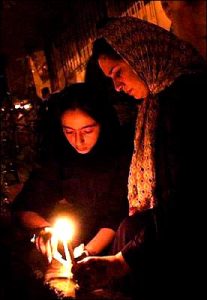
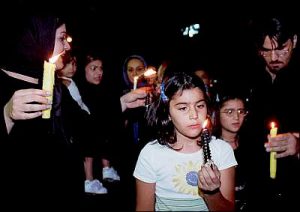
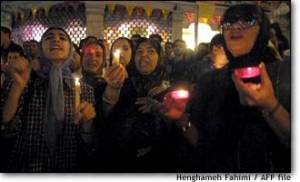
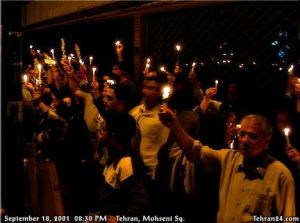
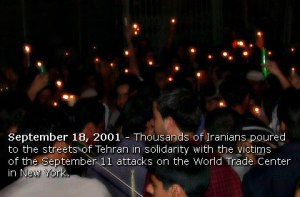
Iran’s exceptional reaction to 9/11 attacks: candlelit vigils for the victims and 60k soccer fans respected a minute’s silence

“Iran’s sympathetic response to the American tragedy has been exceptional for a country under US economic siege for two decades. Only hours after the Sept. 11 attack, President Muhammad Khatami condemned it, as did Supreme Leader Ayatollah Ali Khamenei. Other officials have sent sympathetic messages, including one from the mayor of Tehran to the mayor of New York – the first public official contact between Iran and the US since the 1979 Iranian revolution. […]

More important, 60,000 spectators observed a minute of silence during a soccer match in Iran’s Azadi Stadium, and hundreds of young Iranians held a candle-lit vigil in Tehran.”
Source: The Christian Science Monitor | US and Iran must work together against Taliban by R. K. Ramazani – September 24, 2001

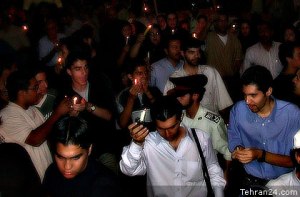
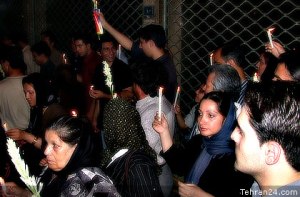
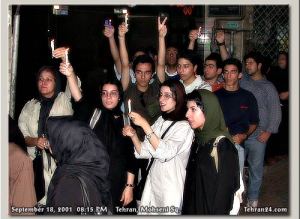
“Iranian women light candles in Tehran’s Mohseni Square in memory of the victims of the terror attacks on the World Trade Center in New York and the Pentagon in Washington DC. [see first picture above] […]

Even the most hardline Islamic clerics, who despise the United States, have been shocked into silence by the attacks. President Mohammad Khatami set the tone for Iran’s reaction with a statement that in Persian rang with deep compassion: ‘On behalf of the Iranian people and the Islamic Republic, I denounce the terrorist measures, which led to the killing of defenseless people, and I express my deep sorrow and sympathy with the American people.’ […]

Iran’s supreme leader Ayatollah Ali Khamenei condemned the attacks which have been blamed on Saudi-born Osama bin Laden. […]

‘Why should Americans deserve this? That’s a sick thought. They are just ordinary people like us,’ said Massoud Moshiri, as he bought cigarettes at a juice stand.” […]
Source: Times.com | Photoessay | Iran mourns America’s dead – September 18, 2001

On Tuesday, Ayatollah Khamenei, in his first public remarks on last week’s attacks, markedly failed to brand the United States an enemy. ‘Islam condemns the massacre of defenseless people, whether Muslim or Christian or others, anywhere and by any means,’ he said, adding pointedly: ‘And so Iran condemns any attack on Afghanistan that may lead to another human tragedy.’ […]

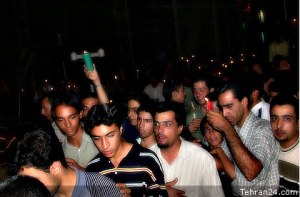
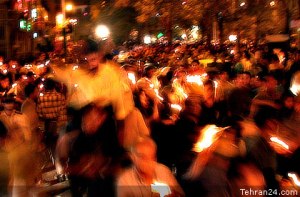
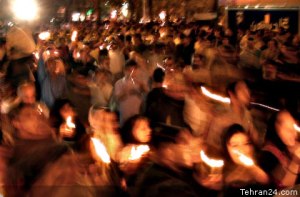
On Tuesday, more than than 3,000 mostly young people held a candlelight vigil in Tehran for the victims of the terror attacks, closely watched by security forces.

One reformist member of Parliament, Ahmad Borghani, even went to the United States interest section at the Swiss Embassy on Tuesday with a wreath of white flowers to sign the memorial book in sympathy with the family’s of the victims. ‘This tragedy has brought the two countries closer,’ he said. ‘But the United States must not expect Iran to cooperate in a military attack — considering our past relations.’
Source: The New York Times | World | A NATION CHALLENGED: TEHRAN; Iran Softens Tone Against the United States by Nazila Fathi – September 21, 2001

“IRAN — President Mohammad Khatami condemned ‘terrorist’ attacks on the United States”
Source: The New York Times | US | Reaction from around the world – September 12, 2001

“Leaders of Middle Eastern nations, including U.S. foes Libya and Iran, have condemned the terror attacks on the U.S. […] Mohammad Khatami, the Iranian president, said he felt ‘deep regret and sympathy with the victims.’ ”
Source: CNN.com | World | Attacks draw mixed response in Mideast – September 12, 2001

“Iranian President Mohammad Khatami, a moderate who is struggling for power against the country’s hard-line Islamic leaders, expressed ‘deep regret and sympathy with the victims’ and said ‘it is an international duty to try to undermine terrorism.’ ”
Source: FoxNews.com – September 12, 2001

“And in Iran, Tehran’s main football stadium observed an unprecedented minute’s silence in sympathy with the victims. Iran’s Ayatollah Imami Kashani spoke of a catastrophic act of terrorism which could only be condemned by all Muslims, adding the whole world should mobilise against terrorism.”
Source: BBC News | World | Americas | Islamic world deplores US losses – September 14, 2001

“Even in Tehran, where anti-American chants are all too common, thousands of people attending a World Cup qualifying match between Bahrain and Iran observed a moment of silence.”
Source: The New York Times | US | AFTER THE ATTACKS: THE VIGILS; Surrounded by Grief, People Around the World Pause and Turn to Prayer by Dan Barry – September 15, 2001

“In Iran, antipathy toward the United States was set aside as 60,000 spectators and players observed a minute of silence at the Tehran soccer stadium before a World Cup qualifying match.”
Source: Spartanburg Herald-Journal | REACTION ABROAD | World grieves along with America by Audrey Woods from Associated Press – September 15, 2001

“Iran’s Supreme Leader, Ayatollah Ali Khamenei, has strongly condemned the suicide terrorist attacks in New York and Washington. ‘Mass killings of human beings are catastrophic acts which are condemned’ he said ‘wherever they may happen and whoever the perpetrators and the victims may be’. ”
Source: BBC News | World | Middle East | Iran condemns attacks on US – September 17, 2001

“Last week, Ayatollah Ali Khamenei of Iran, one of the most conservative and anti-American Muslim clerical leaders, called the fight against terrorism a ‘holy war.’ He joins a host of learned Muslims who have loudly condemned terrorism as forbidden in Islamic law in the wake of the attacks on Sept. 11.”
Source: The New York Times | Opinion | Islam and the opposition to terrorism by Roy Mottahedeh – September 30, 2001

“After news of the Sept. 11 terrorist attacks spread to Tehran, hundreds of Iranians, students, merchants and housewives joined in a candlelight vigil in a downtown square. Many were crying. Three weeks later, I am still approached by ordinary Iranians, in restaurants, Internet cafes and on the street, telling me how sorry they are, and how worried they are about the ‘American war’ that is about to begin, just next door.”
Source: NBC News | Inside Iran, a nation conflicted by Jim Maceda – October 7, 2001

“On the evening of September 11, 2001, about two hundred young people gathered in Madar Square, on the north side of Tehran, in a spontaneous candlelight vigil to express sympathy and support for the United States. A second vigil, the next night, was attacked by the basij, a volunteer force of religious vigilantes, and then dispersed by the police. […]

The statement that Mohammad Khatami, Iran’s popularly elected President, made was extraordinary — extraordinary to American ears, at least. ‘My deep sympathy goes out to the American nation, particularly those who have suffered from the attacks and also the families of the victims,’ he said. ‘Terrorism is doomed, and the international community should stem it and take effective measures in a bid to eradicate it.’ ”
Source: The New Yorker | Letter from Tehran | Shadow Land by Joe Klein – February 18, 2002

“Iranian Students are calling for pro-american demonstrations, marking 9/11
A Public Call For Rememberance of the 9/11 Tragedy […]
Now, with the first anniversary of 9/11 tragedy upon us, as SMCCDI expresses its sympathy to the families of the victims and survivors of that ungodly event, and the honorable nation of America; it invites all free spirited Iranians to honor the memory of the victims of that day by gathering and lighting a candle in front of the main entrance of the Tehran university and major public squares in Tehran, and the main squares in other cities and townships, from 6:00 PM till 9:00 PM, on Wednesday 11 September.”
Source: daneshjoo.org | Post 1873 by SMCCDI Political Committee – September 10, 2002

“Finally, I’ve found a pro-American country. Everywhere I’ve gone in Iran, with one exception, people have been exceptionally friendly and fulsome in their praise for the United States […]. Iran is also the only Muslim country I know where citizens responded to the 9/11 attacks with a spontaneous candlelight vigil as a show of sympathy. ”
Source: The New York Times | Opinion | OP-ED Columnist: Those Friendly Iranians by Nicholas D. Kristof – May 5, 2004

“Ordinary Iranians have long had a softer stance toward the West than their leaders; after the Sept. 11 attacks, Iranians held a spontaneous candlelight vigil in Tehran.”
Source: Chicago Tribune | News | Contenders for Iranian presidency talk up U.S. by Evans Osnos – June 12, 2005

“In Iran, vast crowds turned out on the streets and held candlelit vigils for the victims. Sixty-thousand spectators respected a minute’s silence at Tehran’s football stadium.”
Source: BBC News | Middle East | Iran-US: Gulf of misunderstanding by Gordon Corera – September 25, 2006

“Mourners held a spontaneous candlelight vigil as thousands of people took to the streets of north Tehran chanting, ‘Death to terrorists.’ Iranian soccer fans observed a minute of silence before a match with Bahrain. Even Supreme Leader Ayatollah Ali Khamenei condemned the attacks: ‘Mass killing is wrong, whether it’s in Hiroshima, Bosnia, New York, or Washington.’ During Friday prayers at Qom, Ayatollah Ibrahim Amini said that the Iranian people grieved with the relatives of those killed, and the traditional slogan ‘Death to America’ was absent from the crowds’ mantras.
Source: Command Posts | Focus on: 9/11, Iran | After 9/11: The United States and Iran by David Crist – September 11, 2012

“Iranians mourn 9/11 victims”
Sources: shabhaft.blogfa.com | Post 134 and LiveLeak.com | Forgotten fact: night of 9/11, Iran – Spontaneous candlelight vigil to express sympathy and support for the American people

Other must read Iran-USA news: The other Iran | Tag | USA

” 2001/09/11, thousands and thousands Iranians went instantly in the streets with candles in homage to the victims ”
http://news.blogs.cnn.com/category/terrorism/september-11/” iranians mourn 9/11 victims ”
http://shabhaft.blogfa.com/post-134.aspx” Iranian Students are calling for pro-american demonstrations, marking 9/11 ”
http://daneshjoo.org/article/publish/printer_1873.shtml
Read more at http://www.liveleak.com/view?i=44b_1359356589&comments=1#DDqQZ5dOfJ70MPYf.99
” 2001/09/11, thousands and thousands Iranians went instantly in the streets with candles in homage to the victims ”
http://news.blogs.cnn.com/category/terrorism/september-11/” iranians mourn 9/11 victims ”
http://shabhaft.blogfa.com/post-134.aspx” Iranian Students are calling for pro-american demonstrations, marking 9/11 ”
http://daneshjoo.org/article/publish/printer_1873.shtml
Read more at http://www.liveleak.com/view?i=44b_1359356589&comments=1#DDqQZ5dOfJ70MPYf.99In Iran, vast crowds turned out on the streets and held candlelit vigils for the victims. Sixty-thousand spectators respected a minute’s silence at Tehran’s football stadium. http://news.bbc.co.uk/2/hi/middle_east/5377914.stm

Zohreh Abdollah-Khani: Iranian ice climber (Photos)

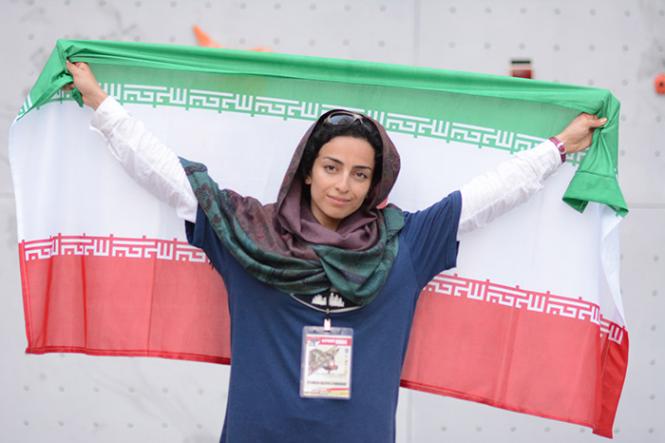
Abdollah Khani, Zohreh - Iranian ice climber - First Iranian female to win an international ice climbing medal 0Zohreh Abdollah Khani, born on September 30th, 1984 in Karaj, Iran. She is currently Iran’s ice climbing champion and Asia’s bronze medal holder. She became the first female ice climber to win a medal for Iran at an international venue, when she finished third in Women Speed at the 2014 UIAA Ice Climbing Asian Championship in Cheongsong, South Korea.

The photo gallery was taken during Abdollah Khani’s training by reporters of Borna News.

Below a video of Zohreh Abdollah Khani

Other posts about great Iranian women: click here

Sources: Borna News | Photos, everest51.blogspot.de, Ice Climbing World Cup | Women Speed Asia 2014, ISNA-Alborz | News

Iran’s youth and junior national climbing team training in Hamedan (Photos)

Twenty seven athletes from Iran’s youth and junior national climbing team participated end of July at a four-day training camp in Hamedan to improve their speed, leed and bouldering skills.

Sources: Iran Mountaneering and Sport Climbing Federation | News, Borna News | Photos, IRNA | Photos

Football World Stars beat Iranian Stars in Tehran Charity Match to raise money for MS patients (Photos)

The World Stars team included Michel Salgado (captain), Luis Figo, Roberto Carlos, Fabio Cannavaro, Guti, Fernando Hierro, Fernando Couto, Vitor Baia, Bodo Illgner, Clarence Seedorf, Patrick Kluivert, Steve McManaman, Fernando Morientes, Marcel Desailly, Gaizka Mendieta, Edgar Davids, Jari Litmanen, Christian Karembeu, Boudewijn Zenden and Santiago Solari. Iran’s All-Star team featured 1998 and 2006 Iran World Cup players as well as Iranian celebrities.

The World Stars team takes the field once a month in a country to raise funds for people who are suffering from a disease or disaster. Support for Ebola patients in Africa was one of the latest fundraisers of this team. The match was held to raise money for MS patients.

The game
The constellation of world-renowned former soccer giants, including Vitor Baia, Luis Figo, Marcel Desailly, Pedro Miguel Carreiro Resendes, known as Pauleta, as well as Fabio Cannavaro, edged the Iranian side 3-0 in a fixture staged at Azadi stadium in western Iran.

On the 24th minute, the world stars were awarded a free kick, which Brazilian footballer Roberto Carlos, adroitly landed just inside the Iranians’ net. In the 31st minute, Figo cracked a terrific shot into the bottom corner of the net to put the world’s all-star team 2-0 ahead.

Shortly afterwards, Iran’s Alireza Mansourian, who is currently manager of Naft Tehran F.C. in Iran Pro League, delivered a pass to Farhad Majidi, who shot. The goalkeeper for world stars’ team, Vitor Baia, parried the shot outside the penalty area, and the referee, Afshariya, flashed the red card. However, he altered his decision due to the nature of the match and showed the Portuguese retired footballer the yellow card.​

Pauleta seized a golden opportunity one minute before the breather and scored the third goal for the world retired soccer giants. The match lost its momentum after the break, and both squads did not threaten each others’ posts.

Sources: Payvand News 1, Payvand News 2, Tasnim News Agency, IRNA, Borna News

Iran wins 3rd place in FIVB U19 Volleyball World Championship 2015 in Argentina

An incredible tournament-high production of 40 points from Iranian star Rasoul Aghchehli ejected the Asians to a remarkable bronze medal as they won over previous champions Russia 3-1 (25-17, 26-28, 25-16, 25-23).

Iranian captain worked at their maximum and he completed 36 spikes and 4 blocks, to break all previous records. Rasoul was escorted by Mirbabak Mousavigargari and Aliasghar Mojarad, with 13 and 12 points respectively. On top of that, Rasoul won a terrific battle of opposites over powerful Russian Dmitry Yakovlev, who led his side with 26 tallies. Yakovlev had in middle-blocker Aleksandr Melnikov his best supporter with 13 points, but it wasn’t enough to stop the Iranian machinery.


Iran finished second behind Poland on the group stage, winning against Germany on the round of 16 and although they were only a few inches away from elimination, Iran resurged from ashes and achieved a spectacular return to rule out Italy 3:2 (17:25, 22:25, 25:20, 25:20, 15:11) and move to semifinals, where they lost against champion Poland 3:1.

Iran improved his previous run with the step onto the podium, as they were left out on the very verge of it on Mexico 2013, finishing fourth. Russia fell out of the top, as the gold medal will now change hands.

Iran U19 national volleyball team
Iran’s youth team have won seven gold medals and a silver medal – the best record in this age group in the Asian region. Last year, the team earned the qualification ticket to the FIVB Volleyball Boys’ U19 World Championship in Argentina after an unbeaten run in the continental championship. The result is the product of a long-term project of Iran to serve as a farm of talents for the senior men’s team. In the World Championship, Iranian youth have been a consistent force in the final, finishing with a gold medal in 2007, two silver medals in 2001 and 2009, a bronze medal in 2003, and a fourth place finish in the last edition.

Source: 2015 U19 FIVB Men Volleyball Championship | News, FIVB | Press releases, 2015 U19 FIVB Men Volleyball Championship | Iran

Morteza Jafari: First Iranian gold medal at the FIS Grass Skiing World Cup competition held in Dizin, Iran (Photos)

Iranian skier Seyyed Morteza Jafari made history at the Grass Skiing World Cup in Dizin, collecting the Iran’s first gold medal in the sport. After winning a silver medal in Super G, he finished in the first place in the giant slalom competitions with a time of 51:09 seconds, followed by Italian Eduardo Frau with 51:78 and Austrian Michael Stocker with 51:98. Slovakian Barbara Mikova won gold medals in Ladies’ Giant Slalom and Ladies’ Super G.

The tournament, that brought together skiers from Austria, the Czech Republic, Italy, Slovakia, Switzerland and Iran, was organized in Dizin. It is the third time, that this ski resort located in the Alborz mountain range and near the capital Tehran, hosts a Grass Skiing World Cup event.

The World Cup season 2015 got underway on July with giant slalom and slalom competitions in Predklasteri (Czech Republic) before moving to Ravascletto (Italy) for slalom events on 17th and 18th July. The tour stopped in Dizin (Iran) on 6th and 7th August, and Marbachegg (Switzerland) on 15th and 16th August, both for giant slalom and super-G events. The World Cup Finals will be held from 21st-23rd September in Kaprun (Austria).

The two major highlights of the season will be the Junior World Championships in Stitna (Czech Republic) from 28th July-2nd August and the World Championships in Tambre (Italy) from 1st-6th September.

Full Dizin Grass Skiing WC results: International Ski Federation (FIS) | Event results

Sources: FIS | News, Tehran Times | News, Team Iran | Skiing News, Press TV | News, Tasnim News | Photos (01-06), ISNA | Photos (07-19), IRNA | Photos (20-46), Fars News Agency | Photos (47-58), BORNA News | Photos (59-76)

Tehran calligraphy show promoting Iranian calico art

An exhibition of works by calligraphers Omid Ganjali and Mohsen Soleimani opened at Tehran’ Niavaran Cultural Center on Sunday to promote qalamkari, Iranian calico art that the artists believe is being forgotten.

The artworks were previously showcased at “From Earth to Heaven”, an exhibition that the Salam Art Creations Institute, a Tehran-based private organization developing Iranian arts, held at Cemal Resit Rey Concert Hall in Istanbul in July.

Photos by Mona Hoobehfekr for ISNA

All 30 calligraphy works are huge in size with designs of qalamkari done on their margins. Qalamkari is passing into oblivion in the country, Salam Art Creations Institute Managing Director Rafi Razavi told the Persian service of ISNA. The exhibition was organized to turn the spotlight on Iranian art, he added. “We need to take serious action to support artisans and masters who are still active in this field of time-honored art,” he stated.

The exhibition will run until August 25.

Sources: Tehran Times | Art Desk News, ISNA | Photos

Iran’s women inline speed skating competition (Photos)

135 Iranian athletes, divided in juniors and seniors, participated during the first stage of women’s inline speed skating competition. The best athletes in the different disciplines were invited to Iran’s national team camp in Mazandaran and Borujen in August.

Other posts about Iranian women: The other Iran | women

Sources: IRNA | Photos, Iran Skating Federation | News, Iran Skating Federation | Photos, BORNA News Agency | Photos

Iran’s Isfahan Province: Kashan – Fin Garden Series (2nd photo gallery)

Fin Garden, located in Kashan, Iran, is a historical Persian garden completed in 1590. It is the oldest existing garden in Iran. Unesco declared the garden a World Heritage Site in 2012.

Related post about Bagh-e Fin (Fin Garden) with more information and photos:
The other Iran | Kashan – Fin Garden Series

Sources: Wikipedia | Fin Garden, Mehr News Agency | Photos

Show Jumping Competitions Held in Isfahan, Iran (Photos)

Isfahan hosted the 3rd Naqsh-e-Jahan Cup, a show jumping competition. For three days more than 200 riders from Isfahan, Tehran, Fars, Qom, Tabriz, Zanjan and Kerman competed in different classes and categories (children, teen, youth and adults).

Show Jumping, also known as “stadium jumping”, “open jumping”, or simply “jumping”, is a part of a group of English riding equestrian events that also includes dressage, eventing, hunters, and equitation. Jumping classes are commonly seen at horse shows throughout the world, including the Olympics. International competitions are governed by the rules of the International Federation for Equestrian Sports (FEI).

Sources: Wikipedia | Show jumping, Tasnim News | Photos, IRNA | Photos, Equestrian Federation of Iran | Naqsh-e-Jahan Cup results (in Persian)

China Philarmonic Orchestra performed together with the Tehran Symphony Orchestra in Iran (Photos)

Iranian-Austrian conductor Alexander Rahbari conducted the Teheran Symphony Orchestra as it played Scheherazade by Rimski-Korsakov and Yu Long conducted the China Philharmonic playing the New World Symphony by Dvorak.

In preparation for the joint concert, Rahbari was in Beijing rehearsing with the China Philharmonic. “It’s a very nice orchestra,” he says. “I hadn’t been to Beijing before, but I am familiar with Chinese musicians and the way Chinese think. Over the past 40 years I’ve conducted a lot of orchestras with Chinese musicians.

“It took us just an hour and 40 minutes to finish rehearsals on the first day. This is a well disciplined orchestra. Good orchestras have similar qualities. When they get down to work, they’re not Chinese or Iranian or German; they’re all musicians.

Rahbari’s positive feelings about the orchestra seem to have been reciprocal. Zhao Yunpeng, the first cello, says: “He’s charismatic and he’s got very sharp ear. He seems to be able to pinpoint problems very quickly. […] We knew little about him before but the rehearsals have been terrific.”

The China Philharmonic Orchestra’s two-night appearance in Teheran is the fourth stop on a 14-day tour taking in five countries (Kyrgyzstan, Tajikistan, Kazakhstan, Iran and  Greece) on the Silk Road.

About Alexander Rahbari and the Tehran Symphony Orchestra
Rahbari first conducted the Teheran Symphony Orchestra about 40 years ago, before the Islamic revolution, when the orchestra was in its heyday and hosted the likes of the violinist Yehudi Menuhin and the choreographer Maurice Bejart.

Rahbari left Iran in 1976 and did not return for another 30 years. In 2005 he was invited to rebuild the Teheran Symphony Orchestra but turned down the offer on political grounds. But eight years later, when Hassan Rouhani was elected Iran’s president, he promised to revive the 80-year-old orchestra and invited Rahbari back.

Sources: China Daily | Musical diplomacy’s perfect harmony, Honar Online | Photos 1, Mehr News Agency | Photos 1, Mehr News Agency | Photos 2, Honar Online | Photos 2, ISNA | Photos

Iran’s Kerman Province: Fath-Abad Garden (Photos)

Fath-Abad Garden is located next to the village of Ekhteyarabad, 25km from the city of Kerman. It dates back to the Qajar era. The garden has been recently renovated after having its last restoration in 1972.

Shazdeh Garden, a historical  Persian Garden near Mahan, also in Kerman Province, has been modeled on Fathabad Garden.

Related articles: The other Iran | Shazdeh Garden

Sources: IRNA | Photos, Wikipedia | Fath-Abad Garden (in Persian), Tasnim | Photos , ISNA | Photos

Iran’s Radkan (East) Tower a sophisticated instrument for studying the stars built in AD 1261

Radkan (East) Tower or Mil-i Sharq Radkan lies near Radkan Village, 25km away of Chenaran in Razavi Khorasan Province, Iran. According to Iranian archaeo-astronomer Manoochehr Arian, it was actually a highly sophisticated instrument for studying the stars built in AD 1261 by astronomers led by Nasruddin Tusi (Nasir Al-Tusi; 1201–74).

The round, conical-topped brick tower was designed so that the sun shines directly through its doors and niches on solstice and equinox days. It was possibly with data collected here and at his more famous observatory at Maraqeh that Tusi managed to calculate the earth’s diameter and explain discrepancies between Aristotle’s and Ptolemy’s theories of planetary movement.

Based on epigraphic remnants, German archaeologist and Iranologist Ernst Herzfeld, has argued that the tomb tower belongs to Amir Arghun Khan, a residence of Radkan who died in 1274. The tomb is cylindrical, with an octagonal burial chamber crowned by a conical dome. It is entered from two axial entrances facing southeast and northwest.

The thirty-six engaged columns enveloping its exterior between the base and the dome give the tomb a wavy outline. A spiraling stair encased within the monument’s walls gives access to the inner dome, of which only the base remains. The double dome construction of the roof has a long history in the tomb towers built in Iran during the Seljuk period (roughly 1050-1150) and before. Gunbad-i Qabus in Gorgan is the first example of a monumental tomb structure that employs a double dome construction with an outer conical roof covering an inner hemispherical one.

Sources: Lonely Planet | Radkan, Iran, ArchNet | Mil-i Sharq Radkan, Mehr News Agency, Facebook.com | Ariana Ahangary, citypedia.ir, The best travelled | Witold Repetowicz

Iran’s Isfahan Province: The underground city of Nushabad (Photos)

The underground city of Ouyi (Noushabad) in northern Kashan, Isfahan Province, is considered one of the masterpieces of ancient architecture. The complex spreads across thousands of square meters and consists of many labyrinth-like architectural structures, corridors, rooms and wells. Natural air conditioning and water supply of the city are among its ancient engineering wonders. The ventilation system used in the underground city through devising canals made it possible for the refugees to breathe even at a depth of 20 meters below the ground.

A large number of historic evidence including earthenware vessels and stone instruments ranging in date to Sassanid (224-651 AD), Ilkhanid (1256-1336), and Safavid (1501-1736 AD) dynastic periods have been retrieved from the underground city. After three seasons of performing archeological studies, tourists can once again visit the city from entrances adjacent to two old water reservoirs.

In the past this region was quite insecure and by forming an underground chain of passages beneath the entire city, the inhabitants would shelter there in the time of being attacked. Through these passages they could reach any spot of the city without being seen.

The depth of this underground city varies from 4 to 18 meters. Entrances to the city were from population concentration points such as water reservoirs, markets, fortresses and also some individual houses. People could live in the underground passages and room for several days without the need of going outside.

There are three levels in this underground city and these levels were cleverly planned in a way that going to the different levels required moving from down to up. This made it easier for the people sheltering in the underground city to prevent enemies from getting to the upper levels.

Another interesting feature of their architecture was the curvy passages that made it possible for the inhabitants to ambush enemies. Furthermore there were several other tricks that were used to resist against the enemies, for instance digging deep holes in the middle of the rooms and covering it with rotating stones that would fall down if anyone stepped on them.

Other great photo series and stories on Iran: The other Iran | Photos

About Nushabad
Nushabad (Persian: نوش آباد‎, also Romanized Noshabad) is a city in the Central District of Aran va Bidgol County, Isfahan Province, Iran about 5 kilometers north of Kashan. At the 2006 census, its population was 10,476, in 2,859 families. As Nushabad city is located in the region of central desert of Iran, its weather is quite harsh. During the day Nushabad has a very hot temperature and during the nights it gets pretty cold.

Sources: Wikipedia | Nushabad, Hamshahri Online (Photos), Fars News | Photos, Historical Iran

Badab-e Surt Spring, Iran – naturally formed staircase built over thousands of years

Badab-e Surt’s springs are two distinct mineral springs with different natural characteristics, located at 1,840 metres (6,040 ft) above sea level in Mazandaran Province in northern Iran

Over the course of thousands of years the water from these two springs emanating from the mountain range have combined and resulted in a number of orange-, red- and yellow-colored pools shaped as a naturally formed staircase.

Other interesting photos of Iran: The other Iran | Photos

Sources: Wikipedia | Badab-e Surt, Bing (pictures)

German broadcaster, DW’s Dan Hischfeld, shares his experience in Tehran, Iran

The taxi ride from the airport to the center takes about an hour. The first thing you notice is that something is missing. Even the rush-hour traffic lacks the chaos that we know from Arab countries and from mega-cities such as Bangkok or Mumbai. No weaving cars or pedestrians risking their lives to get to the other side of the street. Everything seems somehow European. […]

Friendly and helpful
Most of the population is under 30. They are not afraid of contact with strangers and welcomed me, the visitor from the West, with an openness and friendliness that would surprise even a well-traveled globetrotter. Strangers on the street invited me for tea. Someone offered me his mobile phone – me, a foreigner who had obviously got lost – so I could call my hotel. He even rang an acquaintance that spoke a smattering of English and might have been able to help me.

Tehran is a modern metropolis where I quickly felt at home. […] But I soon noticed I was in an Islamic country too. The subway carriages are divided by glass doors into male and female compartments – and of course I got in the wrong side! No problem, I just switched to the men’s section. But another passenger told me that hardly anyone paid attention to the segregation of the sexes in the metro anyway and that nobody got upset when someone sat in the “wrong” place. In fact, it’s a sort of protest.

Tradition and progress

There’s also a measure of public protest as far as Islamic dress code is concerned. In public, women in Iran have to wear the “hijab,” a kind of headscarf, or the black “chador,” which covers the entire body – only the face is left exposed. But I saw only a few women all dressed in black. And even the headscarf, which is supposed to cover the entire hair, tends to be worn in the capital as a scarf. If the religious police show up, then they say the wind has just blown it down.

Young women in particular love to wear pink jeans and modern-cut clothing. Tehran is undoubtedly a modern metropolis. And, although it seems quite normal to me as a European to see women sitting behind the wheel of their cars, compared to other Islamic countries, it’s quite progressive. In Saudi Arabia, a woman driving without special permission can be punished by caning.

Propaganda and censorship
Strolling through the city, I was enchanted by the beautiful ornate houses and palaces from the time of ancient Persia. Here I got an idea of how magnificent this country once was. But the people impressed me most. They have a huge interest in world events. Although anti-American propaganda is on walls and billboards everywhere, most people in Tehran think differently and talk openly in the restaurant in the evenings. Thanks to satellite TV (which is actually prohibited, but somehow everyone has it anyway) and the Internet (whose government firewall censorship can be circumvented in just a few clicks), many Iranians now have their own opinions on world events, corruption and politics.

Tourism as an opportunity
This country, where I encountered forests, deserts, beaches and high mountains, is just waiting to be discovered. In Tehran, for example, I took a cable car to more than 4,000 meters above sea level and experienced what climbers call “altitude sickness.” In any case, a week was far too short. For this country, you have to take your time. Or maybe just come back.

Source: DW | A trip to Tehran (Photos in the article)

Iran’s East Azerbaijan Province: Beautiful nature of Arasbaran (Photos)

Arasbaran is a large mountainous area stretching from the Qusha Dagh massif, south of Ahar, to the Aras River in East Azerbaijan Province of Iran. The region enjoys great history as well as magnificent nature and landscapes; peaks as high as 2,200 meters, alpine meadows, rangelands, forests, rivers and springs. Since 1976, UNESCO has registered 72,460 hectares of this region as biosphere reserve.

Related article with more information about Arasbaran:
The other Iran | Photo Series: Spring in Iran – Arasbaran, East Azerbaijan Province

Sources: Tasnim News Agency | Photos, Mehr News Agency (Photos)

Iran’s Tehran Province: Tangeh Savashi (Photos)

Tangeh Savashi (or Tangeh Vashi) is a gorge and narrow mountain pass in the Alborz range. Located 15 kilometers west of Firouzkouh, the narrow gorge was created by a perennial stream which comes down from a series of waterfalls upstream.

Slightly lower, in a hilly area, the stream provided a patch of lush grazing land within the mountains. Until the 20th century the area was a royal hunting reserve, populated by various wildlife. Fath Ali Shah (1772 – 1834), Qajar Shah of Persia, maintained a hunting lodge there and to commemorate his hunts he ordered the carving of a relief in the mid way point of the pass. There are ruins of a Qajar guard tower at the top of one of entrances to the gorge.

Today, the relief is a popular tourist attraction and the location is also highly popular among trekking and hiking fans.

Sources: Wikipedia | Tangeh Savashi, Wiki Commons | Tangeh Savashi, Mehr News | Photos

Iran’s Mazandaran Province: A glimpse at its beautiful and diverse nature (Photos)

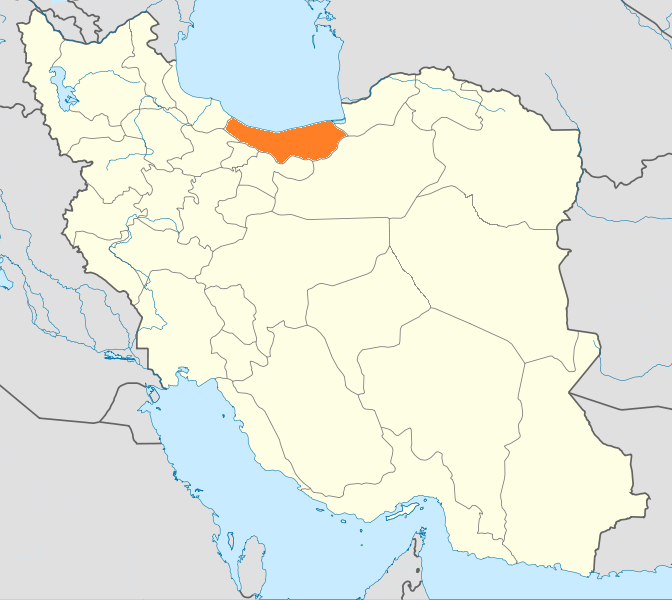
Mazandaran Province is located in the north of Iran, on the southern coast of the Caspian Sea, with Sari as its provincial capital.

The diverse nature of the province features plains, prairies, forests and rainforest stretching from the sandy beaches of the Caspian Sea to the rugged and snowcapped Alborz mountain range, including Mount Damavand, one of the highest peaks and volcanos in Asia. The Alborz Mountain Range surrounds the coastal strip and plains of the Caspian Sea like a huge barrier.

The province enjoys a moderate, subtropical climate with an average temperature of 25 °C in summer and about 8 °C in winter. Although snow may fall heavily in the mountains in winter, it rarely falls at sea level.

Mazandaran, Iran - MapThis region has a variety of climates, including the mild and humid climate of Caspian shoreline and the moderate and cold climate of mountainous regions. In the 1,500- to 3,000-meter altitudes, snow covers parts of the province even up to the middle of the warm season. In fact, snow can be observed in this region even in the warmest months of the year, which lends a touch of beauty to this region.

Human habitation in the area dates back at least 75,000 years. Recent excavations in Goher Tippe provide proof that the region has been urbanized for more than 5,000 years, and the area is considered one of the most important historical sites of Iran. Mazandaran was a part of the ancient Persian province of Hyrcania.

The population is overwhelmingly Mazandarani, with a minority of Azerbaijanis, Georgians, Armenians, Circassians, Turkmen and others. Mazandaran is a center for Iranian culture and has produced a number of famous poets. The people are largely secular, and consequently women have had greater social freedom and independence than their Persian cousins. The cuisine of the province is very rich in seafood due to its location by the Caspian Sea, and rice is present in virtually every meal. Indeed, the rest of Iran was introduced to rice through Gilan and Mazandaran.

Sources: Wikipedia | MazandaranMehr News | Photos 1Mehr | Photos 2, WikiCommons | Mazandaran, Fars News | Photos, Tasnim News | Photos, Iran Chamber Society | Mazandaran