Tag Archives: Awards

Professor Hossein Baharavand – Iranian Scientist Wins UNESCO Biology Award

Professor Hossein Baharavand from the Stem Cell Research Center of Royan Institute was qualified to win the 2014-2015 UNESCO-Equatorial Guinea International Prize.


UNESCO-Equatorial prize is awarded to those projects and activities of an individual, individuals, institutions, other entities or non-governmental organizations for scientific research in life sciences, which have led to improving the quality of human life.

Hossein Baharvand is an Iranian stem cell and developmental biologist and director of Iran’s Royan Institute for Stem Cell Biology and Technology.


Hossein Baharvand was born in 1972 and obtained his PhD degree in 2004 in the field of Developmental Biology from Khwarizmi University (formerly Tarbiat Moallem University), Tehran, Iran.


He began work at the Royan Institute in Tehran from 1996. He is currently full professor and head of Department of Stem Cells and Developmental Biology at Royan institute for Stem Cell Biology and Technology.


Moreover, Baharvand is the head of department of Developmental Biology at University of Science and Culture in Tehran.


He and his colleagues have established several human embryonic stem cell lines since 2003 and later human induced pluripotent stem cells. This has enabled them to pursue many avenues of research into methods of generating therapeutic cells from stem cells and made them the pioneer in stem cell research throughout the Middle East.


Professor Baharvand has published more than 150 peer-review papers in national and international journals, as well as 4 international books and 9 books in Persian. He is editor of Trends in Stem Cell Biology and Technology book. He is an editorial board member of five international journals. He has won 11 national and international awards and presented as invited speaker in several meetings.


http://www.payvand.com/news/14/aug/1134.html

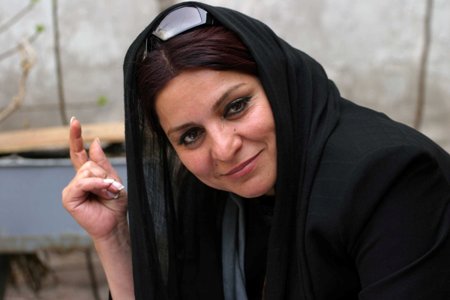
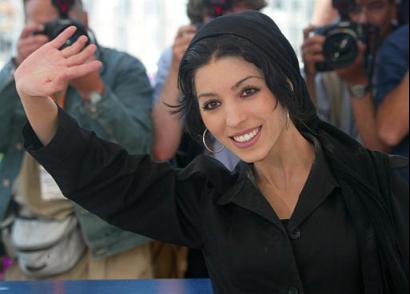
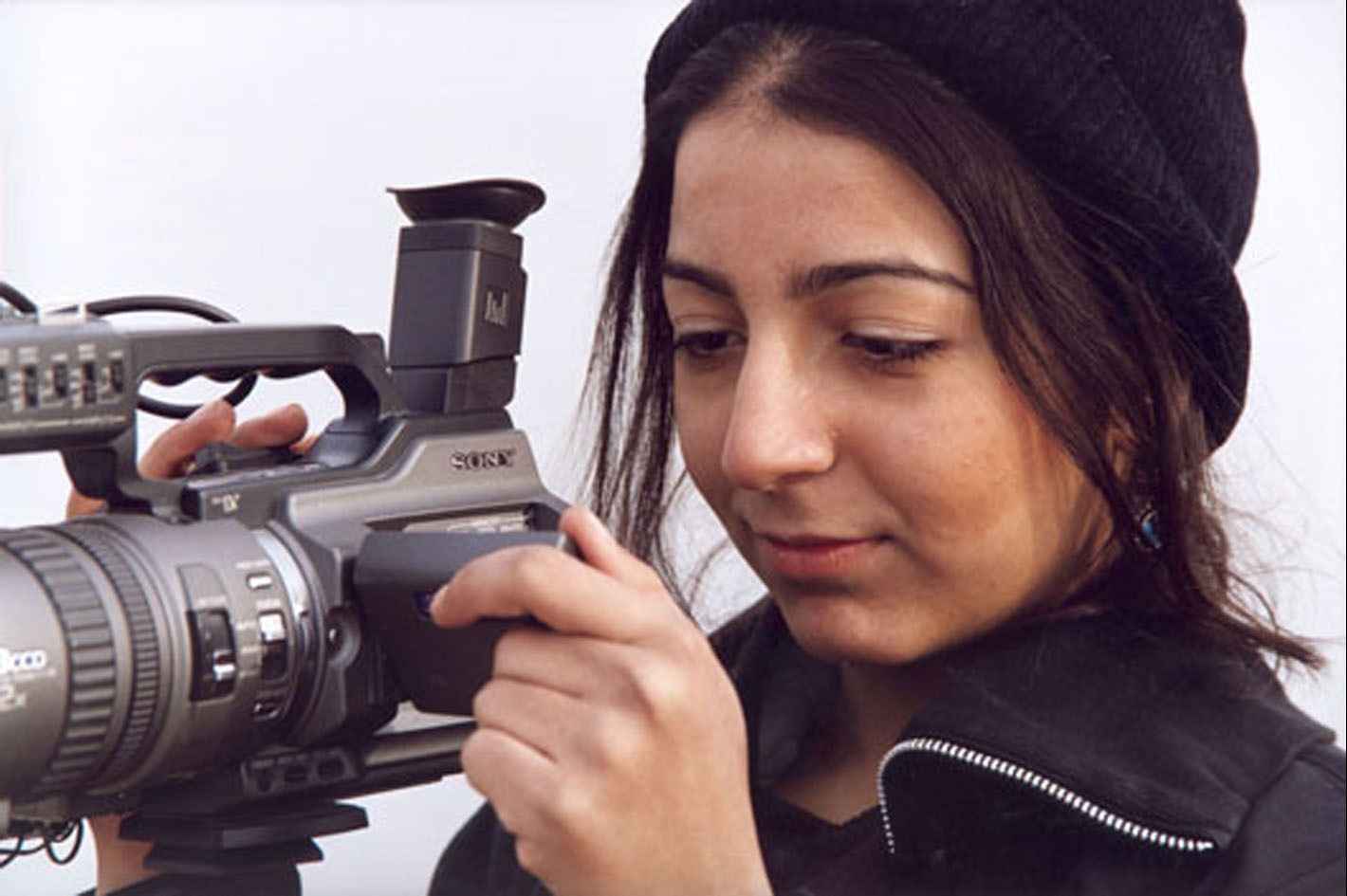
Mitra Farahani: Awarded Iranian filmmaker

Mitra Farahani

Mitra Farahani’s biography:
She was born in Tehran in 1975 and studied painting and drawing with various Iranian masters of pictorial art, notably with Gholam Hossein Nami. After receiving a degree in graphic art at the Azad University in Tehran, she moved to Paris and took up residence in the Cite Internationale des Arts.

In 2001, she began a course of video studies at the Ecole Natioanale Superieure des Arts Decoratifs, where she made her first documentary entitled “Just a Woman”. The film was chosen for Berlin Film Festival and was awarded the Teddy Awards Special Jury Prize.

Her documentary “Zohre and Manouchehr” (Taboos) was presented at the Berlin Film Festival of 2004 and was later shown in cinemas in France and Canada.

In 2005 she made the documentary “Behjat Sadr: Suspended Time”, a portrait of one of the pioneers of abstract expressionist painting in Iran. In 2009, as part of the Three Continents Festival, Le Lieu Unique in Nantes presented her one-person multi-disciplinary exhibition. Her latest documentary film, Fifi Howls from Happiness, on painter Bahman Mohassess, premiered at the 2013 Berlin and Telluride film Festival.

More about her documentary “Fifi Howls from Happiness”:
http://www.payvand.com/news/14/aug/1104.html

Fifi Howls from Happiness: An awarded Documentary on Iranian Artist Bahman Mohassess running in Cinemas now

Mitra Farahani’s lyrical documentary explores the enigma of provocative artist Bahman Mohassess, the so-called “Persian Picasso,” whose acclaimed paintings and sculptures dominated pre-revolutionary Iran. Irreverent and uncompromising, a gay man in a hostile world, Mohassess had a conflicted relationship with his homeland-revered by elites in the art scene and praised as a national icon, only to be censored later by an oppressive regime. Known for his iconoclastic art as well as his scathing declarations, Mohasses abandoned the country over 30 years ago for a simple, secluded life in Italy.

Reactions

Critics Pick “Addictively fascinating…The lovely meeting of artistic sensibilities makes this doc sing.” -Michael Atkinson, Village Voice

Five stars! “Stunningly multifaceted…surprising and deeply affecting.” – Keith Uhlich, Time Out NY

“Thoughtful, moving…A portrait of the artist as a refusenik, a recluse, a survivor and a stubborn question mark, “Fifi Howls From Happiness” registers, by turns, as a celebration, an excavation and an increasingly urgent rescue mission.” Manohla Dargis, The New York Times

“A fascinating portrait.” – Jay Weissberg, Variety

“The most startlingly unexpected Iranian triumph at Telluride was Mitra Farahani’s FIFI HOWLS FROM HAPPINESS, an unconventional documentary about forgotten Iranian artist Bahman Mohassess. Mohassess, who died in 2010, was a fantastic character, a viciously witty gay guy who cut a stylish swath through Europe and makes wicked fun of his dim-bulb oppressors. In the film, Farahani, gorgeous and stylishly feminine, spars skillfully with the artist, deftly penetrating his defenses through sheer intelligence and knowledge of his work, like Truffaut interviewing Hitchcock.” – Tim Appelo, The Hollywood Reporter

“A joyous celebration of freedom to create, to destroy, to live without regret.” – Lincoln Film Center

“When a film about an artist becomes itself a transcendent work of art.” – Peter Sellars

“Exceptionally clever. The final sequence makes for unforgettable cinema.” – Ken Eisner, Georgia Straight

Awards & Festivals

  • Winner! Buenos Aires Indendent Film Festival 2014 – International Competition
  • Telluride Film Festival- Official Selection
  • New York Film Festival – Official Selection
  • Berlin International Film Festival – Official Selection
  • Outfest 2014 – Official Selection

http://www.payvand.com/news/14/aug/1104.html

Iranian Mathematician Maryam Mirzakhani: The first woman to win the “Nobel Prize of Mathematics”

Maryam Mirzakhani

Maryam Mirzakhani is the first woman to ever win the Fields Medal – known as the “Nobel Prize of mathematics” – in recognition of her contributions to the understanding of the symmetry of curved surfaces. […]

Mirzakhani was born and raised in Tehran, Iran. As a young girl she dreamed of becoming a writer. By high school, however, her affinity for solving mathematical problems and working on proofs had shifted her sights. […]

She became known to the international math scene as a teenager, winning gold medals at both the 1994 and 1995 International Math Olympiads – she finished with a perfect score in the latter competition. Mathematicians who would later be her mentors and colleagues followed the mathematical proofs she developed as an undergraduate.

After earning her bachelor’s degree from Sharif University of Technology in 1999, she began work on her doctorate at Harvard University under the guidance of Fields Medal recipient Curtis McMullen. […] —By Bjorn Carey for Stanford University

Interesting Interview with Mirzakhani by The Guardian:

G: What are some of your earliest memories of mathematics?

I grew up in a family with three siblings. My parents were always very supportive and encouraging. It was important for them that we have meaningful and satisfying professions …

In many ways, it was a great environment for me, though these were hard times during the Iran-Iraq war. My older brother was the person who got me interested in science in general. He used to tell me what he learned in school. My first memory of mathematics is probably the time that he told me about the problem of adding numbers from 1 to 100. I think he had read in a popular science journal how Gauss solved this problem. The solution was quite fascinating for me.

G: What experiences and people were especially influential on your mathematical education?

I was very lucky in many ways. The war ended when I finished elementary school; I couldn’t have had the great opportunities that I had if I had been born 10 years earlier. I went to a great high school in Tehran – Farzanegan – and had very good teachers. I met my friend Roya Beheshti during the first week of middle school. It is invaluable to have a friend who shares your interests, and it helps you stay motivated.

Our school was close to a street full of bookstores in Tehran. I remember how walking along this crowded street, and going to the bookstores, was so exciting for us. We couldn’t skim through the books like people usually do here in a bookstore, so we would end up buying a lot of random books. Also, our school principal was a strong-willed woman who was willing to go a long way to provide us with the same opportunities as the boys’ school.

Later, I got involved in Math Olympiads that made me think about harder problems. As a teenager, I enjoyed the challenge. But most importantly, I met many inspiring mathematicians and friends at Sharif University. The more I spent time on mathematics, the more excited I became.

G: Could you comment on the differences between mathematical education in Iran and in the US?

It is hard for me to comment on this question since my experience here in the US is limited to a few universities, and I know very little about the high school education here. However, I should say that the education system in Iran is not the way people might imagine here. As a graduate student at Harvard, I had to explain quite a few times that I was allowed to attend a university as a woman in Iran. While it is true that boys and girls go to separate schools up to high school, this does not prevent them from participating say in the Olympiads or the summer camps. […]

G: What advice would you give those who would like to know more about mathematics – what it is, what its role in society has been, and so son?

This is a difficult question. I don’t think that everyone should become a mathematician, but I do believe that many students don’t give mathematics a real chance. I did poorly in math for a couple of years in middle school; I was just not interested in thinking about it. I can see that without being excited mathematics can look pointless and cold. The beauty of mathematics only shows itself to more patient followers.
Source: The Guardian

Excerpts of an article by Erica Klarreich published in Quanta Magazine that shows some other interesting aspects about her personality:

With her low voice and steady, gray-blue eyes, Mirzakhani projects an unwavering self-confidence. She has an equal tendency, however, toward humility. Asked to describe her contribution to a particular research problem, she laughed, hesitated and finally said: “To be honest, I don’t think I’ve had a very huge contribution.” And when an email arrived in February saying that she would receive what is widely regarded as the highest honor in mathematics — the Fields Medal, which will be awarded today at the International Congress of Mathematicians in Seoul, South Korea — she assumed that the account from which the email was sent had been hacked.

Other mathematicians, however, describe Mirzakhani’s work in glowing terms. […]

As a child growing up in Tehran, Mirzakhani had no intention of becoming a mathematician. Her chief goal was simply to read every book she could find. She also watched television biographies of famous women such as Marie Curie and Helen Keller, and later read “Lust for Life,” a novel about Vincent van Gogh. These stories instilled in her an undefined ambition to do something great with her life — become a writer, perhaps. […]

In her first week at the new school, she made a lifelong friend, Roya Beheshti, who is now a mathematics professor at Washington University in St. Louis. As children, the two explored the bookstores that lined the crowded commercial street near their school. Browsing was discouraged, so they randomly chose books to buy. “Now, it sounds very strange,” Mirzakhani said. “But books were very cheap, so we would just buy them.”

To her dismay, Mirzakhani did poorly in her mathematics class that year. Her math teacher didn’t think she was particularly talented, which undermined her confidence. At that age, “it’s so important what others see in you,” Mirzakhani said. “I lost my interest in math.”

The following year, Mirzakhani had a more encouraging teacher, however, and her performance improved enormously. “Starting from the second year, she was a star,” Beheshti said. […]

In 1994, when Mirzakhani was 17, she and Beheshti made the Iranian math Olympiad team. Mirzakhani’s score on the Olympiad test earned her a gold medal. The following year, she returned and achieved a perfect score. […]

After completing an undergraduate degree in mathematics at Sharif University in Tehran in 1999, Mirzakhani went to graduate school at Harvard University, where she started attending McMullen’s seminar. […]

She started going to McMullen’s office and peppering him with questions, scribbling down notes in Farsi.

“She had a sort of daring imagination,” recalled McMullen, a 1998 Fields medalist. “She would formulate in her mind an imaginary picture of what must be going on, then come to my office and describe it. At the end, she would turn to me and say, ‘Is it right?’ I was always very flattered that she thought I would know.”
Read on here: Quanta Magazine

Other interesting articles on Mirzakhani in iranianroots.com:
http://iranianroots.com/?s=Mirzakhani

‘Hush! Girls Don’t Scream’ awarded Iranian movie

Hush! Girls Don’t Scream’ scoops awards in Los Angeles Filmfest

Iranian social drama Hush! Girls Don’t Scream has swept awards at the third Women’s Independent Film Festival in Los Angeles.

Directed by the leading Iranian woman filmmaker Pouran Derakhshandeh, the film swept two awards as well as an honorable mention of this year’s competition.

The film received the best screenplay award, while the best actress award went to the film’s star Tannaz Tabatabaei.

Derakhshandeh’s latest production also nabbed an honorable mention in the Narrative Feature Film Category of the event.

The film tells the story of abused children and ignorant families who do not make enough time in their day to listen and solve their children’s issue.

The movie received a great attention from the movie goers in Canada and the United States.

Oscar Academy had earlier requested a copy of screen script of Hush! Girls Don’t Scream during a letter signed by the center’s Script Librarian Gregory Walsh.

The film has been screened in numerous international competitions and garnered several awards such as Audience Special Award of the 2014 Irvine International Film Festival in the United States. 

Iranian teams shine at International Robo Cup 2014 in Brazil

RoboCup Rescue – Simulation League
– Virtual Robot Competition
1st place: MRL, Qazvin Azad

– Agent Competition
1st place: S.O.S, AmirkabirUniversity
2nd place: MRL, Qazvin Azad

RoboCup Rescue – Robot League
2nd place: MRLQIAU, Qazvin Azad
Best-in-Class Small UAV:   YRA, Islamic Azad University of Yazd
Best-In-Class Mobility: MRL, Qazvin Azad
Best-In-Class Manipulation: YRA, Islamic Azad University of Yazd

RoboCup Soccer Humanoid League
– TeenSize Competition
1st place: Baset TeenSize, Baset

– KidSize Competition
3rd place: Baset KidSize, Baset

Source: RoboCup 2014

Iran crowned Asian Basketball champion

http://www.tehrantimes.com/component/content/article/117131

Ahmad Shamloo – awarded Iranian poet, writer and journalist

https://i0.wp.com/i1.ytimg.com/vi/_c9Fa-8F_wA/hqdefault.jpg
Ahmad Shamloo (Persian: احمد شاملو‎, also known under his pen name A. Bamdad (December 12, 1925 – July 24, 2000) was a Persian poet, writer, and journalist. Shamlou was arguably the most influential poet of modern Iran. His initial poetry was influenced by and in the tradition of Nima Youshij.
Shamlou has translated extensively from French to Persian and his own works are also translated into a number of languages.
His thirteen-volume Ketab-e Koucheh (The Book of Alley) is a major contribution in understanding the Iranian folklore beliefs and language. He also wrote fiction and Screenplays, contributing to children’s literature, and journalism.
Some of his books
  • The Forgotten Songs (1947)
  • Poems of Iron and Feelings (1953)
  • Blossoming in the Mist (1970)

Awards

  • Forooghe Farrokhzad Prize, 1973
  • Freedom of Expression Award given by Human Rights Watch, 1990
  • Stig Dagerman Prize, 1999
  • Free Word Award given by Poets of All Nations in Netherlands, 2000

Iranian vocalist Mohammadreza Shajarian to receive France’s highest honor

The living legend of Iranian traditional music Mohammadreza Shajarian will receive the medal of Chevalier of the Legion of Honor in Paris next week.

Shahram Nazeri, another Iranian vocalist, received the honor on September 29, 2008 for the scholarly interest he has taken in the musical interpretation and vocalization of the transcendent lyrics of Rumi.

More about Shajarian

Mohammad-Reza Shajarian (Persian: محمدرضا شجريان‎) (born 23 September 1940) is an internationally and critically acclaimed Persian classical singer, composer and Ostad (master) of Persian music.[1][2][3] He has been called “Iran’s greatest living master of traditional Persian music.”[4] Shajarian is also known for his skills in Persian calligraphy, and humanitarian activities.

Shajarian was born in Mashhad, Iran, and started singing at the age of five, under the supervision of his father. At the age of twelve, he began studying the traditional classical repertoire known as the Radif.

Invention of New Musical Instruments

Shajarian has led the invention of many new Iranian classical music instruments, many of which were showcased in his 2012 concert tour with the Shahnaz Ensemble. Among these instruments are the Kereshmeh, the Saboo, the Saghar, the Sorahi, and the Tondar.

Awards and distinctions

  • One of NPR‘s 50 great voices.[6] (2010)
  • Nushin medal (2008)
  • The UNESCO award – the UNESCO Mozart Medal[7] (2006)
  • Nominated for Grammy award in Best World Music (2006)
  • Nominated for Grammy award in Best World Music (2004)
  • Iran’s best classical vocalist (2000)
  • Golden Picasso Medal (1999), one of UNESCO‘s highest honors
  • National radio and television golden cup (1977)
  • Prize presented by Turkish parliament speaker (1976)

http://www.payvand.com/news/14/jun/1130.html

http://en.wikipedia.org/wiki/Shajarian

Ali Mosaffa: Awarded Iranian actor and director

Ali Mosaffa (born December 1, 1966 in Tehran) is an Iranian actor and director. His parents are professors for Persian literature at the University of Tehran. His father, Mozaher Mosaffa, is a renowned Persian poet and his mother, Amir Banoo Karimi is the eldest daughter of the Persian poet, Amiri Firuzkuhi.

He is a graduate of Civil Engineering from the University of Tehran where he showed an interest in acting. His acting film debut was 1991 in Omid. In the following year he won the Best Actor Award at the 10th Fajr International Film Festival for his role in Darius Mehrjui’s film, Pari. On the set of Leila, Mehrjui’s 1996 film, met Mosaffa his future wife, Iranian actress Leila Hatami.

He directed his first short film, Incubus, in 1991. Neighbors (Hamsaye-ha) in 1999 was chosen Best Experimental Film at the Iranian Short Film Fest. His first feature film, Portrait of a lady far away (Sima-ye zani dar doordast) starring Leila Hatami and Homayoun Ershadi, in 2005. The film was shortlisted for the Sutherland Trophy at the London Film Festival.

Portrait of a lady far away subsequently won the People’s Choice Award at the Chicago International Film Festival and was nominated for the Crystal Globe at the 2005 Karlovy Vary International Film Festival.

In 2012 was the international premiere of his second film, The last step (Pele-ye akhar) starring Leila Hatami, at the Karlovy Vary International Film Festival, where Leila Hatami received the Best Actress Award and Ali Mosaffa the FIPRESCI Prize.

In October 2012, Mosaffa joined Oscar winning director of A Separation, Asghar Farhadi in Paris; starring alongside Bérénice Bejo and Tahar Rahim for Farhadi’s first foreign language film The Past (Le Passé) which premiered at the Cannes Film Festival in May 2013.

Filmography (as an actor)
– 2014: What’s the time in your world? (Dar donya-ye to saát chand ast?) by Safi Yazdanian
– 2013: The past (Le passé) by Asghar Farhadi
– 2012: The last step (Pele-ye akhar) by Ali Mosaffa
– 2011: Beloved sky (Aseman-e mahboob) by Dariush Mehrjui
– 2010: There are things you don’t know (Chizhaie hast ke nemidani) by Fardin Saheb-Zamani
– 2006: Who killed Amir? (Che kasi Amir ra kosh?) by Mehdi Karampoor
– 2003: Another place (Jayi digar) by Mehdi Karampoor
– 2001: Mix by Dariush Mehrjui
– 2000: Dear Cousin is Lost (Segment in Tales of an Island by Dariush Mehrjui)
– 2000: Party by Saman Moghadam
– 1999: Lost Girls
– 1998: Leila by Dariush Mehrjui
– 1996: Minou Tower (Borje Minou) by Ebrahim Hatamikia
– 1994: Pari by Dariush Mehrjui
– 1992: All My Daughters by Esmail Soltanian
– 1991: Omid by Habib Kavosh

Filmography (as a director)
– 2012: The last step (Pele-ye akhar)
– 2005: Portrait of a lady far away (Sima-ye zani dar doordast)
– 1996: The deceit of poesy (Farib-e-she’r), a documentary short film
– 1999: Neighbors (Hamsaye-ha), short film
– 1991: Incubus, short film

Television Series
– 2000: The English Bag (Keef-e Eenglisi)
– 2007: Paridokht

Awards
– Best Supporting Actor Award at the 13th Fajr International Film Festival for Pari in 1995
– People’s Choice Award for “Portrait of a Lady Far Away”, from Chicago International Film Festival, 2005
– Crystal Simorgh (Phoenix) for Best Adapted Screenplay at the 30th Fajr International Film Festival in 2012 for The last step (Pele-ye akhar)
– FIPRESCI at the Karlovy Vary International Film Festival for The last step (Pele-ye akhar) in 2012
– Best Adapted Screenplay at the 16th Iranian House of Cinema Film Festival for The last step (Pele-ye akhar) in 2014

Sources: Wikipedia | Ali Mosaffa, Festival Scope | Ali Mosaffa

Christian Composer and Coductor Loris Tjeknavorian – one of the most celebrated cultural figures in Iran

socialinform's avatarRemarkable people with Iranian roots

Loris Tjeknavorian (also spelled Cheknavarian, Armenian: Լորիս Ճգնավորյան; Persian: لوریس چکناواریان‎, born 13 October 1937) is an Iraniancomposer and conductor. He is one of the most celebrated cultural figures in Armenia and Iran.

As a composer Tjeknavorian has written 6 operas, 5 symphonies, choral works (among them God is love, The Life of Christ, the oratorio Book of Revelation, and a requiem), chamber music, ballet music, piano and vocal works, concerti for piano, violin, guitar, cello and pipa (Chinese lute), as well as music for documentary and feature films.

Born in Borujerd, Iran in 1937 to immigrant Armenian parents, …
Following this fruitful period of education, Tjeknavorian went back to Iran in 1961, where he taught music theory at the Tehran Conservatory of Music. At the same time, he was appointed director of Tehran’s Music Archives and put in charge of…

View original post 536 more words

Environment week sees 40 Iranian hunters swear off hunting

Forty hunters in Mazandaran Province took part in Environment Week by taking an oath to give up hunting and guns. IRNA reports that the hunters expressed remorse for hurting nature and they signed a promise and recited an oath never to take up a gun or go hunting.

Nasser Mehrdadi, the head of Mazandaran Environmental Protection, lauded the hunters and said: “Farewell oaths by hunters and asking forgiveness from nature are aimed at promoting the culture of environment and wildlife protection.”

The Sabz Chia Association, an environmental group, received the National Environment Award for its campaign against hunting in Kurdistan.


Bijan – well known and awarded Iranian designer, dressed some of the world’s most influential men

Bijan Pakzad ( Persian: بیژن پاکزاد), generally known simply as bijan (4 April 1940[1][2][3] or 1944 – 16 April 2011),[4] was an Iranian designer of menswear and fragrances.
Born in Tehran, Iran, Bijan migrated to Los Angeles in 1973. His exclusive boutique on Rodeo Drive in Beverly Hills was established in 1976. It has been described as “the most expensive store in the world”.[5]

Bijan’s career began in Iran with the Pink Panther Boutique in Tehran. He has dressed some of the world’s most influential men: President of the United States Barack Obama,…
According to the 2001 Los Angeles Times Calendar Section, the Bijan Perfume and Fashion Business has brought in an estimated $3.2 billion in sales worldwide.[10]

Awards:
FiFi Most Successful Men’s Fragrance 1988
FiFi Best Women’s Fragrance Package 1988
FiFi Men’s Fragrance Star of the Year Specialty/ Department Stores 1997
FiFi Best National Advertising Campaign – Men’s 1997
2010 Otis College of Art and Design Otis Design Legend Award
2011 Oxford University “Entrepreneur of the Year”

http://en.wikipedia.org/wiki/Bijan_%28designer%29

High-flyer: Iranian stunt woman Mahsa Ahmadi – with others awarded for stunts in the James Bond movie “Skyfall”

socialinform's avatarRemarkable people with Iranian roots

She fights, she drives cars at breakneck speed, she jumps out of planes and helicopters … these are just a few of the talents of Mahsa Ahmadi, the best stunt woman in Iran.

Woman in a male-dominated world: the stunt scene in Iran is a male-dominated world: "most of the time, women's roles in Iranian films are pretty safe; nothing happens to them, explains "Stunt 13" boss Arsha Aghdasi. "Slowly, however, things are changing. With her courageous and professional manner, Ahmadi has gradually won the trust of the directors."

She had already done a number of dangerous scenes in 21 Iranian films when she shot to world fame in 2012 in the most recent James Bond film, “Skyfall”.

Gymnastics champion: Mahsa Ahmadi is now 24 years of age, but her career began when she was a young child. As a gymnast, she spent eleven years on the Iranian national team, winning numerous competitions in the process. When she had to leave the national team at the age of 18, she found a new challenge in the group “Stunt 13”. She is also a qualified sports teacher.

Woman in a male-dominated world: the stunt scene in Iran is a male-dominated world: “most of the time…

View original post 84 more words

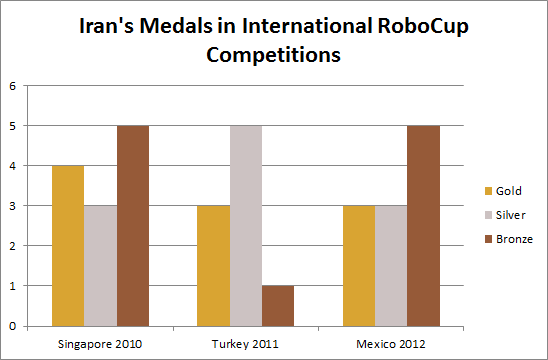
Iran’s impressive trackrecord in RoboCup

Iran's Medals in International RoboCup Competitions

Iran’s Medals in International RoboCup Competitions

Sources: RoboCup 2010, RoboCup 2011, RoboCup 2012

The first gold medal in RoboCup that I can remember of goes back to 1999. Unfortunately I only have german sources for that: derStandard.at, heise.de

About RoboCup
RoboCup is an annual international robotics competition founded in 1997. The aim is to promote robotics and AI research, by offering a publicly appealing, but formidable challenge. The name RoboCup is a contraction of the competition’s full name, “Robot Soccer World Cup”, but there are many other stages of the competition such as “RoboCupRescue”, “RoboCup@Home” and “RoboCupJunior”. (Source: Wikipedia | RoboCup)

Abbas Kiarostami – highly awarded Iranian cineast and jury member at numerous film festivals

Kiarostami & Bavi Crop.jpg
Abbas Kiarostami
(Persian: عباس کیارستمی‎;[1] born 22 June 1940) is an Iranian film director, screenwriter, photographer and film producer.[2][3][4] An active filmmaker since 1970, Kiarostami has been involved in over forty films, including shorts and documentaries.

He is part of a generation of filmmakers in the Iranian New Wave, a Persian cinema movement that started in the late 1960s and includes pioneering directors such as Forough Farrokhzad, Sohrab Shahid Saless, Mohsen Makhmalbaf, Bahram Beizai, and Parviz Kimiavi.

Kiarostami has a reputation for using child protagonists, for documentary-style narrative films,[6] for stories that take place in rural villages, and for conversations that unfold inside cars, using stationary mounted cameras.

Kiarostami was born in Tehran. His first artistic experience was painting, which he continued into his late teens, winning a painting competition at the age of 18 shortly before he left home to study at the University of Tehran School of Fine Arts.[7]

Kiarostami has been a jury member at numerous film festivals, most notably the Cannes Film Festival in 1993, 2002 and 2005. He was also the president of the Caméra d’Or Jury in Cannes Film Festival 2005. He has been announced as the president of the Cinéfondation and short film sections of the 2014 Cannes Film Festival.[44]

Honors and awards

Kiarostami has won the admiration of audiences and critics worldwide and received at least seventy awards up to the year 2000.[81] Here are some representatives:

Filmography

9th RoboCup Iran Open – International competition kicked of in Tehran with 388 teams from US, UK, France, Portugal, Italy, Germany, …

The 9th RoboCup Iran Open competitions and symposium officially kicked off in Tehran on Wednesday. This event provides an environment to present and share scientific achievements in the areas of Artificial Intelligence (AI) and Robotics.

The competition hosts 388 teams from Iran, US, UK, France, Portugal, Italy, Germany, Sweden, The Netherlands, Brazil, Mexico, Japan, China, Thailand, India, Pakistan, UAE, Canada, Turkey, Colombia, Egypt and Indonesia.

Iran’s international robocup competition is among the top premier robotic competitions worldwide.

Source: Payvand | Photos: 9th International Robocup Competition Kicks Off In Tehran

Article on some of Iran’s RoboCup successes in the near past:
The other Iran | Iran’s impressive trackrecord in RoboCup

Mary Apick – awarded Iranian actress, writer, and producer

https://i0.wp.com/festivalofarts.com/achievers/upload/2013/08/03/20130803144143-1010640f.jpg
Mary Apick (in Persian: مری آپیک; born in 1954) is an Iranian actress, writer, and producer. She won the award for Best Actress at the 10th Moscow International Film Festival for her role in the 1977 film Dead EndHer other notable works as actress:

Ref: wikipedia.org/wiki/Mary_Apick

Female Pianist Dena Taherianfar awarded with the Bita Prize

Stanford, California – In a ceremony held at Stanford University last Wednesday evening, March 12, 2014, global philanthropist and humanitarian Bita Daryabari awarded the First Annual Bita Prize for Young Persian Artists to acclaimed seventeen-year-old concert pianist Dena Taherianfar.

About Dena Taherianfar
Dena was born in Tehran, in November of 1996. She began taking lessons in piano when she was six years old. Her first teacher was Mrs. Shohreh J. Ghajar. Dena gave her debut concert in the renowned Roudaki Concert Hall of Tehran in 2008. At her teacher’s suggestion, Dena eventually moved to Vienna with her Mother (her father still in Iran) where she began to study piano with Prof. Stanislaw Tichonow at the Joseph Haydn Conservatory. She has won numerous national and international prizes. She performed at the Gala Concert in the House of “Music House” in Vienna and won two first prizes in the Austrian Youth Competitions “Prima La Musica.” She has also won first prizes in the International Competition “Concours Flame 2011” in Paris, “Valsesia Musica 2012” in Italy, and the “21st Century Art 2013” in Vienna.

http://www.payvand.com/news/14/mar/1144.html

Vahid Shamsaei: Futsal’s top international goalscorer of all time

Vahid Shamsaei (born 21 September 1975 in Tehran, Iran) is an Iranian futsal player who is futsal’s top international goalscorer of all time. […] He is the leading goalscorer for the national team, the seven time Top Goalscorer of the Asian Futsal Championship.

On May 19, 2007 after scoring 1 goal against Japan in Iran’s 4–1 victory in the final of the 2007 AFC Futsal Championship, he scored his 316th national goal. He was officially the world’s Top Futsal Goalscorer with 14 goals ahead of Manoel Tobias of Brazil national futsal team, the previous holder of the title with 302 goals (as of May 19, 2007). […]

HONOURS

Country
* AFC Futsal Championship:
– Champion (8 times) in 2000, 2001, 2002, 2003, 2004, 2005, 2007 and 2008
– Third place (twice) in 2006 and 2012
* Asian Indoor Games: Champion in 2005
* Confederations Futsal Cup: Champion in 2009
* WAFF Futsal Championship: Champion in 2012

Club
* AFC Futsal Club Championship: Champion (twice) in 2010 with Foolad Mahan and in 2015 with Tasisat Daryaei

Individual
* Best player
– AFC Futsal Player of the Year (3 times) in 2007, 2008 and 2015
– MVP AFC Futsal Championship (5 times) in 1999, 2000, 2005, 2007 and 2008
– MVP AFC Futsal Club Championship (twice) in 2010 and 2015
– MVP Futsal Confederations Cup in 2009
Iran Football Federation Awards:
– International Special Award (2007–08) shared with Ali Daei
– Best futsal player of Iran (2007–08)

* Top Goalscorer
– World’s Top Futsal Goalscorer of All Time (with 390 goals)
– AFC Futsal Championship Top Goalscorer of All Time (with 183 goals)
– AFC Futsal Championship (8 times) in 2001 (with 31 goals), 2002 (26), 2003 (24), 2004 (33),  2005 (23), 2006 (16), 2008 (13) and in 2012 (with 7 goals and 6 assists)
– Asian Indoor Games  2005 (31)
– AFC Futsal Club Championship (twice) in 2010 (17) and in 2015 (10)
– WAFF Futsal Championship in 2012 (8 goals)

Ref: wikipedia.org

The Iranian national futsal team – 6th strongest team in the world

The “Kings of Asian Futsal” have won ten editions of Asian Futsal Championship[2] and are the 6th strongest team in the world according to the most recent Futsal World Ranking. Iranians have played in five editions of FIFA Futsal World Championship reaching the semi-finals in their first appearance in 1992.[3] Iran have won the first FIFA Confederations Cup in Libya in 2009, and reached the finals of Grand Prix de Futsal known as Futsal Mini-World Cup in 2007 and 2009 editions.

http://en.wikipedia.org/wiki/Iran_national_futsal_team

Iranian players handed white roses (a symbol of peace in Iran) to the US players prior to soccer match

All must read USA – Iran posts: The other Iran | Tag | USA

The game was an exceptionally fair game and both teams received the 1998 World Cup FIFA Fair Play Award “for the two countries’ good sportsmanship surrounding the World Cup match between their teams, despite their mutual political tensions for nearly 20 years.”

Below more photos from the match and the episode “Breaking Barriers: USA vs. Iran, 1998” from Fox Sports’ “Rise as One Series”:

https://www.youtube.com/watch?v=sGt9W4rcd2A

Loris Tjeknavorian: Armenian-Iranian composer and holder of Iran’s “Top Medal of Art”

Tjeknavorian, Loris - Iranian composer and conductor - Foto by Arash Mirsepasi for Young Journalists ClubLoris Tjeknavorian (also spelled Cheknavarian) is an Iranian-Armenian composer and conductor. He was born in 1937 in Borujerd in the province of Lorestan, southwestern Iran, and was educated in Tehran.
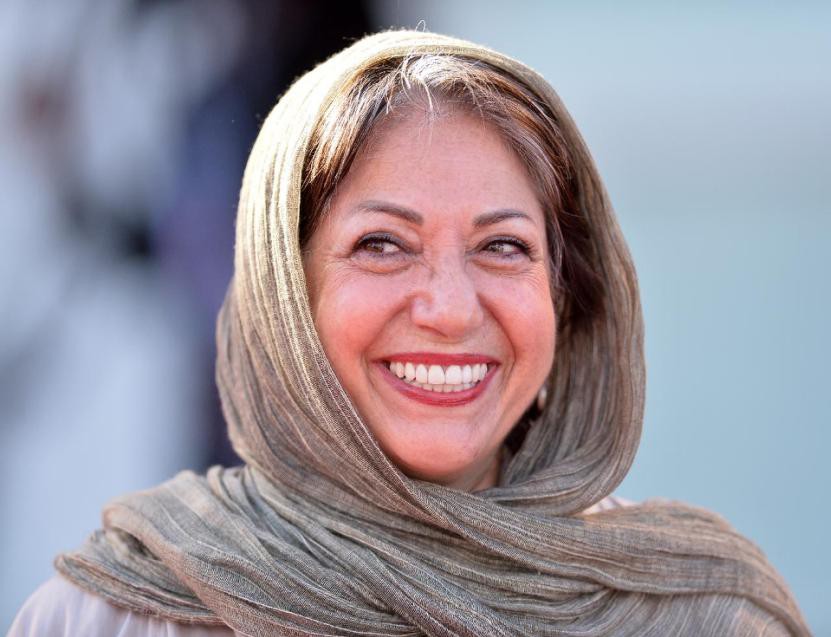
In the course of his career, Tjeknavarian has made about 100 recordings (with RCA, Philips, EMI, ASV, etc.) and written more than 75 compositions (symphonies, operas, a requiem, chamber music, concerto for piano, violin, guitar, cello and pipa (Chinese lute), ballet music, choral works and an oratorio. And over 45 Film mosaics.

Tjeknavarian also has conducted international orchestras throughout the world: in Austria, UK, US, Canada, Hungary, Iran, Finland, former USSR, Armenia, Thailand, Hong Kong, South Africa, Denmark, Israel, etc. In October 2010 he became the Music Director and Principal Conductor of the Glendale Symphony Orchestra in Southern California. Glenn Treibitz, president of the Glendale Symphony said; “with Loris Tjeknavorian at the helm, our orchestra will automatically become one of the most prominent in the Western USA.”

Awards
– Austria’s Presidential Gold Medal of Artistic Merit (2008)
– Austria’s Cross of Honor for Science and Art, first class (2008)
– Awarded “Top Medal of Art”, Iran’s highest medal for performing arts (2002)

Sources: Wikipedia | Loris Tjeknavorian

Manuchehr Mohammadi honored by UNESCO for “outstanding contribution to the promotion and preservation of cultural diversity through film,”

Iranian film The Painting Pool’s producer Manuchehr Mohammadi has been honored by UNESCO during a ceremony held in the capital city of Tehran.

The Painting Pool won the UNESCO Award for “outstanding contribution to the promotion and preservation of cultural diversity through film,” the APSA jury had earlier commented on the film at the award ceremony in Brisbane in December 2013.
APSA is endorsed by UNESCO, with which it shares a common goal of fostering cultural diversity and promoting mutual understanding, dialogue and peace.
The annual Asia Pacific Screen Awards (APSA) is an international cultural initiative of the State Government of Queensland, Australia, through Events Queensland, to honor and promote the films, actors, directors, and cultures of Asia-Pacific to a global audience.


http://presstv.com/detail/2014/02/22/351786

Rakhshan Bani-E’temad – Film director and screenwriter: “First Lady of Iranian Cinema”

Bani-E'temad, Rakhshan - Iranian film director and screenwriter

Iranian director Rakhshan Bani-Etemad arrives for the screening of her movie “Ghessea” (Tales) at the 71st Venice Film Festival on August, 2014 (AFP Photo/Tiziana Fabi)

Rakhshan Bani-E’temad, (Persian: رخشان بنی اعتماد‎, born April 3, 1954 in Tehran, Iran) is an internationally and critically acclaimed Iranian film director and screenwriter. She is widely considered Iran’s premier female director, and her films have been praised at international festivals as well as being remarkably popular with Iranian critics and audiences.

Her title as “First Lady of Iranian Cinema” is not only a reference to her prominence as a filmmaker, but it also connotes her social role of merging politics and family in her work.

Bani-E’temad did not receive immediate praise upon entering the film industry. Her early feature films were met by harsh criticism. However, she finally earned critical and popular success in 1991 with her film Nargess. She received the Best Director Award from the Fajr Film Festival, marking the first time in the history of the festival that a woman was awarded the Best Director prize.

Bani-E’temad’s films are considered socially and politically conscious social documentaries. She aims to reflect the realities of Iranian people’s daily life experiences. Her documentaries are centered on issues of poverty, criminality, divorce, polygamy, social norms, cultural taboos, women’s oppression, and cultural expectations.

With her 2002 film Our Times, Bani-E’temad became the first female filmmaker to explicitly confront the Iran-Iraq war, placing her in an important role in Iranian film history. She has been known to challenge censorship codes to the very edge.

She has donated her international prize for the movie Ghesseh-ha to build a shelter for homeless women. Previously she has also donated some of her awards to help disadvantaged women.

Filmography (as a director)
– 1986: Kharej az Mahdudeh (Off-Limits)
– 1988: Zard-e Ghanari (Canary Yellow)
– 1989: Pul-e Khareji (Foreign Currency)
– 1992: Nargess
– 1995: Rusari Abi (The Blue-Veiled)
– 1998: Banoo-ye Ordibehesht (The May Lady)
– 1999: Baran-O-Bumi (Baran and the Native – short)
– 2001: Zir-e Pust-e Shahr (Under the Skin of the City)
– 2002: Ruzegar-e ma (Our Times – documentary)
– 2004: Gilane
– 2006: Khoon Bazi (Mainline)
– 2009: We Are Half of Iran’s Population
– 2014: Ghesseh-ha (Tales)

Honors and Awards
– Bronze Leopard, 48th Locarno Film Festival (for The Blue-Veiled) (1995)
– The Prince Claus Award (1998)
– Special Golden St. George, 23rd Moscow International Film Festival (for Under the Skin of the City) (2001)
– Best Achievement in Directing, Asia Pacific Screen Awards (for Mainline, with Mohsen Abdolvahab) (2007)
– Honorary doctorate, SOAS, University of London (2008)
– Best Screenplay Award, 71st Venice International Film Festival (for Tales, with Farid Mostafavi) (2014)

Sources: Wikipedia | Rakhshan Bani-E’temad

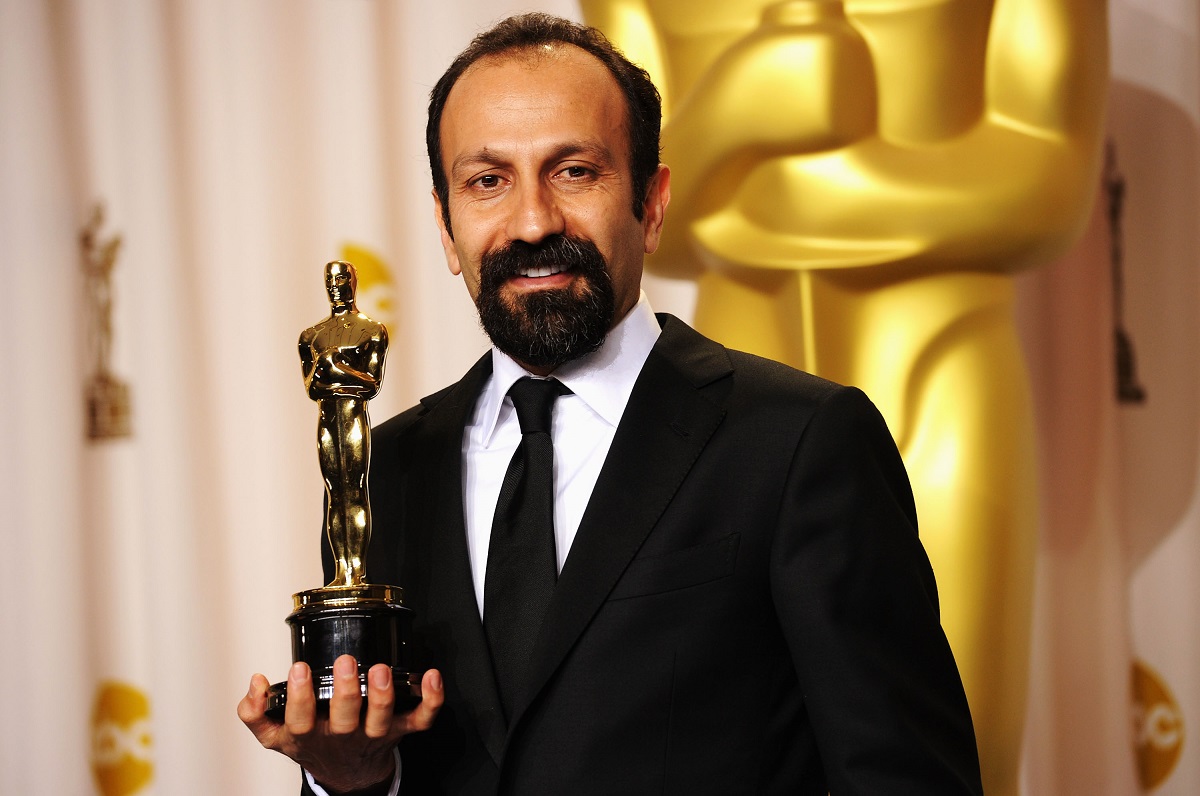
France honors the Iranian filmmaker Asghar Farhadi with L’Ordre des Arts et des Lettres (the Order of Arts and Letters)

Asghar Farhadi receives the Oscar for "A Separation"

Asghar Farhadi receives the Oscar for “A Separation”

The culture minister of France presents the order to a person who has made significant contributions to the arts, literature, or the dissemination of these fields.

Farhadi made his latest film “The Past” in France. The French-language drama brought its star Bérénice Bejo the Palme d’Or for Best Actress at the Cannes Film Festival in 2013. He received the first EU MEDIA prize for “The Past” in 2012 when the film was in its preproduction stage.

His previous film “A Separation” won the Oscar for best foreign-language film at the Academy Awards in 2012. He previously received France’s César award for best foreign film for “A Separation”.

Source: Tehran Times

Tahmineh Milani highly awarded Iranian female film director, screenwriter, and producer

Milani, Tahmineh - Iranian film directorTahmineh Milani is an Iranian film director, screenwriter, and producer.

Milani was born 1960 in Tabriz, Iran. After graduating in architecture from the University of Science and Technology in Tehran in 1986, she apprenticed as a script girl and an assistant director following a screen workshop in 1979. She started her career as a movie director with Children of Divorce in 1989.

Feminist filmmaker Milani is known for touching controversial and sensitive issues, including women’s rights.

Among her most notable films are Children of Divorce, Two women, The Hidden Half, The Fifth Reaction, The Unwanted Woman and Cease Fire.

Filmography (as a director)
– 1989: Bach’che’ha-ye Talagh (Children of Divorce)
– 1991: Afsaneh-ye Ah (The Legend of Sigh)
– 1992: Digeh che khabar? (What Else Is New?)
– 1996: Kakadu
– 1999: Do Zan (Two Women)
– 2001: Nimeh-ye Penhan (The Hidden Half)
– 2003: Vakonesh Panjom (The Fifth Reaction)
– 2005: Zan-e Ziadi (The Unwanted Woman)
– 2006: Atash Bas (Cease Fire)
– 2007: Tasvie Hesab (Settling Scores)
– 2008: Superstar
– 2011: Yeki Az Ma Do Nafar (One of Our Two)
– 2014: Atash Bas 2 (Cease Fire 2)

Awards and honors
– 2006: Best director, Best film and Best screenplay at the 51st Asia Pacific Film Festival for The Unwanted Woman
– 2005: Best film Los Angeles Film Festival for The Unwanted Woman
– 2003: Grand Prix ‘Cinéma Tout Ecran’, Geneva Cinéma Tout Ecran for The Fifth Reaction
– 2003: Best Screenplay at the 27th Cairo International Film Festival for The Fifth Reaction
– 2001: Best Artistic Contribution at the 25th Cairo International Film Festival for the The Hidden Half
– 1999: Award for best screenplay at Iran’s Fajr International Film Festival for Two Women

Source: Wikipedia | Tahmineh Milani

Bahman Kiarostami’s “The Statues of Tehran” to be screened in San Francisco

The Statues of Tehran, a documentary by director Bahman Kiarostami, will be showing at Roxie Theatre in San Francisco on Tuesday, February 25.

Kiarostami’s materful film explores how a revolution and autocratic regime attempt to redefine public space, national symbols and monuments, but more interestingly, it also engages with the experience of artists negotiating with official bodies, public commission, popular aspirations, official discourse and creative freedom.

“Docunights” are hosted by National Iranian American Council (NIAC)‘s Arts & Culture Executive Team Chairman, Ahmad Kiarostami

Tuesday, February 25, 7:00 pm
Roxie Theatre
3117 16th Street, San Francisco

Buy Tickets

The Statues of Tehran – Iran, 2008, 60 min, Persian with English subtitles

http://www.payvand.com/news/14/feb/1155.html

About Bahman Kiarostami:

Image

Bahman Kiarostami (Persian: بهمن کیارستمی‎) (b. 11 August 1978- in Tehran) is an Iranian film director, cinematographer, film editor, film producer and translator, son of the critically acclaimed Abbas Kiarostami.

In 1996 he made his first film ” Morteza Momayez: Father of Iranian Contemporary Graphic Design”.

The main theme in Bahman Kiarostami’s films is “art and music”.

Awards

  • Best Director Award, Mid East Film Festival (2003)
  • “Special Mention” honor, 26th Festival des 3 Continents, Nantes, France (2004)

http://en.wikipedia.org/wiki/Bahman_Kiarostami

Hamlet wins at 32nd Fajr Theater Festival hold in Teheran and five other Iranian cities.

Image

An Iranian troupe won the grand prix of the international section at the 32nd Fajr International Theater Festival for their performance of Shakespeare’s magnum opus “Hamlet”. The play also brought Arash Dadgar the best director and best stage designer awards in this section.

“Ibsen’s Women-Put an Eagle in a Cage” directed by Juni Dahr from Norway received the jury special award and Iranian playwright Hossein Kianizadeh won best dramatist award for his collaboration in “Salt Marsh”.

The best actress award went to Spanish actress Nicole Heesters for her role in “House of Bernard Alba” directed by Calixto Bieito from the National Theater of Mannheim in Germany.

The best director award of the national section of the festival was presented to Shahram Karami for “The End of Tooba’s Long Trip” and Saeid Hassanlu won the best stage designer award for his collaboration in the play.

Iranian actor/director Anushiravan Arjmand, actor Ferdows Kaviani, playwright/actor Nosratollah Masudi and actress Nahid Moslemi were also honored with lifetime achievement awards at the ceremony.

http://www.payvand.com/news/14/feb/1017.html

Iranian film, actress score nominations for French awards

Image

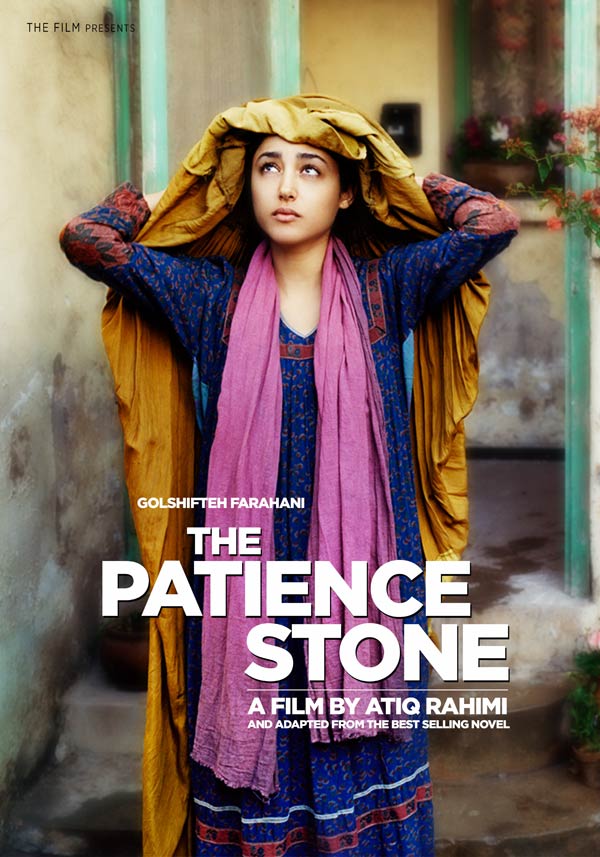
Asghar Farhadi’s The Past has been nominated in five categories for France’s Cesar Awards, while Iranian actress Golshifteh Farahani has also been nominated in the female newcomer category for her role in Afghan filmmaker Atiq Rahimi’s The Patience Stone (Sang-e Sabour).

Farhadi’s film The Past has been nominated in the categories of best director, best film, best original screenplay, best editing and best actress.

France’s Cesar Awards are the local equivalent to the Oscars, and the award ceremony will take place on February 28 in Paris.

http://www.payvand.com/news/14/feb/1005.html

Iran’s Environment Chief, the first woman to receive the Energy Globe Foundation award

Iran’s Vice President and Head of the Department of Environment Masoumeh Ebtekar has won the Energy Globe Foundation award for her long-term efforts in the field of environment protection.

Wolfgang Neumann, the Austrian founder of the Energy Globe Foundation, took a trip to Iran to present the prize to Ebtekar, who is the first women ever receiving the award.

Some more info about Masoumeh Ebtekar from Wikipedia:
Ebtekar was born in Tehran as Niloufar Ebtekar in a middle-class family. Her first name translates to “Innocent Water Lily” in English. Ebtekar’s father studied at the University of Pennsylvania, and she lived with her parents in Upper Darby of Philadelphia. During her six years in Philadelphia, she developed “near-perfect, American-accented English.”

[…]

Ebtekar has served as faculty member at Tarbiat Modares University, which is a post graduate academic center located in Tehran. As an Associate Professor in Immunology, she has taught, supervised and advised PhD and MSc students. Ebtekar currently teaches cytokines, viral immunology, HIV vaccines, aging, immunology of the nervous system and psychoneuroimmunology. She has currently filed 41 ISI scientific articles in the field of immunology in her name. In her speech to the Eleventh International Congress of Immunology in Tehran, she mentioned the detrimental effect of sanctions on the advancement of science in Iran and noted that sanctions should not be directed against nations. Ebtekar is a member of several research board committees and a reviewer for two international and four national immunology journals.

Check my reply to this post to read my comment.

Image

Check the photos here: Payvand Iran News

Highly awarded Iranian filmmaker and director Mohsen Makhmalbaf

Mohsen Makhmalbaf (Persian: محسن مخملباف‎, Mohsen Makhmalbaaf; born May 29, 1957) is an acclaimed Iranian film director, writer, film editor, and producer. He has made more than 20 feature films, won some 50 awards and been a jury in more than 15 major film festivals. His award-winning films include Kandahar, and his latest film is the The Gardener.

Time magazine selected Makhmalbaf’s 2001 film Kandahar as one of the top 100 films of all time.[1] In 2006, he was a member of the Jury at the Venice film festival.

Makhmalbaf, Mohsen Awarded Iranian film director

Degrees and honors

  • Honorary Degree of Doctor of Literature From St Andrew University, Scotland, 2011
  • Honorary Degree of Doctor of Cinema From Nanterre University, France, 2010
  • “Freedom to Create Prize” for his human right activity and promoting social Justice through his art, Art Action, England, 2009
  • “Federico Fillini Honor” from UNESCO in Paris, 2001 (France)
  • A Moment of Innocence: Among Top Ten Films of the Decade – Awarded by International Festival Directors and Critics 1999.
  • Mohsen Makhmalbaf: Selected as the best filmmaker after the revolution by readers of cinema publications, 1988.

International Awards

1. The Cyclist: Best Film – Rimini Festival (Italy) 1989.
2. The Cyclist: Best Film – Hawaii Festival (USA) 1991.
3. Once Upon a Time, Cinema: Best Film – Taormina Festival (Italy) 1992.
4. Once Upon a Time, Cinema: Best Film – Karlovy vary Festival (Czechoslovakia) 1992.
5. Once Upon a Time, Cinema: Best Film – Fiprachi Critics – Karlovy vary Festival (Czechoslovakia) 1992.
6.Once Upon a Time, Cinema: Best Director – Karlovy vary Festival (Czechoslovakia) 1992.

9. Salam Cinema: Best Film – Munich Festival (Germany) 1996.
10. Gabbeh: Best Artistic Film – Tokyo Festival (Japan) 1996.
11. Gabbeh: One of 10 selected films by critics – Times (USA) 1996.
12. Gabbeh: Best Director – Sitguess Festival (Spain) 1996.

16. A Moment of Innocence: Youth Golden Award – Locarno Festival (Switzerland) 1996.
17. A Moment of Innocence: Among Top Ten Films of the Decade – Awarded by International Festival Directors and Critics 1999.
18. Silence: Golden Prize of Italian Parliament – Venice Festival (Italy) 1997.

22. Kandahar: Grand prize from Society of churches of world, Cannes 2001 (France)
23. Kandahar: “Federico Fillini Honor” from UNESCO in Paris, 2001 (France)
24. Kandahar: The best movie from Ajaccio Film Festival, (France) 2001
25. Kandahar: “Public Prize” from Festival des Cinemas du Sud, (France) 2001
26. Kandahar:”Best Director Award” from Riga International Film Forum Arsenals,Latvia 2002

29. The Afghan Alphabet:”Best Film Award”from Document ART International Film Festival, (Germany) 2002.

32. Kandahar: “Best Film” Fiprachi Critics From Thessaloniki (Greece) 2001

35. “Clermont-Ferrand Medallion”, the city medallion granted to the legendary Mohsen Makhmalbaf, France, 2006.

http://en.wikipedia.org/wiki/Mohsen_Makhmalbaf

Samira Makhmalbaf one of the world most famous female directors, and winner of multiple international movie awards

Image

Samira Makhmalbaf (Persian: سمیرا مخملباف‎, Samiraa Makhmalbaaf) (born February 15, 1980,[1] Tehran) is an internationally acclaimed Iranian filmmaker and script writer. She is the daughter of Mohsen Makhmalbaf, the film director and writer. Samira Makhmalbaf is considered to be one of the most influential directors as part of the Iranian New Wave.

At the age of 17, after directing two video productions, she went on to direct the movie The Apple.

Samira Makhmalbaf has been the winner and nominee of numerous awards. She was nominated twice for Golden Palm of Cannes Film Festival for Panj é asr (At Five in the Afternoon) (2003) and Takhté siah (Blackboards) (2001). She won Prix du Jury of Cannes, for both films in 2003 and 2001 respectively. Samira Mohmalbaf also won UNESCO Award of Venice Film Festival in 2002 for 11.09.01 – September 11 and Sutherland Trophy of London Film Festival for The Apple in 1998. In 2003, a panel of critics at the British newspaper The Guardian named Makhmalbaf among the best 40 best directors at work today.[4]

Awards and Nominations

  • “Sutherland Trophy”, London Film Festival 1998, UK.
  • “International Critics prize”, Locarno Film Festival 1998, Switzerland.
  • “Jury’s Special prize”, Thessalonica Film Festival 1998, Greece.
  • “Jury’s Special prize”,São Paulo Film Festival 1998, Brazil.
  • “Jury’s Special prize”, Independent cinema Festival 1999, Argentina.
  • “Critic’s prize”, Independent cinema Festival 1999, Argentina.
  • “Audience’s prize”, Independent cinema Festival 1999, Argentina.
  • “Jury Special award”Official Competition section of the 2000 Cannes Film Festival, France.[11]
  • “Federico Fellini Medal”, UNESCO, Paris, 2000.
  • “François Truffaut prize”, Giffoni Film Festival in Italy 2000.
  • “Giffoni’s Mayor Prize “, Giffoni Film Festival, Italy, 2000.
  • “Special cultural Prize”, UNESCO, Paris, 2000.
  • “The grand Jury prize”, American Film Institute, U.S., 2000
  • “Jury Special award”, Official Competition section of Cannes Film Festival 2003, France.
  • Prize of the Ecumenical Jury, Cannes 2003, France.
  • Golden Peacock, competition (first prize) for Best film at the 34th International Film Festival of India 2003, India.
  • The “Youths’ Cinema” Award in Singapore’s 17th International Silver Screen Film Festival 2004
  • “The Special Jury Prize”, San Sebastian Film Festival (2008)

More details: http://en.wikipedia.org/wiki/Samira_Makhmalbaf

Abdol Hossein Sardari – The Iranian Muslim that saved the lives of thousands of Jews from the Nazis

Image

Abdol Hossein Sardari: Iranian Schindler

An Iranian official risking his life to save Jews? This scenario, while implausible nowadays, actually happened during the Holocaust.

Meet Abdol Hossein Sardari, a diplomat at the Iranian mission in Paris during the 1940s. Known as the “Iranian Schindler,” he helped thousands of Jews escape certain death – by turning the Nazi race ideology on its head. […]

Born into a privileged Iranian family, Sardari was a junior diplomat at the Paris embassy who enjoyed fine dining and the company of pretty women. After the Germans invaded France and the Iranian ambassador left the capital and went to Vichy to reconstitute the embassy there, Sardari was put in charge of consular affairs in Paris. When the Nazis started implementing anti-Jewish decrees in occupied France, Sardari made it his mission to protect his fellow Iranians in the region, regardless of their religion. […]

Writing on the letterhead of the Imperial Consulate of Iran, Sardari tried to convince the authorities that according to “an ethnographic and historical study,” the members of the Jewish communities of Persia and central Asia were not Semitic but rather Aryan, like the Germans themselves. […]

Sardari’s plan actually worked. When Jews were forced to wear the yellow Star of David, a directive was issued that Iranian Jews should be exempt. In addition, Sardari gave out between 500 and 1,000 Iranian passports, without the consent of his superiors. This saved 2,000 to 3,000 Jewish lives, as passports were issued for entire families.

Sardari never took any credit for what he did. When Yad Vashem asked him in 1978, three years before he died a poor exile in London, about his wartime activities, he responded: “As you may know, I had the pleasure of being the Iranian consul in Paris during the German occupation of France, and as such it was my duty to save all Iranians, including Iranian Jews.”

The Simon Wiesenthal Center in Los Angeles and other Jewish institutions have posthumously honored Sardari for his actions.

Read more: Beating the Nazis at their own game | The Times of Israel

The BBC adds:

When Britain and Russia invaded Iran in September 1941, Sardari’s humanitarian task become more perilous. Iran signed a treaty with the Allies and Sardari was ordered by Tehran to return home as soon as possible. But despite being stripped of his diplomatic immunity and status, Sardari resolved to remain in France and carry on helping the Iranian Jews, at considerable risk to his own safety, using money from his inheritance to keep his office going. […]

Fariborz Mokhtari, the author of “In the Lion’s Shadow: The Iranian Schindler and his homeland in the Second World War,” a new biography about Sardari states:

“Here you have a Muslim Iranian who goes out of his way, risks his life, certainly risks his career and property and everything else, to save fellow Iranians,” he says. “There is no distinction ‘I am Muslim, he is Jew’ or whatever.”

Read more: http://www.bbc.co.uk/news/magazine-16190541

Hana Makhmalbaf – Iran’s world famous female filmmaker

Hana Makhmalbaf

Hana Makhmalbaf


Hana Makhmalbaf (Persian: حنا مخملباف ‎) (born September 3, 1988 (age 25) in Tehran) is an Iranian filmmaker. She is the younger sister of filmmaker Samira Makhmalbaf and daughter of filmmakers Mohsen Makhmalbaf and Marzieh Makhmalbaf.
Career

Her first short film was shown at the Locarno Film Festival in Ticino, Switzerland when she was eight years old. Her first full film was in 2003 and entitled Joy of Madness. The film is a documentary about the making of Samira’s At Five in the Afternoon.

Her first feature film, Buddha Collapsed out of Shame won an award at Festival du nouveau cinéma in Montreal, Canada in 2007, as well as two awards from San Sebastian International Film Festival, Spain, and the Crystal Bear for the Best Feature Film by the Generation Kplus Children’s Jury at the Berlinale Film Festival 2008.

Her second feature, Green Days premiered at the 2009 Toronto Film Festival. Begun as a documentary about the run-up to the 2009 Presidential Election in Iran, it was completed by inter-cutting scenes of the post-election violence garnered from cell-phone and other amateur videos circulating anonymously.

http://en.wikipedia.org/wiki/Hana_Makhmalbaf

Iranian wins gold at World Youth Chess Championship

http://www.payvand.com/news/13/dec/1175.html

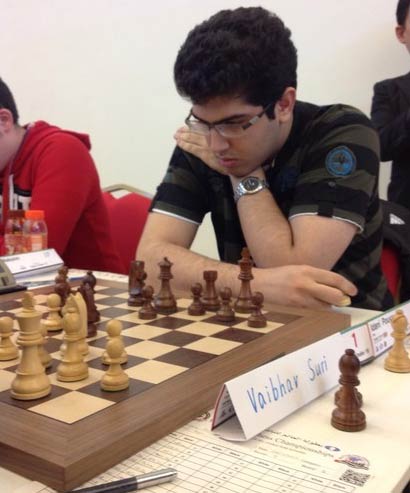
Pouya Idani of Iran won the World Youth Chess Championship 2013 held in Al Ain, the United Arab Emirates on Saturday.

Also: “Pouya Idani grabs the trophy in Khazar Open 2012”
http://www.chessdom.com/pouya-idani-grabs-the-trophy-in-khazar-open-2012/

Iranian-chess-player-Pouya-Idani-1


“A Separation”, first Iranian movie to win the Oscar academy award

A Separation (Persian: Jodái-e Náder az Simin, “The Separation of Nader from Simin”) is a 2011 Iranian drama film written and directed by Asghar Farhadi.

Farhadi focuses on a middle class family in Tehran to explore the tensions and challenges of modern Iran. By examining class, religious and gender conflict through the intimate lens of family life, he highlights the interconnection between the personal and political. The lecture identifies and analyses the multiple pressure points within the film narrative and the central idea that the very things that connect us as human beings also separate us.

A Separation won the Academy Award for Best Foreign Language Film in 2012, becoming the first Iranian film to win the award. It received the Golden Bear for Best Film and the Silver Bears for Best Actress and Best Actor at the 61st Berlin International Film Festival, becoming the first Iranian film to win the Golden Bear. It also won the Golden Globe for Best Foreign Language Film.

The film was nominated for the Best Original Screenplay Academy Award, making it the first non-English film in five years to achieve this.

Nader and Simin: A Separation (trailer):

Asghar Farhadi, 123 mins, Iran, 2011

Source: Wikipedia | A Separation, Australian Centre for the Moving Image | A Separation

Female Iranian motor sports stars

At 28, Laleh Seddigh is known for her stunning looks and legendary driving skills…A PhD student from Tehran, she has been nicknamed “a little Schumacher” after the German Formula One champion. She has now been given the title of Iran’s best female racing driver.
http://news.bbc.co.uk/2/hi/middle_east/4349341.stm

Nora Naraghi is barred by her gender from taking a motorcyle out on Iran’s roads, but has defied discrimination to become the country’s motocross champion…Although women are banned from riding motorcycles on the streets in Iran, scenes of women riding pillion on motorbikes are not unusual.But unlike Saudi Arabia, which is also deeply conservative, they are allowed to drive cars. Some even drive buses and long-haul trucks.”
http://www.telegraph.co.uk/expat/expatnews/6857478/Irans-female-motocross-champion-gets-uphill-ride.html

“Iran’s female motorsports champion Zohreh Vatankhah
http://www.independent.co.uk/news/world/middle-east/lipstick-revolution-irans-women-are-taking-on-the-mullahs-1632257.html?action=gallery
https://www.facebook.com/zohreh.vatankhah.1356

Nasrin Sotoudeh – Sakharov prize winner and human rights lawyer

socialinform's avatarRemarkable people with Iranian roots

Nasrin Sotoudeh (also spelled Sotoodeh, Persian: نسرین ستوده‎) is a human rights lawyer in Iran. She has represented imprisoned Iranian opposition activists and politicians following the disputed June 2009 Iranian presidential elections as well as prisoners sentenced to death for crimes committed when they were minors.[1] Her clients have included journalist Isa Saharkhiz, Nobel Peace Prize laureate Shirin Ebadi, and Heshmat Tabarzadi, the head of the banned opposition group Democratic Front of Iran.[2]

Image

Sotoudeh was arrested in September 2010 on charges of spreading propaganda and conspiring to harm state security[1] and was imprisoned in solitary confinement in Evin Prison.[3] In January 2011, Iranian authorities sentenced Sotoudeh to 11 years in prison.

Prior to her arrest, Sotoudeh represented activists and journalists such as Isa Saharkhiz, Heshmat Tabarzadi, Nahid Keshavarz, Parvin Ardalan, Omid Memarian

View original post 170 more words

Shirin Ebadi – the first iranian woman to receive a Nobel Peace Prize

socialinform's avatarRemarkable people with Iranian roots

Shirin Ebadi (Persian: شيرين عبادىŠirin Ebādi; born 21 June 1947) is an Iranianlawyer, a former judge and human rights activist and founder of Defenders of Human Rights Center in Iran. On 10 October 2003, Ebadi was awarded the Nobel Peace Prize for her significant and pioneering efforts for democracy and human rights, especially women’s, children’s, and refugee rights. She was the first ever Iranian to receive the prize.

Image

She was admitted to the law department of the University of Tehran in 1965 and in 1969, upon graduation, passed the qualification exams to become a judge. After a six-month internship period, she officially became a judge in March 1969. She continued her studies in University of Tehran in the meantime to pursue a doctorate’s degree in law in 1971. In 1975, she became the first woman president of the Tehran…

View original post 85 more words

Behruz Firuzi – Iranian cartoonist finishes first in Italian contest

socialinform's avatarRemarkable people with Iranian roots

The Iranian cartoonist Behruz Firuzi has won the first in the category satirical drawing at the 17th edition of the international competition Fax for Peace, Fax for Tolerance in Spilimbergo, Italy.

Other Iranian cartoonists Sohrab Kheiri and Parvin Mohammadi received honorable mention at the competition.

Peace, tolerance, fighting against any form of racism and the defense of human rights are the themes of the competition.

Sources:
– Gallery: http://www.faxforpeace.eu/?page_id=786
http://www.payvand.com/news/13/dec/1009.html

View original post

Noora Naraghi – Iran’s female motocross champion

socialinform's avatarRemarkable people with Iranian roots

Noora Naraghi was born in Teheran on May 30th 1988. She is the first women’s Iran motocross champion. In 2009, she won Iran’s first-ever Female Motocross Championship.

Image

Links:
http://en.wikipedia.org/wiki/Noora_Naraghi
http://www.telegraph.co.uk/expat/expatnews/6857478/Irans-female-motocross-champion-gets-uphill-ride.html

View original post

Laleh Seddigh – Iranian female racing driver

socialinform's avatarRemarkable people with Iranian roots

A PhD student from Tehran, she has been nicknamed “a little Schumacher” after the German Formula One champion. She has been given the title of Iran’s best female racing driver. The story is featured in a BBC TV documentary called “Girl Racer”.

The documentary can be viewed here:

Image

She earned international fame by fending off a host of male competitors to become Iran’s national rally champion in 2005.

More infos:
http://en.wikipedia.org/wiki/Laleh_Seddigh
http://www.nytimes.com/2005/05/14/international/middleeast/14seddigh.html?_r=2&pagewanted=all

The best posts on Iranian women:
https://theotheriran.com/tag/women/

View original post

Sepideh Mahabadi: Second woman to win gold in the history of the International Olympiads in Informatics

Sepideh Mahabadi received 2011 her B.Sc. in Computer Engineering from the Sharif University of Technology, Iran. That year she moved to the United States to continue her studies. In 2013 she received her M.Sc. and in 2017 her PhD from the MIT.

When she was 18 years old she made history at the International Olympiad in Informatics (IOI) after receiving a gold medal. She was the only female contestant to win a gold medal that year and the second woman to win a gold medal in the history of the Olympiad.

The IOI is one of the most prominent computer science competitions in the world. In 2007 the event was held in Croatia and gathered nearly 300 top students from 75 countries. Sina Sadeghian, Saeed Reza Sedighin, and Hesamodin Akhlaghpor, the other members of Iran’s team, won three silver medals.

Sepideh Mahabadi is a postdoctoral research scientist with an appointment at the Simons Collaboration on Algorithms and Geometry based at Columbia University.

More articles on Iranian successes in science competitions

Sources: Press TV, MIT, Simons Foundation, stats.ioiinformatics.org (IOI 2007)

Iranian students win grand prize in Malaysian 2013 Chem-E-Car Competition attended by 35 teams

Hossein Hassan-zadeh, a chemistry engineering student at Poly Technique University of Orumiyeh, northwestern Iran, said the competition was involved of the two sections of poster and performance, and the Iranian team was granted the prize considering its points in the two sections.

The team ranked 3rd in the previous round of competitions held in Singapore.

In Chem-E-Car Competition, the chemistry and chemistry engineering students are competing in building cars whose motive force is supplied by a chemical reaction.

The cars used in the matches should be self-controlled and not to start moving through pushing or tuning. Using dry battery or other batteries, mechanical or chemical braking systems, mechanical or electronic timing tools to end the chemical reaction is banned.

http://www.payvand.com/news/13/apr/1144.html

Iranian Neurologist Professor Majid Samii Wins Leibniz Ring Prize

socialinform's avatarRemarkable people with Iranian roots

Iranian neurologist has won the Leibniz Ring Prize in Germany. The prize is given to Personalities who have made contributions to human development.

[…]

Prof. Samii is renowned worldwide for his life trajectory and specially for his work in the Project Africa 100. Investing in educating African neuroscientists in order to give these physicians incentives to stay in their home countries. This long lasting bridge building is based on knowledge transfer between professionals on different continents. Prof. Samii has also made partnerships with neurologists in Iran.

[…]

During his speech, Prof. Samii touched upon the importance of investing in training programs for African medical staff, especially in the field of neurosciences. He said the continent needs the investment for sustainable development and growth.

Read the complete article:
http://www.payvand.com/news/13/nov/1131.html

View original post

Iranian doctor received the award of the greatest world woman inventor in 2013

socialinform's avatarRemarkable people with Iranian roots

An Iranian doctor from Mashad Medical Science University received the award of the greatest world woman inventor in Geneva International Festival for Inventions in year 2013.

Dr. Zahra Alizadeh Thani, who is a specialist in radiology of heart and coroners, also received gold medal and special award of 41st Geneva Festival in addition to her award as the world inventor.

Dr. Alizadeh Thani has invented a device to determine level of tightness of heart coroners.

The device also makes it possible to determine if the patient needs angioplasty.

Zahra Alizadeh Thani - Greatest world women inventor 2013

http://www.payvand.com/news/13/apr/1119.html

View original post

Iranian women’s futsal team wins silver at Asian Indoor Games

The Japanese squad defeated the Iranians 2-1 on Friday at the Songdo Global University Campus.

The Iranian women’s futsal team advanced to the final of the 2013 Asian Indoor and Martial Arts Games by defeating Indonesia 4-0. Fereshteh Karimi scored two goals for Iran and Nasimeh Sadat Gholami and Niloufar Ardalan also found the back of the net in the semifinal match.

Iranian team members lift their captain, Leila Eqbali, in the air. Eqbali is quitting the games after 9 years

More photos: Payvand News of Iran

Iran futsal team beats Japan, wins gold at Asian Indoor Games

The national Iranian men’s futsal team has beaten Japan, winning the gold medal at the 2013 Asian Indoor and Martial Arts Games in South Korea.

Iranians trounced the Japanese 5-2 at the Songdo Global University Campus in South Korea’s northwestern city of Incheon on Saturday and clinched the gold medal.

Members of the Iranian men’s futsal team

More pictures:
http://www.payvand.com/news/13/jul/1050.html

Iran’s Kaleh crowned Asian Men’s Club Volleyball Champion

Iran’s Kaleh wrapped up the title of the 2013 Asian Men’s Club Volleyball Championship with a win over Al-Rayyan on Monday.

[…]

Kaleh stayed unbeaten through the competitions. The team had finished in second place in the previous edition.

See more pictures:
http://www.payvand.com/news/13/apr/1207.html