Amir Kabir dam, also known as Karaj dam, is a dam in Iran, located 63 kilometres (39 mi) northwest of Tehran and 23 kilometres (14 mi) north of Karaj. Amir kabir Dam was constructed on the Karaj River, and was the first multi-purpose dam in Iran.
Ref: Wikipedia
“The reactions I received as an American traveling for 10 days in Tehran, Isfahan and Qum mirrored Iran’s politics and posture in this moment — there is a serious, even eager, interest in reconnecting with the West, even as Iranians struggle with three decades of poisoned relations. […]
One important voice in advancing that transformation is Grand Ayatollah Youssef Saanei. […] He endorsed the nuclear deal and said that, “today the people in power in Iran and the people in power in the United States should forgive each other, should forget the past and start the friendship.”
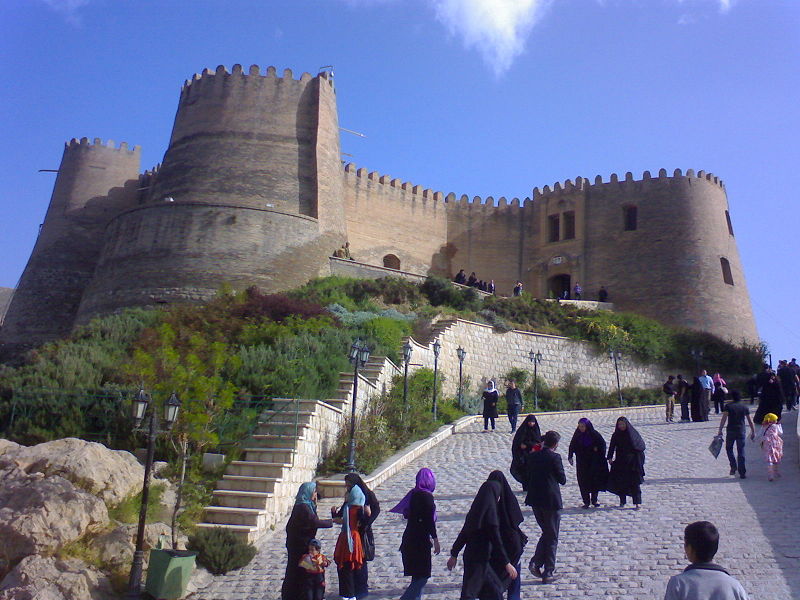
Falak-ol-Aflak Castle (in Persian: Dez-e Shapur-Khwast and in ancient times known as Dezbar as well as Shapur-Khwast) is a castle situated on the top of a large hill with the same name within the city of Khorramabad, the regional capital of Lorestan Province, Iran. This gigantic structure was built during the Sassanid era (226–651).
Source: Wikipedia | Falak-ol-Aflak Castle
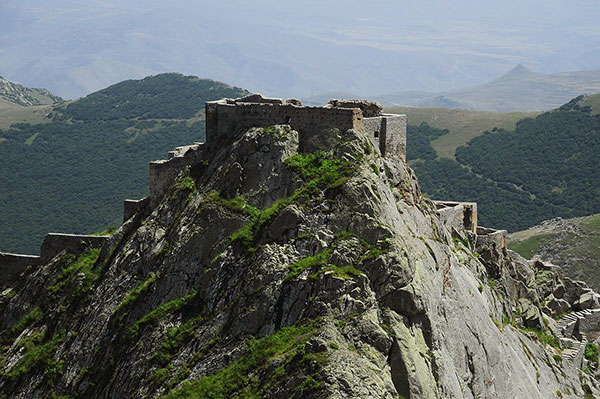
Babak Castle, East Azerbaijan Province, Iran
Papak Fort or Babak Castle (in Azerbaijani Baezz Qalasi), also known as the Immortal Castle or Republic Castle, is a large citadel and National Symbol of Iranians on the top of a mountain in the Arasbaran forests, which is located 6 km southwest of Kaleybar City, East Azerbaijan Province, northwestern Iran.
Source: Wikipedia | Babak Fort
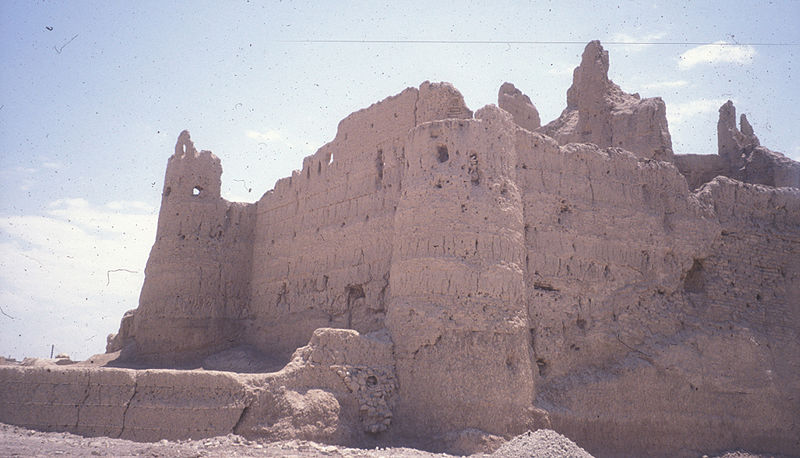
Narin Ghaleh, Yazd Province, Iran
The Narin Qal’eh or Narin Castle is a mud-brick fort or castle in the town of Meybod, Yazd Province, Iran. Structures like these constituted the government stronghold in some of the older (pre-Islamic) towns of central Iran. Some of these castles incorporate mud bricks of the Medes period and of the Achaemenid and Sassanid dynasties.
Source: Wikipedia | Narin Qal’eh
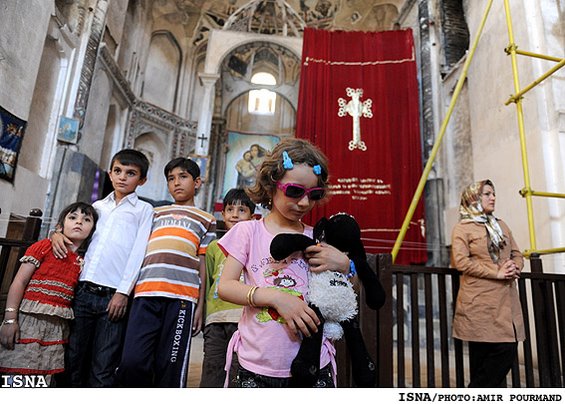
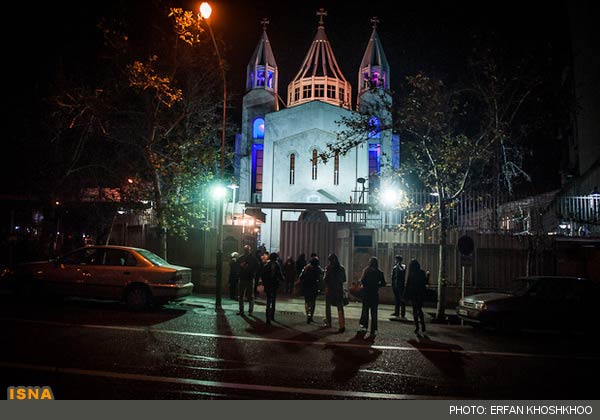
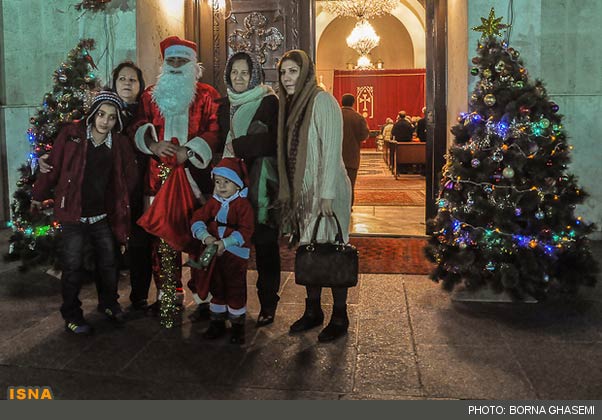
“Today, there are at least 600 churches for 250,000 Christians in Iran. A number of Christian denominations are represented in Iran. Many members of the larger, older churches belong to minority ethnic groups – the Assyrians and Armenians – having their own distinctive culture and language…In 1976, the Christian population numbered 168,593 people, mostly Armenians. Due to the Iran-Iraq war in the 1980s and the dissolution of the Soviet Union in the 1990s, almost half of the Armenians migrated to the newly independent Republic of Armenia. However, the opposite trend has occurred since 2000, and the number of Christians with Iranian citizenship increased to 109,415 in 2006. At the same time, significant immigration of Assyrians from Iraq has been recorded due to massacres and harassment in post-Saddam Iraq.”
A Separation(Persian: Jodái-e Náder az Simin, “The Separation of Nader from Simin”) is a 2011 Iranian drama film written and directed by Asghar Farhadi.
Farhadi focuses on a middle class family in Tehran to explore the tensions and challenges of modern Iran. By examining class, religious and gender conflict through the intimate lens of family life, he highlights the interconnection between the personal and political. The lecture identifies and analyses the multiple pressure points within the film narrative and the central idea that the very things that connect us as human beings also separate us.
A Separation won the Academy Award for Best Foreign Language Film in 2012, becoming the first Iranian film to win the award. It received the Golden Bear for Best Film and the Silver Bears for Best Actress and Best Actor at the 61st Berlin International Film Festival, becoming the first Iranian film to win the Golden Bear. It also won the Golden Globe for Best Foreign Language Film.
The film was nominated for the Best Original Screenplay Academy Award, making it the first non-English film in five years to achieve this.
” ‘The students here are very impressive,’ Richter said, lauding the high level of education at Sharif. […]
The country’s leaders […] invest heavily in scientific and industrial achievement. […]
Iranian scientists claim breakthroughs in nanotechnology, biological researchers are pushing the boundaries of stem cell research and the country’s car industry produces more cars than anywhere else in the region.”
Marjan Kalhor (born July 21st, 1988 in Tehran) is an Iranian alpine skier who became the first Iranian woman to participate in the Winter Olympics, at the 2010 Vancouver Olympics. She was her nation’s flag bearer in the Opening Ceremony. Kalhor competed in the slalom and giant slalom competitions. She finished 60th among 86 competitors in the Giant Slalom and 55th among 87 participants in the Slalom.
Kalhor started skiing at the age of four, in Dizin, a ski resort in the Alborz mountain range, north of Tehran. At the age of eleven, she won a national competition, and later competed and won medals in Turkey and Lebanon. She has not yet competed in a World Cup event.
Iran has had a history of integrating members of it’s Christian minority in the national football team. Just to focus on the better known names this small selection should be put forward:
Andranik Eskandarian was born on December 31, 1951 in Tehran in an Armenian family. He became a United States citizen in 1984. Eskandarian was a member of the Iranian team winning the Asia Cup 1976 in Tehran and reaching the quarterfinals of the Olympic Tournament in Montreal in 1976. He also played for Iran in the 1978 World Cup. Ref: wikipedia.org
Edmond Bezik (born 12 August 1975 in Tehran, Iran) is a retired Armenian-Iranian footballer and coach. He played for Persepolis, Sepahan and Ararat Tehran and was a member of Iran national football team. Having scored 22 goals for Ararat, 32 goals for Persepolis and 30 goals for Sepahan, he scored a total number of 84 goals during his time in Iran’s top division football league, becoming the top division’s all-time top goalscorer. Ref: wikipedia.org
Andranik Timotian-Samarani, born March 6, 1983 is an Iranian-Armenian footballer, more commonly known as Andranik “Ando” Teymourian. […] He played his first match for Iran in 2005, and has featured in Iran’s national squad for the 2006 FIFA World Cup and the 2007 and 2011 Asian Cups. He has played a total of 74 international matches, scoring 8 times. Ref: wikipedia.org
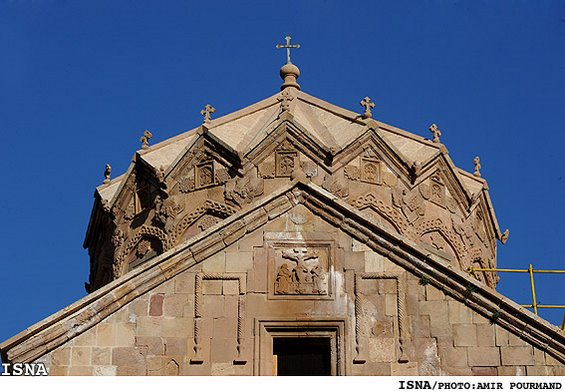
Iran’s East and West Azerbaijan Provinces are host to the oldest churches in Iran. Among the most significant are the Tatavous Vank ( St. Tatavous Cathedral), which is also called the Ghara Kelissa (the black monastery). This is located at the Siahcheshmeh (Ghara-Eini) border area south of Makou.
There is also the Saint Stepanous Monastery, which stands 24 kilometers south of East Azarbaijan’s Jolfa town. The general structure mostly resembles Armenian and Georgian architecture and the inside of the building is adorned with beautiful paintings by Honatanian, a renowned Armenian artist. Hayk Ajimian, an Armenian scholar and historian, recorded that the church was originally built in the ninth century AD, but repeated earthquakes completely eroded the previous structure. The church was rebuilt during the rule of Shah Abbas the Second.
Saint Stepanous Monastery (Maghardavank) near Jolfa, East Azerbaijan, Iran
Saint Stepanous Monastery (Maghardavank) near Jolfa, East Azerbaijan, Iran
A number of Christian denominations still live in Iran today and include Assyrians, Armenians, Catholics, Protestants and Evangelical Christians. Although a minority religious group in Iran, Christians of Iran are free to practice their religion and perform their religious rituals. (see article)
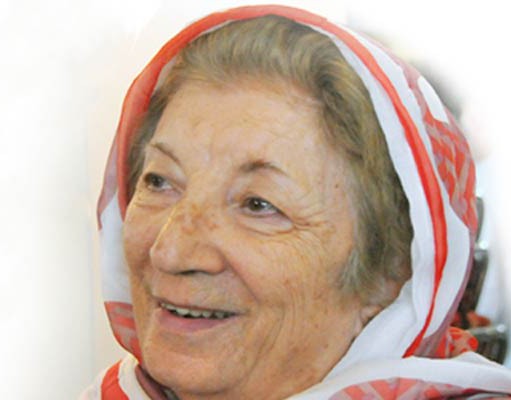
Professor Parvaneh Vosough was born in 1935 in Tafresh, central Iran. She received her MD in general medicine in 1963 in Tehran University of Medical Science. She completed her specialty and sub-specialty in Cambridge, Massachusetts, and Illinois Universities, and she attended Washington University for her graduate course. In 1971 she returned to Iran and practiced her profession in Ali Asghar Hospital in Tehran.
Her colleagues say that many times, she had been proposed residence of US and European countries for research and lucrative income, but that she had chosen providing free service to her country’s cancer-suffering children.
In the course of her medical services, Professor Vosough treated many cancer-suffering children around the world, giving them health, and she had never married. Perhaps for this reason, she was called ‘Iran’s Mother Theresa’ by some people.
The first world grass skiing competitions for youth (boys and girls) was held in Dizin slopes north of Tehran, Iran. Below are some pictures from the opening ceremony and first competition day:
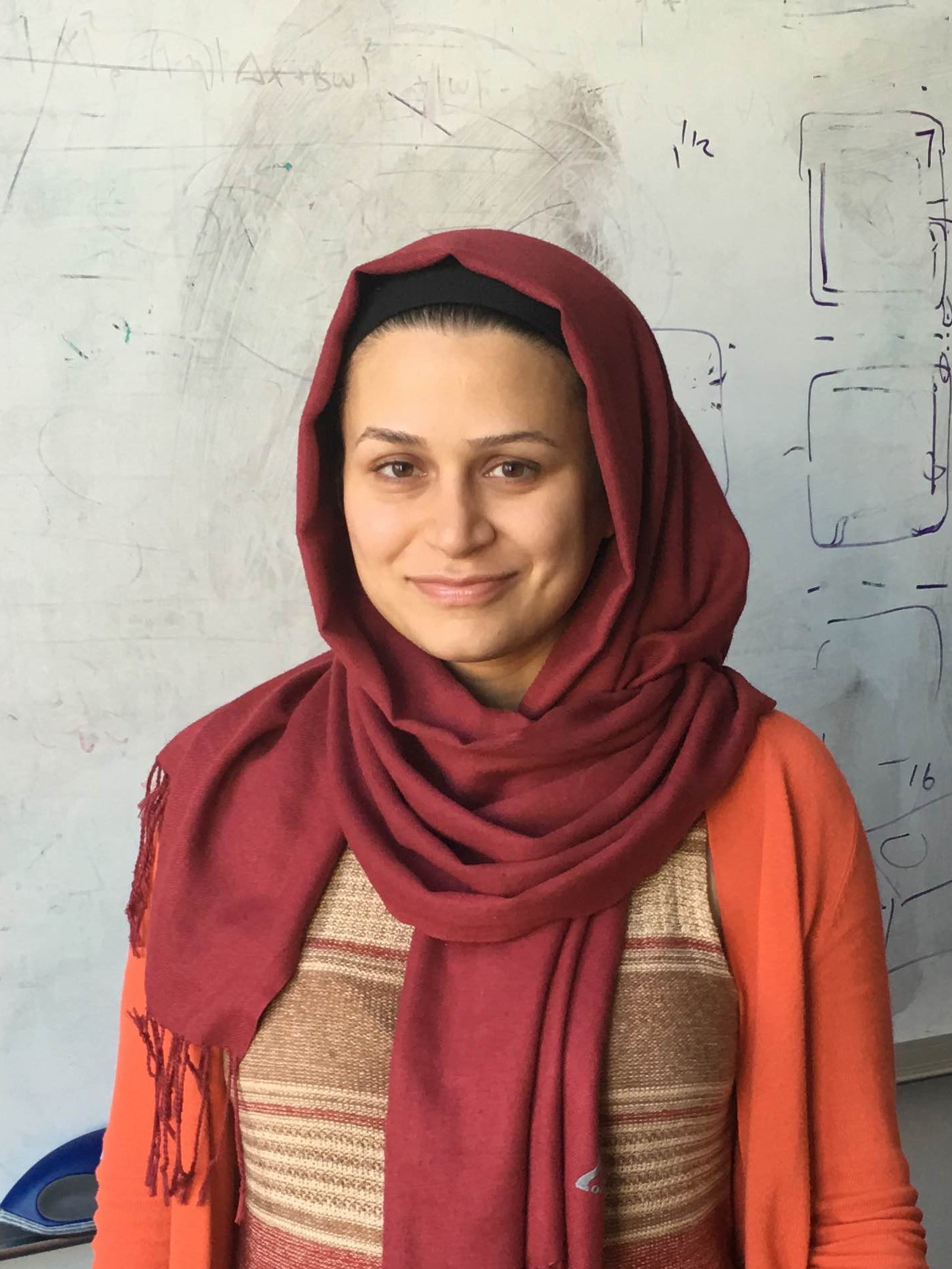
Sepideh Mahabadi received 2011 her B.Sc. in Computer Engineering from the Sharif University of Technology, Iran. That year she moved to the United States to continue her studies. In 2013 she received her M.Sc. and in 2017 her PhD from the MIT.
When she was 18 years old she made history at the International Olympiad in Informatics (IOI) after receiving a gold medal. She was the only female contestant to win a gold medal that year and the second woman to win a gold medal in the history of the Olympiad.
The IOI is one of the most prominent computer science competitions in the world. In 2007 the event was held in Croatia and gathered nearly 300 top students from 75 countries. Sina Sadeghian, Saeed Reza Sedighin, and Hesamodin Akhlaghpor, the other members of Iran’s team, won three silver medals.
Sepideh Mahabadi is a postdoctoral research scientist with an appointment at the Simons Collaboration on Algorithms and Geometry based at Columbia University.
The Japanese squad defeated the Iranians 2-1 on Friday at the Songdo Global University Campus.
The Iranian women’s futsal team advanced to the final of the 2013 Asian Indoor and Martial Arts Games by defeating Indonesia 4-0. Fereshteh Karimi scored two goals for Iran and Nasimeh Sadat Gholami and Niloufar Ardalan also found the back of the net in the semifinal match.
Iranian team members lift their captain, Leila Eqbali, in the air. Eqbali is quitting the games after 9 years
Atieh Kazemi Mojarad is among the recipients of UNESCO’s Young Scientist Award. She won the award for her research in “sustainable development of Biosphere Reserves through the promotion of key ecosystem services.”. Kazemi Mojarad has received her Masters degrees in Ecology from Azad University and in Environmental Studies from Shahid Beheshti University.
“Tehran has 11 functioning synagogues, many of them with Hebrew schools. It has two kosher restaurants, and a Jewish hospital, an old-age home and a cemetery. There is a Jewish representative in the Iranian parliament.” http://www.sephardicstudies.org/iran.html
“Despite the offence Mahmoud Ahmedinejad has caused to Jews around the world, his office recently donated money for Tehran’s Jewish hospital.
It is one of only four Jewish charity hospitals worldwide and is funded with money from the Jewish diaspora – something remarkable in Iran where even local aid organisations have difficulty receiving funds from abroad for fear of being accused of being foreign agents.
Most of the patients and staff are Muslim these days, but director Ciamak Morsathegh is Jewish.
“Anti-Semitism is not an eastern phenomenon, it’s not an Islamic or Iranian phenomenon – anti-Semitism is a European phenomenon,” he says, arguing that Jews in Iran even in their worst days never suffered as much as they did in Europe.” http://news.bbc.co.uk/2/hi/middle_east/5367892.stm







 The other Iran